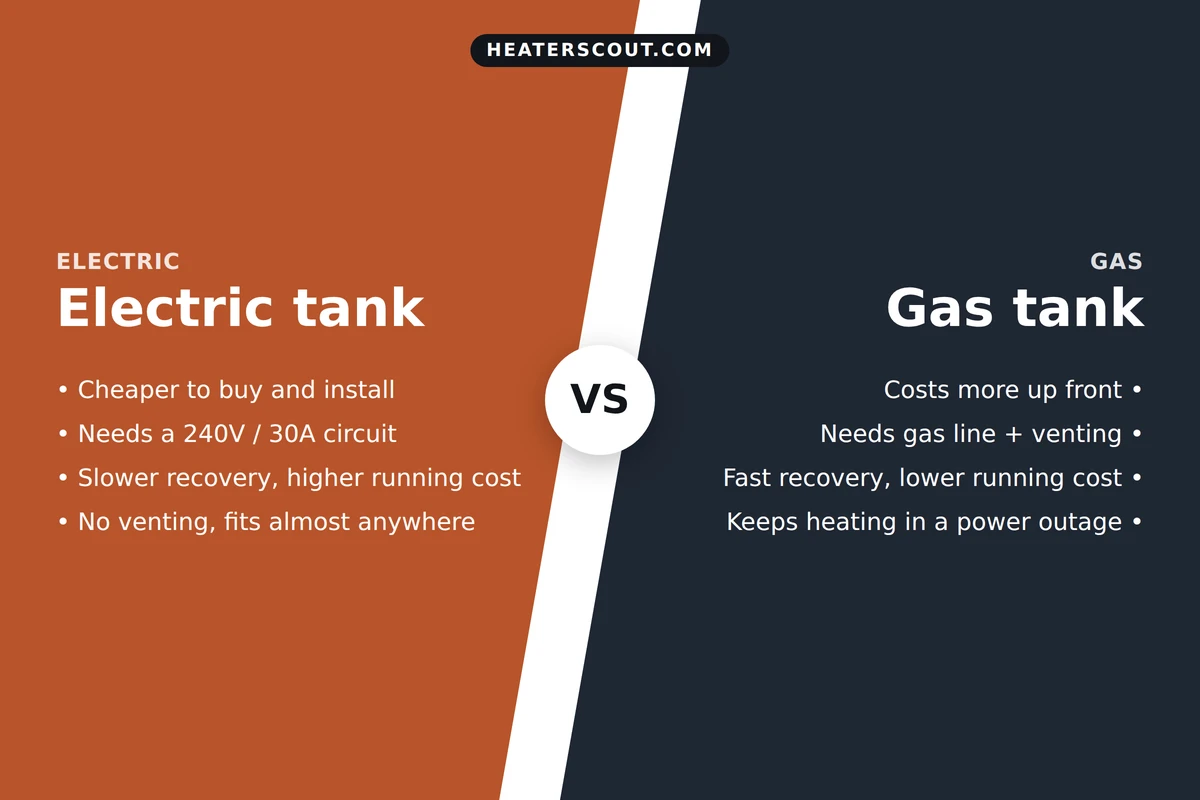
The sticker price tells you almost nothing. A gas water heater costs more to buy and more to install, then quietly hands most of that money back through lower energy bills — but only if you already have a gas line and a legal way to vent it. Miss either one, and electric wins before the comparison even starts.
First question: what does the install spot already have?
This decides more than any efficiency chart. A like-for-like swap is a few hundred dollars of labor. Switching fuel type is a different project, and it is where most of the real money goes.
Electric needs a dedicated 240-volt, 30-amp circuit on a double-pole breaker with the correct wire gauge, usually 10-gauge copper. If the spot never had an electric heater there, you are paying an electrician to run that circuit from the panel. If the panel is already full, add a subpanel or a panel upgrade to the bill. None of that shows up on the price tag of the heater itself.
Gas needs a gas line sized for the burner and a legal vent path. A standard 40-gallon atmospheric heater pulls roughly 40,000 BTU and vents up a flue by natural draft. Move it away from an existing flue, or drop in a high-efficiency power-vent model, and you add PVC venting plus a nearby outlet for the blower. No gas at the house at all? Gas is off the table without a utility run you almost never want to pay for.
What each one actually costs to run
Gas is cheaper per unit of heat almost everywhere in the US, and that gap is the whole reason people tolerate the higher install cost. Standard electric-resistance heating converts nearly all the electricity to heat, but electricity itself is the expensive fuel. Standard atmospheric gas throws some heat up the flue, yet still wins on cost because the fuel is so much cheaper per BTU.
| Heater | Efficiency (UEF) | Est. annual energy |
|---|---|---|
| Electric resistance | ~0.90–0.95 | $450–$550 |
| Atmospheric gas | ~0.60–0.64 | $280–$340 |
| Heat-pump (hybrid) electric | ~3.3–3.9 | $120–$180 |
Read that bottom row twice. A heat-pump water heater runs on electricity but moves heat instead of making it, so it beats gas on running cost while keeping the simple electric install. If low bills are the goal and you have the headroom and a 240V circuit, it changes the whole math — more on that below. Your own answer also swings with local rates: in a region with cheap electricity and expensive propane, even a plain electric tank can pull ahead of gas. Check your last utility bill for the price per therm and per kilowatt-hour before you trust any national average.
Recovery: how fast it makes the next tankful
This is where gas feels different in daily use. Recovery rate is how many gallons the heater can reheat per hour. A 40-gallon gas unit recovers around 40 gallons an hour; a 40-gallon electric recovers closer to 20. Same tank size, but the gas model catches up twice as fast after a run of showers.
The practical fix on the electric side is to size up. A 50-gallon electric often serves a household as well as a 40-gallon gas, because the bigger reserve covers the slower reheat. If mornings are a bottleneck, look at the first-hour rating on the yellow EnergyGuide label, not just the tank gallons — it is the number that predicts whether the last person gets a warm shower. If you are unsure what capacity fits your household, our guide on what size water heater you need walks through the math.
Venting is the part people underestimate
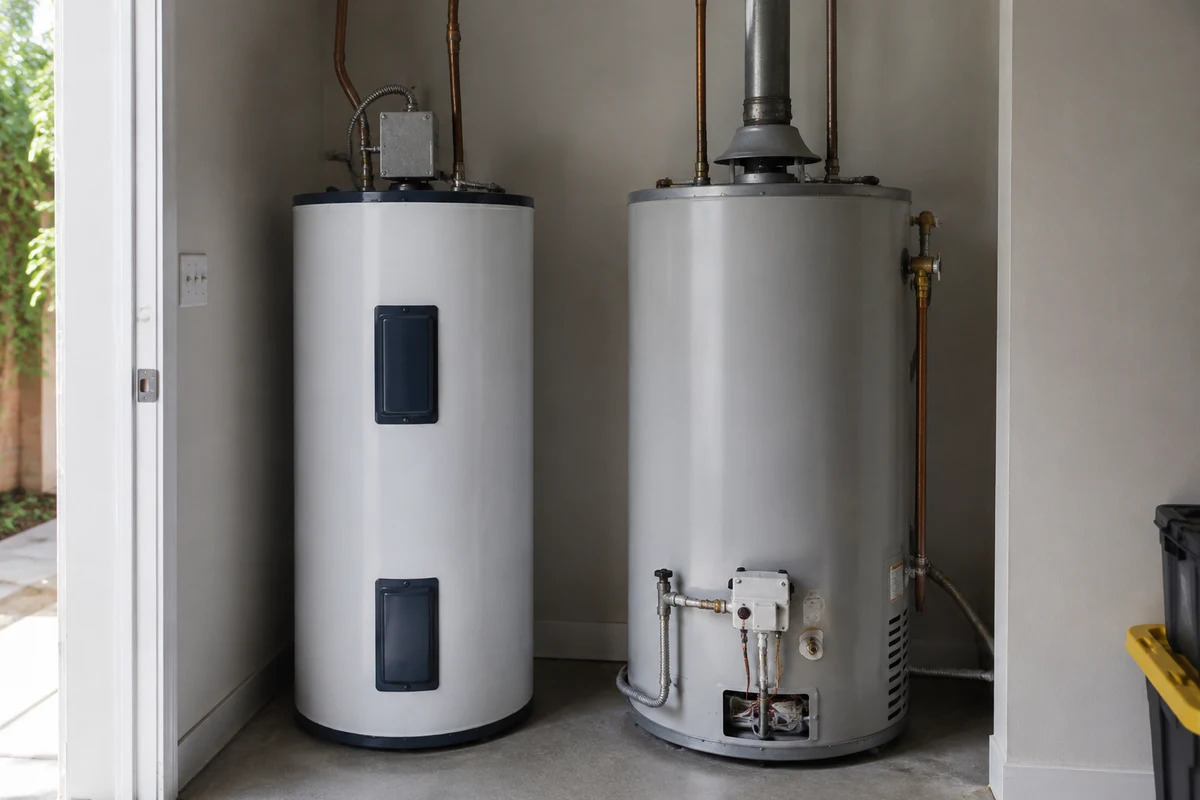
An electric heater has nothing to vent. A gas heater burns fuel indoors, so it must carry combustion gases outside, and the venting style drives both cost and placement:
Atmospheric (natural draft)
The cheapest and most common. Hot exhaust rises up a metal flue on its own. It needs that vertical flue and enough combustion air in the room, which is why a gas heater cannot simply move into a sealed closet.
Power-vent
A blower pushes exhaust out through PVC, so the heater can sit farther from a chimney and vent horizontally through a wall. It costs more, needs an electrical outlet, and — ironically — will not run in a power outage because the blower is electric.
Direct-vent / condensing
Pulls combustion air from outside and vents outside, the safest around living space and the most efficient, but also the priciest to buy and install.
Electric skips this entire decision tree. If your only viable spot is an interior closet with no chimney and no exterior wall nearby, that alone can settle the question in electric's favor.
Safety: the one genuine difference
An electric heater produces no combustion gases, so there is no carbon monoxide risk from the appliance itself. A gas heater does, and a blocked or backdrafting flue can spill CO into the home. That is not a reason to fear gas — millions run safely for decades — but it does mean a gas install demands a correct vent, adequate combustion air, and a working CO detector nearby. If you ever notice soot around the draft hood or a pilot that keeps going out, read our piece on gas water heater backdrafting before relighting anything.
What happens in a power outage
An atmospheric gas heater with a standing pilot keeps making hot water when the power is out, because it needs no electricity to run. Power-vent gas and electric models both stop, since they rely on a blower or on heating elements. In areas with frequent outages, that standing-pilot gas heater is a real, if old-fashioned, advantage — the last hot shower before the grid comes back.
Space, placement and noise
A standard electric or gas tank is roughly the same footprint, so for a like-for-like swap, space is rarely the issue. The exception is the heat-pump electric unit: it is taller, needs open air around it to pull heat from, and hums like a small dehumidifier while it runs. Put one in a tight, cold closet and it will struggle and annoy you. A garage, utility room, or unfinished basement is its natural home.
What the whole job really costs
Put the two together and the pattern is consistent: gas costs more to install and less to run, electric flips it. A like-for-like electric tank swap often lands around $700–$1,400 installed; a same-fuel gas swap runs a bit higher, roughly $900–$1,800, because of the gas connection and vent check. The numbers jump only when you change fuel or venting. A first-time gas line, a panel upgrade for electric, or a switch from atmospheric to power-vent can each add four figures. A heat-pump unit sits highest on the sticker, often $1,600–$2,800 installed, but rebates and the running-cost savings usually claw that back within a few years. The honest way to compare is total cost of ownership over ten years, not the price on the box.
Lifespan is a wash
Both tank types last about 8 to 12 years, and the thing that decides where you land in that range is the same for both: the anode rod and your water chemistry, not the fuel. Flush the tank yearly and replace the anode before it is gone, and either type reaches the top of its range. Ignore it, and hard water eats either one early. Our guide on how long water heaters last covers the maintenance that actually moves the number.
The option most people skip
If the real goal is a small utility bill, the honest answer in 2026 is often neither a plain electric nor a plain gas tank — it is a heat-pump water heater. It installs like an electric unit, runs at two to three times the efficiency, and federal and utility rebates frequently knock a big chunk off the higher purchase price. The catch is the same one noted above: it needs space and moderately warm air to pull heat from, and it makes noise. Weigh that against a decade of lower bills and, for many households, the numbers land in its favor. If you are also weighing a tankless unit, compare the trade-offs in tankless vs tank.
Frequently asked
Is a gas or electric water heater cheaper to run?
Gas is cheaper to run than a standard electric-resistance heater almost everywhere in the US, because natural gas costs far less per unit of heat than electricity. A heat-pump electric heater, however, usually beats gas on running cost because it moves heat instead of generating it. Your local gas and electricity rates decide the exact gap.
Can I replace a gas water heater with an electric one?
Yes, but it is a conversion, not a swap. You need a dedicated 240V/30A circuit run to the spot, and you can abandon the old flue. Expect an electrician's bill on top of the heater. Going the other way, electric to gas, means adding a gas line and venting, which usually costs more.
Does an electric water heater work during a power outage?
No. Electric heaters need power for their heating elements. A standard atmospheric gas heater with a standing pilot keeps working during an outage, but power-vent and condensing gas models stop because their blower needs electricity.
Why does gas recover hot water faster?
A gas burner delivers more heat per hour than electric elements. A 40-gallon gas heater reheats about 40 gallons per hour versus roughly 20 for a same-size electric. To match a gas unit's real-world output, size an electric heater one step larger, or check the first-hour rating.
Do gas and electric water heaters last the same amount of time?
Roughly yes, about 8 to 12 years for both tank types. Lifespan depends on the anode rod and water hardness, not the fuel. Yearly flushing and timely anode replacement push either type to the top of that range.
Should I consider a heat-pump water heater instead?
If low running cost is the priority and you have a 240V circuit plus a warm, open install spot, yes. Heat-pump units cost more up front but run at about three times the efficiency and often qualify for rebates. They are noisier and need surrounding air, so they suit a garage or basement more than a small closet.
Is a gas water heater dangerous?
A properly installed and vented gas heater is safe and common, but it does produce combustion gases. The real risks are a blocked or backdrafting flue spilling carbon monoxide, so a gas install needs a correct vent, adequate combustion air, and a working CO detector nearby. Electric heaters have no combustion and no CO risk.