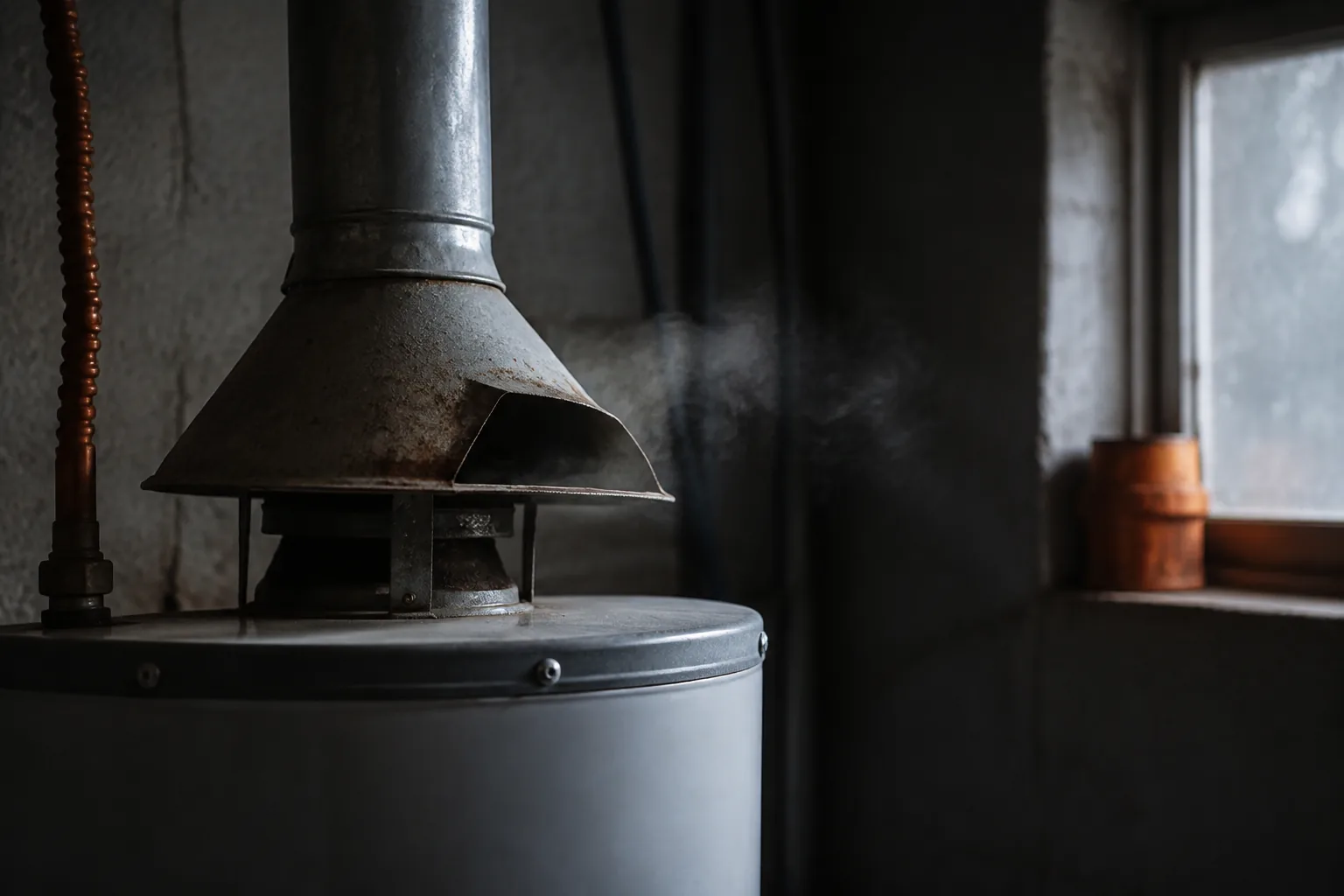
Melted plastic on top of a water heater is not a cosmetic problem. It means hot exhaust that should have gone up the flue rolled back down out of the draft hood and cooked the plastic instead. That is backdraft, and the same exhaust carries carbon monoxide.
Proper draft
Exhaust leaves the house. Hot flue gas rises up the vent and out the roof. Room air is pulled in at the hood gap, so nothing spills.
Backdrafting
Exhaust spills into the room. Draft runs backward, so flue gas rolls down and out of the draft hood, carrying carbon monoxide with it.
Carbon monoxide, ppm. Below 9 ppm is a normal home background (WHO 8-hour guide); 35 ppm is the OSHA workday limit; a UL-listed alarm only has to sound around 70 ppm, so low-level spillage can hurt you long before it trips.
Read this before you touch anything
Backdraft puts carbon monoxide into the room. CO is colorless, odorless, and it kills. If you feel a headache, dizziness, nausea, or unusual sleepiness that eases when you step outside, that is the warning. Leave the house, get fresh air, and call 911 or the fire department from outside.
Put a battery CO alarm on every level of the home, especially near the water heater and sleeping areas, before you do any of the testing below. A store-bought alarm is a backstop, not a green light: it is built to catch a life-threatening spike, not the slow low-level spillage that still harms you over weeks.
Draft hood self-test walkthrough
A guided pass or fail sequence. Set the house up, fire the burner, hold a smoking match at the hood, and read which way the smoke goes. Tap Next to move through it.
Step 1. Close up and turn on the fans
Shut the windows and doors in the room. Switch on the exhaust fans that normally run in the house: the kitchen range hood, bathroom fans, and the clothes dryer.
Why: backdraft usually shows up under negative pressure. You want to recreate the worst realistic conditions, not test on a calm, sealed-off day, or the test will pass when real life would fail.
Step 2. Run hot water so the burner fires for one minute
Open a hot tap somewhere until the water heater's burner kicks on. Let it burn for a full minute before you touch anything.
Why: a cold flue has almost no pull. Giving it one minute lets the flue reach its normal operating draft, so you get an honest reading instead of failing a flue that would pass warm.
Step 3. Hold a smoking match at the draft hood edge
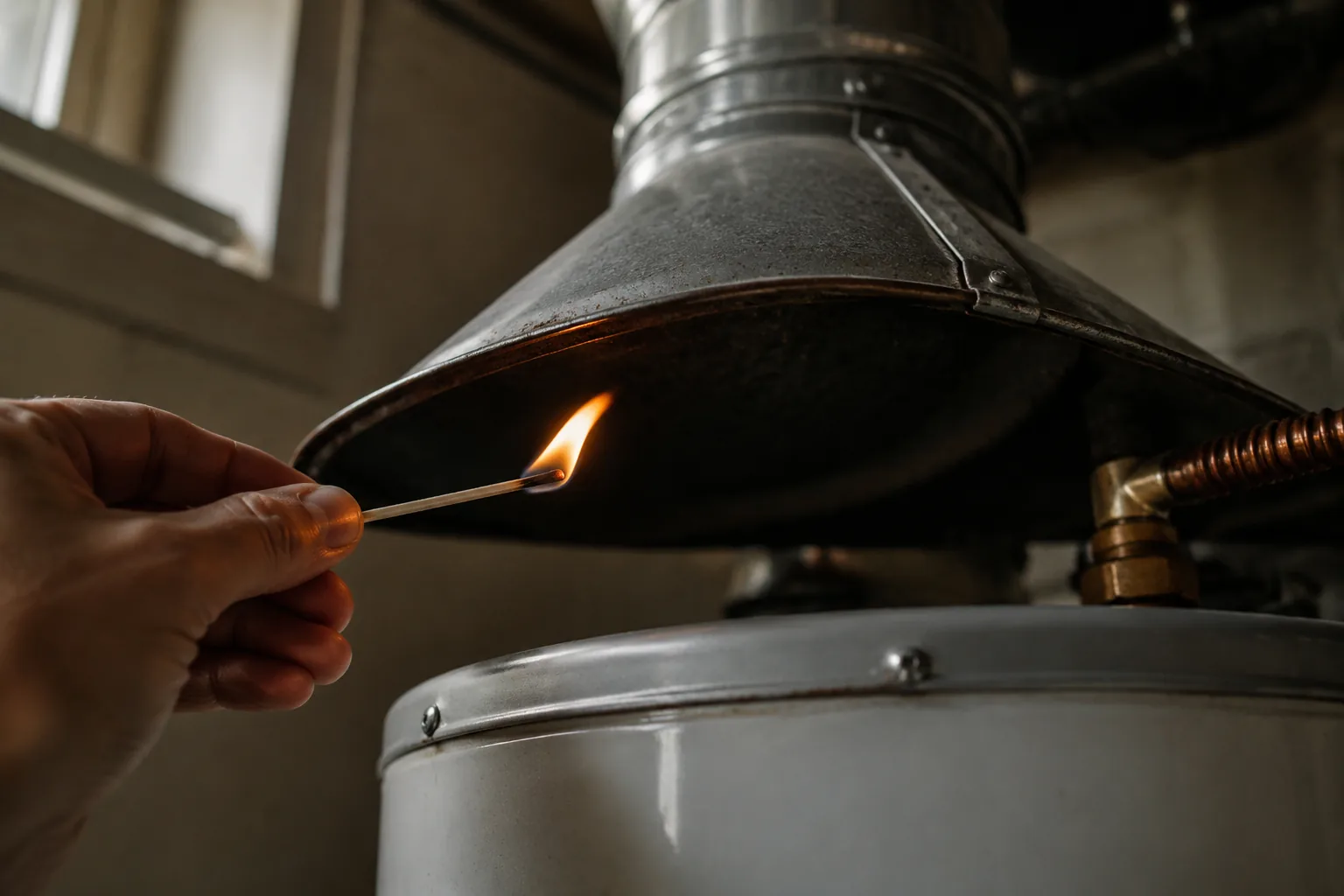
Blow out a wooden match, or light a stick of incense, and hold the smoke right at the gap between the draft hood and the flue collar on top of the tank.
Why: you cannot see gas move, but smoke shows you which way the air at the hood is flowing. That gap is where spillage exits first.
Step 4. Which way did the smoke go?
Watch the smoke for a couple of seconds and pick what you saw.
What backdraft actually is
An old-school atmospheric gas water heater does not have a fan. It relies on one thing: hot combustion gas is lighter than the cooler room air around it, so it wants to rise. The burner fires, the exhaust heats up, and it floats up through the draft hood, into the flue pipe, and out the roof. No electricity, no blower, just physics doing the work.
Backdraft is that flow running the wrong way. Instead of climbing the flue, the exhaust spills out the open draft hood and into the room you are standing in. The draft hood is that bell-shaped metal collar sitting on top of the tank where the flue starts. It is deliberately open, a little air gap by design, so the flue can pull in extra room air. When draft is healthy, that gap sucks air in. When something breaks the draft, the same gap becomes the exit for exhaust. And that exhaust is not clean. Anytime gas burns imperfectly, it makes carbon monoxide. A backdrafting heater feeds CO straight into your air.
Why a flue stops pulling
Draft is fragile. A handful of common problems knock it out, and most of them have nothing to do with the heater itself.
The blunt one is a blocked or disconnected vent. A flue pipe that rusted through, a joint that shook loose, a bird nest packed into the top, or a cap crushed by ice all stop exhaust from leaving. If the gas cannot get out the top, it comes out the bottom, meaning the draft hood.
The sneaky one is negative pressure, and it is the cause people never suspect. Your house is a box. Run a big kitchen range hood, a bathroom exhaust fan, and a clothes dryer at the same time, and all of them are blowing air out of the house. That air has to be replaced from somewhere. If the house is tight, the easiest opening for makeup air to sneak back in is the water heater flue, running backward. The exhaust fan literally out-pulls the flue and drags cold outside air down the vent, pushing combustion gas out the hood with it. This is why a heater that drafted fine for ten years suddenly spills after someone installs a powerful new range hood or seals up the house for winter.
Then there is the flue itself being wrong for the job. A vent that is too long, too narrow, has too many elbows, or slopes uphill too gently gives the gas a hard climb. On a cold morning the metal is stiff and frigid, and a cold flue has almost no pull until it warms up. That first minute after the burner lights is the shakiest window, which is exactly why the test below waits a minute before you check anything. A flue shared with a furnace that is oversized for the water heater alone can also draft poorly when only the small appliance is running.
The signs, before you ever light a match
Some spillage leaves a paper trail. Look at the top of the tank around the draft hood and the flue collar. Soot, a dark dusty film, means exhaust has been rolling out and depositing carbon. Melted or warped plastic on the hot and cold water fittings up top is a louder version of the same story: exhaust hot enough to deform plastic has been washing over the tank. Neither one is subtle once you know to look.
Moisture is another tell. Combustion produces water vapor, and when exhaust spills into a cool room it condenses. Beads of water or rust streaks running down from the hood on the outside of the tank suggest gas has been getting out where it should not. Heavy rust on the draft hood or flue that is worse than the tank's age would explain points the same way.
The last sign is the one you hope you never get: a CO alarm sounding. Take it seriously every single time. The catch already covered is that a standard alarm is tuned to catch a dangerous spike, not the trickle that a mildly backdrafting heater produces, so a silent alarm does not clear the heater. Absence of soot or a quiet alarm proves nothing. That is why you run an actual draft test.
The match test, done right
The draft test is simple, and it works because you cannot see gas move but you can see smoke move. You want the house in its worst realistic state, then you watch which way the air goes at the hood.
Set the stage first. Close the windows and doors in the room, and turn on the exhaust fans that normally run: the range hood, bathroom fans, the dryer. You are trying to recreate the negative pressure that causes spillage, not test the heater on a perfect calm day. Next, force the burner to fire by running a hot tap somewhere in the house until the heater kicks on, and let it burn a full minute so the flue reaches its normal operating draft. A cold flue that has not warmed up will fail a test it would pass warm, and you want the honest reading.
Now hold a smoking source, a wooden match you just blew out, a stick of incense, or a lit match, near the edge of the draft hood opening, right at the gap between the hood and the flue collar. Watch the smoke. If it bends up and gets pulled into the hood and up the flue, the heater is drafting correctly. That is a pass. If the smoke is pushed back out at you, blown sideways away from the hood, or just hangs there refusing to go up, exhaust is spilling into the room. That is a fail, and it means CO is coming out with it.
On a fail, do not shrug it off or plan to look at it next weekend. Shut off the burner, open windows and doors to air the room out, and keep people and pets clear until you understand why it is spilling. Then work the causes: check for an obvious blockage or disconnected pipe at the flue, and try the test again with every exhaust fan switched off to see whether negative pressure is the trigger. If killing the fans makes it draft, you have a makeup-air problem, not a broken heater, and the fix is about the house, not the tank.
When to stop and call a pro
Some of this is fair homeowner territory. Running the match test, spotting soot, clearing a visible bird nest from an accessible cap, noticing that the spillage stops when you turn off the range hood: all reasonable to check yourself. But the line to hand it off comes fast, because the failure mode here is a poison gas.
Call a licensed heating pro or plumber when the test fails and there is no obvious blockage you can safely clear, when the flue needs resizing or rerouting, when the spillage continues even with all fans off, or when you find melted plastic and soot that say this has been happening for a while. Those cases need someone with a combustion analyzer to measure actual CO and draft numbers, and often a look at how the whole house handles makeup air. Fixing a too-long or too-narrow flue, or adding a combustion air supply, is code-governed work. If your CO alarm has gone off, treat it as an emergency first and a diagnosis second: out of the house, fresh air, then the call.
Frequently asked
What is backdrafting on a gas water heater?
Backdrafting is when the hot combustion gases from the burner spill out of the draft hood into the room instead of rising up the flue and out of the house. An atmospheric water heater vents by natural draft, hot gas rising on its own, so anything that stops that rise, like a blocked vent or negative pressure in the house, sends the exhaust backward. That exhaust carries carbon monoxide.
How do I test my water heater for proper draft?
Close the windows in the room and turn on the exhaust fans that normally run, so the house is at its worst realistic pressure. Run a hot tap until the burner fires and let it burn one full minute so the flue warms up. Then hold a smoking match or a stick of incense near the edge of the draft hood. If the smoke gets pulled up into the hood, it passes. If the smoke is pushed back out at you, it fails and exhaust is spilling into the room.
Why does my water heater backdraft only sometimes?
The most common reason is negative pressure from other appliances. A kitchen range hood, bathroom fans, and a clothes dryer all blow air out of the house, and in a tight home the water heater flue becomes the easiest path for replacement air to sneak back in, running backward. So the heater drafts fine until you run the range hood or the dryer. A cold flue on a winter morning also drafts weakly until it warms up.
Can a backdrafting water heater make me sick?
Yes. Backdraft spills carbon monoxide into your living space, and CO is colorless and odorless. Symptoms include headache, dizziness, nausea, and unusual sleepiness, and they often ease when you go outside, which is a warning sign in itself. Low-level spillage can harm you over time without ever setting off a standard alarm. If you feel any of these symptoms, leave the house, get fresh air, and call for help from outside.
Will my carbon monoxide alarm catch a backdrafting heater?
Not reliably. A UL-listed home CO alarm is built to sound at a level that becomes dangerous over a few hours, around 70 ppm and up. A mildly backdrafting heater often produces low-level spillage that stays under that threshold, so the alarm stays quiet even though exhaust is entering the room. A quiet alarm does not clear the heater. You still need to run an actual draft test, and every home with a gas appliance should have CO alarms on each level.
What causes a water heater flue to stop drafting?
Four common causes. A blocked or disconnected vent, from rust, a loose joint, a bird nest, or an ice-crushed cap. Negative pressure in the house from exhaust fans and dryers pulling air out. A flue that is undersized, too long, or has too many elbows for the gas to climb. And a cold flue that has not warmed up yet, which drafts weakly in the first minute after the burner lights. Diagnosing which one is at play is the point of the match test.