Quick answer
Code 11 on a Rheem tankless (and the same board in Ruud, Paloma, and the RTG / RTGH series) means no ignition: the unit sparked, opened the gas, and the flame rod never proved a flame, so it shut down instead of dumping raw gas. Nine times out of ten the trigger is on the gas side — a closed valve, an empty propane tank, or air in the line — not a dead part. Use the tabs below to match the fix to how often the code shows up.
Code 11 = no ignition: the sequence ran but the flame rod never proved a flame. Usual culprits are the gas supply, the igniter, or venting.
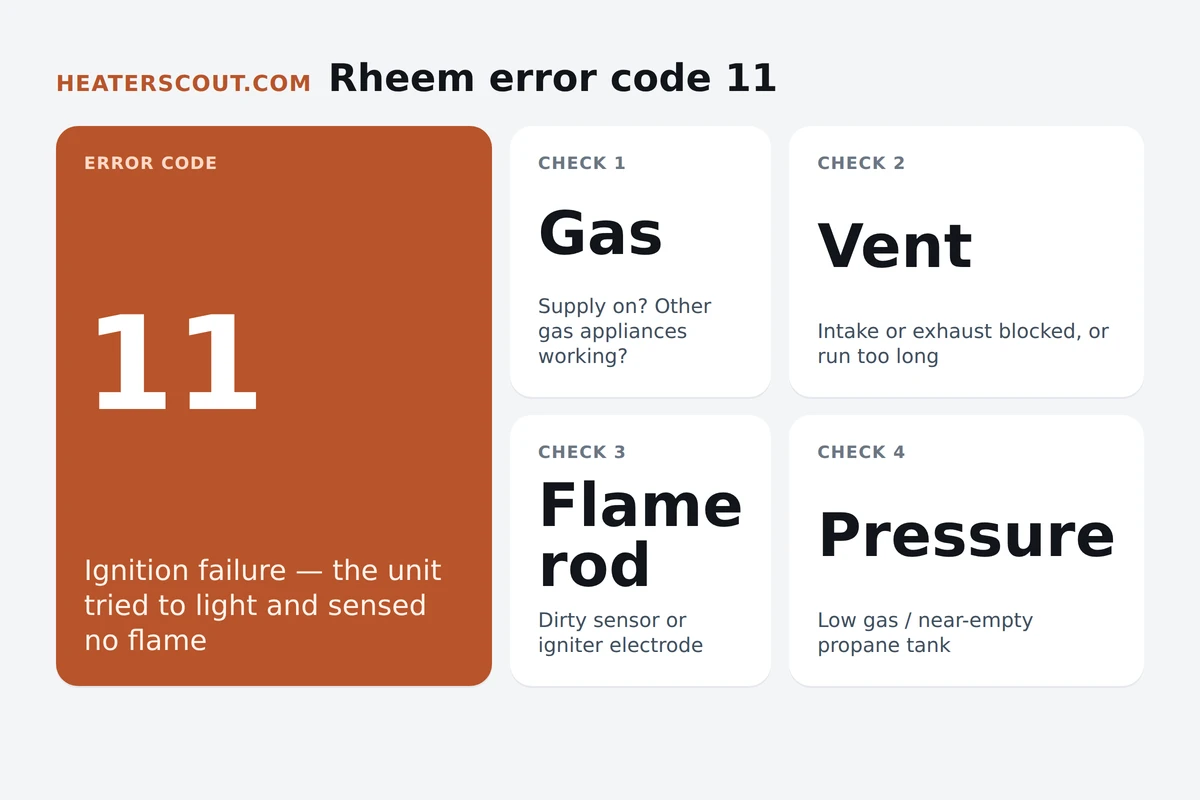
A Rheem that throws 11 the first time it fires after a propane refill is telling a very different story than one that throws 11 on every single call for hot water. Same code, same display, but the cause list barely overlaps. Sort your problem by pattern first and you skip most of the guesswork.
What code 11 is actually reporting
When you open a hot tap, the Rheem control board runs a fixed sequence: it spins the fan for a pre-purge, fires the igniter, and opens the gas valve. A single flame rod then checks for an actual flame by reading the micro-amp ionization current a flame conducts through the burner. If that current does not appear within the board’s allotted ignition trials, the unit locks out and posts 11. The code does not name a broken part. It says the burner never lit, and the job is to find out why the flame either never started or never got proven.
That single distinction — never started versus never proven — is why frequency matters so much here. A flame that starts every time but reads as absent points at the flame rod or its wiring. A flame that only fails under heavy draw points at gas pressure sagging. A flame that never starts at all points at gas simply not arriving. The tabs below split those apart.
Match the fix to the pattern
Pick the tab that describes what you are seeing. Each one lists the checks that actually matter for that pattern, in order, and tells you where the safe steps end.
First time it has shown up
A one-off 11 is usually a hiccup in gas delivery, not a failed component. Work top to bottom.
- Confirm gas is actually flowing. Light a stove burner or run another gas appliance. If nothing else lights, the problem is your gas supply, not the heater.
- Check the shutoff under the unit. The handle should sit in line with the pipe, fully parallel. A valve knocked halfway shut starves the burner.
- On propane, check the tank. A near-empty or freshly refilled LP tank is the single most common cause of a first-time 11. If it just ran dry, you also have air in the line (see the next tab).
- Purge air after any gas work. Cycle the unit and let a nearby gas appliance run briefly to pull fresh gas through. It can take a few ignition trials before the line clears and the flame holds.
- Reset once. Kill power at the disconnect for 30 seconds, restore it, and call for hot water again. One reset clears a stale lockout; it does not fix anything by itself.
It comes and goes
Intermittent 11 means the flame usually starts but something drops it out under certain conditions. This is the pattern that fools people.
- Note when it fails. Only at high flow (two showers, a filling tub)? That points hard at gas pressure sagging under load. Only on cold mornings? Suspect the LP regulator.
- Gas pressure under load. An undersized or overlong gas line reads fine at rest but drops below the burner’s minimum once it pulls full BTU. The flame lights for a second, starves, and the rod loses it — code 11. Confirming this needs a manometer.
- Cold-weather propane. In hard cold, an LP tank’s vapor pressure falls and the regulator can partially freeze, so gas volume drops right when demand is high. A first-stage regulator issue or an undersized tank for the load shows up as intermittent winter-only 11.
- Partial vent or intake block. A vent termination half-clogged with lint, a nest, or ice, or a dirty intake, can choke combustion enough to fail ignition on some cycles and not others. Inspect the outside terminations and the accessible intake screen.
- Marginal flame rod. A flame rod starting to foul reads a weak, unstable current and cuts out inconsistently.
Every time, and it will not clear
A constant 11 that survives resets is either total gas starvation or a genuinely failed part. The safe checks are quick; then it is a tech.
- Rule out no gas at all. If no other appliance in the house will light, or the propane tank is empty, or a main valve is shut, the heater cannot possibly fire. Fix supply first.
- Confirm gas type matches. A unit set for natural gas but fed propane (or the reverse) after an install or conversion will never light and throws a hard 11. Conversions need the correct Rheem kit and setup.
- Stop resetting. Repeated resets on a constant 11 accomplish nothing except clearing the display. The cause is still there.
- Failed component territory. With gas confirmed present and correct, a constant 11 usually means the igniter, the flame rod, the gas solenoid valve, or the control board. Those are diagnosed and replaced by a technician, not guessed at.
Air in the line: the first-timer’s trap
If your Rheem runs on propane and threw 11 right after the tank was topped off, air is the prime suspect. When an LP tank runs dry it draws air into the supply line. After the refill the unit tries to ignite on an air-and-gas mixture, cannot establish a flame, and locks out on 11 until that air is purged. New installations do the same thing before the line is properly bled. It looks like a dead unit, but the fix is just clearing the air: cycle the heater and run a nearby gas appliance to draw fresh gas through. Expect a few failed ignition trials before the line is fully purged and the flame holds steady.
The flame rod, and why cleaning it is not really a DIY step
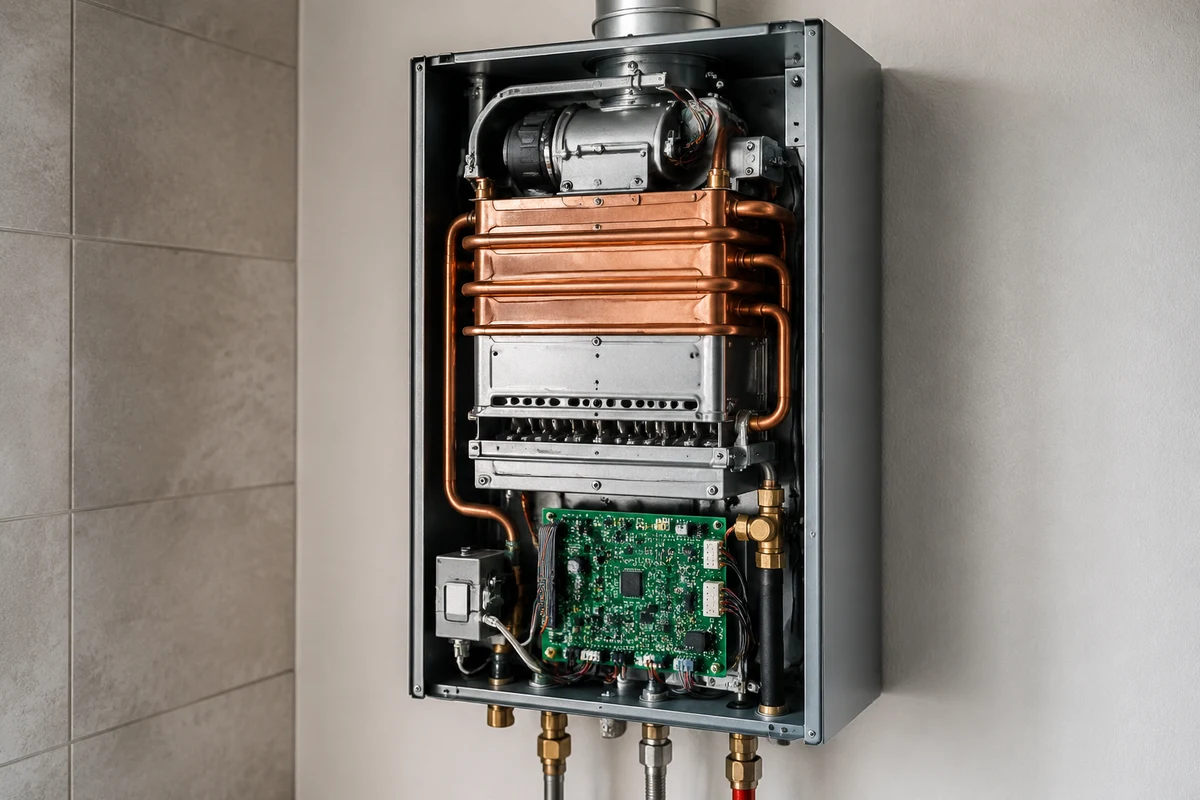
The flame rod is the thin sensor that proves a flame by reading the ionization current the flame conducts. Over time it fouls with a light carbon or oxide film, or its wire loosens, and then it reports “no flame” even while the burner is clearly lit — a false 11. Cleaning it with fine abrasive is a known fix, and plumbers report it resolves a large share of code 11 calls. The catch is that the rod sits inside the sealed combustion chamber next to live gas components. Reaching it means opening the unit, which most manufacturers warn voids the warranty and, more to the point, puts you next to a gas valve without the training to work there safely. That is why this belongs to a technician even though the task itself sounds trivial.
Gas pressure and line sizing: the sag that mimics a bad part
When the simple checks do not clear an intermittent or constant 11, gas pressure is the usual culprit, and it is where DIY stops. Rheem specifies an inlet pressure the gas must hold while the burner runs at full load: at least 3.5″ WC on natural gas and 8.0″ WC on propane, with the line sized for full BTU over its run length.
Typical inlet ranges run roughly 4 to 10″ WC for natural gas and 8 to 13″ WC for propane, but the number that matters is the dynamic reading while firing. A line that is too long or too small passes the static test and then collapses below the minimum the instant the burner draws maximum gas. The flame lights, starves, and drops out — code 11 that behaves exactly like a flaky sensor. Only a manometer on the inlet, taken while the unit fires at full rate, tells the two apart. Correcting it means resizing the line: licensed gas work, not a reset.
Venting and cold weather: the quiet contributors
A blocked vent or air intake starves combustion enough to fail ignition, and on a condensing RTGH the intake screen collects dust while the outside termination catches leaves, snow, ice, or an insect nest. You can inspect the exterior vent and the accessible intake yourself without opening the sealed unit. Cold weather adds its own twist on propane: as temperatures drop, LP vapor pressure falls and a regulator can partially freeze, cutting gas volume right when a morning shower demands the most. A unit that only throws 11 on the coldest mornings is usually fighting an undersized tank or a struggling first-stage regulator, not a bad board.
When to stop resetting and call
Reset the unit once — power off 30 seconds, back on, call for hot water — and run the checks for your pattern. If 11 keeps returning, resist the urge to keep cycling power; each reset only clears the display, never the cause. A code 11 that survives the safe checks points at gas pressure, the flame rod, the igniter, the gas valve, or the control board, and that is the point to bring in Rheem support or a licensed installer. One safety line that overrides all of it: if you ever smell gas, do not troubleshoot. Leave the building and call your gas utility from outside.
Frequently asked
What does Rheem error code 11 mean?
Code 11 is an ignition failure, or no ignition. The unit ran its lighting sequence, sparked the igniter, and opened the gas, but the flame rod never proved a flame, so it locked out rather than release unburned gas. It applies across Rheem, Ruud, and Paloma tankless units and the RTG and RTGH series. It does not name a failed part; it means the burner did not light, and the cause is usually on the gas side.
Why did my Rheem show code 11 right after a propane refill?
Because air got into the gas line. When an LP tank runs empty it pulls air into the supply. After the refill the unit tries to ignite on an air and gas mix and cannot hold a flame, so it posts 11. Purging the air, by cycling the unit and running another gas appliance to draw fresh gas through, usually clears it. Expect a few failed trials before the line is fully bled.
How do I reset a Rheem code 11?
Turn the unit off at its disconnect or breaker for about 30 seconds, restore power, then call for hot water again. First confirm the gas is on, the valve under the unit is fully open, and the vent is clear. A reset only clears the lockout display, not the underlying cause, so if 11 comes right back, stop resetting and look at the gas supply and pressure.
Can I fix a Rheem code 11 myself?
You can safely do the gas-delivery checks: confirm other appliances light, open the main and unit shutoff valves, check the propane tank, purge air from the line, clear the vent and intake, and reset once. What you should not do is measure gas pressure, clean the flame rod, or open the unit to reach the igniter or gas valve. Those need instruments and gas certification and belong to a licensed installer.
What gas pressure does a Rheem tankless need?
The inlet must hold at least 3.5 inches of water column for natural gas or 8.0 inches for propane while the burner fires at full load, with typical static ranges around 4 to 10 inches for natural gas and 8 to 13 for propane. An undersized or overlong line reads fine at rest and sags below the minimum under load, causing the unit to light briefly then drop out on 11. Measuring the dynamic pressure requires a manometer and a technician.
Why does my Rheem light for a second then show code 11?
That is the signature of low dynamic gas pressure. The unit gets enough gas to spark a flame, but once the burner draws its full demand the pressure falls below what the flame needs, the flame rod loses the flame, and it locks out. The usual fix is correcting an undersized or overlong gas line, or on propane a cold-weather regulator or tank issue. Both are gas work, not a reset.