Quick answer
Set the tank to 120°F (49°C) for most homes. It scalds far slower than the factory 140°F, cuts standby losses, and still delivers plenty of hot water. If anyone in the house has a weak immune system — or you’ve ever smelled sulfur from the taps — there’s a real case for 140°F with a mixing valve. The rest of this page is why, and how to do it right.
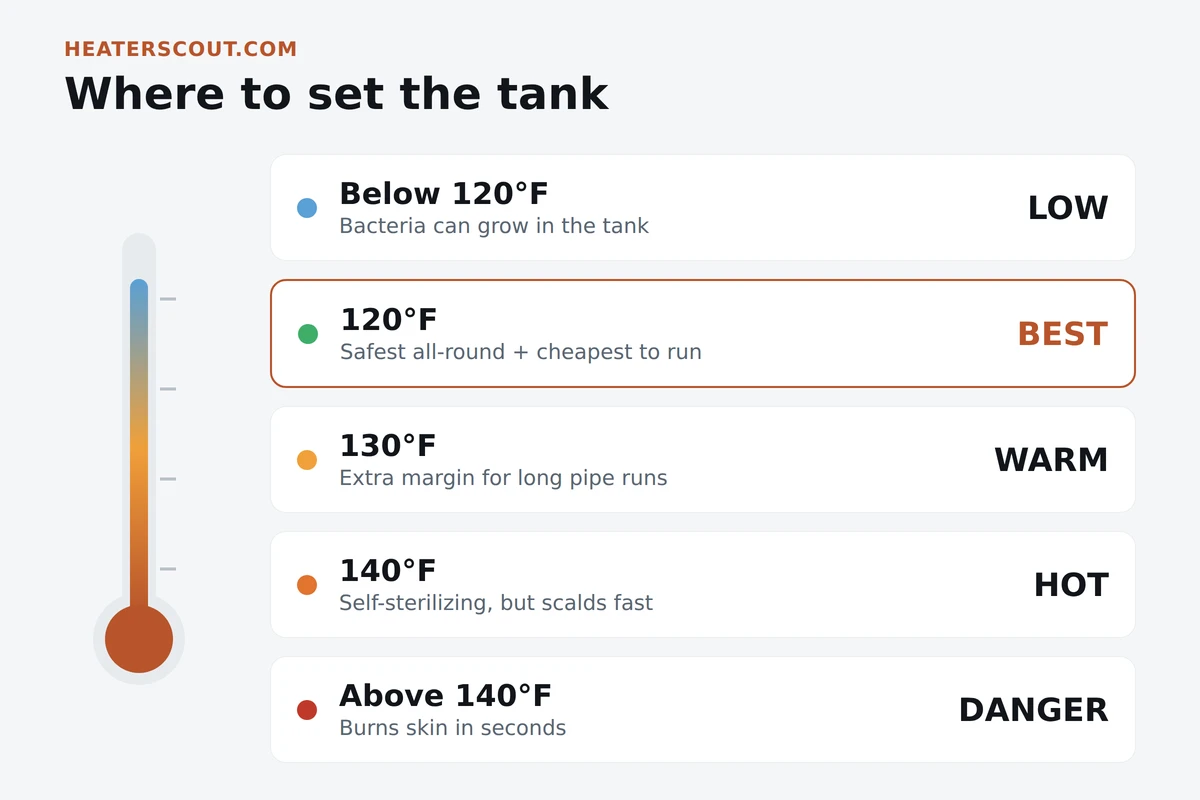
There is no single “correct” water heater temperature, and anyone who tells you otherwise is skipping the part that matters. Three federal agencies have looked at this and landed in three different places. The right number for your house is where their advice overlaps — and that depends on who lives there.
Why the “right” number is a fight between three agencies
Here’s the honest tension nobody puts on a thermostat sticker:
- The CDC wants it hot. Legionella bacteria — the bug behind Legionnaires’ disease — multiplies happily between 77 and 113°F. It stops growing around 122°F and dies off at 140°F. From a pure microbiology standpoint, storing water at 140°F is the safe play.
- The CPSC wants it cool. The Consumer Product Safety Commission looks at scald burns, not bacteria. At 140°F, tap water gives an adult a third-degree burn in about five seconds. On a small child or an older adult with thin skin, it’s faster. Their recommendation is 120°F.
- The DOE wants it low. The Department of Energy cares about the bill. A tank held at 140°F loses heat to the room around the clock. Drop it to 120°F and most homes save 6–10% on water heating — roughly $36–61 a year for a typical family.
Two of the three say 120°F. The one that says 140°F is worried about a real but relatively rare illness. That’s why the default answer is 120°F for the average household — and why the exception matters so much when it applies to you.
What each temperature actually does to skin
Scald time is the part people underestimate. It isn’t linear — a 20-degree jump doesn’t double the risk, it collapses your reaction window from minutes to a heartbeat. Move the slider and watch how fast the margin disappears.
Burn-time explorer
Time to a serious (third-degree) burn on adult skin, from CPSC scald data. Children and the elderly burn faster at every point.
The numbers behind that slider, laid out:
| Tap temperature | Time to a serious burn (adult) |
|---|---|
| 120°F | About 5 minutes |
| 125°F | About 1.5–2 minutes |
| 130°F | About 30 seconds |
| 140°F | About 5 seconds |
| 150°F | About 1.5 seconds |
At 120°F you have time to yank a hand away, pull a kid back, or turn the tap. At 140°F you don’t. That five-second window is the whole reason the CPSC settled where it did, and it’s why scald injuries cluster among the two groups slowest to react — young children and older adults.
What each temperature does to the bill
A storage tank is a thermos that leaks. Every degree above the temperature you actually use is heat bleeding into your basement or closet, day and night, whether you draw water or not. That’s standby loss, and it scales with the setting.
Plug in what you think you spend on water heating a year — if you have no idea, the U.S. average is around $400–$500 — and slide the temperature to see the trade.
Temperature → savings calculator
Based on DOE’s figure of roughly 3–5% of water-heating cost per 10°F, measured against the 140°F factory setting.
Estimated annual cost
$411
Saved vs 140°F
$39/yr
It’s not a fortune. But it repeats every year for the life of the tank, it costs nothing to capture, and going the other way — cranking the dial to 140°F for “more hot water” — buys you a burn hazard and a higher bill at the same time. If you’re running out of hot water, the fix is almost never a higher setting; it’s a failing element or a small tank.
The Legionella exception — and how to have it both ways
So when is 140°F worth the burn risk? The CDC’s concern is legitimate for specific households. Legionella thrives in lukewarm, stagnant water. It grows from 77 to 113°F, survives up to about 122°F, and only reliably dies at 140°F. People inhale it as a mist — a shower, a humidifier — not by drinking it.
Turn the tank up if your household includes someone who is:
- Over 50, or a current/former smoker;
- Living with a chronic lung condition, diabetes, kidney or liver failure;
- On chemotherapy or immunosuppressant drugs, or post-transplant.
Here’s the move that resolves the whole three-way fight: store hot, deliver cool. Set the tank to 140°F so bacteria can’t colonize it, then fit a thermostatic mixing valve (also sold as a tempering or anti-scald valve) on the hot outlet. It blends in cold water automatically so nothing above about 120°F ever reaches a faucet. You get the CDC’s kill temperature in the tank and the CPSC’s safe temperature at the tap. A plumber installs one in under an hour, and it’s the standard fix in hospitals and care homes for exactly this reason. It also lets a smaller tank act bigger, because you’re drawing hotter water and diluting it.
How to actually set it — and measure it
The dial on the heater is a rough guide, not a calibrated instrument. Two identical tanks set to the same mark can deliver water 8–10 degrees apart. So set it, then measure at the tap.
Electric tanks have two thermostats. There’s an upper and a lower one behind the access panels, and they must be set to the same temperature or the elements fight each other and one wears out early. Kill the breaker first — those terminals carry 240 volts. Pop both panels, fold back the insulation, and turn both dials to match.
Gas tanks have one dial on the control valve at the bottom, usually marked with a “hot” reference point rather than exact numbers. Nudge it a notch, wait, re-measure.
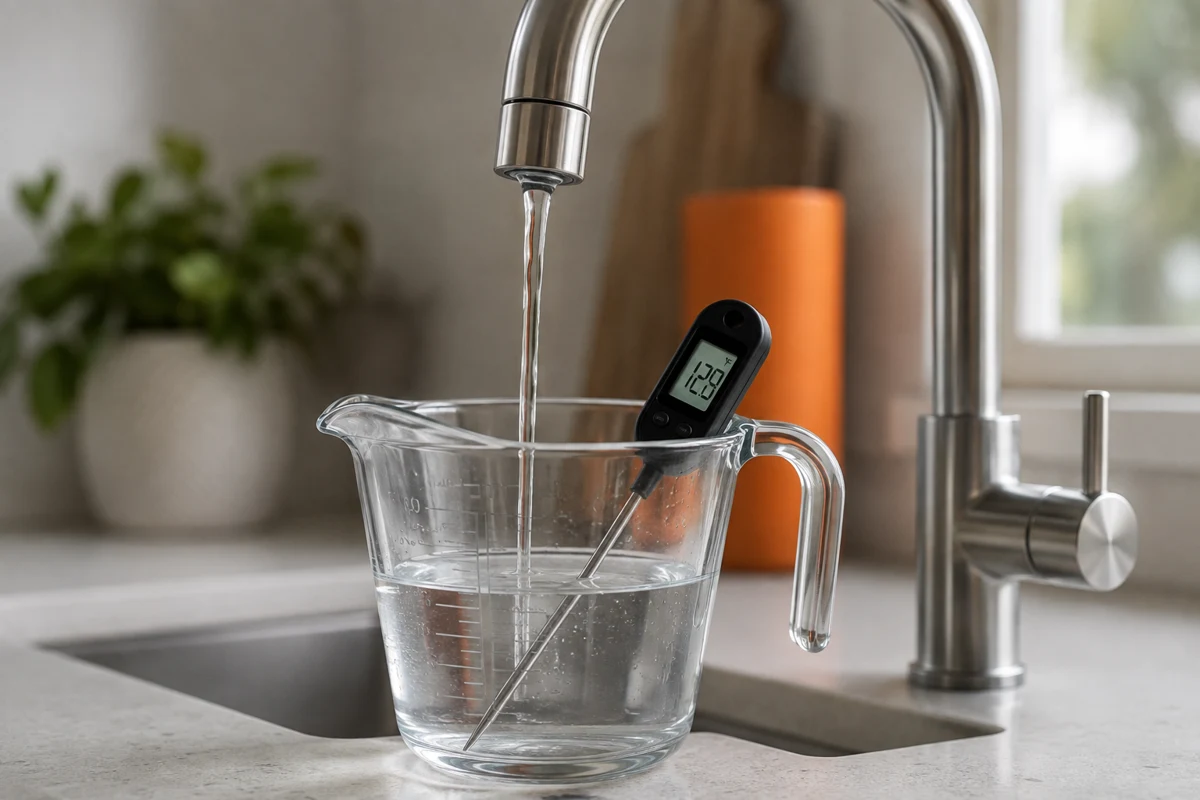
To measure the way the CPSC recommends: don’t run hot water for about two hours first, then hold a candy or meat thermometer under a running hot tap for a full minute and read it there. That’s your real delivered temperature — the number that actually reaches skin. Adjust, wait a few hours for the tank to stabilize, and check again.
Special cases worth a second look
- Older dishwashers sometimes needed 140°F to clean and dry. Nearly every unit built in the last 15 years has its own internal booster heater, so 120°F is fine — check the manual if yours is ancient.
- Homes with small children or elderly residents should not exceed 120°F at the tap, full stop. If you also need 140°F for the Legionella reasons above, that’s exactly the mixing-valve scenario.
- Leaving for a week or more? Most heaters have a “vacation” or “VAC” setting that keeps the tank warm without fully heating. When you get back, run the hot taps for a few minutes before showering — water that sat lukewarm for days is exactly what Legionella likes, and flushing clears it.
- Tankless heaters don’t store water, so the Legionella-in-the-tank problem largely disappears. Set the delivery temperature to 120°F on the unit’s digital panel and you’re done — no two-thermostat dance.
Frequently asked
Is 120 or 140 degrees better for a water heater?
For most homes, 120°F. It prevents scald burns (140°F burns an adult in about five seconds), lowers the bill by 6–10%, and still supplies plenty of hot water. Choose 140°F only if someone in the home has a weakened immune system, and pair it with a thermostatic mixing valve so the taps still deliver 120°F.
Will lowering my water heater to 120 degrees cause Legionella?
For a healthy household, the risk is very low — the CDC’s concern centers on immunocompromised people. If someone is over 50, smokes, has a chronic lung condition, or is immunosuppressed, keep the tank at 140°F and add a mixing valve to keep tap water safe. Flushing taps after a long absence also helps.
How much money does lowering the temperature actually save?
The DOE estimates roughly 3–5% of your water-heating cost for every 10°F you lower it. Going from the 140°F factory setting to 120°F saves most families about $36–$61 a year — small, but it repeats annually and costs nothing to set.
Why does my electric heater have two thermostats?
Electric tanks have an upper and a lower heating element, each with its own thermostat. They must be set to the same temperature; if they differ, the elements cycle against each other and one fails prematurely. Always cut the 240V breaker before opening the access panels.
How do I measure my real water temperature?
The dial isn’t accurate. Don’t use hot water for about two hours, then run a hot tap over a candy or meat thermometer for a full minute and read it. That’s the temperature actually reaching your skin. Adjust the heater, wait a few hours, and re-check.
My water isn’t hot enough — should I turn it up past 140?
Usually no. Running out of hot water is almost always a failed heating element, sediment in the tank, or an undersized unit — not a low setting. Cranking past 140°F adds a serious burn hazard and raises your bill without fixing the real problem. Diagnose the element first.