Quick answer
An electric tank that makes no hot water at all almost always comes down to three things: a tripped ECO (the red reset button on the upper thermostat), a dead upper element, or no power reaching the tank. Warm but never hot is the opposite pattern - the upper half works and the lower element is dead. Hot that runs out fast is the lower element too. Kill the breaker before you touch anything, and never energize an element in a tank that isn’t full of water.
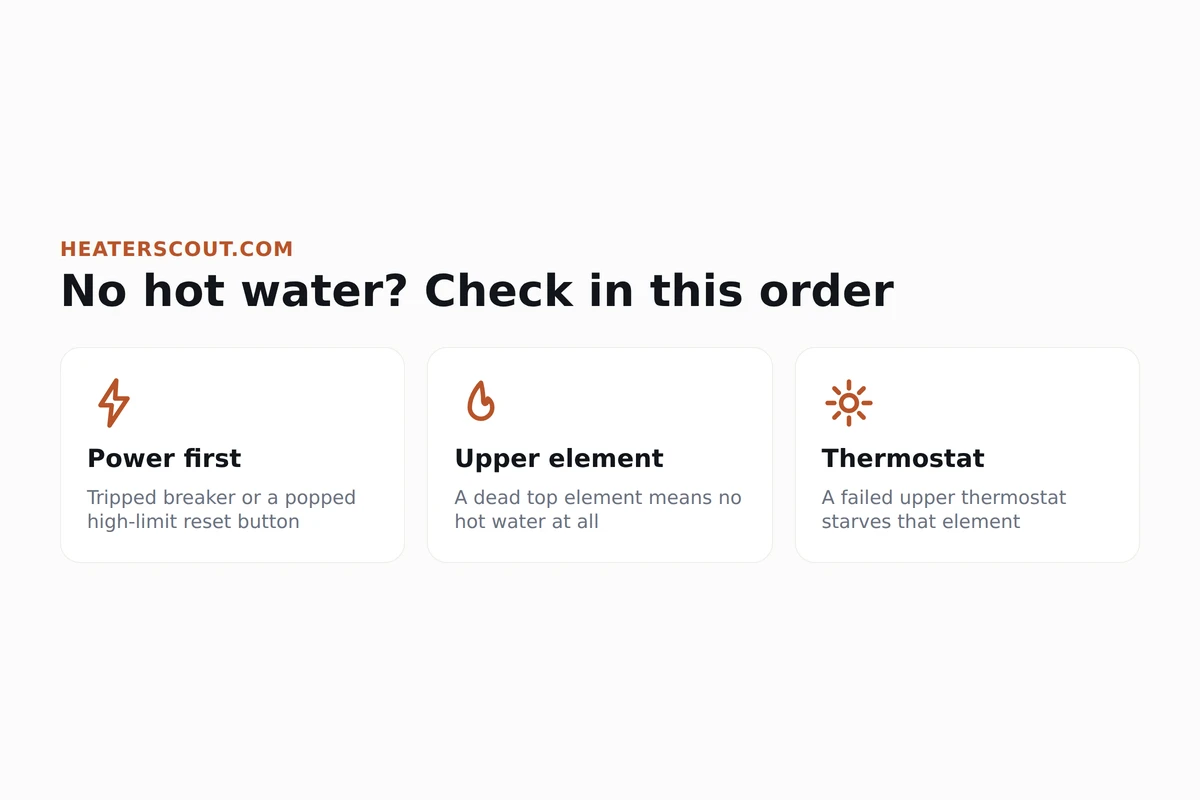
A standard electric water heater has exactly four parts that can rob you of hot water, and the tank tells you which one broke by how much heat you still get. No heat at all, lukewarm, or hot-then-cold are three different failures with three different fixes. Read the symptom first and you skip most of the guessing.
How the two elements actually work
Almost every 40 to 80 gallon electric tank runs two 4500-watt elements at 240 volts, each with its own thermostat. What trips people up is that the two elements never run at the same time. On a cold tank the upper thermostat powers the upper element first until the top third of the tank hits temperature. Only then does the upper thermostat hand off, sending power down to the lower thermostat and lower element, which heats the rest of the tank and does the day-to-day work of reheating as you draw hot water.
That handoff is the whole diagnostic key. The upper element guarantees you always have at least some hot water at the top of the tank; the lower element supplies volume. So if the upper circuit fails you get nothing, and if the lower circuit fails you get a little hot water that vanishes fast. The symptom is not random - it maps straight onto which half of the tank still has a working heater.
The red button that fixes half these calls
Sitting on the upper thermostat is a small red button: the ECO, short for energy cut-off, also called the high-limit switch. It is a mechanical safety that snaps open if the water ever climbs past roughly 170 to 180 deg F, cutting all power to both elements. When it trips you get no hot water at all, and there is no other symptom - no leak, no noise, just cold.
Press it firmly and you should feel a soft click. If it clicks and stays reset, you may have caught a one-time fault. But an ECO does not trip for no reason. If it pops again within a day, stop resetting it. A repeat trip means a thermostat is stuck closed or an element is shorted and the tank is genuinely overheating, and continuing to reset it defeats the one part that keeps the tank from scalding you.
Find your symptom, get the checklist
Pick the pattern that matches what you have. Each one opens a different ordered set of checks, worst-offender first. Everything below assumes the breaker is off while you test.
Symptom router
Choose how much hot water you actually get. The checklist reorders to match.
Cold at every tap. The whole tank is unheated, so the fault is upstream of both elements or in the upper circuit that feeds them.
- Check the breaker firstA water heater sits on a double-pole 240V breaker. Look for one that’s tripped or sitting halfway. Flip it fully off, then on. If it trips again immediately, you have a short - stop and call a pro.
- Reset the ECO / high-limitKill the breaker, pull the upper panel and insulation, press the red button. A click that holds may be your whole fix. A click that trips again soon means a deeper fault, not a loose button.
- Confirm 240V is arrivingWith power back on and a meter, check for about 240 volts at the top two terminals. No voltage points at the breaker, wiring, or the ECO still being open.
- Test the upper elementPower off. Pull the two wires and read across the terminals. A healthy 4500W element is roughly 12 to 13 ohms. OL or infinity means it’s burnt open and is your no-heat cause.
- Suspect the upper thermostatElements and ECO fine but still no power passing through? The upper thermostat contacts can fail open and never hand power to anything below them. Replace it.
Most likely part: tripped ECO, dead upper element, or a failed upper thermostat / lost power.
You get warm water but it never reaches a satisfying hot, no matter how long you wait. The upper element is doing its job; the lower one isn’t.
- Rule out a low setpointCheck the lower thermostat dial. If it’s below 120 deg F, someone set it low. Nudge it up and give it an hour before you tear anything apart.
- Test the lower elementPower off. Read across the lower element terminals. Around 12 to 13 ohms is healthy; OL means it’s open and dead, which is exactly why only the top of the tank warms.
- Check the lower element for a ground shortOne probe on a terminal, one on the tank flange. Any continuity to ground means the element is shorted and must be replaced.
- Suspect the lower thermostatElement reads fine but stays cold? The lower thermostat may not be closing to feed it. Swap it - it’s cheap and often paired with the element.
Most likely part: dead lower element, or the lower thermostat set too low or failed.
Plenty hot at first, then it turns cold far sooner than it used to - a short shower and you’re done. The tank only holds a small hot layer at the top.
- Confirm the pattern isn’t usageNew dishwasher run, more people, a colder incoming supply in winter - real demand can mimic a fault. If nothing changed, move on.
- Test the lower elementPower off, read the terminals. A dead lower element (OL) leaves only the upper element heating the top third of the tank, so you get one small slug of hot water and then cold.
- Check for a ground short on that elementTerminal to tank flange should read open. Continuity means shorted - replace it.
- Look at the dip tube and sedimentA broken dip tube dumps cold water at the top and mixes it into your hot draw; heavy sediment insulates the lower element and cuts usable capacity. Both shrink how long the hot lasts.
Most likely part: failed lower element, sometimes a broken dip tube or a sediment-buried lower element.
Testing an element the right way
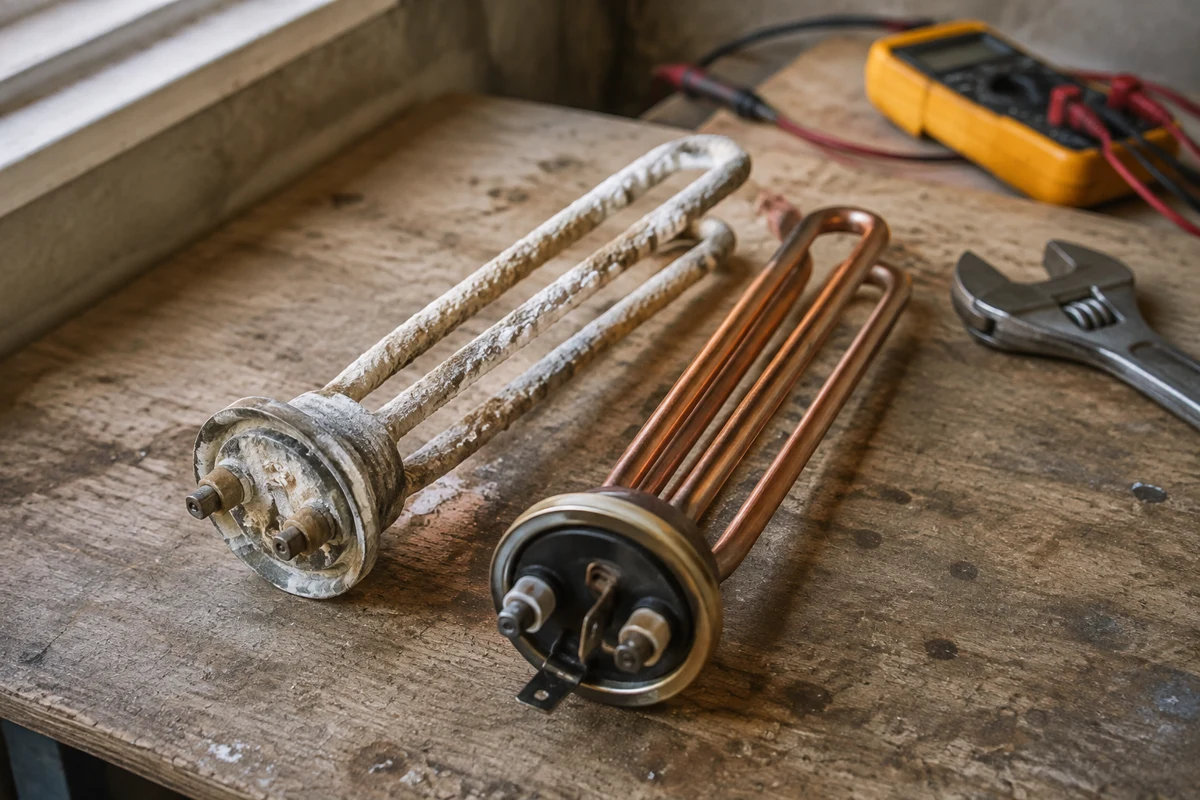
Every element test starts the same way: turn off the double-pole breaker feeding the heater and confirm it’s dead with a meter before a screwdriver goes near a terminal. There is enough voltage here to kill you. Pull the panel and the insulation, fold back the plastic safety cover, and disconnect at least one wire from the element so you’re reading the element alone, not the circuit.
Set a multimeter to ohms and touch one probe to each element screw. Resistance tells you the whole story:
No hot water at all — ranked by how often it’s the culprit
Tripped ECO / high-limit reset button
Failed upper heating element (burnt open)
Tripped breaker / no power reaching the tank
Failed upper thermostat (contacts stuck open)
A dead lower element leaves the upper working, so you still get some hot water — that’s a warm-not-hot fault, not no heat at all.
A reading in the 10 to 16 ohm band means the element is good. OL or an infinity symbol means the heating coil is broken and no current can flow, so replace it. A near-zero reading, or any continuity between a terminal and the tank body, means the element is shorted to ground - also a replacement, and often the exact fault that keeps tripping your ECO or breaker.
The one safety rule that outranks the rest
Never send power to an element that isn’t submerged in water. A dry-fired element burns out in seconds because the water that normally carries its heat away is gone. So if you drained the tank to swap an element or a thermostat, refill it completely and open a hot tap until water runs steady and air stops sputtering out before you flip the breaker back on. Every element replacement ends with a full tank first, power second - in that order, no exceptions.
When it’s not the heater at all
Two failures masquerade as a heating problem. A tripped breaker that won’t stay set usually means a shorted element or wiring, not a bad breaker, and swapping the breaker just hides a real short. And a leak from the bottom of the tank can quench the lower element and read like a heat fault while the actual problem is a tank that needs replacing. If your checks come back clean and you still have no heat, those are the two places to look before you buy parts.
Frequently asked
Why is my electric water heater not producing any hot water?
No hot water at all on an electric tank almost always means one of three things: the red ECO reset button on the upper thermostat has tripped, the upper heating element has burned out, or power is not reaching the tank because of a tripped double-pole breaker or failed upper thermostat. Kill the breaker, reset the ECO, then test the upper element for continuity. A healthy 4500W element reads about 12 to 13 ohms.
Where is the reset button on a water heater?
It is the red button on the upper thermostat, behind the upper access panel and under the insulation. It is the ECO, or high-limit switch, a safety that cuts all power if the water passes roughly 170 to 180 deg F. Turn off the breaker, pull the panel, and press it firmly until it clicks. If it trips again within a day, stop resetting it and find the shorted element or stuck thermostat that is overheating the tank.
Why is my water warm but not hot?
Warm but never hot means the upper element works and the lower element is dead. The upper element only heats the top third of the tank, so you get lukewarm water and it never climbs higher. Check the lower thermostat setting first in case it is below 120 deg F, then test the lower element for continuity. An OL or infinity reading confirms the lower element is open and needs replacing.
Why does my hot water run out so fast now?
Hot that turns cold quickly usually points to a failed lower element. With only the upper element working, the tank heats just its top third, so you get one short burst of hot water and then cold. Test the lower element with power off. If it reads OL it is dead. A broken dip tube or heavy sediment burying the lower element can also cut how long your hot water lasts.
How do I test a water heater heating element?
Turn off the double-pole breaker and confirm the power is dead with a meter. Pull the access panel and insulation, fold back the safety cover, and disconnect at least one wire from the element. Set a multimeter to ohms and touch one probe to each element screw. A 4500W element should read about 12 to 13 ohms, a 3500W around 16. OL or infinity means the element is open and dead. Continuity from a terminal to the tank means it is shorted.
Is it safe to reset a water heater more than once?
Reset the ECO once. If it holds, you may have caught a momentary fault. If it trips again within hours or a day, do not keep resetting it. A repeat trip means a thermostat is stuck closed or an element is shorted and the tank is actually overheating. The ECO is the safety that stops the water from scalding you, so hunt down the real fault instead of forcing it back on.