Quick answer
That red button is the ECO (energy cut-off), the high-limit switch mounted on the upper thermostat. It snaps open when water at its sensor climbs past roughly 180 to 190°F, or when it reads an electrical fault. If it trips once, reset it. If it trips again, stop resetting and find the cause: nine times out of ten it’s a shorted heating element or a thermostat stuck closed, and every reset after that is heating water toward a real hazard.
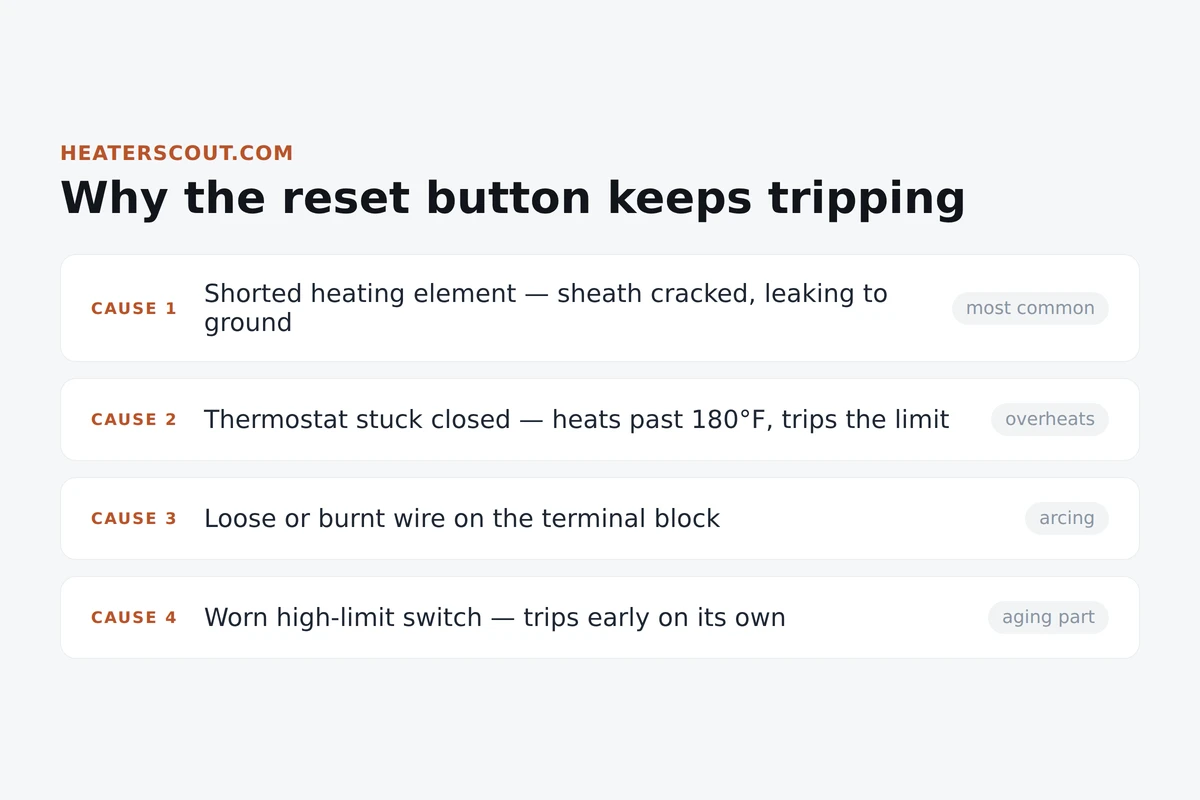
What actually trips the ECO high-limit, by frequency
- 40%Grounded or shorted heating element
- 30%Thermostat stuck closed, overheating the water
- 15%Loose or burnt wiring at the terminals
- 15%The ECO switch itself worn out
The ECO is a mechanical safety of last resort. It does not measure temperature to give you a reading; it sits against the tank wall with a bimetal disc that physically breaks the circuit when the metal gets too hot. So when it keeps tripping, it is doing its one job correctly. The question is never “why is the button bad” but “what is heating the tank past 180°F, or faulting the wiring, that keeps forcing it open.”
What the reset button is, and why it trips
Behind the upper access panel, under the insulation, the upper thermostat and the ECO share one mounting bracket clamped tight to the tank. The thermostat is the everyday control that cycles the element on and off around your setpoint, usually 120°F. The ECO is the backup: a spring-loaded bimetal disc set to open near 180 to 190°F. When it opens, both elements lose power and you get no hot water until you press the button back in.
It opens for two reasons. Either the water genuinely got that hot, which means something downstream of the ECO stopped shutting the element off, or the ECO sensed an electrical fault such as a short to the tank that let current flow where it should not. A grounded element can trip the high-limit even when the water is not actually at 190°F, because the fault current itself is the problem. Sorting which of those is happening is the whole diagnosis.
The five causes, ranked by how often they are the culprit
Work them in order. The cards below open one at a time so you can compare mechanism against fix without losing your place.
Ranked most-likely to least-likely. Tap a card to expand it; the others close.
1 Shorted or ground-faulted heating element Very likely ▸
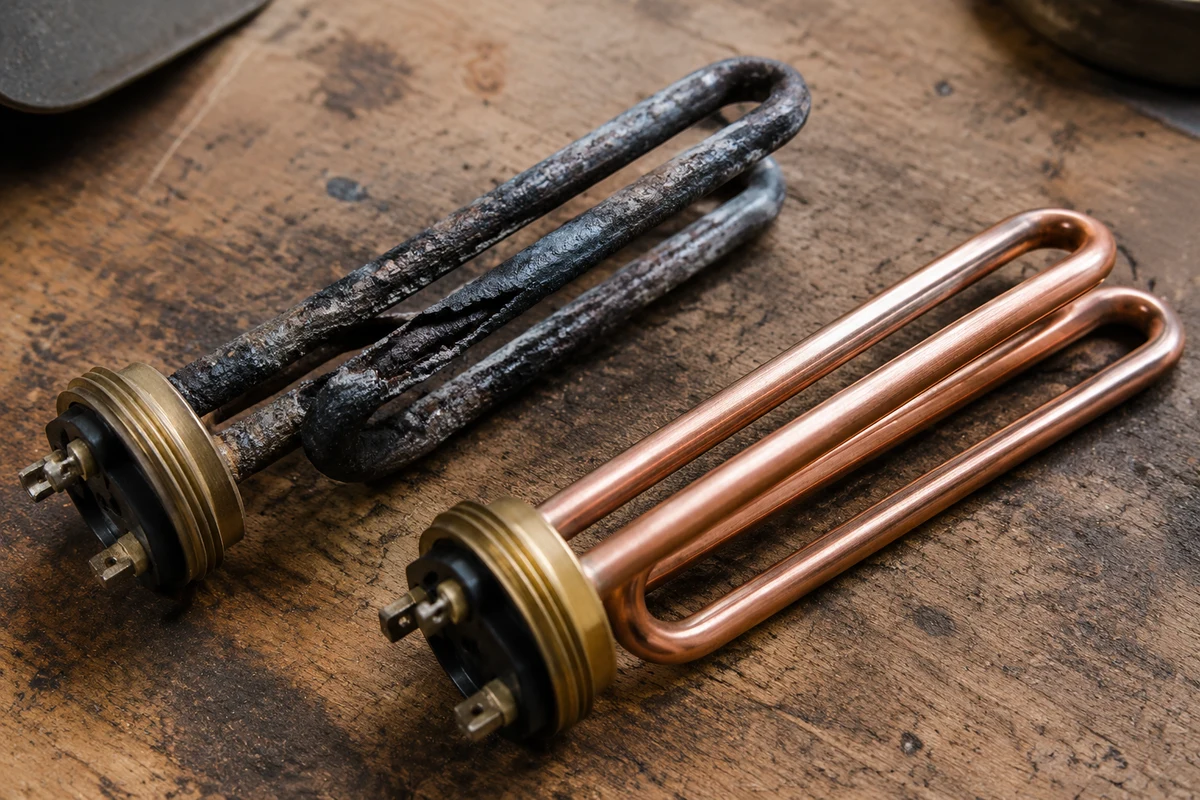
The single most common cause. An element is a coiled resistance wire packed in mineral insulation inside a metal sheath. When the sheath cracks or the insulation absorbs moisture, current leaks from the live coil to the sheath and into the water and tank. That leakage is a short to ground. The ECO reads the fault and opens, and no amount of resetting clears it because the leak is constant.
Tell-tale signs: the reset trips again within minutes or hours of pressing it, the breaker may also trip, and often the water was running lukewarm before it quit. Sediment burying the lower element and dry-firing it is a common way elements crack in the first place.
2 Thermostat stuck closed, overheating the water Likely ▸
The thermostat’s contacts are supposed to open when the water hits your setpoint. When those contacts weld or stick closed, the element never shuts off. It just keeps heating past 120, past 140, past 160, until the water reaches the ECO’s trip point and the high-limit saves the tank. Most often it is the lower thermostat that sticks, which drives heat up into the top of the tank where the ECO sensor sits.
Tell-tale sign: scalding hot water right up until the reset trips, and the water is genuinely near-boiling, not lukewarm. That heat, rather than a wiring fault, is the giveaway that separates this from cause 1.
3 Worn-out ECO tripping early Possible ▸
Bimetal discs fatigue. After years of cycling, or after a few genuine over-temp events, the ECO can start opening below its rated point, tripping when the water is only warm. Now the button is the fault rather than the messenger. This is real, but it is third on the list for a reason: assume the element or thermostat first, because a prematurely blamed ECO is how people end up resetting a truly overheating tank.
Tell-tale sign: the water was never especially hot, the elements test clean, the thermostat cycles normally, and yet the reset still pops.
4 Loose or corroded wiring arcing under the cap Possible ▸
Every screw terminal in the heater carries the full element load, around 18 to 19 amps on a 4500-watt element at 240 volts. A terminal that has backed off or corroded raises resistance at that joint, and resistance under load makes heat. A loose lug can arc, char the insulation, and heat the bracket the ECO is bolted to enough to trip it. This one is also the reason the codebooks call repeated tripping a fire hazard.
Tell-tale signs: discolored or melted wire insulation, a burnt smell, or a terminal that is scorched when you pull the panel. Aluminum-to-copper joints without the right connectors are classic offenders.
5 Miswiring after a recent repair Least likely ▸
If the reset started tripping right after someone changed an element or a thermostat, suspect the wiring job before anything else. A crossed thermostat lead, a jumper left off, or both elements wired to run at once instead of in the normal non-simultaneous sequence can drive the tank hot or confuse the high-limit. Standard residential heaters heat one element at a time; wire them to fire together and you can overheat and overload.
Tell-tale sign: it worked fine until the last repair, and the trouble showed up on the first heat cycle afterward.
Before you open anything: shut off the double-pole breaker feeding the heater and verify zero volts at the terminals with a meter. There are two hot legs at 240V, and switching only one leaves the other live. Do not rely on the ECO or a thermostat as your disconnect.
Testing an element for a ground fault with a multimeter
This is the test that settles cause 1, and it takes two minutes. Power stays off the entire time. You are checking whether the element is leaking to the tank, which is what trips the ECO.
Ground-fault check, power off
- Turn off the breaker. Confirm 0V across both element terminals and from each terminal to the tank with the meter on AC volts.
- Pull the wires off the element’s two terminals so nothing else is in the circuit.
- Set the meter to ohms, the highest resistance range or continuity.
- Put one probe on either element terminal and the other on bare tank metal or the mounting bolt.
- A good element reads OL / infinite resistance to the tank, meaning no path to ground. Any real reading, or a continuity beep, means the element is shorted to ground and must be replaced.
- While you are there, read across the two terminals: a 4500W/240V element should read about 12 to 16 ohms. Infinite here means an open, burnt-out element instead.
Run the same test on both the upper and lower elements. It is common for only the lower one to fail, since sediment collects at the bottom and cooks it.
Why you cannot just keep resetting it
The ECO is the only thing standing between a stuck element and a tank full of near-boiling water. Press reset on a heater whose thermostat has welded shut and you hand the element another few minutes to push the water toward 200°F. At that point you are relying on the temperature-and-pressure relief valve, the next safety down the line, and hoping it has not seized. Repeatedly overriding the high-limit is exactly the scenario that leads to scalding discharge and, in the worst documented cases, tank rupture. A ground-faulted element that keeps tripping the ECO is also energizing the tank and the water, which is a shock risk on the plumbing.
One reset to confirm it was a fluke is reasonable. A second trip is the heater telling you a part has failed. Find the part.
When to call a pro
If the elements test clean, the thermostats cycle, the wiring is tight and unburnt, and the ECO still trips, you are into replacing the thermostat-and-ECO assembly, and that is worth doing carefully. Call a licensed plumber or electrician if you are not comfortable verifying zero volts, if you find scorched wiring or a melted terminal, or if the heater keeps tripping after you have replaced the obvious failed part. Burnt terminals in particular mean heat has already been building where it should not, and that gets a set of trained eyes.
Frequently asked
What is the red reset button on my water heater?
It is the ECO, the energy cut-off or high-limit switch, mounted on the upper thermostat behind the top access panel. It is a bimetal safety that physically breaks power to both elements when water at its sensor passes about 180 to 190 degrees F or when it detects an electrical fault. It is separate from the thermostat that controls your normal setpoint.
Why does my water heater reset button keep tripping?
Most often a heating element has shorted to ground, or a thermostat has stuck closed and overheated the water past the ECO trip point. Less common causes are a worn-out ECO that trips early, a loose or corroded wiring terminal arcing under the cap, or miswiring after a recent repair. Work them in that order, because the element and thermostat are the usual culprits.
Is it safe to keep pushing the reset button?
No. One reset to confirm a fluke is fine, but a second trip means a part has failed. Every reset after that lets a stuck element keep heating the water toward 200 degrees F, leaning on the relief valve as the last safety, and a ground-faulted element also energizes the tank. Repeatedly overriding the high-limit is a genuine scald, shock, and fire hazard.
How do I test a heating element for a ground fault?
Shut off the breaker and confirm zero volts. Disconnect the two wires from the element, set a multimeter to ohms or continuity, put one probe on an element terminal and the other on bare tank metal. A good element reads infinite resistance to the tank. Any reading or continuity beep means it is shorted to ground and needs replacing. Test both elements.
Can a bad thermostat trip the reset button?
Yes. When a thermostat sticks closed its contacts never open, so the element runs continuously and heats the water past the ECO’s roughly 180 degree F trip point. The tell is genuinely scalding water right up until the reset pops, versus lukewarm water, which points more to a shorted element or wiring fault instead.
Should I replace the ECO or the whole thermostat?
On most residential heaters the upper thermostat and the ECO are sold as one combined part, so replacing a failed upper thermostat gives you a new ECO at the same time. Only blame the ECO itself after the elements test clean and the thermostat cycles normally, since a prematurely blamed ECO is how people end up resetting a tank that is actually overheating.