Quick answer
The anode rod is a sacrificial metal bar that corrodes so your steel tank doesn’t. Pull it every 3 to 5 years and replace it if it’s down to the bare core wire or thinner than half an inch. You need a 1-1/16″ socket, a breaker bar, and 20 minutes. Match the new rod to your water: magnesium for normal water, aluminum-zinc for hard water or rotten-egg smell, powered for softened water. Refill and purge the tank before you turn the heat back on.
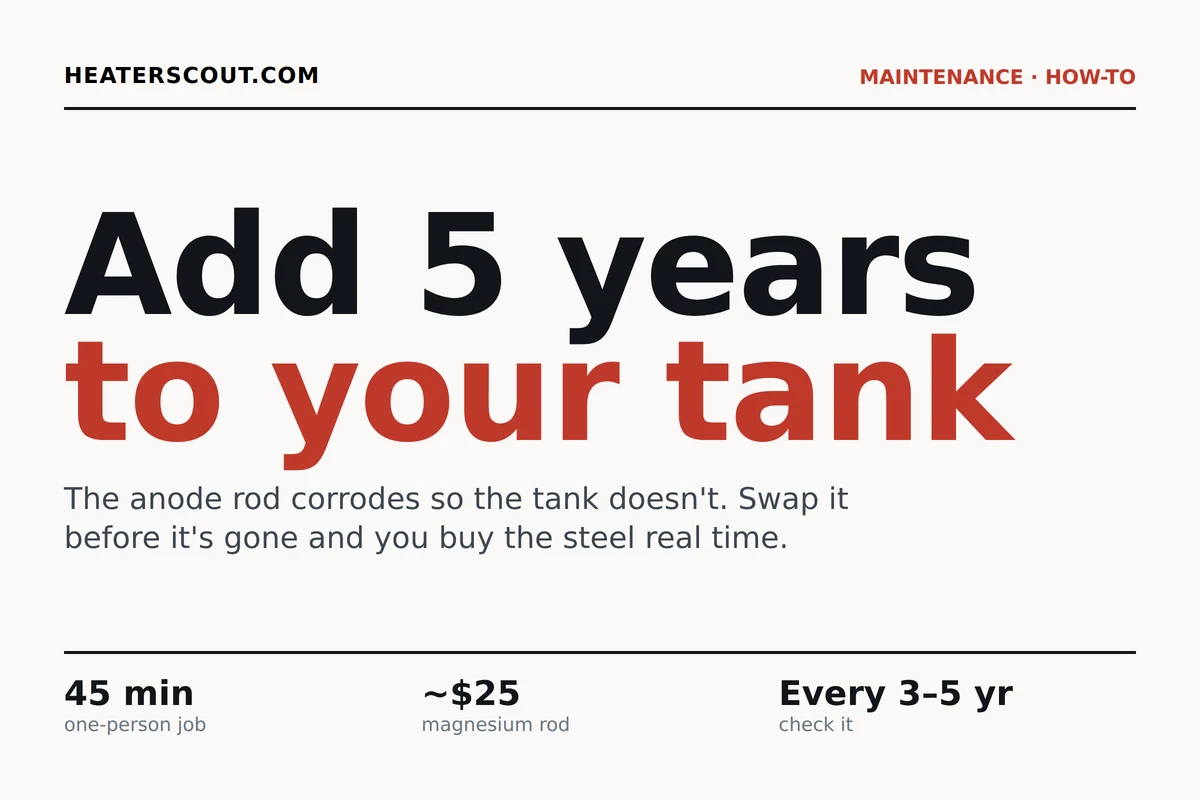
A $25 anode rod is the single part that decides whether your water heater lasts 6 years or 14. It is a bar of reactive metal that dissolves in place of the steel tank, and once it is gone the tank starts rusting from the inside. Most people never touch it, which is exactly why most tanks die early.
Anode wear gauge
Check every 2-3 yrs, sooner on softened water
New
3/4"
Full magnesium or aluminum around a thin core wire
Half worn
~1/2"
Still working, but you are near the threshold now
Core wire shows
Replace
Bare steel core exposed, the tank is no longer protected
Replace now once the rod drops under half an inch or the steel core wire shows through. A $20-40 rod versus a whole new tank.
What the anode actually does
Your tank is steel with a thin glass lining, and that lining always has microscopic gaps. Bare steel in hot water rusts fast. The anode rod is made of a metal more reactive than steel - magnesium or aluminum - so the water attacks it first. This is galvanic protection: the more active metal gives up its electrons and corrodes, holding the steel at a potential where it stays intact. The rod is literally sacrificing itself. When it is fully consumed, the protection ends and the tank becomes the thing that corrodes.
That is why timing matters. A rod that looks fine at year two can be a naked core wire by year five, and every month past that is the tank quietly rusting toward a leak.
How to tell your rod is spent
You do not replace on a calendar alone. You pull it and look:
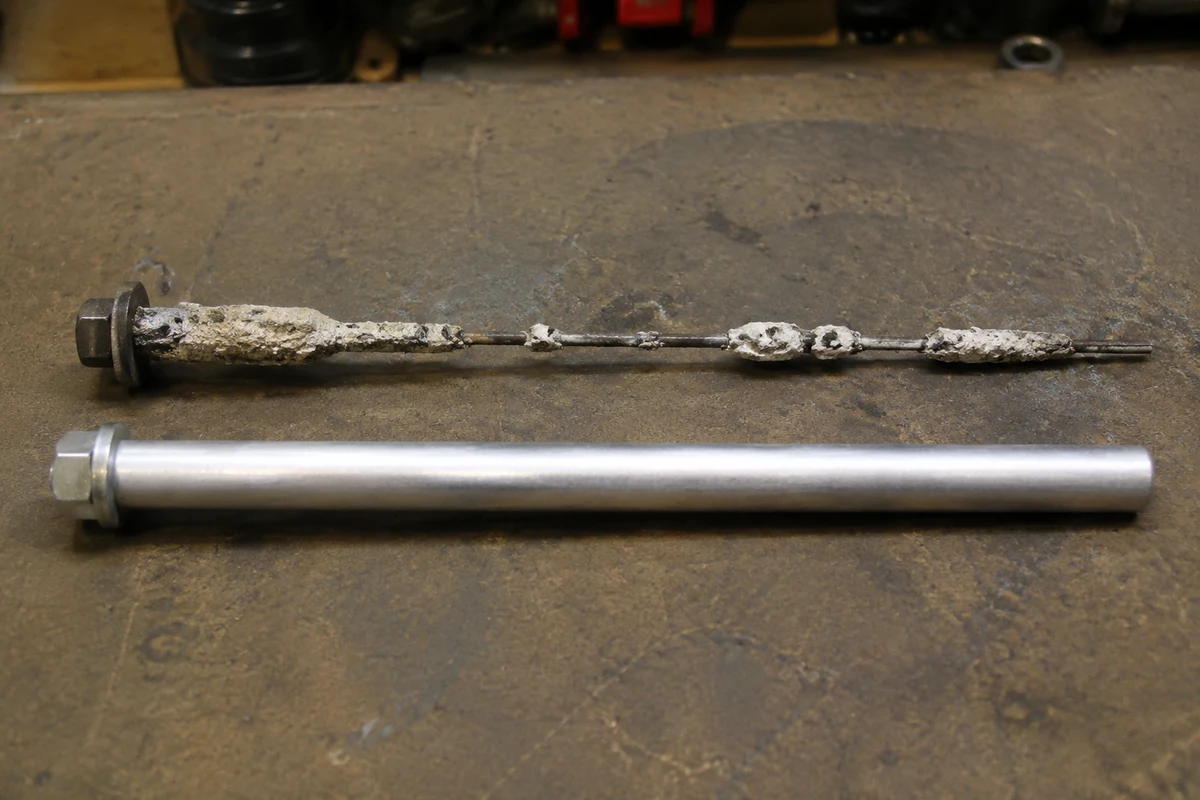
- Down to the core wire. A new rod is metal wrapped around a thin steel wire. If long stretches of that wire are exposed, the rod is done.
- Thinner than half an inch. A fresh rod is about 3/4″ across. Under 1/2″ means most of it is already gone.
- Rusty or smelly hot water. Rotten-egg odor or rust color at the hot tap often means the rod is exhausted and the tank is starting to react.
- Heavy crust or flaking. A rod caked in scale or crumbling apart is no longer passing current to the steel.
On softened water, check at year two, not year five. A water softener makes the water far more conductive and can burn a magnesium rod down in as little as six months.
Tools, and the torque nobody warns you about
The job is short but the first hex nut can fight you. That rod was torqued at the factory and then bonded by years of heat and mineral. Do not be surprised if a breaker bar isn’t enough and you reach for an impact wrench.
Tools & supplies
- 1-1/16″ socket (6-point grips better than 12-point)
- Breaker bar, and an impact wrench in reserve for a seized nut
- New anode rod - matched to your water (see the selector below)
- PTFE (Teflon) thread tape
- Garden hose, bucket, gloves
- Segmented or flexible rod if you have low ceiling clearance
Time & difficulty
- Active work: 20–30 minutes
- Check clearance: a standard rod is ~44″ and comes out straight up
- Difficulty: intermediate, mostly a matter of breaking the nut loose
- Interval: every 3–5 years, every 2 on softened water
- Know where your main water shutoff is first
Low headroom is the one thing that stops people cold. A one-piece rod needs about four feet of clearance above the tank to slide out. If your heater sits under a low ceiling or in a closet, buy a segmented rod - it is a series of short links joined by chain or a flexible spine, so it feeds in and out in a foot of space.
Replacing the rod, step by step
Cut the power or gas
Flip the water heater’s breaker to OFF on an electric unit, or set the gas valve to Pilot or Off. Never energize an electric element in a tank you are about to drain.
Shut the cold inlet
Close the cold-water supply valve on top of the heater so the tank stops refilling.
Drain a few gallons
Open a hot faucet in the house to break the vacuum, hook a hose to the drain valve, and let out two or three gallons. You only need the water level below the top of the tank, not a full drain.
Find the hex head
The anode threads into the top of the tank. It may be exposed, hidden under a plastic cap, or built into the hot-water outlet nipple. Look for a 1-1/16″ hex.
Break the nut loose
Fit the 1-1/16″ socket and breaker bar and turn counterclockwise. Brace the tank so you don’t twist the water lines. If it will not budge, switch to an impact wrench - the hammering action frees a seized rod without the huge steady force that can rock the tank.
Pull the old rod out
Lift it straight up. In tight quarters, bend a flexible rod as it clears, or unlink a segmented one. Set the old rod aside and note how little is left of it.
Tape and install the new rod
Wrap the new rod’s threads three or four turns of PTFE tape, feed it into the port, and thread it in by hand first to avoid cross-threading. Snug it firmly with the socket. It should be tight, not gorilla-tight.
Refill, purge air, then restore heat
Close the drain, reopen the cold supply, and leave that hot tap running. When it flows in a steady stream with no spitting, the tank is full and the air is out. Only now flip the breaker back on or relight the gas. Restoring heat to a dry element burns it out in seconds.
When the rod won’t budge
A seized anode is the most common wall people hit, and forcing it can spin the whole tank and crack a fitting. Work through this before you give up:
- Reach for an impact wrench. Its hammer blows shock the threads loose with almost no reaction force on the tank. This alone solves most stuck rods.
- Brace the tank. Have a helper hold it, or wedge it against a wall, so your force goes into the nut and not into the plumbing.
- Add leverage carefully. A cheater pipe on the breaker bar works, but only with the tank braced - otherwise you rock the connections.
- Warm the port. A little heat from a hair dryer on the fitting can break a mineral bond. Skip open flame near a gas unit.
- Know when to stop. If the rod is frozen solid and the tank is already near end of life, leaving the old rod and adding a hot-outlet anode is a fair fallback.
Which anode for your water
The wrong rod for your water either wears out in months or does nothing about the smell you were trying to fix. There is no universal best - it comes down to your water chemistry. Magnesium gives the strongest protection but dies fast in soft or softened water. Aluminum-zinc trades a little protection for durability in hard water and, thanks to the zinc, fights the rotten-egg odor. A powered rod uses a small transformer to push protective current with no metal to consume, which is the only real answer for softened water. Pick your condition:
Anode rod selector
Choose the water you have. The panel names the rod that fits it and why.
Why softened water changes everything
If you run a water softener, the calculus flips. Softeners swap hardness minerals for sodium, and that raises the water’s conductivity, which speeds every galvanic reaction in the tank. A magnesium rod that would last five years on city water can be gone in six to twelve months on softened water, and while it dissolves it often feeds the bacteria that make hydrogen sulfide - the rotten-egg smell. The fix is a powered anode. It drives a fixed protective current from a plug-in transformer with a titanium electrode that never wears down, so you install it once and stop thinking about it. It costs more up front, roughly $150 and up, but on softened water it pays for itself against a rod you would otherwise replace every year.
Does the smelly-water trick really work?
Sometimes swapping a magnesium rod for aluminum-zinc clears a rotten-egg smell within a day, and sometimes it barely helps. The odor comes from sulfate-reducing bacteria reacting with hydrogen the anode releases. The zinc in an aluminum-zinc rod suppresses that reaction for many homes. If the smell persists after the swap, the bacteria are established in the tank, and the durable answer is a powered rod plus a one-time chlorine shock of the tank. Do not just yank the anode out to kill the smell - a tank with no anode rusts through in a couple of years.
Frequently asked
How often should I replace the anode rod?
Every 3 to 5 years for most homes, but pull it and look rather than trusting the calendar. On softened water check at year two, because the higher conductivity can consume a magnesium rod in six to twelve months. Replace it once it is down to the bare core wire or thinner than half an inch.
What size socket fits a water heater anode rod?
A 1-1/16 inch socket fits almost all US residential anode rods. Use a 6-point socket rather than a 12-point, because the 6-point grips the hex flats better and is less likely to round off the head on a stuck rod.
What if the anode rod is stuck and will not turn?
Use an impact wrench. Its hammering action breaks the seized threads loose with very little steady force, so the tank does not twist and stress the water lines. Brace the tank against a wall or have a helper hold it, and only add a cheater pipe once it is braced.
Which anode rod is best for hard water?
Aluminum-zinc. Aluminum stands up to the faster wear that hard water causes, and the zinc in the alloy also suppresses the sulfur odor that hard well water often carries. Magnesium protects better but wears out too quickly in hard or softened water.
Do I need a special rod if my ceiling is low?
Yes, use a segmented or flexible rod. A one-piece rod is about 44 inches long and needs roughly four feet of clearance above the tank to slide out. A segmented rod is short links joined by chain or a bendable spine, so it feeds in and out in about a foot of space.
Can I just remove the anode rod to stop rotten-egg smell?
No. The rod is the only thing protecting the steel tank from rust, so a tank with no anode can corrode through in as little as two years. To fight the smell, switch to an aluminum-zinc rod or a powered rod and chlorine-shock the tank instead of removing protection.