A homeowner puts a new heat pump water heater in the basement, and a week later they are standing at the top of the stairs wondering why the thing sounds like an air conditioner running in the middle of the night. It does, and that is the point. The compressor and fan on top of the tank push air across a coil the same way a window AC does, so a steady hum in the 45 to 55 dBA range is exactly how a healthy unit behaves. The trouble is telling that normal hum apart from a rattle or a grind that actually means something.
Key takeaways
- A running heat pump water heater sits around 45-55 dBA, about as loud as a dishwasher or a window AC.
- That constant hum is normal while the heat pump is actively running.
- A rattle or a buzz usually means a loose panel or debris caught in the fan, not a failing compressor.
- Where you put it matters more than which model you buy for whether the sound bothers anyone.
What normal sounds like, in numbers
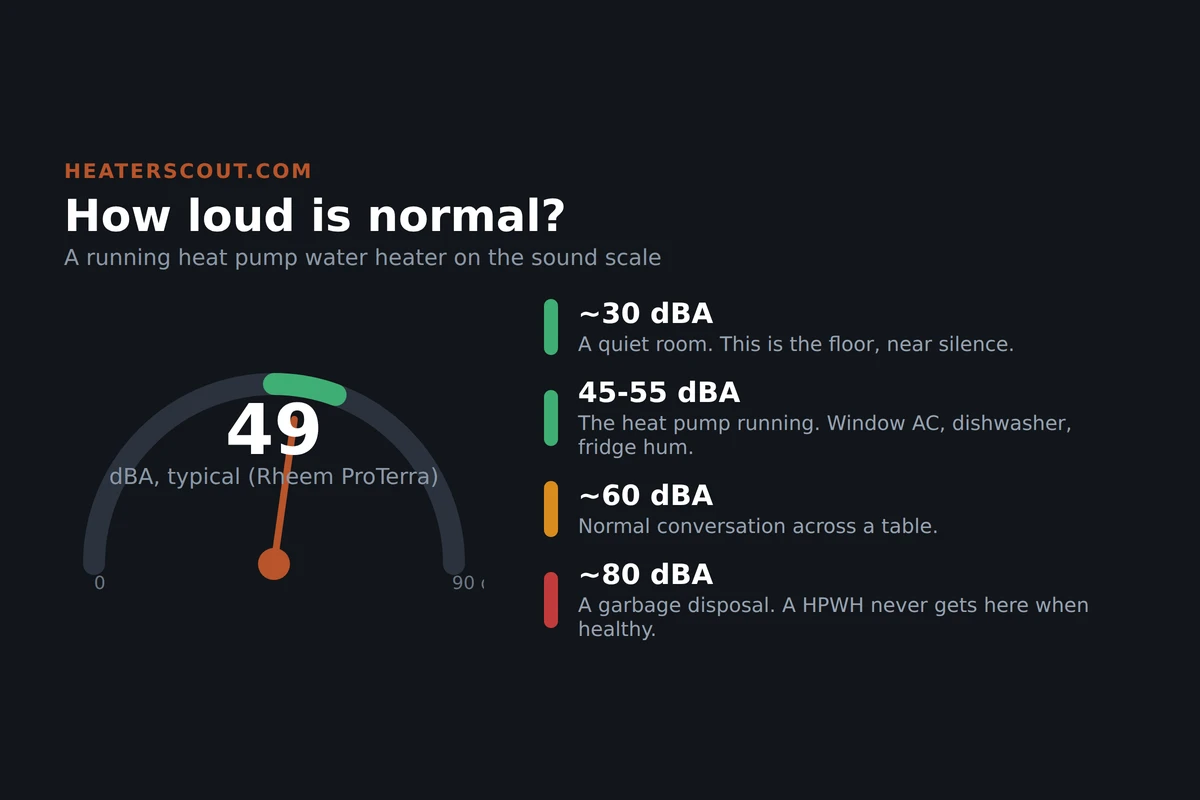
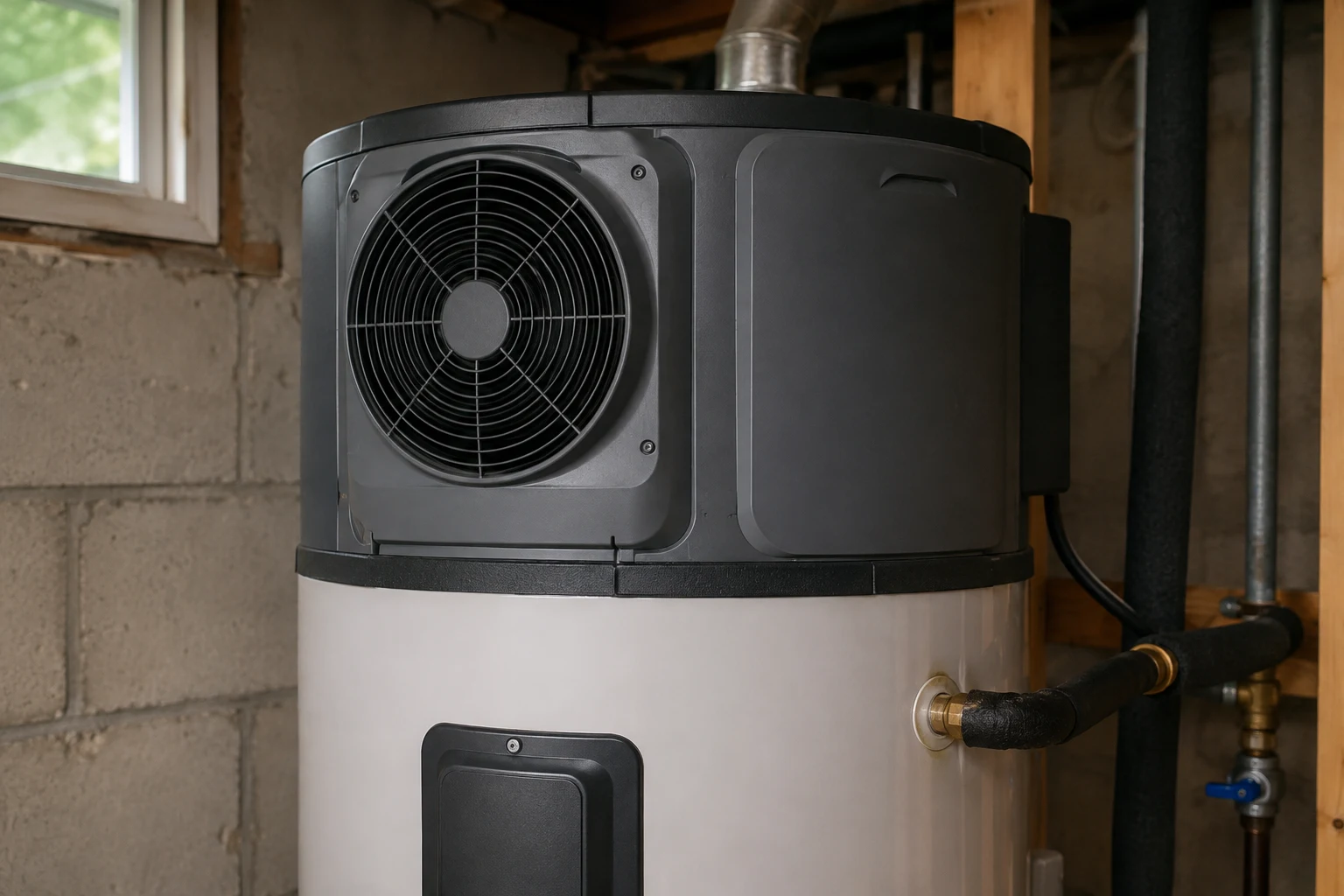
The sound comes from two parts working together on top of the tank: a small refrigeration compressor and a fan pulling room air across the evaporator coil. Together they land around 45 to 55 dBA. Rheem rates its ProTerra at about 49 dBA, which is a fair benchmark for the category. That is the same neighborhood as a window air conditioner, a running dishwasher, or the low hum of a refrigerator compressor. It is not silent, and it is not supposed to be.
Numbers on their own are hard to feel, so anchor them. A quiet room reads about 30 dBA. Normal conversation across a table is roughly 60 dBA. A garbage disposal is around 80 dBA. The dBA scale is logarithmic, so 60 is not twice 30; it is a lot louder. A heat pump water heater lives in the gap between a quiet room and a conversation, closer to background than to foreground. In an open basement most people stop noticing it within a day.
When it runs, and when it does not
The hum is constant only while the heat pump is actually pumping heat, which is most of the time in the default hybrid mode. Two mode details change what you hear. In heat-pump-only mode the unit runs longer to keep up, but it never fires the loud resistance elements, so the sound is a steady low hum you can predict. In high-demand or electric mode the resistance elements do the heavy lifting, and those elements are completely silent. The catch is that the fan may still spin in that mode, so switching to electric does not always buy you silence.
Knowing this helps you diagnose complaints. If someone says the heater is loud at 2 a.m., check whether it is in heat-pump-only mode and simply running a long recovery cycle. That is normal. If it is loud in bursts with a mechanical edge to the sound, that is a different problem, and the next section is where you look.
Is it normal for the unit to run and make noise at night?
Yes. In heat-pump-only mode the unit runs longer to keep up with demand, but it does so at a steady, quieter low hum instead of firing the loud resistance elements. Hearing it recover overnight is normal, not a fault.
Noises that mean something is wrong
A steady hum is fine. A rattle, a buzz, a gurgle, or a grind is not, and each points at a different cause. A rattle or a metallic buzz almost always traces back to something loose: a top panel that was not fully seated, screws that backed out with vibration, or a fan blade catching lint and debris and slapping against it. These are the most common and the easiest to fix. A gurgle usually is not a fault at all; it is either condensate draining out of the unit or refrigerant moving through the coil, both of which are normal, though a persistent loud gurgle is worth a look at the drain line.
A loud hum that seems to come up through the floor is a vibration problem, not a compressor problem. The unit is transmitting its normal running vibration into the structure, and the structure is acting like a soundboard. That is a placement and isolation issue. The one noise you never ignore is grinding. A grind, a screech, or a rising whine points at a failing fan bearing or, worse, a failing compressor bearing. That is the sound of a part on its way out, and it warrants a service call before it seizes.
How to make one quieter
Start with vibration, because that is the cheapest and most common win. Set the unit on an anti-vibration pad or rubber isolation feet so its running buzz stops feeding into the floor. If the tank sits on bare concrete against a framed wall, that wall can carry sound into the room above; a pad breaks the path. Next, tighten the jacket. Go around the top section and snug up the panel screws, since a loose panel is the usual source of a rattle that appears a few weeks after install.
Then clear the airflow. Rinse the air filter over the evaporator coil and clean lint off the fan intake, because a starved fan works harder and louder, and a blade fouled with debris rattles. Leave the clearance the manufacturer asks for around the unit; crowding it against boxes or a wall restricts airflow, which both hurts efficiency and raises the noise. If you want to go further, a sound blanket wrapped around the tank body can knock down a few decibels, but there is a hard rule with it.
Never wrap the air intake or exhaust
A sound blanket may go around the tank body only. Do not cover, wrap, or restrict the fan intake or the exhaust on top of the unit. Starving that airflow wrecks efficiency and can overheat the unit, forcing it onto its resistance elements. Quieter is not worth a dead heat pump.
Placement is the real fix
The best noise control happens before the unit is bolted down. A heat pump water heater belongs in a basement, a garage, or an open utility room, spaces where a 49 dBA hum simply disappears into the background and where there is plenty of air for it to breathe. It does not belong in a hallway closet that shares a wall with a bedroom. In that spot the same normal hum that nobody would notice in a basement becomes the thing that keeps someone awake, because the sound has nowhere to dissipate and a bedroom wall right there to travel through.
If a closet is your only option, keep the unit off any wall shared with a room where people sleep, give it the required air volume or a louvered door and ducting so it does not starve, and lean harder on the isolation pad. The physics does not change: the unit makes the same sound everywhere. What changes is whether that sound has room to fade before it reaches an ear.
Frequently asked
How loud is a heat pump water heater?
A running heat pump water heater sits around 45 to 55 dBA, with many models like the Rheem ProTerra rated near 49 dBA. That is about the same as a window air conditioner, a dishwasher, or a refrigerator hum. For reference, a quiet room is about 30 dBA and normal conversation is about 60 dBA, so the heater lives in the gap between the two, closer to background noise than to something you actively hear.
Is it normal for a heat pump water heater to be noisy?
A steady hum is completely normal. The compressor and fan on top of the tank move air across a coil the same way a window AC does, so a constant low hum while the heat pump runs is expected. What is not normal is a rattle, a buzz, a grinding sound, or a hum loud enough to come up through the floor. Those point at a loose part, restricted airflow, a bearing on its way out, or a vibration problem, not routine operation.
Why does my heat pump water heater rattle or buzz?
A rattle or metallic buzz usually means something is loose. The most common causes are a top panel that was not fully seated, screws that backed out under vibration, or a fan blade catching lint and debris. Snug up the panel screws around the top section and clean lint off the fan intake and air filter. If the buzz turns into a grind or a screech, stop troubleshooting the panels and have the fan or compressor bearing checked, because that is a failing part.
Why does my heat pump water heater gurgle?
A gurgle is usually not a fault. It is typically condensate draining out of the unit, since the heat pump pulls moisture from the air, or the sound of refrigerant moving through the coil. Both are normal. If the gurgle is loud and persistent, check that the condensate drain line is clear and running freely, because a backed-up drain can make more noise and eventually leak.
How do I make my heat pump water heater quieter?
Set it on an anti-vibration pad or rubber feet so its hum stops transmitting into the floor, tighten the panel screws on the top section, clean the air filter and fan intake so the fan is not straining, and leave the clearance the manufacturer specifies so airflow is not restricted. A sound blanket around the tank body can shave off a few decibels, but never let it cover the fan intake or exhaust. The biggest single fix is placement: a basement or garage instead of a closet by a bedroom.
Where should I put a heat pump water heater so the noise doesn't bother anyone?
A basement, garage, or open utility room is ideal, because a 49 dBA hum fades into the background there and the unit has plenty of air to breathe. Avoid a hallway closet that shares a wall with a bedroom, where the same normal hum has nowhere to dissipate and a wall right there to travel through. If a closet is unavoidable, keep the unit off any shared bedroom wall, give it enough air or a louvered door, and use an isolation pad.
Is a heat pump water heater quieter in electric mode?
Not necessarily. In high-demand or electric mode the resistance elements do the heating, and those elements are silent, but the fan may still run, so you can still hear it. Heat-pump-only mode actually runs a steady, predictable low hum and never fires the loud elements, so for many people that mode is the more pleasant sound even though the unit runs longer. Switching to electric does not guarantee silence.