A heat-pump water heater does not care about the calendar. It cares about the thermometer on the wall next to it. Drop that reading below the high 30s and the compressor on top of the tank simply stops trying, because there is no longer enough warmth in the room air to pull out. What you are left with is an expensive tank running on its backup resistance elements, doing the same job a $500 electric heater would do, only slower to recover. So the real question about a cold garage is not whether the unit fits. It is whether the air around it stays warm enough to let the part you paid for actually run.
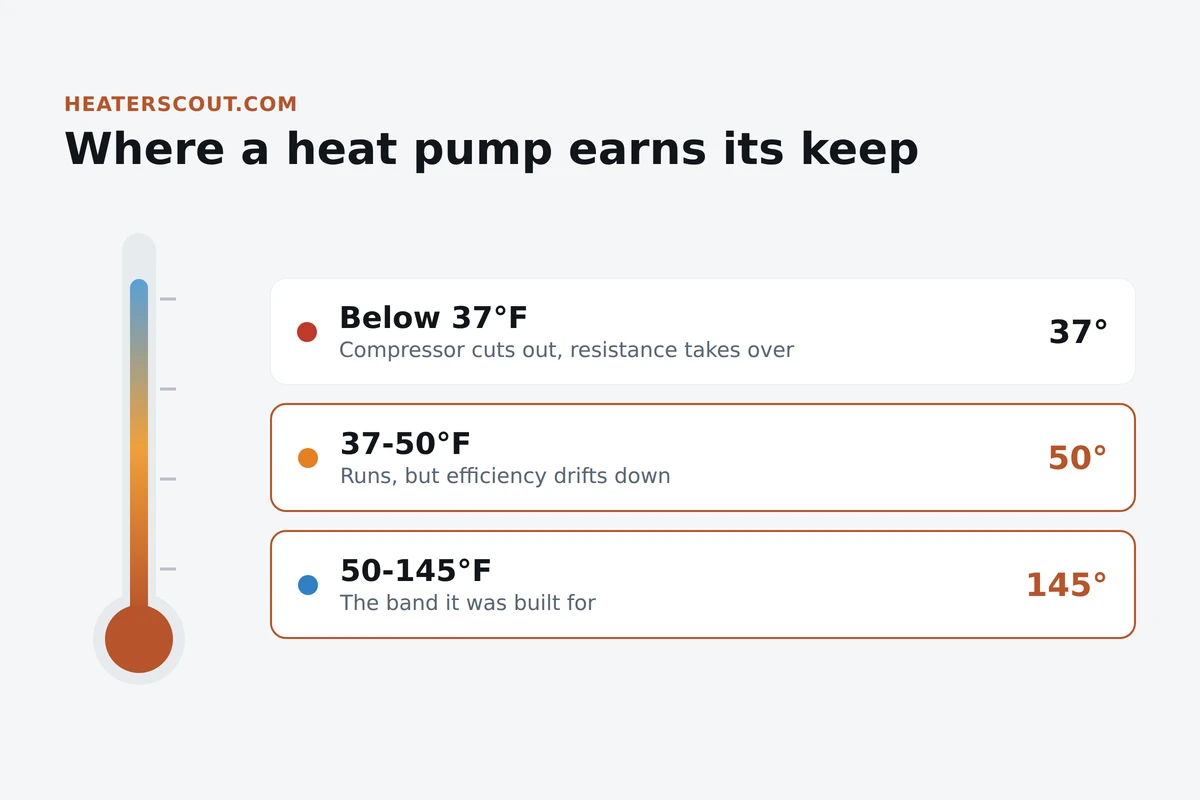
A freezing garage quietly turns an efficient heat pump into a plain resistance heater you overpaid for.
Ambient operating range
The band of surrounding air temperature within which the heat pump will actually run its compressor instead of falling back to resistance elements. Below the low end of that band the controller shuts the compressor down; above it, the unit does the efficient work you paid for.
Why ambient temperature is the whole story
Every heat-pump water heater works by moving heat, not making it. The fan pulls room air across an evaporator coil, a refrigerant grabs the warmth in that air, the compressor concentrates it, and it gets dumped into the water. That is why one of these can deliver a UEF of 3.5 or better, roughly three and a half units of heat per unit of electricity, while a resistance tank sits near 0.92. But the trick only works while there is heat in the air to harvest. Colder air holds less of it, so as the room temperature falls, the pump has to work harder for less return, and below a hard cutoff it cannot work at all.
Manufacturers publish that band. A Rheem ProTerra is rated to run its heat pump from about 37 to 145°F. Some other models are narrower, around 40 to 120. Read your own spec sheet, because the low number is the one that decides whether a garage in January is a good home or a bad one. Above the cutoff the unit runs; below it, the controller shuts the compressor down to protect it and lights the resistance elements instead. And even inside the band, efficiency is not flat. A tank breathing 45-degree air is noticeably less efficient than the same tank breathing 68-degree air, because there is simply less heat per cubic foot to pull.
| Garage air temp | What the unit does |
|---|---|
| Below ~37°F | Compressor off. Runs on resistance elements, or makes no heat at all in heat-pump-only mode |
| ~37 to 50°F | Heat pump runs, but efficiency drops and recovery slows |
| ~50 to 90°F | Ideal band, full efficiency, the range it was designed for |
| Very hot and humid | Runs great, and the cool dry exhaust also cools and dehumidifies the space |
The air it exhales is the catch nobody mentions
Here is the part that surprises people the first winter. The unit does not just need warm air, it actively makes the room colder. Everything that comes out of the exhaust is air with its heat removed, so it blows a steady stream of cool, dry air back into the space. In a hot, humid garage in July that is a genuine perk. You get free dehumidification and a slightly cooler corner. In an unheated garage in January it is the opposite problem. The pump is chilling a space that is already too cold, and it can pull the local air temperature around itself down toward its own cutoff, which makes the efficiency slide worse than the outdoor reading alone would suggest.
There is also an air-volume requirement that trips up closet installs but not garages. A heat-pump water heater needs roughly 750 to 1000 cubic feet of air to draw from, or ducting to a larger space. A one-car garage clears that easily. A small mechanical closet does not, and starving the intake forces the same fallback to resistance you get from cold, only for a different reason.
Making a cold spot actually work
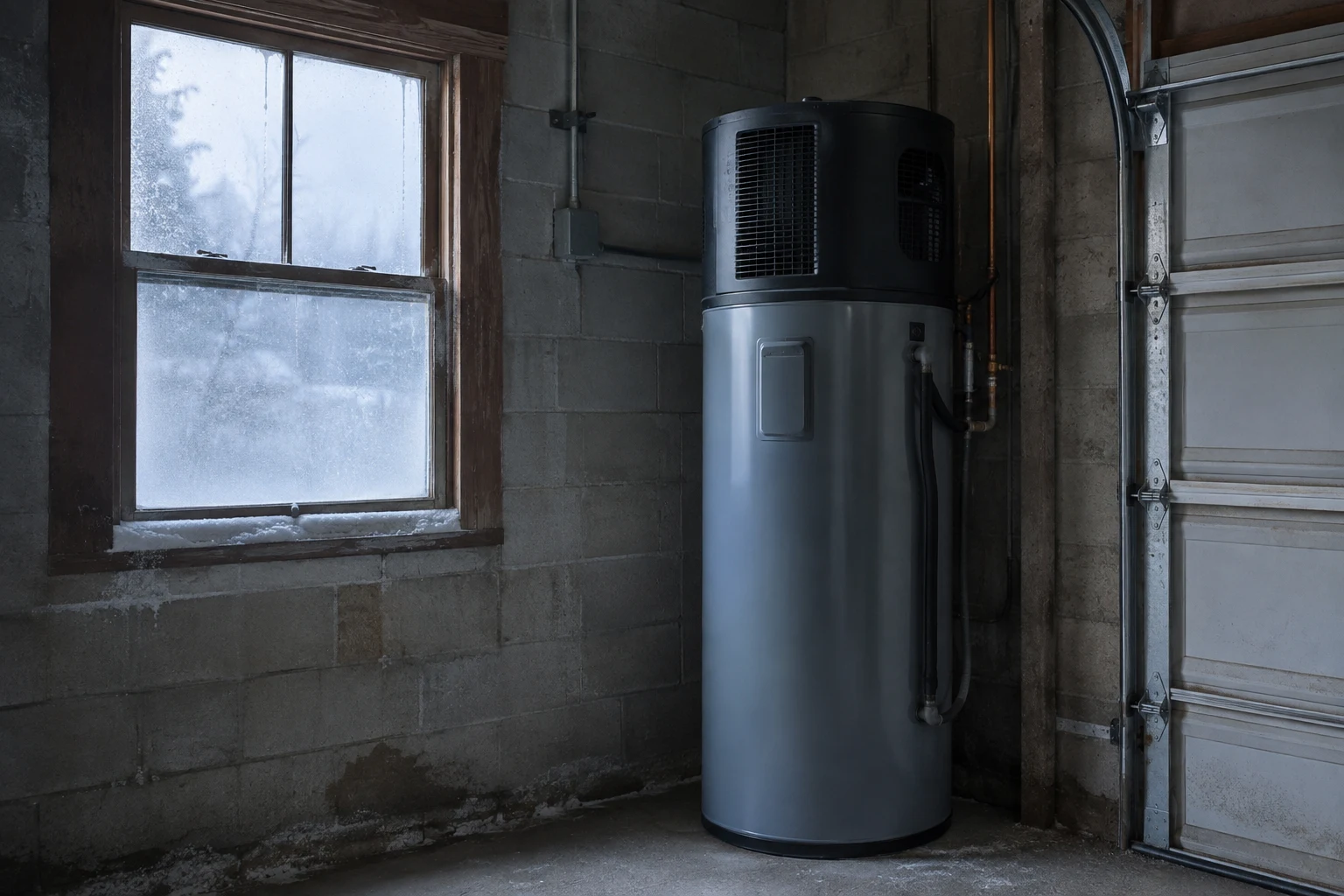
None of this rules out a garage or basement. It just means you plan around the low number instead of ignoring it. The cleanest fix is to keep the space above about 50°F, which keeps you out of the efficiency-loss zone entirely. An attached garage sharing a wall with the conditioned house often sits warmer than the outdoor air already, especially if it is insulated. A basement below grade is even more forgiving, because the earth holds it in the 50s and 60s most of the year even where winters are brutal.
The setting matters as much as the space. Do not run heat-pump-only mode through a cold winter. In that mode there is no backup, so once the compressor cuts out on a cold morning you get no hot water at all until the room warms. Leave it in Hybrid mode instead, which lets the resistance elements carry the load when the pump cannot, and hands back to the pump when the air recovers. You lose efficiency during the cold stretch, but you never lose hot water. Some models also accept a duct kit that pulls intake air from a warmer part of the house and exhausts the cold air outdoors, which sidesteps both the room-cooling problem and the low-ambient problem at once.
The freeze line is separate from the efficiency line
Efficiency starts sliding in the 40s, but the real danger is a tank sitting in a garage that drops below 32°F while the unit is off or unpowered. Standing water in the tank and connected lines can freeze and split a pipe or fitting. If the space can hit freezing, keep the unit powered so it can protect itself, and treat freeze protection as its own task rather than assuming the heat pump handles it.
So, can you put one in a cold garage?
Yes, with eyes open. If your garage or basement stays above 50°F for most of the year, a heat-pump water heater is a strong choice and you will barely notice the cold-weather dip. If it swings into the 40s and 30s for weeks at a time, you can still run one, but expect it to lean on the resistance elements during those weeks, expect the efficiency you bought to shrink while the air is coldest, and expect it to make that cold corner a little colder. Set it to Hybrid, keep it powered, and if the space ever flirts with freezing, deal with that as its own problem. Get those right and the unit spends most of the year doing exactly what it was built to do, and only a few weeks a year working like a plain electric tank.
Frequently asked
Can I install a heat-pump water heater in an unheated garage?
You can, as long as the air stays inside the compressor's operating band, which is roughly 37 to 145 degrees Fahrenheit on most models. An attached, insulated garage usually rides warm enough. A detached, uninsulated garage that spends weeks below the high 30s in winter will force the unit onto its backup resistance elements during the cold, so you lose the efficiency for that stretch. It still works, it just runs like a plain electric tank until the air warms back up.
What temperature does a heat-pump water heater need to work?
The compressor needs ambient air above its low cutoff, commonly around 37 degrees on a Rheem ProTerra and about 40 on some other models. Below that the controller shuts the pump down to protect it. Efficiency is also not flat inside the band. The unit is most efficient breathing air in the 50s and up, and it drifts down as the room gets colder even before it hits the cutoff. Aim to keep the space above about 50 degrees to keep full efficiency.
What happens when the garage gets too cold?
Below the compressor's low limit the heat pump stops and the unit switches to its resistance elements, the same way a standard electric tank makes heat. In Hybrid mode you still get hot water, just at ordinary electric efficiency and slower recovery. In heat-pump-only mode there is no backup, so a cold snap can leave you with no hot water until the air warms. That is why you should not run heat-pump-only mode through a cold winter.
Does a heat-pump water heater make the garage colder?
Yes. It works by pulling heat out of the surrounding air, so the air it blows back out is cooler and drier than what it took in. In a hot, humid garage in summer that is a benefit, a bit of free cooling and dehumidification. In a cold garage in winter it works against you, chilling a space that is already cold and dragging the local air temperature down toward the compressor's cutoff.
How much air space does a heat-pump water heater need?
About 750 to 1000 cubic feet of air to draw from, or ducting to a larger space. A typical one-car garage clears that with room to spare. A small mechanical closet does not, and a starved intake forces the unit onto its resistance elements the same way cold air does. If the only spot is a tight closet, you need a duct kit or a louvered door to feed it enough air.
Will the tank freeze in a cold garage?
The tank can freeze and split if the garage drops below 32 degrees while the unit is off or unpowered, since there is standing water inside it and in the connected lines. The heat pump running does not guarantee protection, especially if it is in heat-pump-only mode and the compressor has cut out. If the space can reach freezing, keep the unit powered and treat freeze protection as its own job rather than assuming the water heater handles it on its own.
Is a basement or a garage better for a heat-pump water heater?
A below-grade basement is usually the better home. The surrounding earth holds it in the 50s and 60s through most of the year even in cold climates, which keeps the compressor in its efficient range and reduces the freeze risk. A garage can work well when it is attached and insulated, but a detached, uninsulated garage swings with the outdoor temperature and will push the unit onto resistance heat in winter.