A Rheem ProTerra that suddenly costs more to run, with a compressor that never kicks on, is almost always telling you something on its display. Hybrid heat-pump water heaters report faults as alphanumeric codes, and the first character does most of the work: an A is an alarm that has already cut your heat pump, an element, or the whole heater, while a T is a transient alert you can usually shrug off. The trap is that many of these codes quietly fall back to the electric resistance elements, so the tank keeps making hot water and hides the real problem behind a bigger power bill. This page maps the codes on the ProTerra and Performance Platinum hybrids, straight from the Rheem manual, and shows which ones you can clear yourself and which ones mean the sealed system is done.
A codes versus T codes: read the letter first
Every fault on a Rheem hybrid carries a letter and a number, and the letter is the triage. An A code is an alarm. The control board found a condition it refuses to run through, so it does one of three things: it drops the compressor and falls back to the electric elements, it disables one heat source, or on the serious codes it shuts the whole heater down and beeps at you. A T code is a transient alert, a notice that the heater is still running but wants attention, like a filter that needs washing or a demand it cannot quite satisfy. So when you walk up to the panel, note the letter before the number. An A means you have lost heating capacity and need to act. A T means keep an eye on it. The numbers group by subsystem: the low hundreds are sensors, the 125 to 129 band is elements and relays, the 900s are the control board, and the single-digit and low codes are the compressor.
| A004 / A005 / A006 | Compressor shutdown (discharge-suction trip, discharge temp high, suction temp low). Runs on elements. |
| A008 | Dry fire detected. Not enough water in the tank. Heater disabled until filled and purged. |
| A009 | Compressor wiring may be faulty. Runs on elements. |
| A101 / A105 / A106 | Suction, evaporator, or discharge temp sensor failure. Runs on elements. |
| A102 | Ambient temp sensor failure. Runs on elements. Often an unplugged sensor on new installs. |
| A103 / A104 | Lower / upper tank temp sensor failure. Heater disabled. |
| A107 | Water detected in the drain pan. Check for leaks. LeakGuard may close the water valve. |
| A108 | Condensate drain blocked. Runs on elements. Unclog the line. |
| A125 / A126 | Lower / upper element error or relay stuck closed. Heater disabled. |
| A127 / A128 / A129 | Element wire routing or relay-close failure. Heater disabled. Wiring or board. |
| A130 | Air temp freezing, unit off. Freeze warning. Re-enable the unit. |
| A200 | High water temp, ECO tripped. Heater disabled. Call tech service. |
| A900-A906 | Controller / power-board fault. Replace the control board. |
| T131 / T132 | Alert only. Clean the air filter / heater struggling to meet demand. |
One naming warning, because it bites people online. Rheem uses an overlapping A100-number scheme on its standard electric tank heaters where A102 means water in the pan and A100 means a lower sensor. On the hybrid, those meanings are different: A102 is the ambient sensor and A107 is the leak code. If you search a bare code number and land on an electric-tank chart, the definition can be wrong for your unit. Match against a hybrid manual, or the table above, and confirm the exact display text.
The letter is the triage. An A alarm has already cut a heat source. A T alert is a notice you can keep running through.Rheem hybrid alarm-code convention
Why so many codes quietly leave you on electric heat
Notice how many rows in that table end with runs on elements. That is the hybrid's fail-safe, and it is the reason so many owners do not realize anything is wrong for weeks. When the board loses the compressor or one of the heat-pump sensors, it does not leave you cold. It defaults to the two resistance elements, the same heating method a plain electric tank uses, and keeps making hot water. The tell is the electric bill, because the heat pump is roughly two to three times more efficient than the elements, so losing it can double the running cost of the heater without any obvious symptom. That is why checking the display matters even when you still have hot water. A silent A005 or A101 can burn money for a month before anyone notices the compressor is idle.
Quick answer
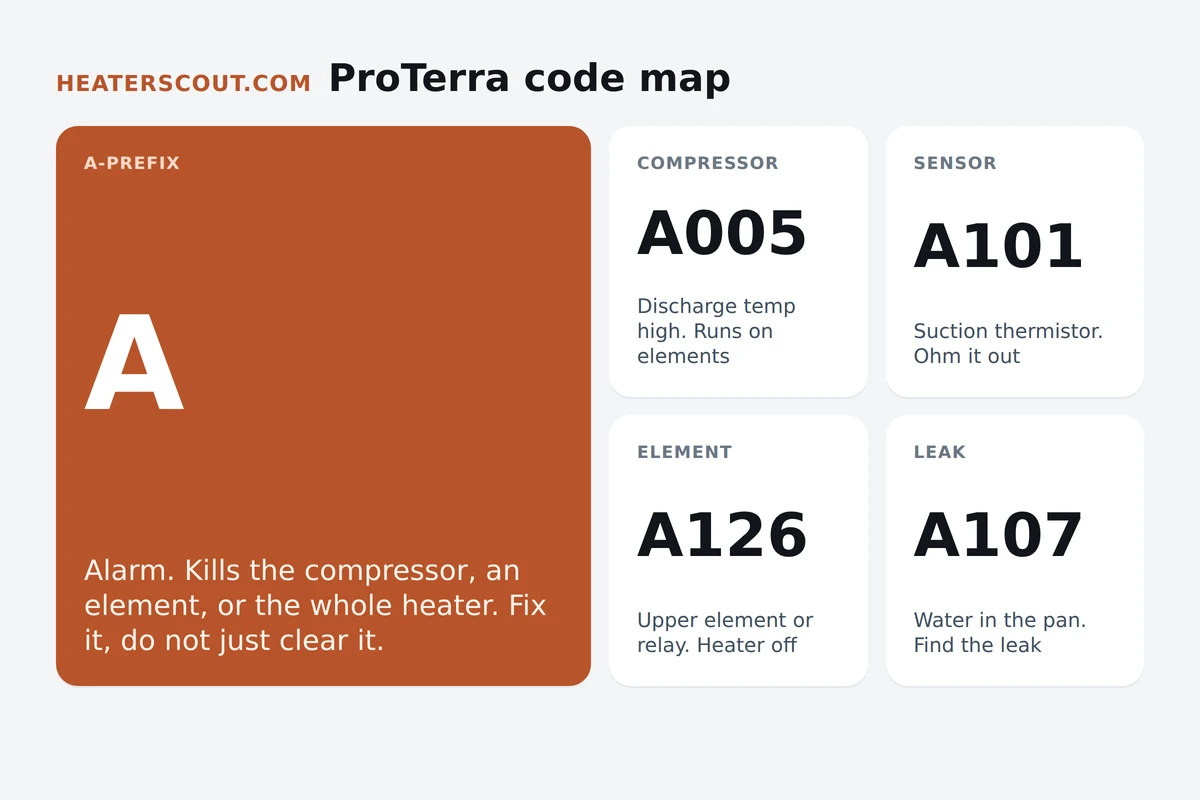
On a Rheem ProTerra or Performance Platinum hybrid, an A code is an alarm (it cut the compressor, an element, or the whole heater) and a T code is an alert (a notice, not a shutdown). Clear any code from Service → Current Alarms → Clear Alarm, or by cutting power at the breaker for two minutes. But clearing is not fixing: a real fault returns. Compressor and sensor codes (A004-A009, A101-A108) drop you to electric elements, so the tank still runs hot while the heat pump is down. Sealed-system faults like a bad compressor are not field-serviceable and fall under the 10-year warranty. Filter, condensate, and unplugged-sensor codes you fix yourself.
Working a code, step by step
The order matters. Read and record before you clear, and rule out the free causes before you buy a part. Here is the sequence a tech follows on a hybrid, adapted for a homeowner who wants to do the safe parts and know when to stop.
Read the code off the display, do not clear it yet
Press Next until Current Alarm shows, then the Down arrow to scroll every active alarm. Write down the full code with its letter, A102 not just 102, because a power cycle wipes the display and you lose it. If you have the EcoNet app, the alarm and its history are there too, and the app will flag when a code warrants a service call.
Split A from T and check whether you still have heat
A T code (T131 filter, T132 demand) is maintenance, handle it on your schedule. An A code means a heat source is down. Feel whether you still have hot water: most compressor and sensor A codes keep the elements running, but A008, A103, A104, A125, A126, and A200 disable the heater entirely and need prompt attention.
Do the free checks first: filter, condensate, connectors
A huge share of hybrid codes are airflow and maintenance. Set the unit to Electric or Off, pull the air filter, and wash it with mild detergent (T131, and a dirty filter contributes to A005). Check the condensate line for a clog (A108). On A102 and other sensor codes, open the top and confirm the thermistor connectors are seated on the board, which fixes a lot of new-install faults.
For a sensor code, ohm the thermistor against the chart
A101, A102, A103, A104, A105, A106 are thermistor faults. On the Service screen under Sensors, a reading of -40 F means the circuit is open and about +250 F means it is shorted. To confirm, power down, unplug the thermistor, and measure its resistance against Rheem's ohm chart. A reading off the chart means replace that sensor, a cheap part.
For an element code, kill power and ohm the elements
A125, A126, A127, A128, A129 are element and relay faults, and the heater is disabled, so shut off the breaker first. Check the resistance across each element against the included ohm chart. A good element reads a low resistance; an open one reads infinite. If the element ohms out fine but the code stays, the relay on the control board is the suspect and the board gets replaced.
For a compressor or refrigerant code, stop and check warranty
A004, A005, A006, A009 point at the sealed system. Confirm the fan spins when the compressor should run and look for oily residue that signals a refrigerant leak. Beyond that, stop. Rheem states plainly that it does not service sealed-system parts, so a genuine compressor failure is a whole-unit warranty replacement, not a field repair. Run Electric mode as a bridge and open a warranty claim.
Clear the code only after you address the cause
Once you have fixed or ruled out the cause, clear the alarm from Service and watch one full heating cycle. If the code returns, the fault is unresolved. On A107, holding Clear Alarm for five seconds overrides the leak alarm for 24 hours, useful while you dry a pan, but never a permanent answer to a wet drain pan.
The sealed-system line: what you fix and what Rheem replaces
The single most important distinction on a heat-pump water heater is the sealed refrigerant system. The compressor, the evaporator and condenser coils, the refrigerant charge, and the metering device are a factory-sealed loop, and Rheem does not authorize field service on any of it. So the compressor codes in the A004 to A009 band, and a genuine A005 that survives a clean filter and a working fan, are not parts you replace at home. They are warranty events. The upside is real: ProTerra and Performance Platinum hybrids carry a 10-year limited warranty on the tank and the sealed system on most models, so a compressor that dies in year four is a covered swap where you pay a plumber's labor and Rheem provides the unit. Pull the model and serial off the rating label, register or confirm the install date, and let the warranty carry the sealed-system cost.
Everything outside that loop is fair game for a competent do-it-yourselfer. The air filter, the condensate drain, the leak rope sensor, the tank thermistors, the two resistance elements, and their wiring are all serviceable parts with published ohm values. The control board sits in between: you can diagnose your way to it by elimination, but it is the expensive electronic part, so confirm the cheaper causes before you buy one on the A900-series or a stuck-relay element code.
Ambient temperature, freeze warnings, and the mode workaround
The ProTerra's heat pump is rated to run from about 37 to 145 degrees ambient, one of the wider ranges in its class, but it does its best work in a space that stays between roughly 40 and 90 degrees. Below 37 the heat pump loses efficiency and the board leans on the elements, and if the surrounding air drops to freezing you can see A130, a freeze warning that turns the unit off to protect it. That is a location problem, not a broken heater: a hybrid in an unheated garage or a cold basement corner will throw freeze and low-ambient behavior every winter. The fix is placement and airflow, giving the unit the roughly 700 to 1,000 cubic feet of surrounding air it wants, or ducting it, not resetting the code.
This is where the energy modes double as a repair tool. Rheem builds five modes: Heat Pump, Energy Saver, High Demand, Electric, and Vacation. Energy Saver is the default and the one to live in. But when a compressor or heat-pump-sensor code has you diagnosing a fault, deliberately switching to Electric-Only mode does two useful things. It keeps you in hot water on the resistance elements, and it stops the board from repeatedly retrying a failed compressor while you wait on a part or a warranty visit. Rheem specifically sanctions Electric mode for compressor-service periods, so it is the intended bridge. Just do not forget you are on it. The heat pump is the whole reason you bought the unit, so once the fault is cleared and the compressor is proven, switch back to Energy Saver and let the efficiency come back. A code you clear and a cause you fix are two different jobs, and on a hybrid the second one is what gets your power bill back down.
Frequently asked
What do the A and T codes mean on my Rheem hybrid water heater?
Rheem splits its hybrid readouts into two families and the first letter tells you how serious it is. An A code is an Alarm: the control board found a condition it will not run through, so it either drops the heat pump and falls back to the electric elements, or it disables a heat source entirely, or on the worst codes it shuts the whole heater down. A005, A101, and A126 are all A codes. A T code is a transient Alert, a notice rather than a shutdown, like T131 (clean the air filter) or T132 (the heater is having trouble keeping up with demand). So read the letter first. An A code means you have lost some or all of your heating and need to act. A T code means the heater is still working but is nagging you about maintenance or sizing. The number after the letter is the specific fault, and the full map is in the table on this page.
Can I reset a Rheem ProTerra error code myself?
Yes, clearing the code is a two-minute job on the front panel, but clearing is not fixing. On the display press Next until you reach the Service menu, scroll to Current Alarms, and press the Clear Alarm button. On the leak code A107 you can press and hold Clear Alarm for five seconds to override it for 24 hours, which buys time to dry things out. You can also do a hard reset by cutting power at the breaker for a couple of minutes. Here is the catch: if the underlying condition is still there, the code comes right back. A dirty filter, an unplugged ambient sensor, or air in the tank clears and returns. A failed compressor or a cracked tank clears and returns. So clear the code once to confirm you actually fixed the cause, not as the repair itself. If it reappears within a heating cycle, the fault is real and you move on to diagnosing the part.
Why does my Rheem hybrid keep running on electric only?
Because a fault knocked the heat pump offline and the board defaulted to the resistance elements to keep you in hot water. That is by design and it is the single most common complaint people bring to a forum: the tank still makes hot water but the power bill jumps and the compressor never runs. The codes that do this are the compressor and heat-pump-sensor family: A004, A005, A006, A009 for the compressor itself, and A101, A102, A105, A106, A108 for the sensors and the condensate drain that feed it. Check the display for any active alarm. A102, an unplugged or failed ambient sensor, is a frequent one on newer installs and an easy fix. If the code points at the sealed refrigerant system, though, the elements are your stopgap until a warranty swap, because Rheem does not field-service the compressor.
How much does it cost to fix a Rheem heat pump water heater error?
It splits sharply by which part the code names. Cheap end: a clogged air filter or a blocked condensate line (A108, T131) is a free do-it-yourself clean. A tank thermistor or a leak rope sensor runs roughly 50 to 150 dollars in parts if you do it yourself, a few hundred with a plumber. A heating element on the A125 or A126 codes is a 20 to 50 dollar part plus labor. A control board on the A900-series controller faults is the pricey electronic repair, often 250 to 500 dollars installed. Expensive end: a compressor or a refrigerant leak. Rheem does not service the sealed system, so a genuine compressor failure means a whole-unit replacement. The saving grace is the warranty. ProTerra and Performance Platinum hybrids carry a 10-year warranty on the tank and the sealed system on most models, so a compressor fault inside that window is a covered swap and you pay labor, not for the unit.
Is a Rheem A107 leak code an emergency?
Treat it as one until you prove otherwise. A107 means the rope-style leak sensor in the drain pan got wet, and on LeakGuard models the unit can shut its own water supply valve to stop a flood. Sometimes it is a real tank or fitting leak, which is a replace-the-heater situation. Sometimes it is condensate that overflowed a blocked drain, or a nearby spill, or a sensor that stayed damp. So look before you clear: pull the top cover, check for standing water in the pan and any drip from fittings, and follow the condensate line. If it is dry and there is no obvious leak, unplug the rope sensor from the board, and if the code disappears the sensor was wet, so dry it with a hair dryer or replace it. If the code stays with the sensor unplugged, the board is the problem. You can hold Clear Alarm five seconds to override for 24 hours while you sort it out, but do not ignore a wet pan.
What does A005 or A007 mean on a Rheem ProTerra?
Both are compressor codes and both drop you to electric heat. A005 is Compressor Shutdown: Discharge Temperature High, meaning the refrigerant leaving the compressor got too hot and the board pulled the compressor to protect it. The usual causes, cheapest first: a dirty air filter starving airflow, a fan that has quit, or a low or leaking refrigerant charge. A007 on the field-service literature is a compressor feedback failure, the board commanding the compressor to run but not seeing it respond, which points at compressor wiring (close cousin to A009) or the compressor itself. Start with the free checks: wash the filter, confirm the fan spins when the compressor should be on, and look for oily residue that signals a refrigerant leak. If the fan and filter are fine and the compressor still will not run or reports high discharge temps, you are into sealed-system territory and that is a warranty call.
Will running my Rheem in Electric mode hurt anything?
No, it is a sanctioned mode, not a workaround that stresses the heater. Rheem builds Electric-Only mode in specifically for two situations: ambient air below about 37 degrees where the heat pump loses efficiency, and any time the heat pump is down for service. It heats with the resistance elements alone, recovers fast, and costs the most to run. So when a compressor or heat-pump-sensor code has you stuck on elements anyway, switching to Electric mode deliberately just makes the situation official and stops the board from retrying a failed compressor. What you should not do is leave it there forever and forget the code. The whole point of a hybrid is the roughly two-to-one efficiency of the heat pump, so treat Electric mode as the bridge to a repair, not the destination. Clear the fault, fix the cause, and get back into Energy Saver or Heat Pump mode.
Why does my brand-new Rheem hybrid show A102 right after install?
A102 is an ambient temperature sensor failure, and on a heater that was working an hour ago the odds are the sensor is fine but not connected. This shows up constantly on fresh installs: the ambient thermistor was left unplugged from the control board, or a harness got knocked loose while the unit was set in place. The heater still runs, on the elements, because the board defaults to electric when it loses a heat-pump sensor. So before you call it defective, power down, open the top, and confirm the ambient sensor is plugged into the board. People have cleared this in under a minute by seating one connector. If it is plugged in and the code persists, ohm the thermistor against Rheem's resistance chart. A reading that shows minus 40 degrees on the Service screen means an open circuit, and around 250 degrees means a shorted one, both of which mean replace the sensor.