Gasoline vapor is heavier than air. That single fact is behind almost every odd rule about putting a water heater in a garage. If a car leaks fuel, the vapors sink and spread across the slab in a thin invisible layer, and a burner flame sitting down at floor level is exactly the spark that sets them off. So codes pushed the ignition source up: 18 inches above the finished floor, high enough to clear the pool. Modern FVIR heaters changed the math after 2003, but the 18-inch number never fully went away, and it is only one item on a longer list a garage install has to satisfy.
Two heaters, two garages, two different answers
Before you measure anything, figure out which situation you are in. The code that applies to a garage water heater turns on two questions: how old the heater is, and whether the garage is attached to the house. The answers move you between the strict old rule and the modern exception, and they decide whether an inspector is going to make you build a platform.
No flame arrestor, no exception
A gas water heater built before the 2003 FVIR standard has an open burner with nothing to stop garage-floor vapors from flashing back to the flame. For these, the 18-inch elevation is not negotiable anywhere. If you find one sitting flat on a garage slab, it was either installed before the rule was enforced or installed wrong. When you replace it, the new FVIR unit may qualify for the floor exception, but the old one never did.
Exception exists, local rules vary
Any gas tank you buy new today from Rheem, A.O. Smith, Bradford White, or State is FVIR-listed, with a flame arrestor and thermal cutoff built in. The IRC and IFGC add an exception letting these sit on the floor. But the exception is only as good as your local amendment. Plenty of building departments strike it and still require the platform, so confirm before you skip the 18 inches.
Full garage code applies
An attached garage shares a wall with living space, so the vehicle barrier, the fire separation, and self-closing door rules all come into play, and the water heater sits inside that envelope. This is the most common garage install and the one inspectors look at hardest, because a failure here can push carbon monoxide or fire toward the house.
Fewer house rules, same hazard
A detached garage drops the fire-separation-to-dwelling requirements, but the fuel-vapor hazard is identical, so the ignition-elevation logic and vehicle-impact protection still apply. You also inherit the freeze risk of an unconditioned outbuilding, which shapes where the drip pan drain can run without freezing solid in winter.
The garage checklist, requirement by requirement
Here is the whole picture in one table. Each row is a separate code requirement, and a garage install has to clear all of them, not just the famous 18-inch one. Some come from the IRC and IFGC for fuel-gas appliances, some from the IPC or UPC for the plumbing side, and the seismic line depends on your design category. Bring this to the building department and ask which apply under your local amendments.
| Ignition elevation | Burner and pilot 18 in above the finished floor on a gas heater, unless the unit is FVIR-listed and your jurisdiction allows the IRC/IFGC floor exception. Measured to the ignition source, not the tank base. |
| Vehicle-impact barrier | Required by IRC M1307.3.1 where a vehicle can strike the heater. A steel bollard or pipe post set in concrete, or an approved bumper rail. Not a wood 2x4. |
| Seismic strapping | Two straps in seismic categories D, E, F: upper third and lower third of the tank, lagged to studs. Lower strap at least 4 in above the gas control valve. |
| Drip pan and drain | Corrosion-resistant pan, sides 1.5 in minimum, 3/4-in drain piped to a floor drain, standpipe, or outside to daylight. Per IPC/UPC where a leak would cause damage. |
| Combustion air | About 50 cu ft of room volume per 1,000 BTU/hr input, plus makeup air. A typical two-car garage supplies this easily. Keep the intake clear of stored chemicals. |
| Flue and venting | Category I atmospheric vent needs continuous upward rise, proper connector size, and clearance to combustibles. B-vent through the roof or a listed connector to the chimney. |
| Clearances | Maintain the listed clearance to combustibles printed on the rating plate, and leave working room in front of the burner and controls for service and inspection. |
| T&P discharge | Temperature-and-pressure relief line run full-size down to within 6 in of the floor, ending where a discharge is visible and cannot scald. Not into the drip pan blindly. |
Vehicle impact and the 18-inch rule share one logic
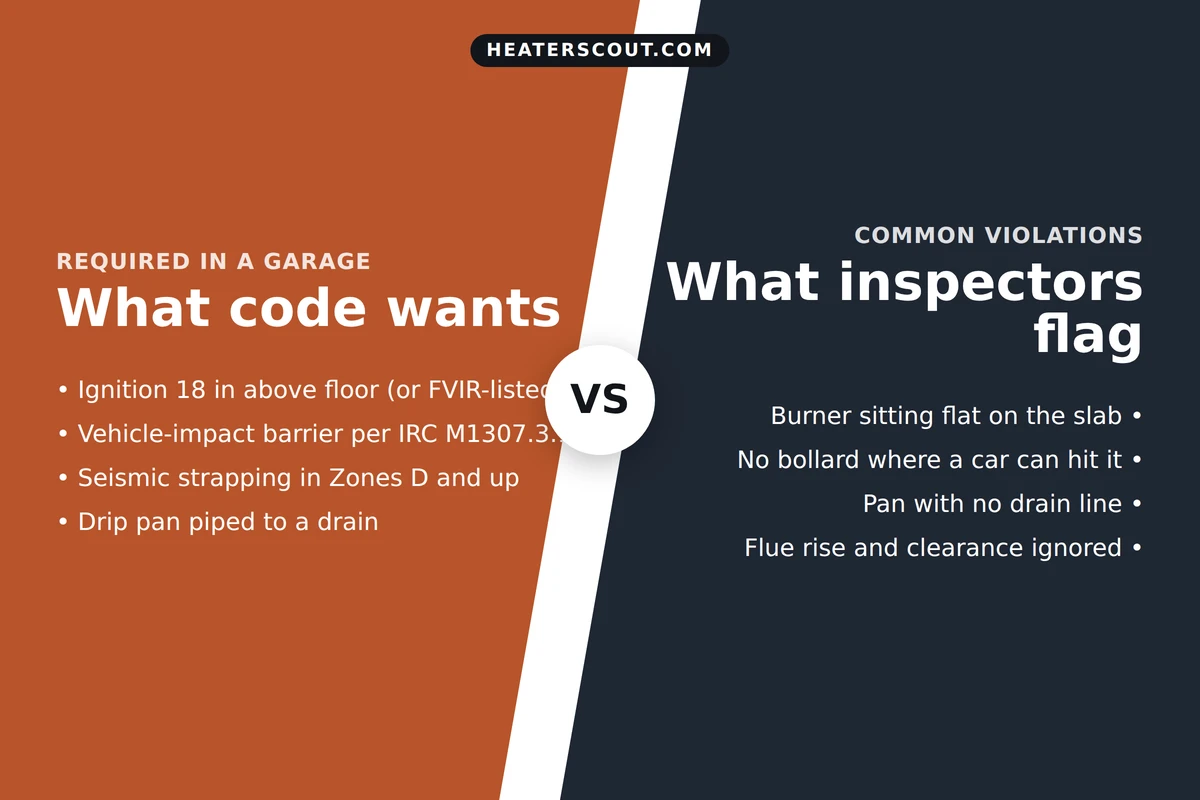
A car weighs two tons and a garage water heater full of 50 gallons is a fixed target sitting in the driving path. IRC M1307.3.1 exists because a bumper tap can shear a gas line or crack a flue connector, and now you have gas leaking next to an open flame in a closed room. If the heater is anywhere a vehicle can reach it, set a concrete-filled steel bollard in front of it in a proper footing. This pairs with the 18-inch ignition rule: both assume the worst case is fuel plus a spark in the same space, and both are cheap compared to a garage fire.
What a passing garage install has, item by item
Walk the install against this list before you call for inspection. It is the same list the inspector carries, translated into things you can see and touch. Miss one and the correction notice sends you back under the tank, which in a garage usually means moving stored junk out of the way twice.
- Gas burner and pilot 18 inches above the finished floor, unless the unit is FVIR-listed and the local code accepts the floor exception. Confirm the exception in writing, do not assume it.
- A steel bollard or approved barrier in front of the heater wherever a vehicle can reach it, set in concrete, not bolted to studs.
- Two seismic straps in the upper and lower third of the tank in seismic categories D and up, lagged into studs, lower strap clear of the gas control.
- A corrosion-resistant drip pan with a 3/4-inch drain line piped to an approved discharge, not dumping onto the slab.
- Adequate combustion air, easy in a garage, with the burner intake kept clear of stored solvents, paint, and salt.
- A continuous upward flue rise with the correct connector size and clearance to combustibles all the way to the vent termination.
- A full-size T&P discharge line run down to within 6 inches of the floor, ending where any release is visible.
- The listed clearances to combustibles maintained on every side, with service room left open in front of the controls.
The violations that actually fail inspections
Most garage water heaters that fail do not fail on something exotic. They fail because someone set the tank on the slab, ran a hose to nowhere, and called it done. These are the rows an inspector writes up over and over, with why each one matters.
Burner sitting flat on the slab
The single most common write-up on an older gas heater. If the unit is not FVIR-listed, or the jurisdiction did not adopt the floor exception, the ignition source has to be 18 inches up. A heater set directly on the garage floor with an open burner is exactly the flashback hazard the rule was written to prevent. The fix is a code-compliant platform or a floor-exception-eligible FVIR unit.
No vehicle barrier in the driving path
The tank sits three feet inside the overhead door with nothing in front of it. IRC M1307.3.1 wants an approved barrier there. Inspectors flag it because the failure mode is a struck gas line next to a flame. A concrete-filled steel post clears it; a stored bin or a painted line on the floor does not.
Drip pan with no drain line
A pan is present, which shows good intent, but nothing carries the water away. On a garage slab that slopes to the door, an overflowing pan just relocates the leak toward the living space. The correction is a 3/4-inch drain from the pan to a floor drain, standpipe, or daylight.
Flue rise and clearance ignored
The vent connector runs level or even downhill before it turns up, or it touches framing with no clearance. An atmospheric flue needs continuous upward rise to draft, and clearance to combustibles to avoid charring wood over years.
Missing or bogus seismic strapping
In a high-seismic area the tank has one strap, or a loop of plumber's tape, or nothing. Code wants two rated straps anchored to structure, lower strap above the gas valve. A garage makes this easy with exposed studs.
T&P line terminating in the pan or capped
The relief valve discharge is plumbed into the drip pan, run uphill, or, worst case, capped off. The T&P line has to run full-size, downhill, to a visible point near the floor. A capped or trapped relief line turns a stuck valve into a pressure vessel, which is the failure the valve exists to prevent.
Where the garage helps and where it bites
A garage is genuinely one of the better places to put a water heater on the combustion-air side. The volume is large, the envelope is leaky, and you almost never fight for makeup air the way you would in a sealed interior closet. Exposed studs make strapping and venting straightforward. The tradeoffs are the fuel-vapor hazard that drives the 18-inch and FVIR rules, the vehicle-impact exposure, and the cold. An unconditioned garage can drop below freezing, which threatens both the tank and any pan drain line run to an exterior wall, so insulate the lines and keep the drain routing where it will not freeze solid.
Frequently asked
Does a water heater in the garage really have to sit 18 inches off the floor?
The 18-inch rule is about the ignition source, not the tank. Gasoline vapor is heavier than air, so if a car leaks fuel the vapors pool at floor level. Codes have long required that any flame or spark that could ignite those vapors, the pilot and main burner on a gas heater, sit at least 18 inches above the finished garage floor. The measurement is to the ignition source, not the base of the tank. Since 2003 every residential atmospheric gas water heater sold in the US has been FVIR-listed, with a flame arrestor that stops vapors from flashing back to the burner, and the IRC and IFGC added an exception letting those units sit on the floor. Whether you can use that exception depends on your local amendment, and plenty of jurisdictions still require the 18-inch platform regardless. Call your building department before you decide.
What is an FVIR water heater and how do I know if mine is one?
FVIR stands for Flammable Vapor Ignition Resistant. After a 2003 industry-wide change, gas atmospheric water heaters got a sealed combustion chamber with a flame arrestor plate at the air intake, plus a thermal cutoff that shuts the gas off if the arrestor clogs. The design keeps a cloud of gasoline vapor drifting across the garage floor from flashing into the burner. Rheem, A.O. Smith, Bradford White, and State have all built FVIR into their standard gas tanks for two decades now, so any residential gas water heater you buy new is FVIR-listed. Look at the rating plate and the installation manual: it will say FVIR or reference the ANSI Z21.10.1 standard that requires it. If your heater predates 2003, it is almost certainly not FVIR.
Do I need a bollard or barrier to protect a garage water heater from cars?
Yes, if the heater is in the path of a vehicle. IRC section M1307.3.1 requires appliances installed in a garage to be protected from impact by an approved barrier when they are located where they could be struck by a moving vehicle. In practice that means a steel bollard, a pipe post set in concrete, or a bumper rail in front of the heater. If the tank sits in a recessed alcove, tucked behind a wall, or otherwise out of the driving and parking path, the barrier may not be required, but the inspector makes that call. A common cheap solution is a single 3 or 4 inch steel pipe filled with concrete, set in a footing in front of the unit. A wood 2x4 screwed to the studs is not an approved barrier and will not stop a bumper.
Does a garage water heater need a drip pan and a drain?
Most jurisdictions require a drip pan under any water heater where a leak would cause damage, and in a garage that usually applies because the slab drains toward the door and living space. The IPC and UPC both call for a pan of corrosion-resistant material, galvanized steel or aluminum for gas, with sides at least 1.5 inches high, piped by a 3/4-inch drain line to an approved point of discharge. That discharge cannot just dump onto the garage floor in many areas; it needs to run to a floor drain, a laundry standpipe, or outside to daylight where the water is visible. On a garage slab that slopes to the overhead door, a pan without a drain line just moves the puddle, so inspectors look for the pipe, not only the pan.
Do I have to strap a water heater in the garage for earthquakes?
In seismic design categories D, E, and F, which covers most of California and a lot of the western states, code requires water heaters to be braced against toppling. The typical requirement is two heavy-gauge metal straps, one in the upper third of the tank and one in the lower third, each anchored back to the wall studs or masonry with lag screws. The lower strap has to sit at least 4 inches above the gas control valve so a shift does not shear the gas line. A garage is an easy place to strap because you usually have exposed studs to lag into. Plumber's tape wrapped once around the tank is not adequate; the code wants proper seismic strapping kits rated for the tank size.
Is combustion air a problem for a gas water heater in a garage?
Combustion air is rarely the sticking point in a garage, which is one reason garages are a convenient place to put a gas heater. A gas atmospheric water heater needs roughly 50 cubic feet of room volume per 1,000 BTU/hr of input to draw enough air for clean combustion, and it needs makeup air to replace what goes up the flue. A typical two-car garage has plenty of volume, and garage doors and walls are leaky enough to supply makeup air without dedicated louvers. The bigger combustion concern in a garage is contamination: dust, lint, and chemical vapors from solvents, paint, and road salt get pulled into the heater and foul the flame. Keep stored chemicals away from the intake.
Can I convert a garage into a room if the water heater is out there?
You can, but the installation has to meet the code for its new setting, and that changes the rules. The 18-inch elevation and the vehicle barrier exist because the space is a garage; finish it into conditioned living area and the vehicle barrier goes away, but new problems appear. A gas water heater cannot open directly into a bedroom or bathroom without a sealed combustion setup or a dedicated combustion-air enclosure, and the flue and clearances all get re-evaluated. This is a permit-and-inspection conversation every time, because moving the boundary of a garage moves the code that applies to everything inside it.