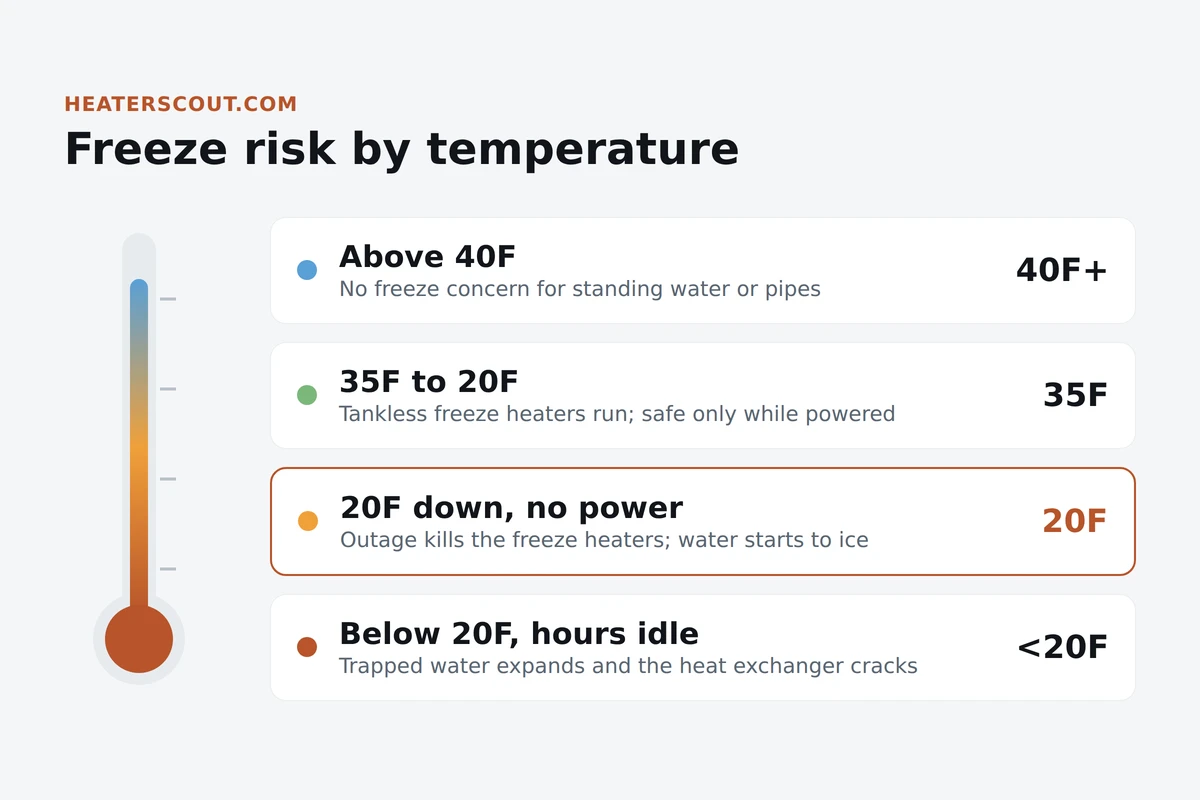
A tankless water heater rated to fire in -30F cold will still crack in a Texas ice storm, and the reason is not the cold. It is the power going out. Every modern tankless unit protects itself from freezing with small electric heaters on the heat exchanger, and those heaters need line voltage to run. The winter event that drops the temperature below zero is the same event that takes down the grid, so the two failures arrive together. The unit goes dark, the freeze heaters die, and the water trapped in the exchanger turns to ice and splits the metal. Understanding that one failure mode is most of what keeps a heater alive through a cold snap.
| Built-in freeze heaters | Protect the tankless heat exchanger and internal lines to about -30F, but only while the unit has power. |
| Isolation valve drain-down | Empties the heat exchanger completely. Power-independent, the surest protection for a long absence. |
| Heat-trace cable + pipe insulation | Protects the exposed inlet, outlet, and condensate lines. Electric, so it also fails in an outage. |
| Dripping a faucet | Keeps supply pipes from bursting by relieving pressure. Does little for the unit itself. |
| Recirculation loop | Cycles warm water through the unit and lines. Protects the unit, but the pump needs power too. |
| Backup power (generator/battery) | Keeps the freeze heaters and controls alive through an outage. The missing piece for outdoor units. |
Who actually has a freeze problem
A water heater in a heated basement or a conditioned utility closet does not freeze. The building keeps the room well above freezing, and a short power blip barely moves the indoor temperature. The freeze problem belongs to a specific set of installs, and if you are not in one of them you can stop worrying. The three that matter are the outdoor tankless in an ice-storm region, the vacation home left empty through the winter, and the tank sitting in a garage or crawlspace that the furnace never reaches.
Outdoor tankless in a winter storm
An outdoor-rated Rinnai or Navien runs fine to -30F on power. The night the ice storm takes the grid down, the freeze heaters stop, and with no building warmth to fall back on the exposed unit ices up within hours. This is the classic burst. The fix is backup power or a drain-down before the storm, not a colder-rated unit.
Vacation home shut for the season
You lock up in October and come back in April. Betting on the power staying up for six straight months in a cold region is a bad bet. Drain the unit instead: shut the gas and power, close the cold isolation valve, and empty the heat exchanger through the drain ports. An empty exchanger cannot crack, no matter what the weather or the grid does while you are gone.
Tank heater in an unheated garage
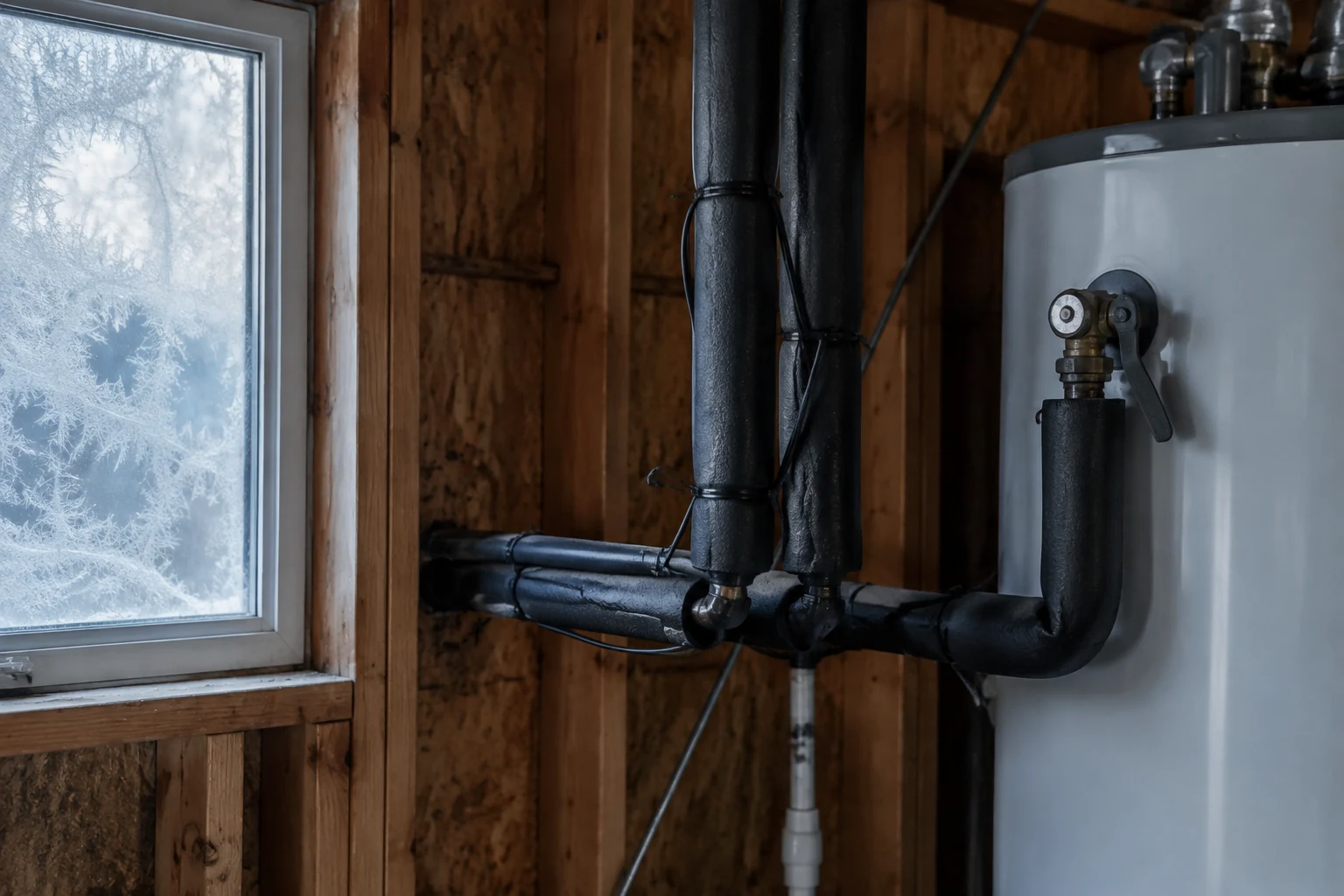
A 50-gallon tank holds heat for a long time, so the tank body rarely freezes. The exposed cold inlet and hot outlet pipes freeze first and burst before the tank ever does. Insulate and heat-trace those lines, and if the garage runs deep below freezing, add a small space heater or an insulated enclosure around the unit.
How the built-in protection works, and why it fails
Open the front panel of a modern gas tankless and you find small electric heaters bonded to the heat exchanger and clipped along the internal water lines. The control board watches an internal temperature sensor, and when the reading falls toward freezing it switches those heaters on. Rinnai publishes freeze protection down to roughly -30F ambient. Navien and Noritz cite similar figures. On paper that covers almost any climate in the continental United States.
The number that matters is not on the spec sheet in bold. It is the condition attached to it: rated with electrical power supplied. The freeze heaters draw watts, the sensor needs the board awake, and the board needs line voltage. Cut the power and every piece of the protection goes dark at once. A gas tankless still needs its electronics to run even though the heat comes from gas, so a dead outlet leaves the unit both unable to make hot water and unable to protect itself from ice.
| Method | Protects | Survives outage | Effort | Best use |
|---|---|---|---|---|
| Built-in freeze heaters | Unit only | No | None (automatic) | Everyday cold with reliable power |
| Isolation valve drain-down | Unit only | Yes | 20 to 30 min | Vacation homes, long absences |
| Heat tape + pipe insulation | Exposed pipes | No | 1 to 2 hr install | Garage and crawlspace lines |
| Drip a faucet | Supply pipes | N/A (no power needed) | None | Pipe insurance during a cold snap |
| Recirculation loop | Unit and lines | No | Wiring/plumbing job | Occupied homes wanting instant hot water |
| Generator or battery backup | Everything electric | Yes | Cost + setup | Outdoor units where the grid is shaky |
The outdoor and vacation-home playbook
For an outdoor unit in a region that loses power in winter storms, the built-in protection is the first layer and not the last. Add a backup power source sized to carry the unit's freeze heaters and controls, which is a modest load, so an outage does not take the protection down with the lights. A small inverter generator or a battery backup keeps the board alive long enough to ride out most storms. If backup power is not in the cards, draining the unit ahead of a forecast hard freeze is the manual fallback.
For the vacation home you drain and walk away. The isolation valve kit that most installers fit to a tankless exists partly for exactly this. Shut off the gas and the electrical supply, close the cold-water isolation valve so no new water enters, and open a downstream hot tap to break the vacuum. Then open the two drain ports on the isolation valves and let the heat exchanger empty. An empty exchanger has nothing inside to freeze, so the unit is safe through anything the winter throws at it while you are gone.
Freeze protection
The built-in system on a modern tankless water heater that switches small electric heaters onto the heat exchanger and internal lines when the temperature drops. It is rated by ambient temperature (often to about -30F on gas units from Rinnai, Navien, and Noritz) but only while the unit has electrical power. Lose power and the protection stops, which is why an outage during a hard freeze is the event that bursts outdoor and garage-mounted units.
Isolation valves
A matched pair of service valves, one on the cold inlet and one on the hot outlet of a tankless unit, each with a small drain port. They let you shut the unit off from the plumbing to flush it, service it, or drain it down for winter without touching the rest of the house water. For freeze protection they are the tool that empties the heat exchanger, which is the one method that does not depend on power staying on.
Protecting the pipes and the condensate line
The appliance usually is not what freezes first. The exposed pipes are. On any inlet, outlet, or condensate line running through a garage, a crawlspace, or an exterior wall, wrap self-regulating heat-trace cable along the pipe and cover it with foam pipe insulation. Self-regulating cable raises and lowers its own output as the pipe warms and cools, so it is safe to leave energized all winter, unlike older constant-wattage tape that can overheat.
Condensing tankless units add a wrinkle. They pull so much heat out of the exhaust that water condenses inside and drains out through a small line, and that condensate is mildly acidic. If the condensate line runs through cold space it freezes, backs up, and faults the unit out on a drain error even though nothing is broken. Heat-trace and insulate the condensate line the same as the water lines, and give it a continuous downhill run so it drains fully instead of holding a slug of water that ices over. Remember that trace cable is electric, so it shares the outage weakness with the freeze heaters.
Tank heaters in unconditioned space
A storage tank in a cold garage is a different animal from a tankless. The 40 or 50 gallons of water inside carry a lot of thermal mass, so the tank body cools slowly and rarely freezes solid even in a deep cold snap. What fails is the plumbing around it. The cold inlet and the hot outlet at the top of the tank are small-diameter pipes with no reserve of heat, and they freeze and burst hours before the tank does. Insulate and heat-trace those two runs first.
If the garage drops well below freezing for days, the tank's own recovery may not keep up, and a gas tank vented to the cold outdoors loses heat fast up the flue. In that case an insulated enclosure around the unit, or a small thermostatically controlled space heater in the closet, buys the margin the appliance cannot make on its own. Never leave an electric tank unpowered in a freezing garage on the assumption the water will stay warm. Without its elements running, the water tracks the room temperature within a day or two, and then the tank is a cold reservoir waiting to freeze at the fittings.
Whatever the install, the decision comes down to a single question you can answer in advance. Will the power stay on. If the answer is yes with confidence, the built-in protection and a little heat tape carry the day. If it is anyone's guess, drain the unit or back up the power, and stop trusting a system that goes dark the moment the storm does its worst.
Frequently asked
At what temperature does a water heater freeze and burst?
Water freezes at 32F, but a tankless heat exchanger or a supply pipe does not burst the instant the temperature crosses that line. Freezing has to run long enough for the water inside to turn solid, and ice expands about 9 percent by volume. In a tankless unit the narrow copper or stainless passages in the heat exchanger have nowhere to give, so they split. The practical danger zone is around 20F and below with several idle hours, or any sustained sub-freezing spell in an unheated space. A tank in an unheated garage is more forgiving because 40 or 50 gallons hold heat for a long time, but the exposed inlet and outlet pipes freeze first and burst before the tank body ever does.
Do tankless water heaters have freeze protection built in?
Yes, nearly every modern gas tankless from Rinnai, Navien, Noritz, and Rheem ships with built-in freeze protection. Small electric heating elements sit on the heat exchanger and the internal water lines, and the control board switches them on when it senses the internal temperature dropping. Rinnai rates its units to roughly -30F ambient with this system active, and Navien and Noritz publish similar numbers. The catch is in the fine print: that protection is rated only while the unit has electrical power. The freeze heaters draw watts. Pull the plug or lose the grid and the protection dies with it. That is why the built-in system is not a substitute for draining an outdoor unit before a known cold snap or a long absence.
Why do tankless units freeze during a power outage?
Because the built-in freeze protection is electric. The freeze heaters, the control board, and the sensors all need line voltage to run. A winter storm is exactly the event that both drops the temperature below zero and knocks out power for hours, so the two failures arrive together. The unit goes dark, the freeze heaters stop, and the water sitting in the heat exchanger and the exposed lines starts to ice. Outdoor-mounted and garage-mounted units are the ones that crack, because indoor units in a heated envelope ride out a short outage on the building's own warmth. If you live where ice storms take the grid down, the fix is a generator or battery backup that keeps the unit powered, or draining the unit whenever a hard freeze and an outage look likely at the same time.
Should I drain my tankless water heater if I leave for the winter?
For a vacation home or a long absence in a cold climate, yes, draining is the surest protection because it does not depend on power staying on. Shut off the gas and the electrical supply, close the cold-water isolation valve, open the hot side, and use the isolation valve drain ports to let the water out of the heat exchanger. Most tankless makers spell out the drain-down sequence in the manual, and the isolation valve kits sold for the unit exist partly for this. An empty heat exchanger cannot freeze and cannot crack. If you would rather leave the unit charged and running, then you are betting on the power staying up the entire time you are gone, which in an ice-storm region is a bet worth thinking hard about.
Will dripping a faucet keep a tankless water heater from freezing?
A slow drip helps the exposed supply pipes because moving water resists freezing longer than standing water, and it relieves the pressure that actually bursts a pipe once ice forms. It does far less for the tankless unit itself. A tankless heater only fires when you open a hot tap at real flow, so a thin drip may not pull enough water through the heat exchanger to trigger the burner, and it will not run the freeze heaters. Treat dripping as pipe insurance, not unit insurance. For the unit, rely on the built-in freeze heaters while powered, and drain it when you cannot count on power.
Do I need heat tape and pipe insulation on the lines?
On any exposed line in an unconditioned space, yes. The pipes freeze before the appliance does, and they are cheap to protect. Wrap the cold inlet, the hot outlet, and the condensate drain on a condensing unit with self-regulating heat-trace cable, then cover the cable and pipe with foam pipe insulation to hold the heat in. Self-regulating cable adjusts its own output as it warms and cools, so it is safer to leave energized than constant-wattage tape. The condensate line matters more than people expect: a condensing tankless makes acidic water that will freeze and block the drain, which faults the unit out. Note the same caveat as the freeze heaters. Heat tape is electric, so an outage takes it down along with everything else.
Is an outdoor tankless water heater a bad idea in a cold climate?
Not automatically, but it changes the rules. Outdoor-rated units from Rinnai, Navien, and Noritz are built for exposure and carry the same freeze protection to around -30F, so they run fine on the coldest nights as long as the power holds. The failure mode is the outage, and an outdoor unit has no building warmth to fall back on. If you put a tankless outside where the grid is shaky in winter, plan for backup power or a drain-down routine from day one. An indoor unit in a heated mechanical room is the low-risk choice for a hard-freeze climate, because a short outage barely moves the temperature inside a conditioned house.