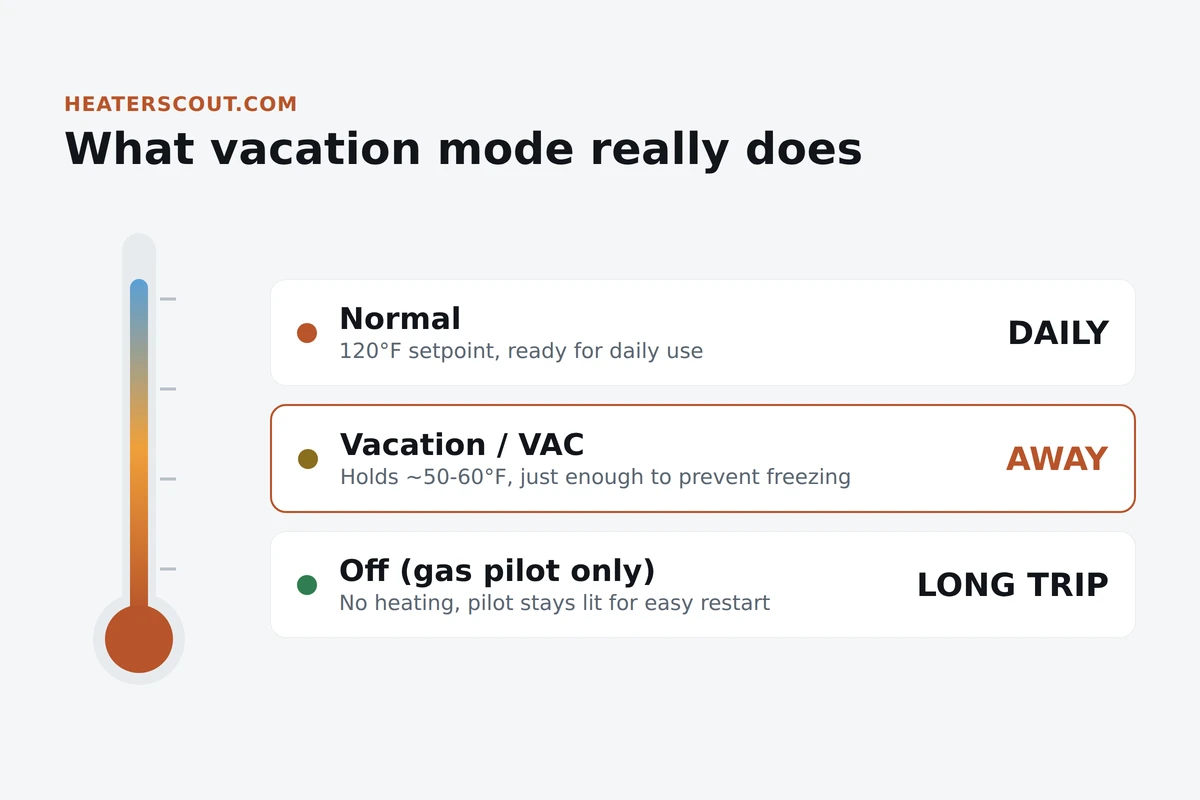
Leaving a water heater at 120 degrees while you are gone for two weeks heats an empty house's worth of water nobody uses. Vacation mode — the VAC setting on a gas control dial or the dedicated button on an electric unit's panel — drops the tank to a low holding temperature instead of turning it fully off. It keeps the tank warm enough not to freeze or grow bacteria, uses almost no energy, and lets you come home to hot water within an hour instead of relighting a pilot or waiting for a cold tank to recover.
What the setting actually does
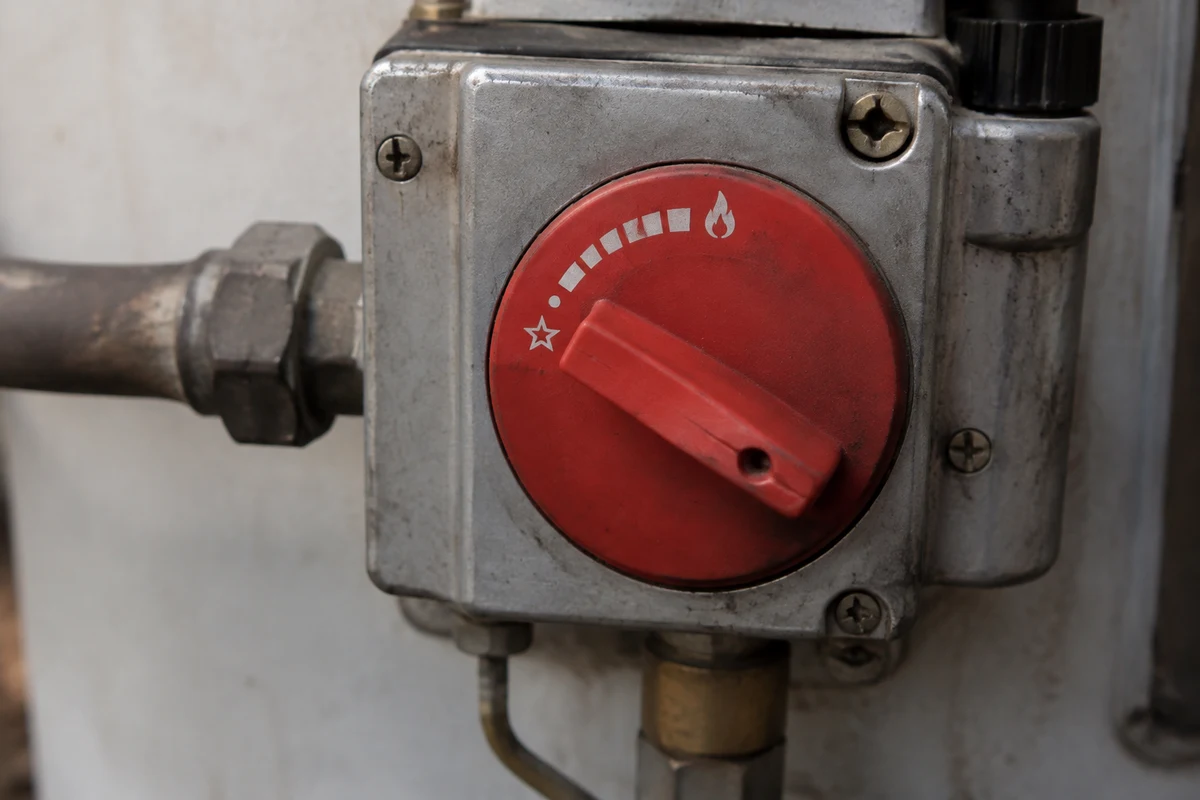
On a gas water heater, the temperature is set by a dial on the red gas control valve near the floor. Between the "hot" range and "off" there is usually a position marked VAC or a snowflake. Turn the dial there and the burner only fires to hold the tank around 50 to 60 degrees — low enough to save energy, high enough that the water never freezes and the pilot stays lit. On an electric heater, vacation or VAC is a mode on the digital panel that drops both elements to a low holding setpoint. Either way, the tank idles warm rather than hot.
The reason it beats simply turning the unit off comes down to two things: convenience and safety. Off means a cold tank when you get back and, on a gas unit, relighting the pilot — a chore some people would rather avoid. Vacation mode skips both. It also keeps the water above the range where stagnant, cold water can encourage bacterial growth in a tank that sits unused, while staying well below the scalding zone. It is the setting designed for exactly the case of nobody home for a while.
When to use it, and when not to bother
For a trip of three days or more, vacation mode is worth setting. The savings scale with how long you are gone and how much the tank would otherwise cycle to replace standby heat loss. For an overnight or a weekend it barely matters — the energy a tank uses just idling for two days is small, and you may forget to switch it back. The sweet spot is the week-or-two trip, where the tank would otherwise reheat itself day after day for no one.
There is one case where you want fully off, not vacation: a long absence of a month or more, especially somewhere the building will be unheated and could freeze hard. Then draining the tank and shutting everything down protects the plumbing better than a low holding temperature. And there is one case where you want to leave it at normal: if someone will actually be in the house, or if you have a smart or heat-pump unit whose own scheduling handles standby better than a manual setting would.
Setting it on a gas heater
Find the gas control valve, the red or grey box low on the front of the tank with a temperature dial. Rotate the dial from its normal setting to the VAC or snowflake position. The pilot stays lit and the burner will only fire occasionally to hold the low temperature. That is all there is to it. When you get home, turn the dial back to your normal setting — around the midpoint, which corresponds to roughly 120 degrees on most units — and within thirty to sixty minutes you have a full tank of hot water again.
Setting it on an electric heater
A modern electric unit with a digital display usually has a "Vacation" or "VAC" mode in the menu; select it and confirm. Older electric heaters without a digital panel do not have a labeled vacation setting — they have two thermostats behind access panels. For those, you can either turn the thermostats down to their lowest setting or simply switch the heater's breaker off for the trip. If you flip the breaker, remember the tank will be cold when you return and will take an hour or so to recover, but there is no pilot to relight, so it is a clean option for electric.
The freeze-protection angle
In cold climates, the low holding temperature of vacation mode does double duty: it keeps the tank and the water in it from freezing while you are gone. That matters if the water heater sits in a garage, a crawlspace, or an unheated utility room. Turning the unit fully off in those spots during a hard freeze risks a frozen, cracked tank or supply line. Vacation mode's 50-to-60-degree hold is usually enough to prevent that, as long as the surrounding space does not drop to freezing itself. For a genuinely deep, prolonged freeze with the house heat off, draining the system is the safer move.
What it saves, honestly
Do not expect a dramatic number. A tank water heater spends most of its energy heating water people use and a smaller slice on standby loss — the heat that leaks out of a full hot tank between draws. Vacation mode cuts that standby slice for the days you are gone. Over a two-week trip that is a real but modest saving, more meaningful on an older, poorly insulated tank than on a new one wrapped in thick foam. The bigger reason to use it is not the dollars; it is avoiding heating water for an empty house and, in winter, keeping the tank from freezing. The savings are a bonus on top.
Frequently asked
What does vacation mode do on a water heater?
It drops the tank to a low holding temperature, usually around 50 to 60 degrees, instead of turning the unit fully off. That saves standby energy while keeping the water warm enough not to freeze and, on a gas unit, keeping the pilot lit so you have hot water again within about an hour of getting home.
Should I turn my water heater to vacation mode when I leave?
For a trip of three days or more, yes. It cuts the energy the tank wastes reheating itself for an empty house and, in winter, protects against freezing. For an overnight or weekend it barely matters. For an absence of a month or more, or before a hard freeze with the house unheated, turning it fully off and draining it is better.
What temperature is vacation mode on a water heater?
Most units hold roughly 50 to 60 degrees in vacation mode. That is low enough to save energy and prevent bacterial growth in stagnant water, but high enough to keep the tank and lines from freezing in a cold garage or utility room.
How do I set vacation mode on a gas water heater?
Turn the temperature dial on the red gas control valve at the base of the tank to the VAC or snowflake position, between the hot range and off. The pilot stays lit and the burner only fires occasionally to hold the low temperature. Turn the dial back to normal when you return.
Is it better to turn the water heater off or use vacation mode?
For most trips, vacation mode is better because it avoids a cold tank and, on gas units, a pilot relight when you get home, while still saving energy and preventing freezing. Turn it fully off only for long absences of a month or more, or when you plan to drain the system before a hard freeze.
How long does a water heater take to reheat after vacation mode?
About thirty to sixty minutes for a full tank to come back up to a normal 120-degree setpoint, whether you had it on vacation mode or switched off. Turn it back to normal as soon as you get home, before you need hot water, and it will be ready by shower time.
Will vacation mode keep my water heater from freezing?
In most cases, yes. The 50-to-60-degree holding temperature keeps the tank and its water above freezing as long as the surrounding space does not drop to freezing itself. For a deep, prolonged freeze with the house heat off, draining the system is the safer choice than relying on vacation mode.