Heating water runs your household roughly $300 to $600 a year, and most people never see the number because it hides inside one lumped utility bill. Water heating is the second biggest energy user in a typical home, behind heating and cooling the air. Which fuel you burn, and what your utility charges, swings that yearly figure by hundreds of dollars.
Typical yearly running cost by fuel
resistance
tank
pump
Heating water is roughly 18% of the average home energy bill. Standard electric costs about 3x what a heat pump does for the same hot water.
Operating cost calculator
Pick your fuel, punch in your own utility rate, and set household size. The estimate uses real annual energy baselines for a mid-size home, scaled to your inputs.
Estimates only. Your real bill moves with how much hot water you draw, incoming water temperature, tank standby losses, and your exact utility rate. Rural propane and off-peak electric plans can push these either direction.
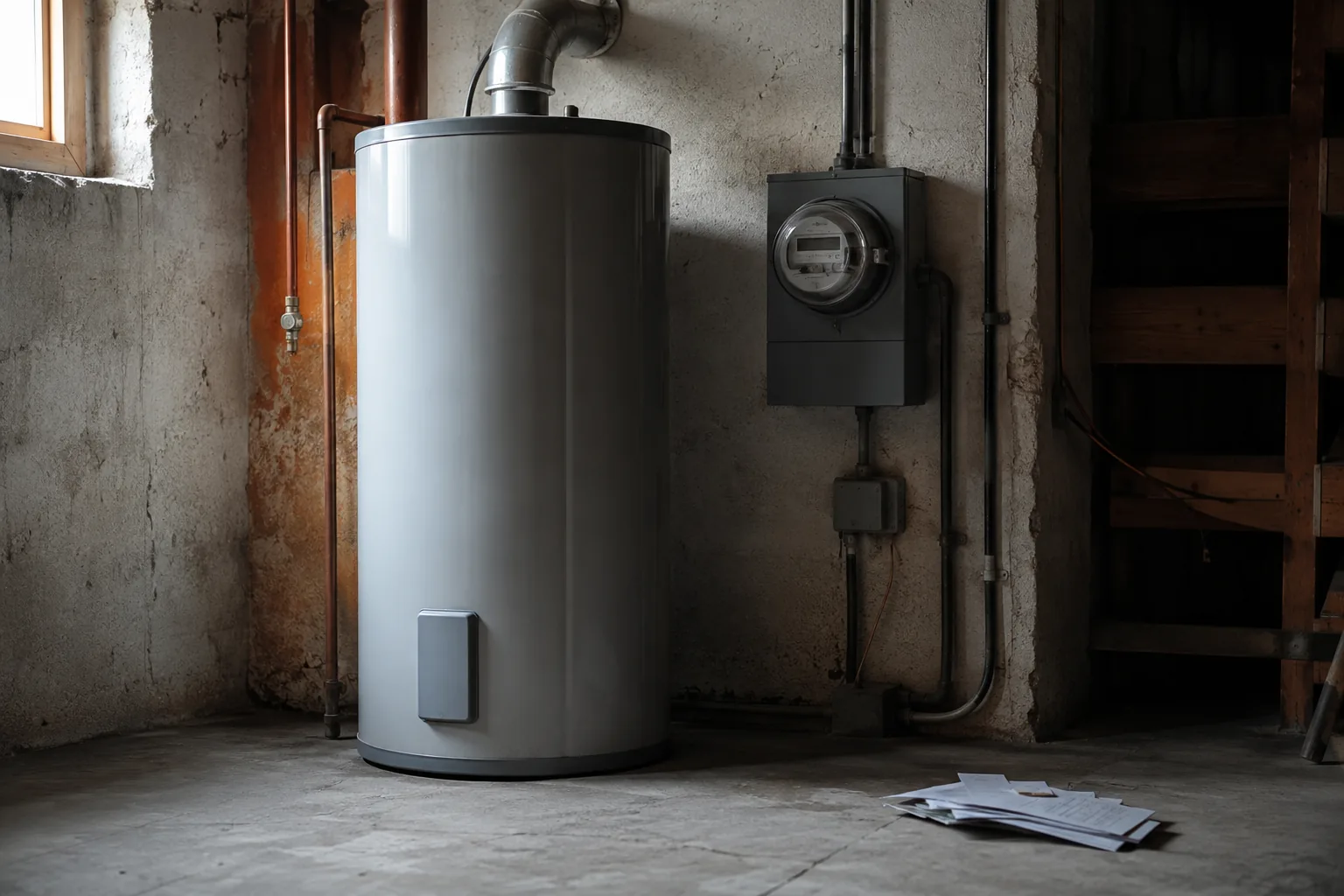
Electric vs gas: where the money goes
Start with energy, not dollars, because energy is the honest number. A standard electric tank serving a family of four burns somewhere around 4,500 to 5,000 kWh a year. At the U.S. average electric rate, which sits near 17 cents per kilowatt-hour, that lands close to $780 for a heavy-use home and drops to the $400s for a smaller one. Run the math on your own rate and it can look very different: Pacific Northwest hydro power at 11 cents changes the story, and California or the Northeast at 30-plus cents makes an electric resistance tank hurt.
Gas plays by different rules. A gas tank uses roughly 200 to 250 therms a year, and at about $1.45 per therm that works out to $290 to $360. Gas is usually cheaper to run month to month, which is why so many households stay with it. The gap is real but smaller than people assume once you account for the extra heat a gas flue sends up the chimney. A gas tank is only about 60 to 70 percent efficient at getting fuel energy into the water; the rest escapes. An electric resistance tank puts nearly all its energy into the water, it just uses a pricier fuel to do it.
Then there is the heat pump, which rewrites the comparison. Instead of turning electricity straight into heat, it moves heat out of the room air into the tank, so it does the same job on roughly a quarter to a third of the electricity. A heat pump water heater serving that same family of four uses around 900 to 1,200 kWh a year. At 17 cents that is $150 to $200, below what most gas tanks cost to run. That is the reason they qualify for federal tax credits and why utilities push them. The catch is a higher sticker price up front and a unit that needs a warmish space with some air volume around it.
What actually drives your bill
Fuel type sets the ballpark. Four other things decide where inside that ballpark you land.
Hot water demand is the big lever. A two-person apartment that showers once a day and runs a dishwasher twice a week uses a fraction of what a five-person house with a soaking tub and daily laundry burns through. This is why the same tank can cost $350 in one home and $650 next door. More draws, longer showers, and hotter setpoints all add up fast.
Setpoint temperature matters more than it looks. Most tanks ship set to 140°F. Dropping to 120°F, the temperature most people actually want, cuts standby heat loss and can shave 4 to 8 percent off the water-heating portion of your bill. Every 10°F down is real money over a year, and 120°F still lands hot enough for a shower while easing scald risk.
Standby loss is the quiet drain. A tank keeps 40 or 50 gallons hot around the clock whether you use it or not, and heat bleeds through the insulation the whole time. Older tanks with thin insulation lose more; an uninsulated tank in a cold garage or basement loses even more because the surrounding air is pulling heat out constantly. This is the cost you pay for water you never draw, and it is exactly the cost a tankless or heat pump unit trims.
Incoming water temperature is the one nobody controls. A tank in Minnesota starts with 40°F groundwater in January and has to lift it to 120°F. The same tank in Florida starts at 70°F and does far less work. Colder climates simply pay more to heat water, all year, and the winter spike is steep. It is why identical households in different states see bills that are hundreds of dollars apart.
Ways to cut it without buying a new heater
You do not need a replacement to spend less. The cheapest fix is the setpoint: turn the thermostat down to 120°F and leave it. That single change costs nothing and trims the bill immediately.
An insulating blanket on an older electric tank knocks down standby loss for about $20 in materials, and it pays for itself inside a year on a tank sitting in unconditioned space. Skip the blanket on most newer tanks; they already carry enough foam insulation that adding more does little. Never wrap the top of a gas tank or block its air intake, since that unit needs to breathe.
Insulating the first six feet of hot water pipe coming off the tank keeps water hotter between draws, so the burner or element cycles less. Fixing a hot-side drip matters more than it seems too: a faucet leaking one drip per second wastes hundreds of gallons of already-heated water a year. Low-flow showerheads cut the volume you heat in the first place, which is where a big share of the bill lives.
If you are on a utility with time-of-use pricing, a simple timer or a smart electric tank can shift heating to off-peak hours and cut the rate you pay on that energy. And when the tank finally dies, that replacement moment is when the fuel-switch math pays off most. Swapping a failing electric resistance tank for a heat pump model is where the biggest long-run savings live, especially with the federal tax credit knocking down the install cost.
The bottom-line number
For most homes, budget somewhere between $300 and $600 a year to keep hot water coming, with gas at the low end, standard electric at the high end, and a heat pump undercutting both. The calculator up top gets you closer than any average because it runs on your rate and your household. Plug in the number off your own utility bill and you will see how much of that spread is fuel and how much is simply where you live and how much water you draw.
Frequently asked
How much does it cost to run a water heater per year?
Most households spend between $300 and $600 a year. A standard electric tank runs about $400 to $600 at the U.S. average rate near 17 cents per kWh, a gas tank runs about $290 to $360 at roughly $1.45 per therm, and a heat pump water heater often lands under $200. Your exact number depends on your utility rate, household size, and how much hot water you use.
Is it cheaper to run an electric or gas water heater?
Gas is usually cheaper to run month to month at national average rates, often by $150 to $300 a year versus a standard electric resistance tank. But it depends heavily on your local prices. In regions with cheap electricity, like the Pacific Northwest, electric can match or beat gas. A heat pump water heater is the exception that flips it: it runs on electricity yet costs less than most gas tanks.
How many kWh does a water heater use per year?
A standard 50-gallon electric tank for a family of four uses roughly 4,500 to 5,000 kWh a year, or about 10 to 12 kWh a day. A heat pump water heater doing the same job uses only about 900 to 1,200 kWh a year because it moves heat instead of generating it. Smaller households use proportionally less.
Does turning down the water heater save money?
Yes. Dropping the setpoint from 140°F to 120°F cuts standby heat loss and can trim 4 to 8 percent off the water-heating part of your bill, with no upfront cost. It also lowers scald risk, and 120°F is still plenty hot for showers and dishes. Every 10°F reduction saves a bit more over a year.
Why is my water heater so expensive to run?
Usually high hot water demand, a high setpoint, or an old, poorly insulated tank losing heat around the clock. Cold incoming groundwater in winter also pushes costs up because the tank works harder to reach temperature. Electric resistance tanks in high-rate areas are the most expensive combination. Lowering the setpoint, insulating the tank and pipes, and fixing hot-side leaks all help.
Are heat pump water heaters really cheaper to run?
Yes, and by a wide margin. A heat pump water heater uses about one-third the electricity of a standard electric tank, so it typically runs $150 to $250 a year versus $400 to $600. That often beats even a gas tank's running cost. The trade-off is a higher purchase price, though federal tax credits and lower yearly bills usually make up the difference over its life.