Say the installed quote for a heat-pump water heater lands at $2,800. A year ago, the federal 25C tax credit alone would have taken 30% of that off your tax bill, $840, and a state rebate plus a utility check could have shrunk the rest toward almost nothing. In 2026 the math changed. The federal credit closed at the end of 2025, so for a heater you buy this year the live money is the state HEAR rebate and your utility, not a tax credit. Which programs pay, how much, and whether they reach your address all depend on the state you live in. Here is what actually comes off in 2026, who qualifies, and how to find and claim it without leaving money on the table.
Read this first
The single most important 2026 fact on this page: the federal 25C tax credit for heat-pump water heaters ended on December 31, 2025. If your unit was installed on or before that date, you can still claim it on your 2025 return filed this spring. If you are buying in 2026, plan around the state HEAR rebate and your utility instead, because there is no federal credit waiting for a new purchase.
The verdict
For a heater bought in 2026, the federal tax credit is gone. Your savings come from the income-based HEAR rebate, up to $1,750 where your state's program is live, and from your utility, which can add hundreds to a few thousand dollars. A 2025 install can still claim the old 30% credit on a 2025 return. Check your state energy office and your utility before you buy, and keep every invoice.
How to find and claim what you qualify for
The programs live in three different places and none of them will chase you down. The order matters, because a couple of these want pre-approval and will not pay after the fact. Work it top to bottom before you sign a quote.
The three layers of money, and how they changed for 2026
There are three pots that can land on a single heat-pump water heater, and understanding which ones are actually available in 2026 is the whole game. The federal tax credit is the one that changed. The state rebate and the utility rebate are the ones still paying out on a new purchase.
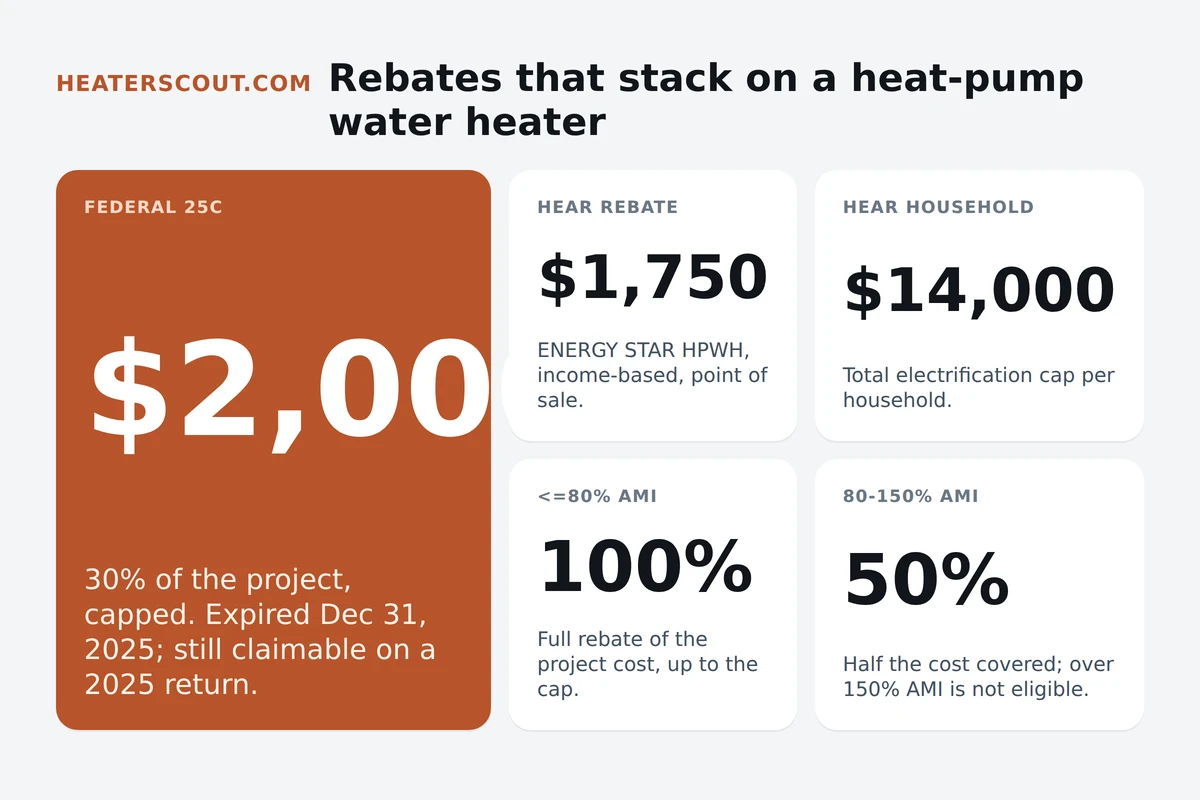
The federal 25C Energy Efficient Home Improvement Credit was worth 30% of the project cost, equipment plus labor, capped at $2,000 a year for a heat-pump water heater. That $2,000 sat in its own bucket, separate from the $1,200 general cap for insulation, windows, and panel upgrades, so a household could work toward both in the same year up to a combined $3,200. It had no income limit but was nonrefundable, which meant it could only wipe out tax you actually owed. All of that is now past tense for new buys. The One Big Beautiful Bill Act, signed in July 2025, moved the credit's expiration to December 31, 2025. A heater installed on or before that date still earns the credit on a 2025 return; a heater bought in 2026 does not.
The HEAR rebate is a different animal, and in 2026 it is the headline federal-funded incentive. Funded by the Inflation Reduction Act and written HEEHRA in the original law, it covers up to $1,750 for an ENERGY STAR heat-pump water heater, inside a larger $14,000 per-household electrification cap that also reaches a space heat pump, an induction range, wiring, and an electric panel upgrade. Two things set it apart from the old credit. It is a point-of-sale discount, so the money comes off your price at purchase through a participating contractor rather than months later at tax time. And it is means-tested on area median income, so who gets it, and how much, depends on your household's income relative to your county.
Program-by-program: what each one pays
This table pairs each incentive with the amount and its 2026 status. The federal credit is included for completeness because 2025 installs can still claim it, but note the closed status before you count on it for a new purchase.
| Federal 25C tax credit | 30% of cost, up to $2,000. Expired 12/31/2025; 2025 installs only, via Form 5695. |
| HEAR rebate, <=80% AMI | Up to 100% of project cost, capped at $1,750 for the HPWH category. |
| HEAR rebate, 80-150% AMI | Up to 50% of project cost, capped at $1,750. |
| HEAR rebate, >150% AMI | Not eligible. Household HEAR cap: $14,000 across all upgrades. |
| HEAR eligibility | ENERGY STAR HPWH, UEF >= 2.2, point of sale, participating contractor. |
| Utility rebate (example) | SMUD: up to $4,000 gas-to-HPWH conversion, $1,000 electric-to-electric. |
| Utility rebate (example) | ConEd New York: $1,000 instant HPWH rebate. Others vary widely. |
The income tiers, in plain terms
HEAR is tied to area median income, the figure the Department of Energy calculates for your county and household size. There are three bands and they decide everything. At or below 80% of AMI, the program can cover up to 100% of the project cost, up to the $1,750 heat-pump water heater cap, so a qualifying household can pay very little out of pocket where the program is live. Between 80% and 150% of AMI, the coverage is up to 50%. Above 150% of AMI, HEAR is simply not available for the heater, though a utility rebate may still be.
Because AMI is local, the same paycheck lands in different tiers in different places. A salary that is well under 80% of AMI in an expensive coastal county can be over 150% in a low-cost rural one. That is why checking your county's number matters more than eyeballing a national income figure. Your state's HEAR portal or a participating contractor can look up your tier from your household size and income.
Utility rebates: the layer people forget
Below the state rebate sits your electric utility, and it is the easiest pot to overlook. Many utilities pay a rebate on a heat-pump water heater specifically because moving a home off resistance heating helps their load. The amounts are all over the map. SMUD in Sacramento has offered up to $4,000 for a gas-to-heat-pump conversion and $1,000 for an electric-to-electric swap, and ConEd in New York has run a $1,000 instant rebate at the register. Plenty of utilities land lower, in the few-hundred-dollar range. Some require the unit to be installed by an approved contractor or to hit a minimum efficiency, and a number of them require pre-approval and will not pay retroactively, which is why the utility page belongs at the top of your list, before you buy, not after.
The one gotcha when you stack these is that a rebate which lowers your purchase price can also lower the basis another program figures its share on. In the years the federal credit was live, a rebate that cut $1,000 off the price also cut the number the 30% credit was calculated from. HEAR and utility rebates can interact the same way, where a utility discount lowers the cost that HEAR's percentage applies to. You still come out far ahead stacking them, but you cannot count the same dollar twice, so keep every invoice and every rebate confirmation and let the contractor sequence them.
Do renters or landlords get any of this?
HEAR is aimed at the household that lives in the home and meets the income test, and states set their own rules on rental properties, so a renter installing a qualifying unit in their primary residence may be eligible where the state allows it. The old 25C tax credit applied to an existing primary residence and did not cover a rental the owner did not live in. If you are a landlord or a tenant, check your specific state HEAR rules, because they vary more than the federal framework does.
What counts as a qualifying heat-pump water heater?
For HEAR the unit generally must be ENERGY STAR certified with a Uniform Energy Factor of 2.2 or higher. The old 25C credit likewise required ENERGY STAR certification and, for 2025 installs, a qualified-manufacturer PIN reported on the return. Check the ENERGY STAR product finder for your model number before you buy, and confirm the specific efficiency threshold your state's HEAR program uses, since a state can hold to the federal minimum or set its own.
Where to actually start in 2026
Skip the search for a federal tax credit on a new purchase; it is not there. Open your state energy office page and find out if HEAR is live where you are, then pin your income against your county's AMI to learn your tier. Run your zip through DSIRE for the full list, and read your utility's rebate page for the appliance rebate and any pre-approval rule. If your unit went in during 2025, the one remaining federal move is Form 5695 on your 2025 return. Do those four lookups before you sign a quote and the sticker price on a heat-pump water heater turns into a much smaller number by the time the rebates land.
Frequently asked
Is the federal tax credit for a heat pump water heater still available in 2026?
The 25C Energy Efficient Home Improvement Credit expired on December 31, 2025, when the One Big Beautiful Bill Act moved up its end date. There is no 25C credit for a heat-pump water heater you buy and install in 2026. There is one important exception on timing rather than eligibility: if your qualifying unit was installed and placed in service on or before December 31, 2025, you can still claim the credit on your 2025 tax return, which you file in early 2026, using IRS Form 5695. So the credit lives on for 2025 installs even though the program itself is closed to new 2026 purchases. If you are shopping now, the live money in 2026 is the HEAR rebate and your state and utility programs, not the federal tax credit.
How much was the 25C heat pump water heater tax credit and who could claim it?
It was worth 30% of the project cost, counting both the equipment and the installation labor, capped at $2,000 per year for a qualifying heat-pump water heater. The unit had to be ENERGY STAR certified, and starting with 2025 installs the model needed a qualified-manufacturer PIN reported on the return. There was no income limit, so any household that owed federal tax could use it, but it was nonrefundable, meaning it could reduce your tax bill to zero but would not pay cash beyond what you owed. The $2,000 heat-pump limit sat in its own bucket, separate from the $1,200 general 25C cap for other efficiency work, with a $3,200 combined ceiling.
What is the HEAR rebate and how much is it for a water heater?
HEAR, the Home Electrification and Appliance Rebates program, is the Inflation Reduction Act rebate that Congress funded separately from the tax credit. It was originally written HEEHRA in the law and the Department of Energy later relabeled it HEAR. For an ENERGY STAR heat-pump water heater it can cover up to $1,750, and that sits inside a larger $14,000 per-household cap that also covers a heat pump, an induction range, an electric panel upgrade, and wiring. It is a point-of-sale discount, so a participating contractor or retailer takes the money off your price at purchase rather than making you file for it later. Unlike the old tax credit, HEAR is means-tested and is administered state by state.
Who qualifies for the HEAR water heater rebate by income?
HEAR is tied to your area median income, or AMI, which the Department of Energy figures for your county and household size. Households at or below 80% of AMI can have up to 100% of the project cost covered, up to the $1,750 category cap. Households between 80% and 150% of AMI can have up to 50% covered. Households above 150% of AMI are not eligible for HEAR at all. Because AMI is local, the same salary can put you in a different tier in a different county, so check the number for where you actually live rather than assuming from a national figure. Your state's program portal or a participating contractor can confirm your tier.
Is the HEAR rebate available in my state yet in 2026?
It depends on your state, because every state stood up its program on its own schedule. As of the middle of 2026 roughly 14 states had launched, including California, New York, Minnesota, Wisconsin, Massachusetts, Colorado, and Maine. Several more, among them Ohio, Pennsylvania, Texas, Michigan, Washington, Oregon, Illinois, and New Jersey, were activating through the second half of 2026, and the remaining states are expected to open in 2027. The only reliable way to know your status is to check your state energy office or the Department of Energy home energy rebates tracker before you buy. Do not assume it exists in your state, and do not assume it does not.
Can I stack a utility rebate, the HEAR rebate, and a state rebate together?
Usually yes. A utility rebate on a heat-pump water heater typically stacks on top of a state HEAR rebate, and each program sets its own rules. The one wrinkle is that a rebate which lowers your purchase price can also lower the cost basis another program figures its percentage on, so the dollars do not always simply add. Some utilities also require pre-approval or an approved contractor and will not pay retroactively. Utility amounts vary widely: SMUD in Sacramento has offered up to $4,000 for a gas-to-heat-pump conversion and $1,000 for an electric-to-electric upgrade, while ConEd in New York has run a $1,000 instant rebate. Check your own utility's page, because the number where you live may look nothing like those.
How do I find the water heater rebates available where I live?
Start with DSIRE, the Database of State Incentives for Renewables and Efficiency at dsireusa.org, a Department of Energy funded database with roughly 2,800 active programs. Enter your zip code and filter by technology, and it returns federal, state, and utility programs for your area. Then go directly to two more sources to confirm current terms: your state energy office for HEAR status, and your electric utility's own rebate page for the appliance rebate and any pre-approval rule. DSIRE updates roughly weekly but can lag utility changes by several weeks, so treat it as a map rather than the final word and verify amounts with each program administrator before you sign a quote.