Say the quote for a heat-pump water heater lands at $2,800 installed. The federal tax credit alone takes 30% of that off your tax bill the following spring, which is $840. Stack an IRA electrification rebate and a utility check on top and a household in the right income band can watch that $2,800 shrink to four figures, sometimes to almost nothing. The catch is that these come from three different places, each with its own rules, and one of them changes the math on the others. Here is what actually comes off, who qualifies, and how to claim it without leaving money on the table.
The short version
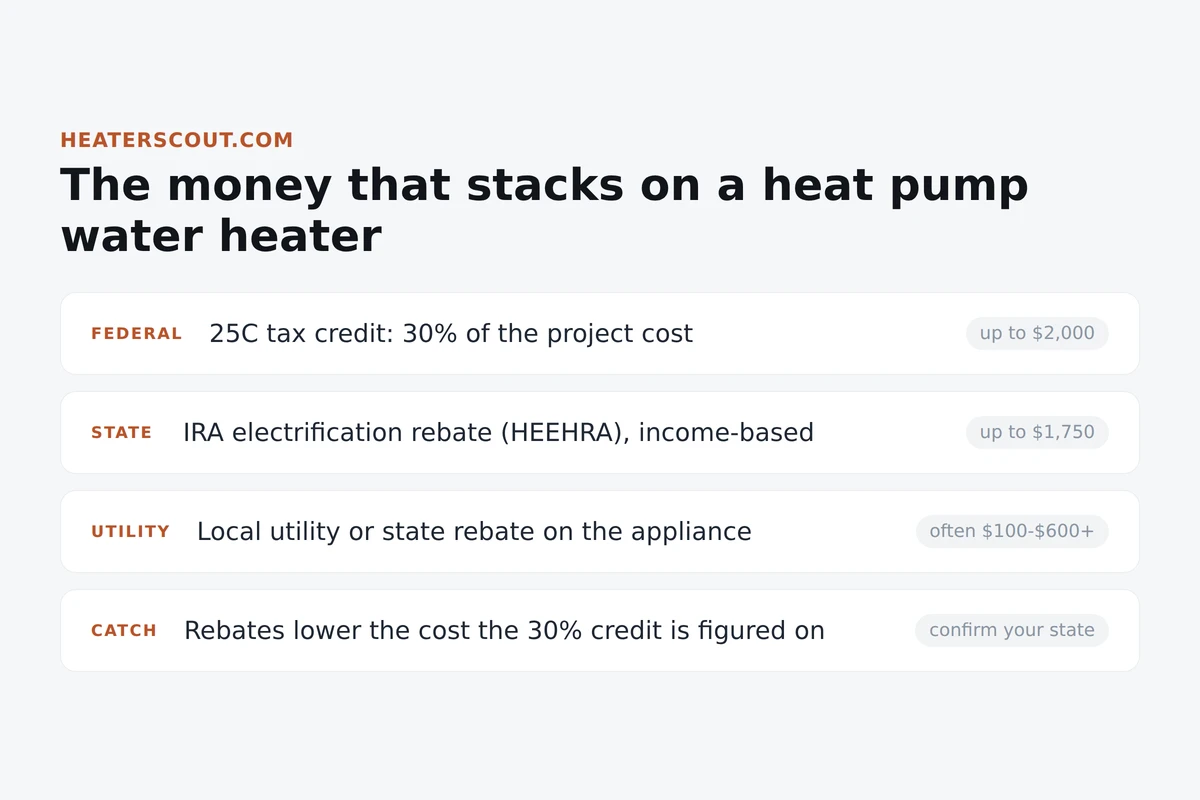
Between the federal credit and rebates, a homeowner can knock a large share off a heat-pump water heater. But the tax credit is nonrefundable, so it only helps up to the tax you owe, and rebate availability varies by state. Confirm your state's program status and your utility's rules before you buy, and keep every invoice.
Key takeaways
- The federal 25C credit is 30% of the project cost, up to $2,000 per year for a qualifying heat pump water heater.
- That $2,000 sits in its own bucket, separate from the $1,200 annual cap that covers other efficiency improvements.
- State HEEHRA/HEAR rebates can add up to $1,750 depending on household income, where the program is live.
- Utility rebates often stack on top of both the credit and the state rebate.
- Claim the federal credit on IRS Form 5695 for the year the unit is placed in service.
| Incentive | What it gives |
|---|---|
| Federal 25C tax credit | 30% of the project up to $2,000, no income limit, reduces the tax you owe. |
| IRA HEEHRA/HEAR rebate | Up to $1,750, income-based, state-administered; availability varies by state. |
| Utility / state rebate | Often $100-$600+, stacks on top of the credit and the state rebate. |
The federal tax credit: 30%, capped at $2,000
The big one is the 25C Energy Efficient Home Improvement Credit. For a qualifying heat-pump water heater it is worth 30% of the project cost, and the project cost includes both the equipment and the installation labor, not just the box. That 30% is capped at $2,000 per year for the heat-pump category. So a $6,000 job and a $12,000 job both max out at the same $2,000, while a $2,800 job returns the full $840 because it is under the cap.
One detail people miss and it works in your favor: that $2,000 heat-pump limit sits in its own bucket. The general 25C credit for other efficiency work, insulation, windows, doors, an electrical panel upgrade, is capped separately at $1,200 a year. A heat-pump water heater does not eat into that $1,200. If you upgrade the panel and add insulation in the same year you install the heater, you can be working toward both caps at once, up to a combined $3,200.
Two things to be clear-eyed about. It is nonrefundable, meaning it can wipe out tax you owe but it will not pay you cash beyond your liability. If your total tax bill for the year is $500, a $840 credit only saves you $500. And there is no income limit on the tax credit, unlike the rebates below, so high earners get the full 30% just the same.

Who qualifies for the credit
The rules on the tax credit are tighter than most people assume, and skipping one of them is how a claim gets denied. The unit has to be ENERGY STAR certified and meet the highest efficiency tier the CEE sets for its category. It has to go into an existing home that is your primary residence in the United States. That last part rules out new construction and rules out a rental you do not live in. Second homes are a gray area worth checking; the credit is aimed at the house you actually live in.
Starting with 2025 installs there is a new hoop: the product needs a qualified-manufacturer PIN, and that PIN has to be reported on your return. The manufacturer registers the model and issues the number. Practically, that means buying a model the maker has enrolled in the program and getting that PIN in your paperwork. Ask the installer or the retailer for it at the time of purchase, because chasing it down at tax time is miserable.
The nonrefundable trap
Because the credit only reduces tax you actually owe, retirees and lower-income households with little tax liability may not capture the full $2,000. And a rebate that lowers your purchase price also lowers the cost basis the 30% is figured on, so the two do not simply add. If your liability is small, the rebate path is often the better route, since a rebate is money off the price rather than a reduction of a tax bill you may not have.
The IRA rebates are a different animal
The Inflation Reduction Act funded a separate program from the tax credit: the Home Electrification and Appliance Rebates, often written HEEHRA or HEAR. For a heat-pump water heater it can cover up to $1,750, and unlike the credit it is means-tested. Households under 80% of area median income can have up to 100% of the project cost covered within that category cap. Households between 80% and 150% of area median income can get up to 50% covered. Above 150%, this particular rebate is not available, though the tax credit still is.
The complication is timing. These rebates are administered state by state, and every state stood up its program on its own schedule. Some are live and paying out. Some are still in setup. So the honest answer to "can I get the $1,750 rebate" is "check your state's energy office, because it depends on where you live and when you ask." Do not assume it exists in your state, and do not assume it does not. It is worth a five-minute look before you sign a quote.
Low-income household
The state rebate can cover up to 100% of the project cost within the category cap, so out-of-pocket can be close to nothing where the program is live.
Moderate-income household
The rebate can cover up to 50% of the cost, and the federal credit still applies on the remaining basis.
Higher-income household
No IRA rebate, but you still get the 30% federal credit up to $2,000, plus any utility rebate your provider offers.
Utility rebates stack on top
Below the federal credit and the state rebate sits a third layer that is easy to forget: your electric utility. Many utilities pay a rebate on a heat-pump water heater specifically because it shifts a home off resistance heating and helps their load. These are usually smaller, commonly $100 to $600 or more, and the amount is all over the map depending on the utility. Some require the unit to be installed by an approved contractor or to hit a minimum efficiency rating. The rebate form usually wants the model number and a copy of the invoice. Look up your utility's rebate page before you buy, because a few of them require pre-approval and will not pay retroactively.
How the three interact, and the one gotcha
Most of the time you can combine all three: claim the federal tax credit, take the state rebate, and collect the utility check. But there is a wrinkle worth understanding, because it changes the math. A rebate that reduces your purchase price also reduces the cost basis that the 30% credit is calculated on. In plain terms, if a rebate knocks $1,000 off the price at the register, the IRS treats your project cost as the lower, post-rebate number, and 30% of a smaller number is a smaller credit.
Run it through the earlier example. A $2,800 job with no rebate gives a $840 credit (30% of $2,800). If a state rebate cuts the price to $1,800 before you pay, the credit is figured on $1,800, so it becomes $540. You are still far ahead, you paid less out of pocket and got a credit, but you do not get to double-count the same dollar as both a rebate and a full 30% credit. The order and the paperwork matter, so keep every invoice and every rebate confirmation.
How to actually claim it
None of this is hard, but it is easy to lose a few hundred dollars by doing it out of order, missing the utility's pre-approval window, or buying a model without a registered PIN. Treat the paperwork as part of the project, not an afterthought, and the sticker price on that quote turns into a much smaller number by the time all three layers land.
Frequently asked
How much is the federal tax credit for a heat pump water heater?
It is 30% of the project cost, counting both the equipment and the installation labor, capped at $2,000 per year. A job under about $6,667 returns the full 30%; anything larger is limited to the $2,000 cap. It is a nonrefundable credit, so it reduces the tax you owe but does not pay cash beyond your liability, and it is claimed on IRS Form 5695 for the year the unit is placed in service.
Is there an income limit for the heat pump water heater tax credit?
No. The 25C federal tax credit has no income limit, so a high-earning household gets the full 30% just like anyone else. The income limits apply to the separate IRA rebate program (HEEHRA), not the tax credit. If your income is too high for the rebate, the tax credit is still fully available to you.
Can I combine the tax credit with a rebate?
Usually yes. You can typically claim the federal tax credit and also take a state IRA rebate and a utility rebate. The one catch: a rebate that lowers your purchase price also lowers the cost basis the 30% credit is figured on. So if a rebate cuts $1,000 off the price, the credit is calculated on the lower number. You still come out ahead, but you cannot count the same dollar as both a full rebate and a full 30% credit.
What is the $1,750 IRA rebate and can I get it?
The Home Electrification and Appliance Rebates program (HEEHRA) can cover up to $1,750 for a heat-pump water heater. It is income-based: households under 80% of area median income can get up to 100% of the cost covered within the cap, and those between 80% and 150% up to 50%. It is administered state by state on separate timelines, so whether you can get it depends on your state and whether its program is live yet. Check your state energy office.
What qualifies a heat pump water heater for the tax credit?
The unit must be ENERGY STAR certified and meet the highest applicable CEE efficiency tier, and it must be installed in an existing home that is your primary residence in the United States. New construction and rentals you do not live in generally do not qualify. Starting with 2025 installs, the product also needs a qualified-manufacturer PIN reported on your tax return, so buy an enrolled model and get that number in your paperwork.
How do I claim the heat pump water heater tax credit?
File IRS Form 5695 with your federal return for the tax year the unit was placed in service. Enter the project cost (equipment plus labor, reduced by any price-cutting rebate) and the manufacturer PIN for 2025 and later installs. Keep the itemized invoice and the ENERGY STAR certification. The credit then reduces the tax you owe on that year's return.
Does the tax credit give me cash back?
No. It is a nonrefundable credit, which means it can reduce your tax bill down to zero but will not pay you anything beyond what you owed. If your total tax liability is smaller than the credit, you only capture up to your liability. Households with little or no tax owed often do better through the price-cutting IRA rebate than through the credit, since a rebate is money off the purchase rather than a reduction of a bill you may not have.