A standard electric water heater turns one unit of electricity into a little under one unit of hot water. A heat pump water heater turns that same unit into three or four. That gap, a UEF of 0.92 against 3.5 or higher, is the entire argument, and it shows up on the utility bill as roughly a 70% cut in what you spend heating water. The catch is the sticker price up front, so the real question is not whether it saves money but how fast the savings pay back the difference.
A heat pump does not make heat, it moves heat. That is why one unit of electricity buys three or four units of hot water instead of one, and why the bill drops by two-thirds.
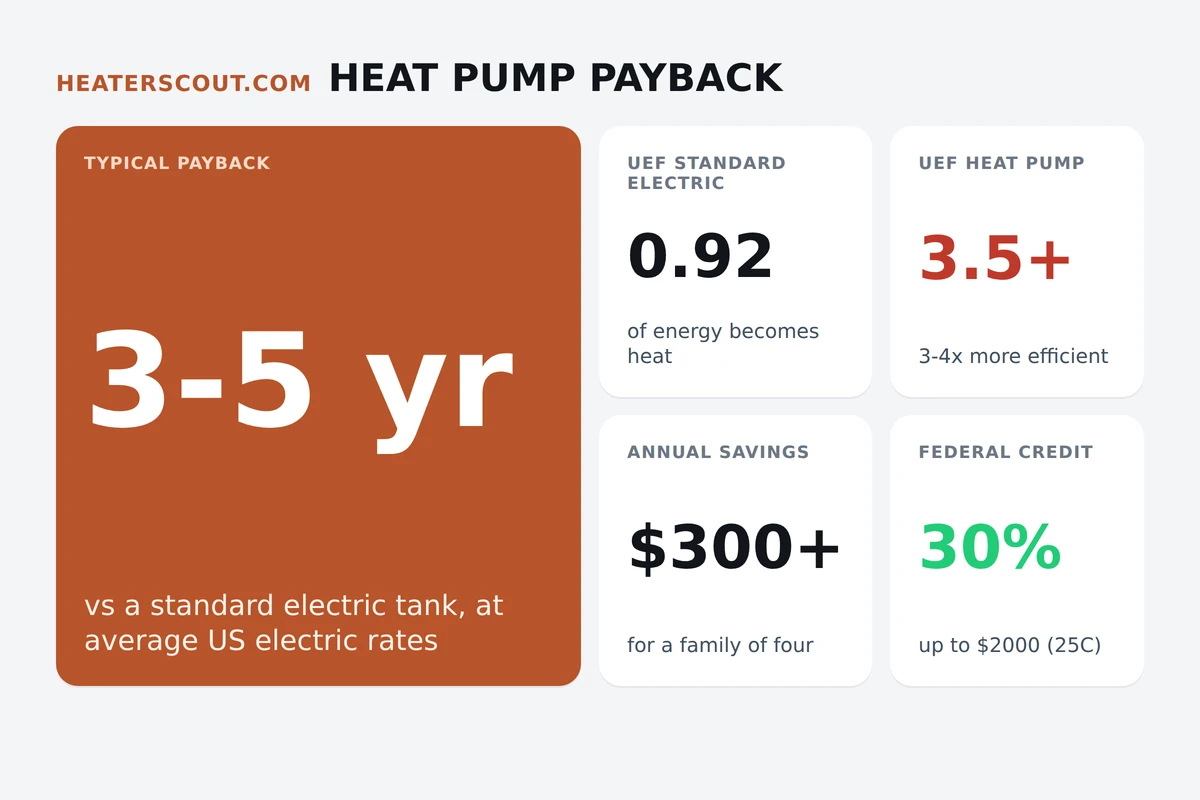
Where the savings actually come from
The efficiency number is not marketing. A resistance element is a coil that turns electricity straight into heat, and physics caps that at just under one to one, which is where the 0.92 UEF comes from. Standby and jacket losses eat the rest. There is no way to beat it with a better element, because you are already converting nearly all of the electricity to heat.
A heat pump plays a different game. It runs a small compressor and refrigerant loop, the same idea as your fridge or an air conditioner, and it pulls low-grade heat out of the room air and pumps it into the water. You still spend electricity, but only to run the pump, not to make the heat. That is why the output can be three to four times the electricity you put in. The extra comes from the air in the room, which is free. A UEF of 3.5 means 350% of the metered energy ends up in the tank, and that ratio is the whole reason the bill falls.
Put the two side by side on the same hot water demand. Say a household needs a fixed number of kWh of actual delivered heat each year. The resistance tank draws that heat divided by 0.92 off the meter. The heat pump draws the same heat divided by 3.5. Divide 0.92 by 3.5 and you get about 0.26, so the heat pump uses roughly a quarter of the electricity for identical hot water. That is the 70% reduction, and it holds regardless of your rate. Your rate only decides how many dollars that reduction is worth.
Run the payback for your house
The math is short. Each person in the house needs about 4 kWh of delivered hot-water heat a day, so multiply household size by 4 to get daily delivered kWh. Divide that by 0.92 for the resistance draw and by 3.5 for the heat pump draw, multiply each by 365 and by your rate, and subtract. The difference is your annual savings. Then take the price premium of the efficient unit, subtract the 30% federal credit (capped at 2000 dollars), and divide the net premium by the annual savings. That is your payback in years. The tool does all of it live.
Heat pump water heater payback calculator
Set your household size, electric rate, and the price premium of the heat pump unit over a standard tank. Output is annual savings, payback after the 30% federal credit, and your 10-year net position. Estimates, not a quote.
Annual savings
$300
Resistance cost minus heat pump cost
Payback
3.0 yr
Net premium after 30% credit
10-year net
+$1800
Savings over a decade, less net cost
—
| Standard electric UEF | About 0.92; nearly all electricity becomes heat, no room to improve |
| Heat pump UEF | 3.5 or higher; moves ambient heat, so output beats input 3 to 4 times |
| Electricity cut | Roughly 70% less for the same hot water |
| Annual savings | $300+ for a family of four at average US rates, more where power is expensive |
| Up-front premium | Often 2 to 3 times a plain tank, roughly $800 to $2500 before credit |
| Federal 25C credit | 30% of cost, capped at $2000/yr, claimed on IRS Form 5695 |
| Space needed | About 700 cubic feet of air, or a vented/louvered space |
| Exhaust | Blows cool, slightly dehumidified air; a low hum from the compressor |
What the sticker price hides
The premium is real and it is not small. A basic 50-gallon electric tank runs a few hundred dollars; a hybrid heat pump unit of the same capacity is commonly two to three times that before install. That gap is what the payback has to erase, and the federal credit does most of the heavy lifting. Thirty percent off, up to 2000 dollars, often cuts the effective premium roughly in half, which is why the credit turns a marginal five-year payback into an easy three-year one.
Space is the other cost that does not show on the price tag. The pump needs air to harvest heat from, on the order of 700 cubic feet, about a 10 by 10 room with a normal ceiling, or a louvered closet, garage, or basement. Wall it into a sealed mechanical closet and it starves, drops into resistance backup, and quietly runs like a plain electric tank, which defeats the point. It also exhausts cool, drier air and hums like a small fridge. In a hot garage that cool exhaust is a bonus. Next to a finished basement TV room it is a consideration.
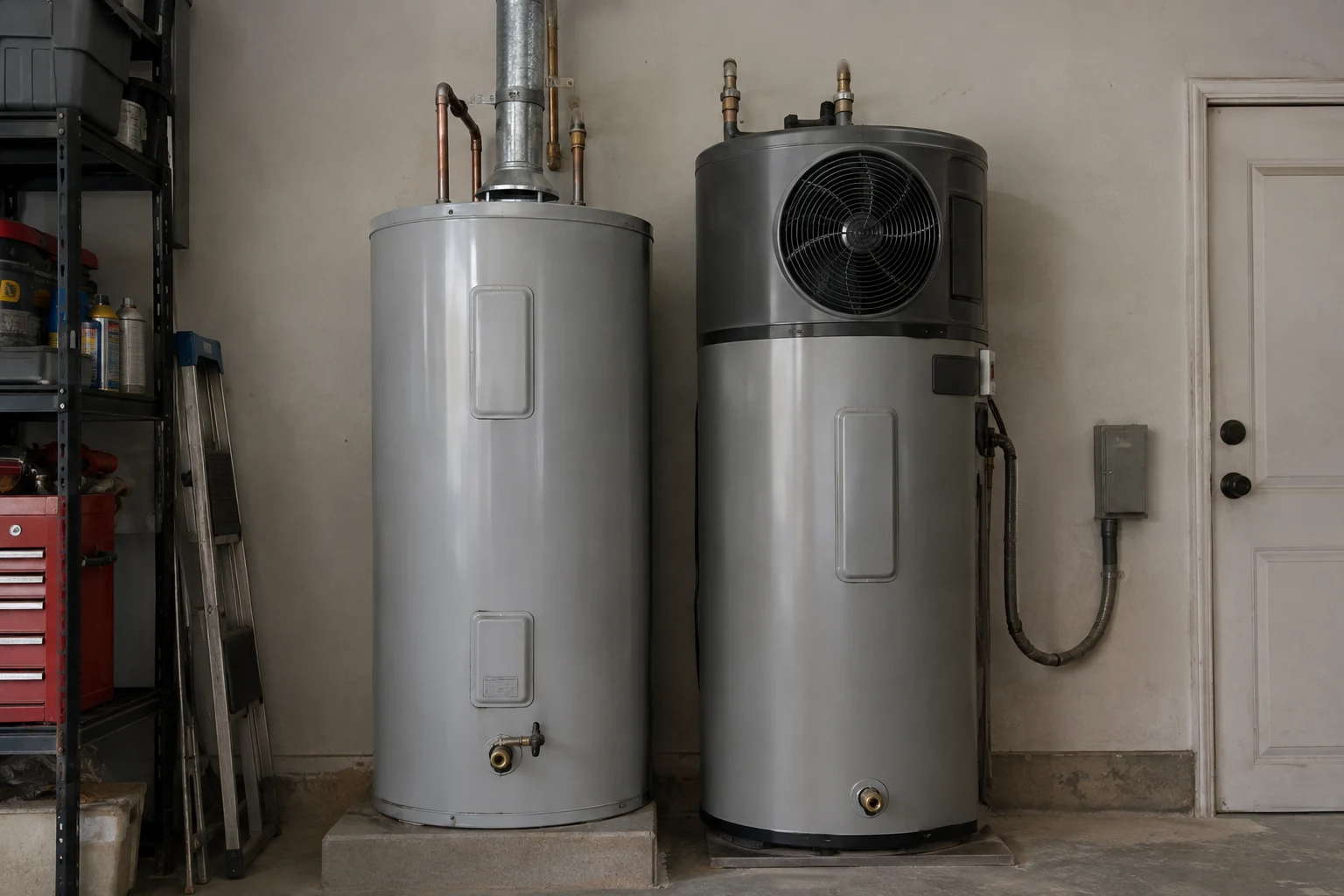
When the math does not work
Two situations flip the answer. The first is a very low electric rate. Because the savings are the electricity cut times your rate, a home paying 10 or 11 cents per kWh sees a smaller dollar gap, and the payback stretches past the point where it feels worth the hassle. The second is a house with no good place to put it: a small sealed closet, a tight condo mechanical room, a space that swings cold in winter and pushes the unit onto its resistance backup half the year. In those homes the efficiency you paid for never fully shows up.
Everywhere else, and that is most of the country now, the swap pays. Run your own rate and premium through the calculator before you decide, because the payback is sensitive to both, and the version in your head is probably conservative once the 30% credit is in the math.
Frequently asked
How long does a heat pump water heater take to pay for itself?
For a family of four on average US electricity rates, most hybrid heat pump water heaters pay back the price premium in three to five years, and faster after the 30% federal credit knocks the net cost down. The number swings on your electric rate more than anything else. At 12 cents per kWh the payback can drift past six or seven years; at 30 cents it can land under three. Since the heater itself lasts 10 to 15 years, a five-year payback means five to ten years of pure savings on the back end.
Why is a heat pump water heater so much more efficient than a regular electric tank?
A resistance tank turns electricity into heat directly, one unit in for a little under one unit of usable hot water, which is why its UEF sits around 0.92. A heat pump does not make heat, it moves heat, pulling warmth out of the surrounding air and pumping it into the water. That gets you three to four units of heat for every unit of electricity, a UEF of 3.5 or higher. Moving heat is just far cheaper than making it, and that ratio is the whole reason the utility bill drops about 70%.
What does UEF mean and why does the number matter for cost?
UEF is Uniform Energy Factor, the federal efficiency rating that tells you how much usable hot water you get per unit of energy. A UEF of 0.92 means about 92% of the electricity becomes hot water. A UEF of 3.5 means you get 350% out, because the extra comes from ambient air heat the pump harvests, not the meter. Your annual cost is basically the heat you use divided by UEF, times your rate. Same hot water, quadruple the UEF, roughly a quarter of the running cost.
How much space does a heat pump water heater need?
Plan on roughly 700 cubic feet of air around the unit, which is about a 10 by 10 room with an 8-foot ceiling, or a vented space, garage, or utility closet with a louvered door. The heat pump pulls heat from that air, so a sealed little closet starves it and forces it into backup resistance mode, which erases the efficiency you paid for. It also blows cool, slightly dehumidified air out the top, welcome in a hot garage, less so next to a finished basement living space.
Is the federal tax credit worth it, and how does the 25C credit work?
The 25C Energy Efficient Home Improvement Credit covers 30% of the cost of a qualifying heat pump water heater, capped at 2000 dollars per year. On a unit that runs 1500 to 2500 dollars installed, that is 450 to 750 dollars straight off your tax bill, which is often enough to cut the payback period in half. It is a nonrefundable credit you claim on your federal return with IRS Form 5695, and the unit has to meet the efficiency tier the program lists. Check for a state or utility rebate on top; many stack.
Does a heat pump water heater work in a cold basement or garage?
It works, but efficiency tracks the surrounding air temperature, because that air is its fuel. In a 50-degree basement it still runs well above a resistance tank. Below about 40 degrees most units lean on the resistance backup more often, so the average efficiency slips. If your install space swings cold, size the payback with a slightly lower effective UEF, or pick a model rated for low-ambient operation. The cool exhaust also means a garage install in a hot climate does you a small favor on summer cooling.
What is the downside of a heat pump water heater?
Three things weigh against it. It costs more up front, often two to three times the price of a plain electric tank before the credit. It needs that 700-plus cubic feet of air and makes cool exhaust and a low hum, so location matters. And recovery is slower on the efficient heat pump mode, though hybrid models switch to resistance to cover a big draw. None of these are dealbreakers for most homes, but a small mechanical closet, a very low electric rate, or a house that burns through hot water fast can push the math the wrong way.