There is a metal rod screwed into the top of your water heater whose entire job is to rot so the tank does not. It is called a sacrificial anode, and which type you put in decides whether your tank lasts eight years or fourteen — and whether your hot water smells like rotten eggs. There are three kinds, and they are not interchangeable.
Why the rod exists at all
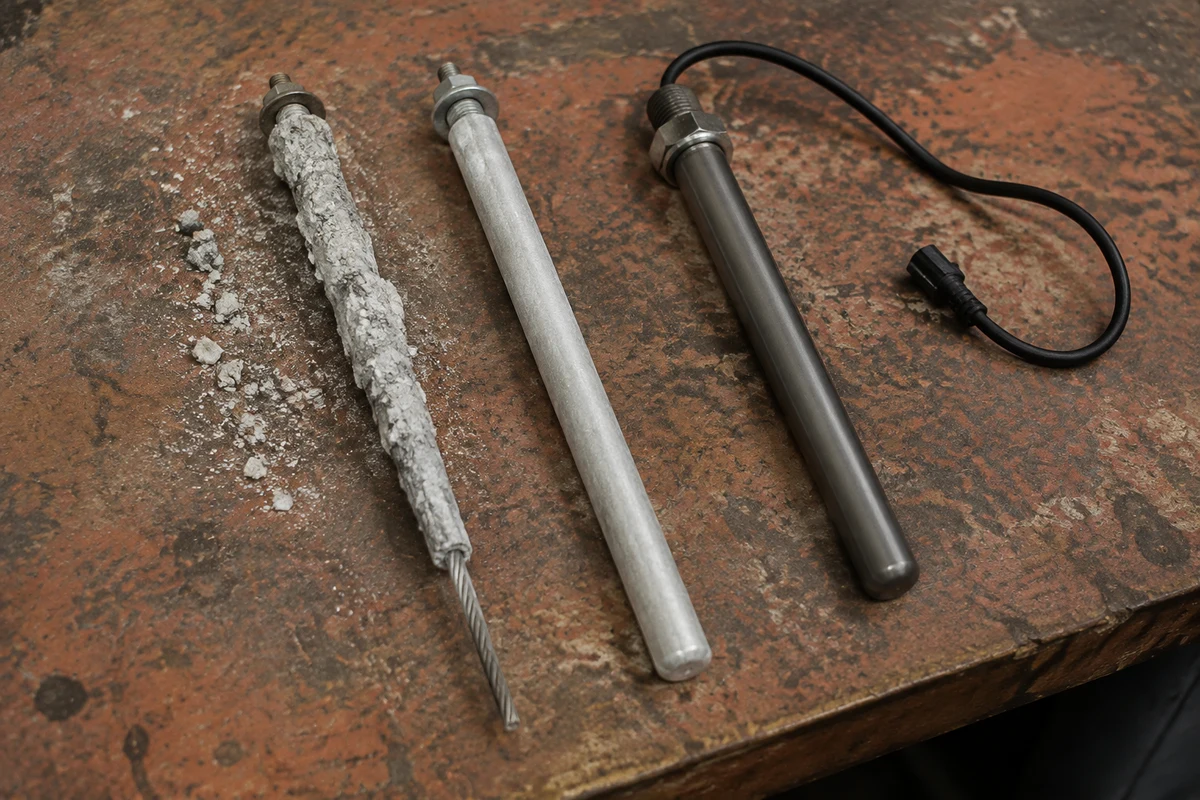
Inside a steel tank full of hot water, corrosion is inevitable. The anode rod is made of a metal more reactive than steel, so the water attacks it first. As long as the rod has metal left, the tank stays protected through a process called galvanic corrosion — the more reactive metal gives itself up to spare the less reactive steel. Once the rod is eaten down to the steel core wire, the tank itself becomes the sacrifice, and that is when tanks start leaking. Replacing a $30 rod on schedule is the single cheapest thing you can do to double a water heater's life.
Magnesium: the best protection, the shortest life
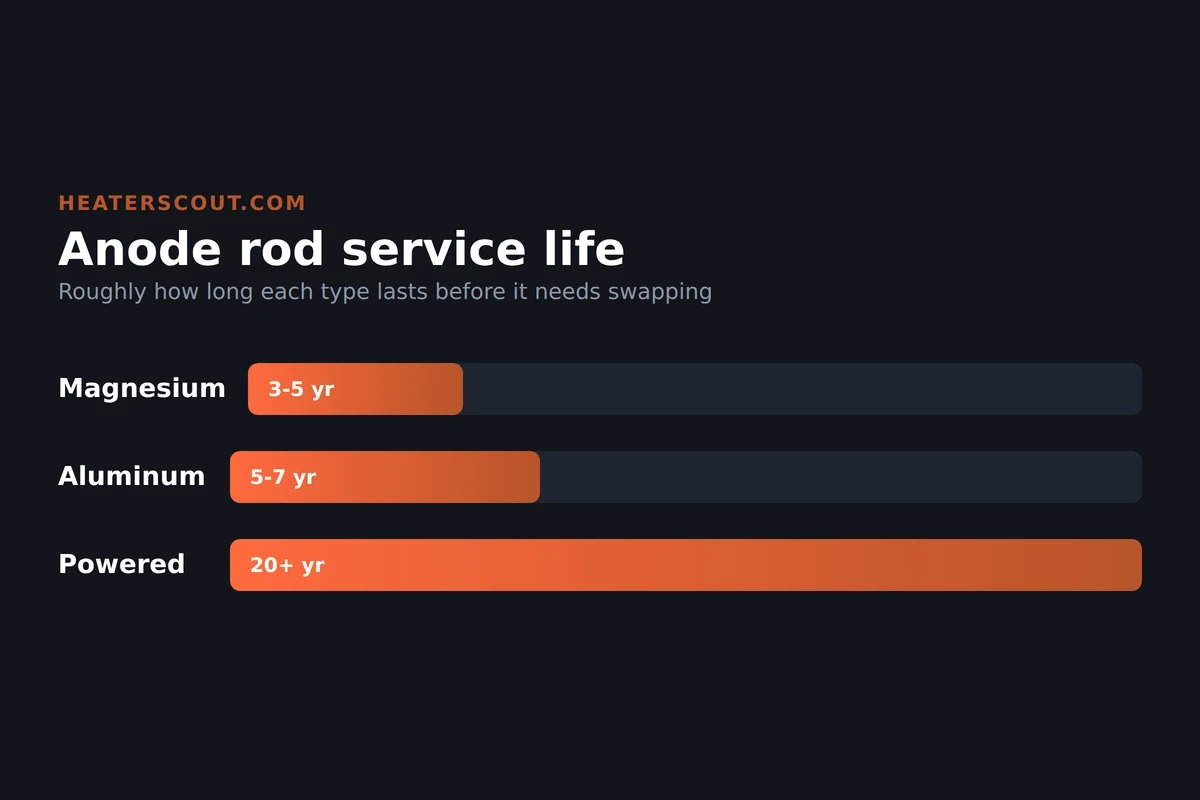
Magnesium is the most reactive of the three, which makes it the most protective. In soft or normal water it guards the tank aggressively and is the default choice most manufacturers ship. The trade-off is that being reactive means it wears out faster — typically three to five years — and in hard water it can be gone in two.
Magnesium has one more quirk: it is the usual source of the rotten-egg smell. In water with certain bacteria and sulfates, the magnesium reaction feeds sulfate-reducing bacteria that produce hydrogen sulfide gas. If your hot water stinks and your cold does not, a magnesium anode is the prime suspect. We break that problem down in rotten-egg smell from hot water.
Aluminum (usually aluminum-zinc): the hard-water choice
Aluminum anodes are less reactive than magnesium, so they protect a little less aggressively but last longer, often five to seven years, and they hold up far better in hard water. Most aluminum rods sold today are actually an aluminum-zinc alloy, and that zinc is the point: it is the standard fix for a smelly tank. Swapping a magnesium rod for aluminum-zinc clears up most rotten-egg cases.
The caution people raise is the aluminum sludge that collects in the tank bottom as the rod corrodes. It is inert, but some prefer not to have it, and it is one more reason to flush the tank on schedule. Aluminum is also usually a dollar or two cheaper than magnesium. One health note that comes up: because of old concerns about aluminum in drinking water, many people avoid aluminum rods on the tank that feeds their drinking tap. The science is not settled, but if it bothers you, that is a reason to lean magnesium or powered.
Powered (impressed-current): install it once
A powered anode is a different animal. Instead of a sacrificial metal, it is a titanium rod driven by a small plug-in power supply that continuously feeds a protective current into the tank. Nothing is consumed, so it does not deplete — a powered anode routinely lasts twenty years or more, effectively the life of the tank. It also stops the rotten-egg smell outright, because there is no reactive metal feeding the bacteria.
The downsides are the price, roughly $60–$150 versus $20–$40 for a sacrificial rod, and the need for a nearby outlet. For anyone tired of replacing rods, or fighting a stubborn smell, it is the buy-once answer. It also fits tanks in tight closets, since a flexible or segmented powered anode can go in where a rigid 40-inch rod cannot.
Straight comparison
| Type | Typical life | Best for | Rough cost |
|---|---|---|---|
| Magnesium | 3–5 yr | Soft/normal water, max protection | $20–$40 |
| Aluminum-zinc | 5–7 yr | Hard water, smell fix | $20–$40 |
| Powered | 20+ yr | Buy-once, stubborn smell | $60–$150 |
A note on the rod shape, not just the metal
Two things about the physical rod trip people up when they go to buy. First, tight installs: if there is not 40-plus inches of clearance above the tank, a rigid rod will not come out or go back in, and you want a segmented (linked) rod that folds at the joints, or a powered one. Second, the combo anode: some tanks hide the anode inside the hot-water outlet nipple instead of a separate port. If you cannot find a hex head on top, you likely have a combo rod, and replacement means a different part. Match the metal to your water, but match the shape to your space.
How to know when to check it
For a sacrificial rod, pull and inspect it every two to three years. If more than about six inches of the steel core wire is exposed, or the rod is caked and thinned, replace it. In hard water, check yearly — see hard water and water heaters for why scale accelerates everything. A powered anode has a small indicator light or meter on its controller: if the light says it is working, the tank is protected, and there is nothing to pull. When you do replace a sacrificial rod, our step-by-step on how to replace an anode rod covers the breaker-bar trick for a stuck one.
How to inspect the rod in ten minutes
You do not have to fully drain the tank to check the anode. The quick version:
Wrap the threads in PTFE tape on the way back in, and do not overtighten. If the rod is fused solid and will not budge, that is a sign it has been in far too long — and a good moment to switch to a powered anode so you never fight it again.
Signs the rod is already gone
Most people never look at the anode until a symptom shows up. Watch for these: a sudden rotten-egg smell on the hot side only, rusty or brown hot water, or a tank that has quietly passed the six-year mark with no service. Any of those is a cue to pull the rod. By the time the tank itself is weeping from a seam, the anode has usually been spent for years and it is too late to save that heater. The rod is cheap insurance precisely because it warns you before the expensive part fails.
Frequently asked
What are the three types of water heater anode rods?
Magnesium, aluminum (usually an aluminum-zinc alloy), and powered (impressed-current). Magnesium gives the strongest protection but the shortest life. Aluminum-zinc lasts longer and suits hard water and smell problems. A powered anode uses a plug-in current, never depletes, and lasts 20-plus years.
Which anode rod stops the rotten-egg smell?
An aluminum-zinc rod fixes most sulfur-smell cases, because the zinc disrupts the reaction that produces hydrogen sulfide gas. A powered anode stops it completely, since it has no reactive metal to feed the bacteria. A plain magnesium rod is the usual cause of the smell.
How long does a water heater anode rod last?
A magnesium rod typically lasts 3 to 5 years, an aluminum-zinc rod 5 to 7 years, and both wear faster in hard water. A powered anode does not deplete and commonly lasts 20 years or more. Inspect a sacrificial rod every 2 to 3 years, or yearly with hard water.
Is a magnesium or aluminum anode better?
It depends on your water. Magnesium protects the tank more aggressively and is best for soft or normal water. Aluminum-zinc lasts longer, handles hard water better, and is the standard fix for a smelly tank. Neither is universally better; match the rod to your water.
Are powered anode rods worth it?
For hard water, a stubborn rotten-egg smell, or anyone tired of replacing rods, yes. A powered anode costs more up front ($60 to $150) and needs an outlet, but it never depletes, protects for the life of the tank, and eliminates the sulfur smell. For soft water with no issues, a cheap sacrificial rod is fine.
What happens if I never replace the anode rod?
Once the rod is fully consumed, the tank steel becomes the next thing to corrode. That is when water heaters rust through and start leaking, usually years earlier than they should. Replacing a worn anode on schedule is the cheapest way to extend a tank's life.
What if there isn't enough room above the tank to pull the rod?
Use a segmented or linked anode that folds at its joints, or switch to a flexible powered anode. Both fit where a rigid 40-inch rod cannot come out. If you can't find a hex head on top of the tank at all, your anode is likely built into the hot-water outlet nipple, which needs a different combo part.