Quick answer
That rotten-egg smell is hydrogen sulfide gas. The first question is whether it comes from your heater or your water supply, and one quick check settles it: does the cold water smell too? Hot-only means the tank — bacteria reacting with the anode rod. Both taps means the smell is in your water before it ever reaches the heater. Everything you do next depends on that answer.
The problem
Magnesium anode feeds the smell
Magnesium rod · most active
- 100–140°Fthe range where sulfate-reducing bacteria thrive in a warm tank
- H₂Shydrogen from the rod lets bacteria turn sulfate into rotten-egg gas
The fix
Swap the anode, flush the tank
Aluminum-zinc or powered rod
- ~1 pthydrogen peroxide per 20 gallons, or 0.5–1 gal chlorine, dwell 3+ hours
- Zincthe aluminum-zinc rod suppresses H₂S; go powered if it persists
A sulfur smell from your taps is easy to fix once you know where it’s coming from, and easy to chase in circles if you don’t. Plenty of people replace a water heater over a smell that was actually in their well. Start with the diagnosis.
First: is it the heater or the water?
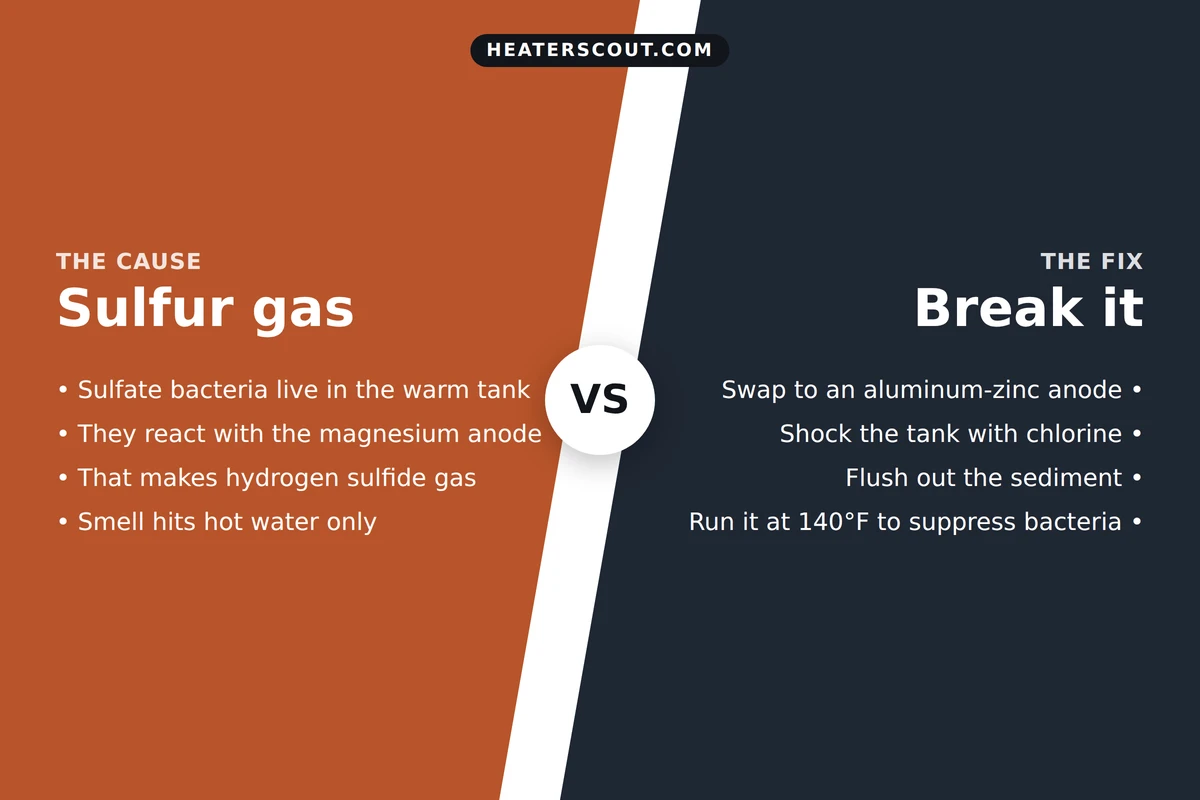
Hydrogen sulfide needs three things to form in your tank: sulfur in the water, a source of hydrogen, and sulfate-reducing bacteria. The tank supplies all three — it’s warm, low in oxygen, and the magnesium anode rod releases the hydrogen that drives the reaction. The cold line has none of that, so a heater-side problem smells only on the hot side. Check where you actually smell it.
Where do you smell rotten eggs?
Nothing selected
Check the tap or taps where you smell rotten eggs to get a diagnosis.
When it’s the heater: the anode and the bacteria
Inside the tank, sulfate-reducing bacteria feed on sulfates naturally present in the water. The sacrificial anode rod — there to corrode so your steel tank doesn’t — gives off hydrogen as it works, and that hydrogen is exactly what the bacteria use to convert sulfate into hydrogen sulfide. The result is the smell. This is why the fix targets both the bacteria and the anode.
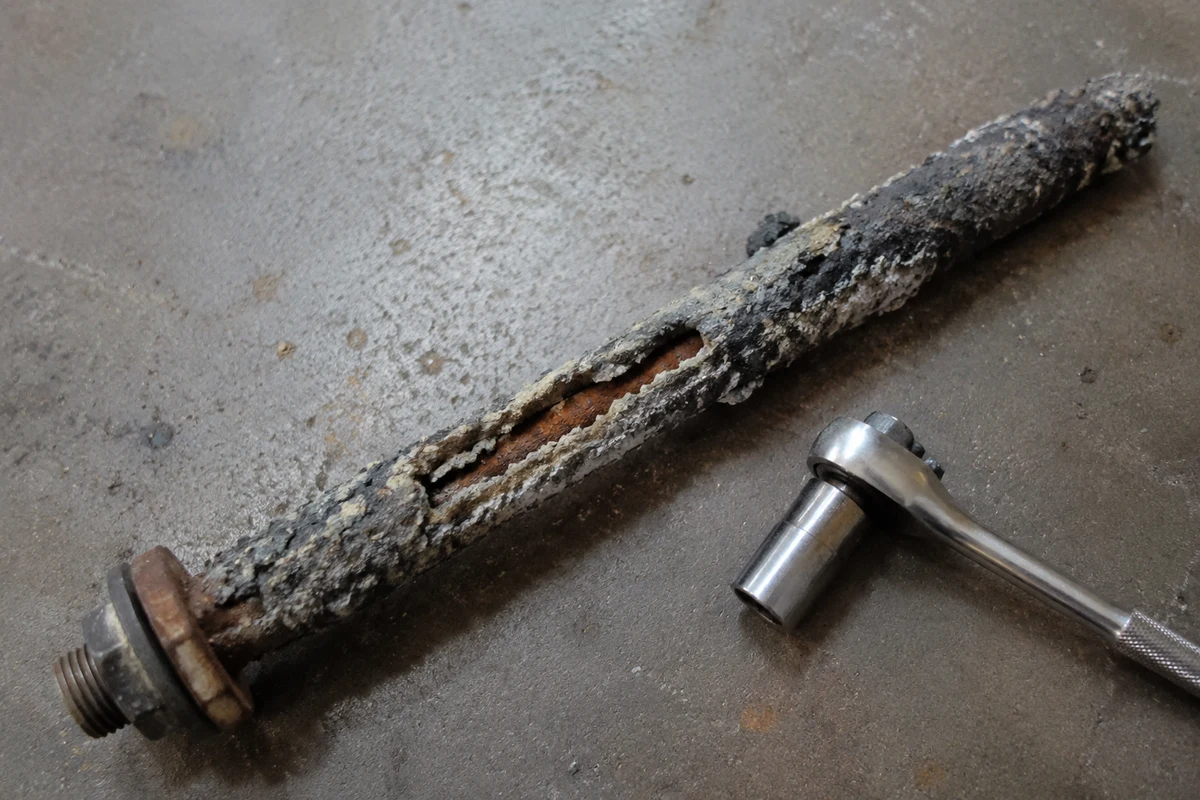
Magnesium anodes are the worst offenders because they’re the most chemically active, so they generate the most hydrogen. That gives you a clear upgrade path.
Fixing a smelly tank, in order
- Disinfect the tank. Kill the bacteria colony. You can flush and add hydrogen peroxide (about a pint per 20 gallons) or chlorine bleach (roughly half a gallon to a gallon fed through the hot outlet), let it dwell at least three hours — ideally most of a day — then flush it out. Peroxide is the gentler, safer choice.
- Swap the anode rod. Replace the magnesium rod with an aluminum-zinc alloy rod. The zinc suppresses hydrogen sulfide, and this is usually the permanent fix. Don’t simply remove the anode — that leaves the tank unprotected and voids most warranties.
- Go powered if the smell persists. On softened water, aluminum-zinc sometimes isn’t enough. A powered (impressed-current) anode uses no sacrificial metal at all and actively discourages the bacteria. It’s the strongest option and the one that solves stubborn cases.
- Raise the temperature temporarily. Sulfate-reducing bacteria thrive between about 100 and 140°F. Cranking the tank to 160°F for a few hours helps knock them back — but 160°F water scalds in about a second, so warn everyone in the house and drop it back to 120°F afterward.
| Setting / dose | Value |
|---|---|
| Bacteria thrive | 100–140°F |
| Temporary kill temp | ~160°F for several hours |
| Hydrogen peroxide | ~1 pint per 20 gallons |
| Chlorine bleach | ~0.5–1 gallon, dwell 3+ hours |
| Best anode swap | Aluminum-zinc, or powered |
How the disinfection actually goes
The disinfect step trips people up, so here’s the shape of it. Turn off the heater — gas to pilot, or the breaker off for electric. Shut the cold inlet and open a hot tap upstairs to break the vacuum. Drain a few gallons from the tank so you have room, then introduce your peroxide or bleach through the anode port or the hot-water outlet. Close everything, refill the tank fully so the solution reaches the top, and let it sit. Peroxide wants at least three hours; overnight is better. Then run every hot tap in the house until you no longer smell the chemical, which also carries the solution through the pipes where bacteria may be living. Only after the tank is full again do you relight or re-energize — an electric element fired in a half-empty tank burns out in seconds.
If the smell is gone for a few days and then creeps back, that’s your signal the anode still needs changing. Disinfection buys time; the anode swap is what keeps it gone.
When it’s the water supply
If both taps smell, or the odor is worse on a well and eases as you run the water, the hydrogen sulfide is in your source, not your heater. Two common cases:
- Sulfur bacteria in a well or plumbing. The standard fix is to shock-chlorinate the well — a strong chlorine dose left to circulate and dwell, then flushed. It often needs repeating.
- Dissolved hydrogen sulfide in the groundwater. When the gas is simply in the aquifer, no amount of tank work helps. You need whole-house treatment, typically an aeration or oxidizing filter ahead of the plumbing.
- A water softener harboring bacteria. If the smell tracks with softened water, the softener itself can host the bacteria and needs sanitizing.
A five-minute test before you spend a dime
You can pin down the source yourself in one evening. Run each tap for 30 seconds and smell it deliberately — hot at the kitchen, cold at the kitchen, then a bathroom or two. Then step through these:
- Hot smells, cold is clean. Heater-side. Move on to the disinfect-and-anode fix. You don’t need whole-house treatment.
- Both smell, and it fades as the water runs. Supply-side, and the source is close — think a well that’s picking up sulfur bacteria. Shock-chlorination is the usual answer.
- Both smell, steady, and never clears. Dissolved gas in the aquifer itself. This is the whole-house-treatment case.
- The smell tracks with softened water only. Suspect the softener resin bed harboring bacteria; sanitize it before blaming the heater.
Filling a glass and carrying it to another room helps too: if the odor disappears once you’re away from the drain, you may be smelling the P-trap under the sink rather than the water at all. That mistake sends people down a very expensive rabbit hole.
Why softened water makes it worse
Ion-exchange softeners swap the calcium and magnesium in your water for sodium. That leaves the water more corrosive to the anode rod, which speeds up hydrogen production and feeds the bacteria — so a house with a softener is more likely to develop the smell, and more likely to have a plain aluminum-zinc rod fall short. On softened supplies, a powered anode is often the only fix that lasts. If you soften your water and keep chasing the odor, stop swapping sacrificial rods and go powered.
What it costs and how long it lasts
A disinfection is essentially free beyond a bottle of peroxide. An aluminum-zinc anode is an inexpensive part and an hour of work if the old rod isn’t seized. A powered anode costs more up front but never needs replacing, which is why it pays off on problem water. The pattern to avoid is disinfecting alone: it clears the smell for a week or two, the colony rebuilds, and you’re back where you started — convinced the tank is failing when it just needs the right anode.
Is smelly water dangerous?
At household levels, hydrogen sulfide is mostly a nuisance — your nose detects it far below any harmful concentration, so if you can just smell it, it isn’t poisoning you. The real caution is ventilation: in a closed basement or well pit the gas can build to irritating or, rarely, dangerous levels, so keep the space aired out while you work. And never mix bleach with other cleaning chemicals when you disinfect.
Frequently asked
Is sulfur-smelling hot water safe to drink or shower in?
At the levels you can smell, it’s generally not harmful — the nose detects hydrogen sulfide far below any dangerous concentration. It’s unpleasant rather than toxic. The main caution is ventilating enclosed spaces like basements or well pits, where the gas can concentrate. If the water also tastes metallic or you suspect other contamination, get it tested.
Why does only my hot water smell like rotten eggs?
Because the smell is made inside the tank. The warm, low-oxygen environment plus the hydrogen from the sacrificial anode rod lets sulfate-reducing bacteria produce hydrogen sulfide gas. The cold line has none of those conditions, so it stays odor-free. Hot-only is the classic sign of a heater-side problem.
Which anode rod stops the sulfur smell?
An aluminum-zinc alloy rod usually does it — the zinc suppresses hydrogen sulfide. On softened water where that isn’t enough, a powered (impressed-current) anode, which uses no sacrificial metal, is the strongest fix. Avoid plain magnesium, which is the most likely to feed the smell.
Will the smell come back after I flush and disinfect?
It can, if you disinfect but leave the original magnesium anode in place — the bacteria simply recolonize. Pairing a disinfection with an anode swap to aluminum-zinc or a powered rod is what makes the fix stick. On well water, shock-chlorination may need repeating.
Can I just remove the anode rod to stop the smell?
Don’t. The anode is what keeps the steel tank from rusting through; pull it and the tank corrodes far faster, and you void most warranties. Replace it with a smell-resistant type instead of removing it.
Both my hot and cold water smell — is it still the heater?
No. If both sides smell, the hydrogen sulfide is in your water before it reaches the heater, usually sulfur bacteria in a well or dissolved gas in the groundwater. Shock-chlorinate a well, or install whole-house treatment. Working on the heater won’t change a supply-side smell.