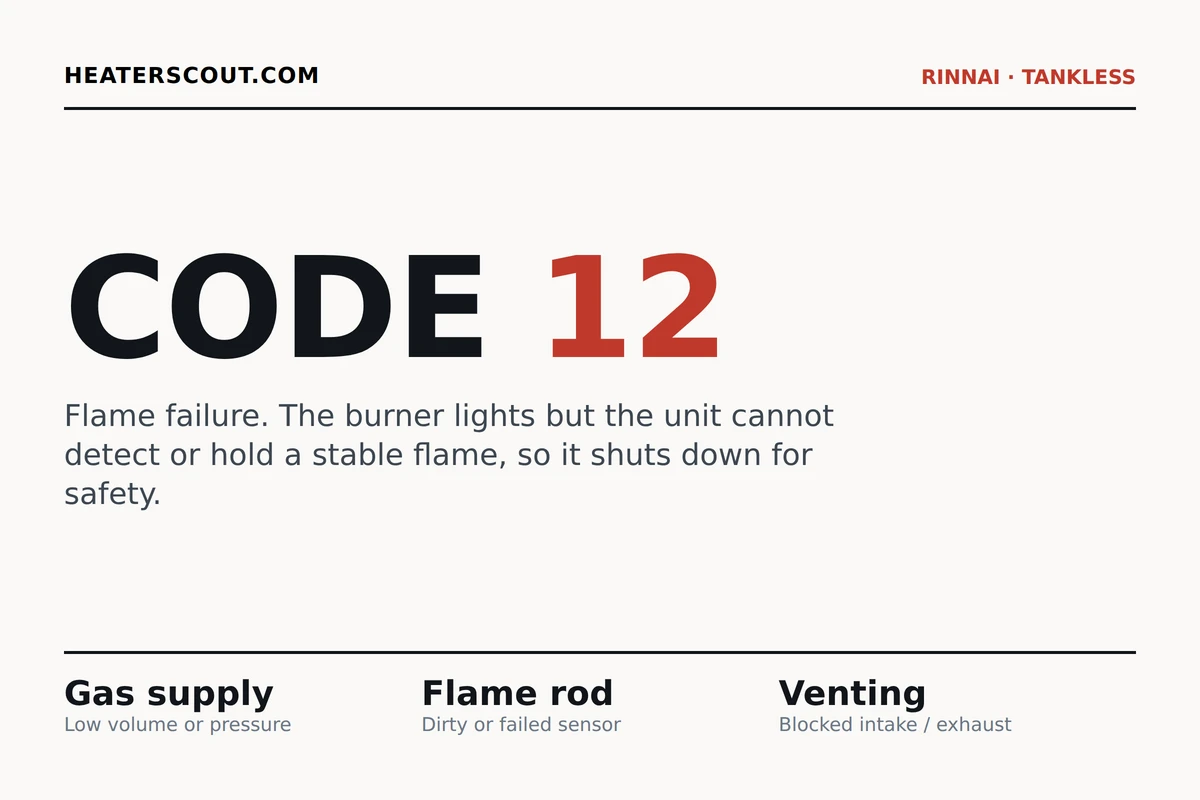
Code 12 on a Rinnai tankless heater is a flame failure. The igniter fires, the burner lights for a moment, then the unit cannot confirm a steady flame and cuts the gas. It is a safety shutdown, not a random glitch, and it almost always points to gas getting to the burner or the sensor that watches the flame.
What the unit is telling you
Rinnai heaters light the burner, then use a flame rod to sense the tiny electrical current that a real flame conducts. If the controller does not see that signal within a set window, it assumes the burner did not light or the flame died, shuts the gas valve, and throws Code 12. The order matters: the unit tried to fire and could not sustain it. So the question is never "why won't it turn on" — it is "why can't it keep a flame." Keep that framing and the checklist writes itself.
Start with the free checks, in this order
1. Is the gas actually on and healthy?
Confirm the manual gas valve at the heater is fully open, not half-turned. Then run another gas appliance in the house — a stove burner or the furnace. If that flame is weak and yellow, or the stove struggles too, the problem is gas supply to the whole house, not the heater. On propane, check the tank level: a nearly empty LP tank drops pressure and starves the burner, and Code 12 is one of the first symptoms to appear.
2. Did it start after cold weather or heavy demand?
Undersized or long gas lines can deliver enough for one appliance but not for the tankless heater at full fire, especially when the furnace kicks on at the same time. A tankless unit can demand 120,000 to 199,000 BTU wide open — several times what a tank heater draws — so a line that was fine for the old heater may choke this one. If Code 12 shows up only during high demand or a cold snap, suspect gas volume, not the heater itself.
3. Is the intake or exhaust blocked?
A tankless burner needs clean combustion air and a clear exhaust. A wasp nest, snow drift, leaves, or lint over the outdoor termination chokes the flame and trips Code 12. Walk outside and look at the vent caps. Clear anything covering them, and make sure the intake is not pulling from a spot that just got boxed in by new landscaping or a stacked woodpile.
When it is the flame rod
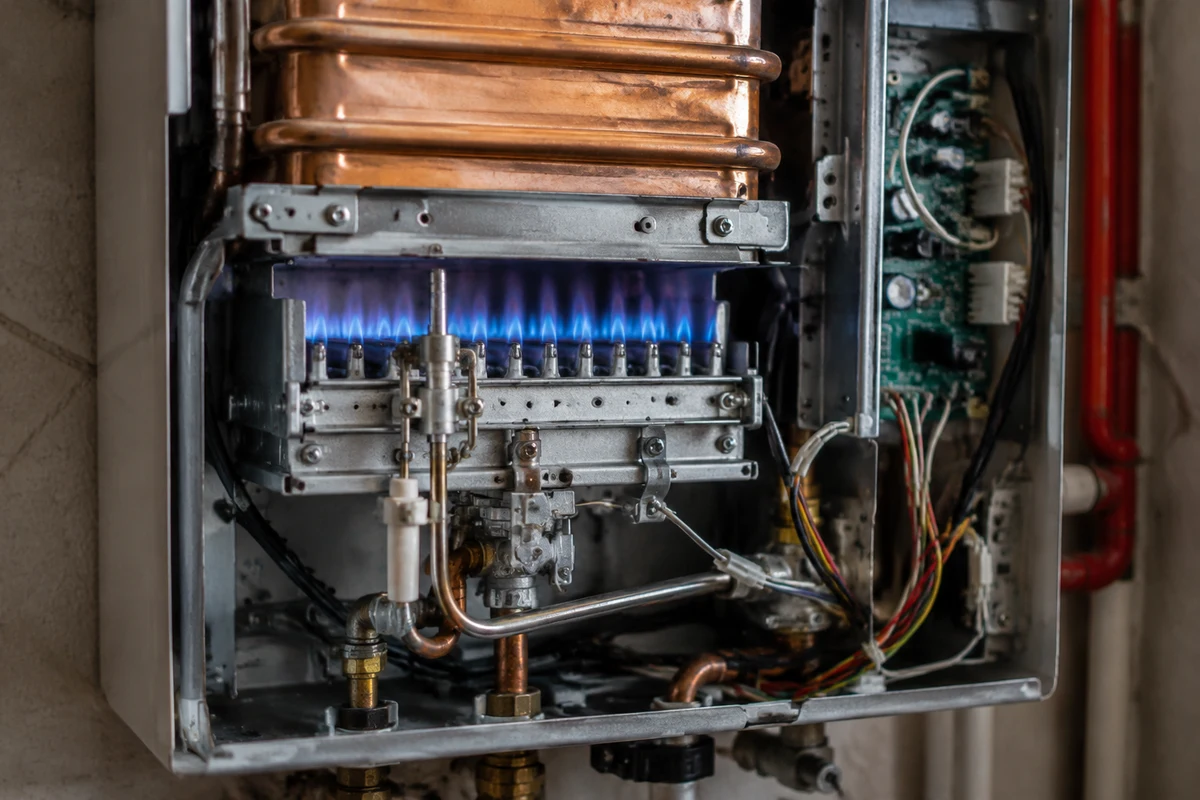
If gas and venting check out and Code 12 keeps returning, the flame-sensing rod is the usual culprit. Over time it gets coated with a thin oxide or scale film, and a dirty rod cannot read the flame current even when the flame is right there in front of it. On many Rinnai models this is a serviceable part: with the gas and power off, the rod can be removed and gently cleaned with fine abrasive, then refitted. If cleaning does not hold, the rod or the igniter assembly is failing and needs replacing. This is the same sensing principle behind a gas tank heater's thermocouple, so if you have fought pilot problems before, the logic will feel familiar.
How Code 12 differs from a hard-start
People confuse a flame failure with a unit that never lights at all. Watch the sequence when you open a hot tap. If you hear the igniter click and the burner catch for a second before the display flips to 12, that is a true flame failure: ignition works, flame retention does not. If there is no ignition sound and no attempt, you are more likely looking at a gas-off condition, a tripped safety, or a control issue. The one-second-of-flame-then-shutdown pattern is the signature of Code 12 specifically.
The pattern that means "call a pro"
Reset the heater and run hot water. If Code 12 clears and does not come back, a temporary gas or venting hiccup caused it and you are done. If it returns within a few cycles after you have confirmed gas is on, other appliances burn cleanly, and the vents are clear, stop guessing. A recurring Code 12 with good gas and clear venting usually means a manifold gas-pressure problem, an undersized gas line, or a failing flame rod or igniter — all of which want a manometer and a technician, not another reset. A pro will check inlet and manifold pressure in minutes, which is the one measurement a homeowner cannot safely take.
What Code 12 is not
It is not a scale or water-flow fault — those show up as different codes such as 10, 11, or 16 on Rinnai units. Code 12 is specifically about the flame. Chasing descaling or water filters when the display reads 12 wastes an afternoon. Fix the combustion side: gas, then venting, then the flame rod. If your unit is actually throwing a different number, the cause and the fix change, so read the exact code off the panel before you start.
The real-world causes, ranked
Across service calls, Code 12 falls out in a fairly predictable order. Working from most to least common saves time:
Notice that the first two buckets cover most cases and cost nothing but time. Do not jump to "the board is bad" until gas and venting are confirmed good.
New install throwing Code 12 right away?
A brand-new tankless unit that codes 12 on the first cold day almost always has a supply problem, not a defect. The usual suspects: a gas line reused from a low-BTU tank heater that cannot feed the tankless at full fire, a gas meter or regulator that is undersized for the added load, or air still in a propane line after a fill. When the whole house's gas demand peaks — tankless plus furnace plus range — the pressure sags and the flame drops out. This is why sizing the gas supply to the tankless BTU rating matters as much as the unit itself, and why a rushed swap without checking line size comes back as Code 12.
Before you call a technician
Have these answers ready and the visit goes faster and cheaper: Is this a new install or an existing unit that just started? Does it code every time or only under heavy demand or in cold weather? Do other gas appliances burn a clean blue flame? Natural gas or propane, and if propane, how full is the tank? Are the outdoor vent caps clear? A tech who hears "existing unit, only during morning showers in winter, furnace runs at the same time, other appliances fine" already knows to bring a manometer and check gas volume, instead of guessing at parts.
Frequently asked
What does error code 12 mean on a Rinnai tankless water heater?
Code 12 is a flame failure. The burner ignites but the unit cannot detect or sustain a stable flame, so it shuts the gas off for safety. It usually points to a gas supply problem, a dirty or failed flame-sensing rod, or a blocked air intake or exhaust.
How do I fix Rinnai code 12 myself?
Work in order: confirm the gas valve at the heater is fully open, verify other gas appliances burn cleanly, check the propane level if you are on LP, and clear anything blocking the outdoor intake and exhaust caps. If it keeps coming back, the flame rod likely needs cleaning or replacing, which is a job for a licensed tech.
Why does Rinnai code 12 happen only in cold weather or during heavy use?
That pattern points to gas volume. An undersized or long gas line can feed one appliance but not the tankless heater at full fire, especially when the furnace runs at the same time. The burner cannot hold a flame and trips Code 12. A technician can confirm gas line sizing and inlet pressure.
Can a dirty flame rod cause code 12?
Yes. The flame rod senses the electrical current a real flame conducts. When it gets coated with oxide or scale, it stops reading the flame even when the burner is lit, and the controller shuts down with Code 12. Cleaning the rod often fixes it; a rod that fails again needs replacing.
Is Rinnai code 12 dangerous?
The code itself is a safety response, not a hazard, because the heater shuts the gas off when it cannot confirm a flame. The underlying cause matters, though. A blocked exhaust or a gas supply fault should be corrected before repeated relighting, and any work involving the gas valve should be done with the gas and power off.
How is Rinnai code 12 different from a unit that won't ignite at all?
Listen to the startup. Code 12 is a flame failure, so you hear the igniter click and the burner catch for about a second before the display shows 12. A unit that makes no ignition attempt at all is usually a gas-off, tripped-safety, or control problem rather than a flame-retention issue.