Quick answer
Navien error E003 (sometimes shown E03) means ignition failure: the unit ran its lighting sequence but the flame rod never detected a flame, so it locked out rather than release unburned gas. The most common real-world causes are simple — gas turned off, a closed valve, or air in the line after a propane tank ran empty. Work through the safe checks below; if it still fails, the remaining causes need a technician with a gas gauge.
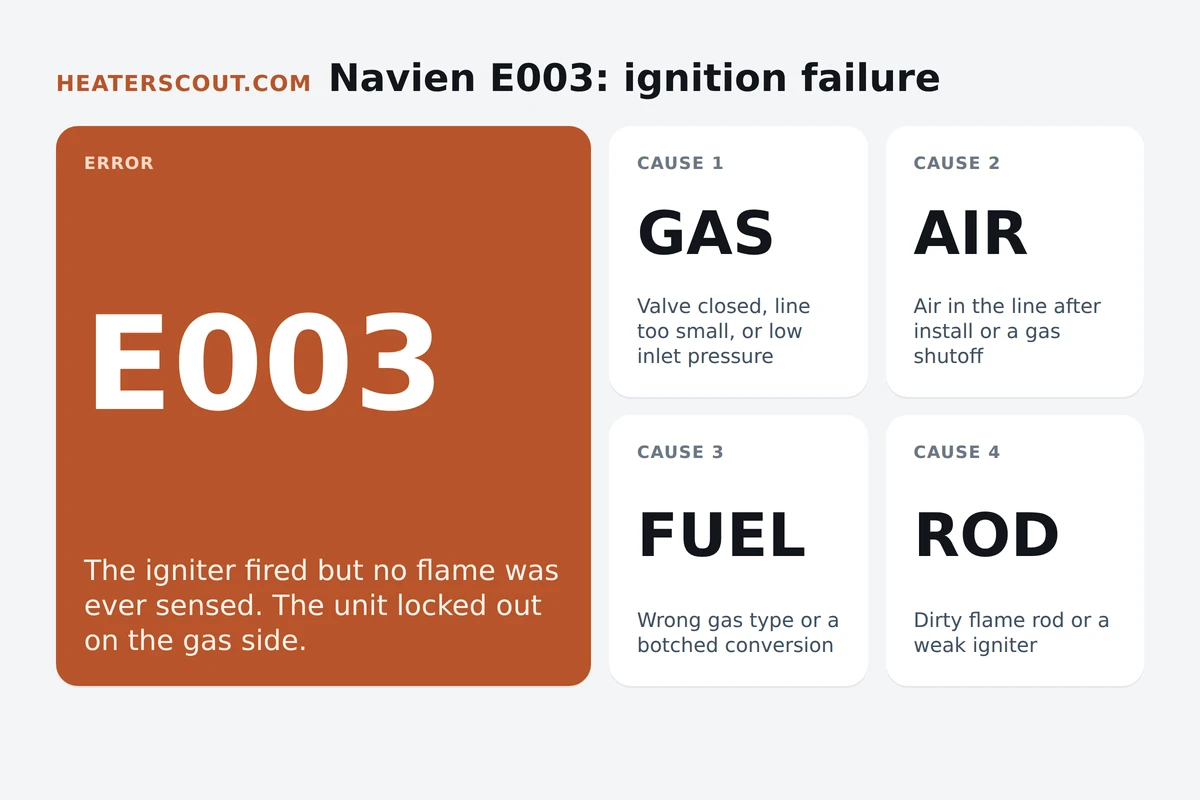
The good news with E003: it’s a gas-delivery problem far more often than a broken part. A surprising share of these codes clear after someone opens a valve they forgot, or bleeds air out of the line following a propane refill. Start there before you assume the worst.
What E003 actually means
On a call for hot water, a Navien unit runs a set sequence: it purges, sparks the igniter, and opens the gas valve, then the flame rod checks for an actual flame by sensing the tiny ionization current a flame conducts. If it doesn’t sense one within a few attempts, the control board shuts everything down and posts E003. The code isn’t telling you a specific part failed — it’s telling you the burner never lit, and now you find out why. That distinction matters: E003 is a symptom with a short list of causes, most of them on the gas side.
The homeowner-safe checklist
These are the checks you can make without opening the unit or touching gas fittings. Tick each as you go; the bar tracks what’s left.
E003 — safe checks first
Do these before calling anyone. Never open the unit or probe the gas valve yourself.
Air in the line: the sneakiest cause
If your Navien runs on propane and threw E003 right after the tank was refilled, air is the prime suspect. When a propane tank runs dry, air gets pulled into the supply line; after the refill the unit tries to ignite on an air-and-gas mixture, can’t establish a flame, and locks out on E003 until that air is purged. The same thing happens on a brand-new installation before the line is properly bled. It looks alarming — a unit that won’t light at all — but the fix is just clearing the air, often by cycling the unit and running a nearby gas appliance to draw fresh gas through. It can take a few ignition attempts before the line is fully purged and the flame holds.
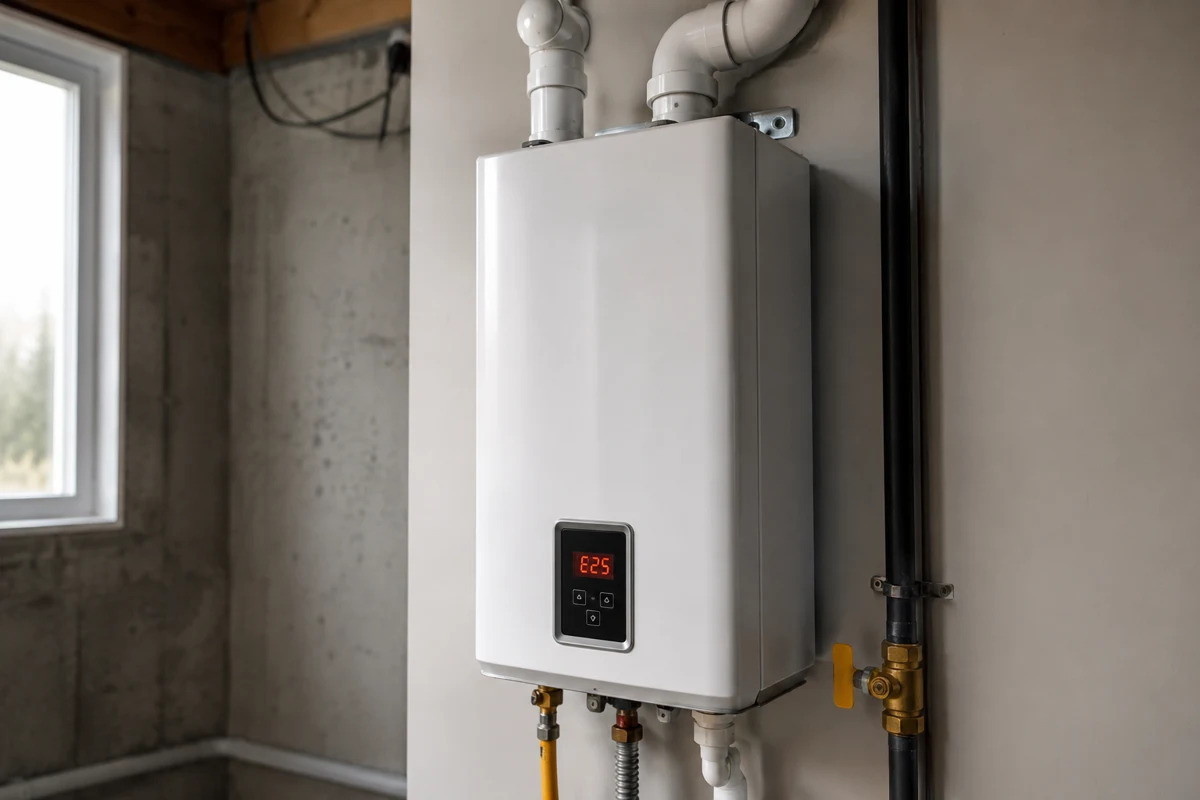
Gas pressure and line sizing: why it’s a tech job
When the simple checks don’t clear it, the usual next cause is gas pressure — and that’s where DIY ends. Navien specifies an inlet pressure range the gas must hold under full load: roughly 3.5–10.5″ WC for natural gas and 8.0–13.0″ WC for propane, with the line sized for the unit’s full BTU load and run length.
The trap is a gas line that’s too long or too small for the unit’s full BTU demand. It reads fine at rest, but the moment the burner fires and pulls maximum gas, pressure sags below the minimum and the flame won’t hold — so the unit lights for a second, drops out, and posts E003. Measuring that dynamic pressure takes a manometer, and correcting it means resizing the line: both licensed gas work. Cleaning or replacing the flame rod and any work on the gas valve or control board are the same — technician territory, not because the parts are exotic but because they demand instruments and gas certification.
The flame rod, and why cleaning it isn’t a DIY step
The flame rod is the small sensor that proves a flame is present by reading the current a flame conducts. Over time it can foul with a thin oxide film, or its mount can loosen, and then it reports “no flame” even when the burner is lit — a false E003. It sounds like the kind of thing you’d just wipe clean, and technically it is, but it sits inside the combustion chamber alongside live gas components. Navien’s own guidance and most installers are blunt about it: don’t open the unit to clean the flame rod or probe the gas valve yourself. The reasoning isn’t that the task is hard, it’s that getting it wrong around gas is dangerous, and the diagnosis usually needs a pressure reading anyway.
Venting and condensate: the quiet blockers
A blocked vent or air intake can starve combustion enough to fail ignition. On these condensing units the intake filter, usually behind the front panel, collects dust, and the outside vent termination can catch leaves, snow, ice, or an insect nest. A partially blocked flue also lets condensate back up. None of that requires opening the sealed portions of the unit — you can inspect the exterior vent and the accessible intake yourself — but if the terminations are clear and E003 persists, it folds back into the same conclusion: time for a technician who can check pressures and the flame circuit together.
Don’t forget a gas-type mismatch
If the unit is newly installed or was recently converted, a natural-gas-versus-propane mismatch will cause persistent ignition failure. A unit set up for natural gas but fed propane (or the reverse) can’t burn correctly and throws E003. Conversions require the proper Navien kit and setup; if the code appeared right after an install or fuel change, have the installer confirm the unit is configured for the gas you actually have.
When to stop and call
Reset the unit once — power off 30 seconds, back on, press reset — and run the safe checklist. If E003 keeps returning after all of that, resist the urge to keep resetting; each reset only clears the display, not the cause. Repeated E003 after the basics points at gas pressure, the flame rod, the gas valve, or the PCB, and those are the point to bring in Navien support or a licensed installer rather than open the unit yourself.
Frequently asked
What does Navien error code E003 mean?
E003 (also written E03) is an ignition failure: the unit ran its lighting sequence but the flame rod never detected a flame, so it locked out to avoid releasing unburned gas. It doesn’t name a specific failed part — it means the burner didn’t light, and the cause is usually on the gas side, from a closed valve to low pressure.
Why did my Navien show E003 right after a propane refill?
Because air got into the gas line. When a propane tank runs empty it draws air into the supply; after the refill the unit tries to ignite on an air-gas mix and can’t hold a flame, so it posts E003. Purging the air — cycling the unit and running another gas appliance to pull fresh gas through — usually clears it.
How do I reset a Navien E003 error?
Switch the unit off at its disconnect for about 30 seconds, turn it back on, and press the reset button. Then run the safe checks: gas on, valves open, vent clear. A reset clears the lockout display but not the underlying cause, so if E003 comes right back, stop resetting and investigate the gas supply.
Can I fix a Navien E003 myself?
You can safely do the gas-delivery checks: confirm gas is on and other appliances work, open the main and service valves, purge air from the line, clear the vent and intake, and power-cycle. What you shouldn’t do is measure gas pressure, clean the flame rod, or open the unit — those need instruments and gas certification and belong to a licensed installer.
What gas pressure does a Navien tankless need?
Navien specifies roughly 3.5 to 10.5 inches of water column for natural gas and 8.0 to 13.0 for propane, and that pressure must hold while the burner runs at full load. A gas line that’s too long or undersized sags below the minimum when the burner fires, causing the unit to light briefly and then drop out on E003. Measuring it requires a technician.
Why does my Navien light for a second and then show E003?
That’s the signature of low dynamic gas pressure. The unit gets enough gas to spark a flame, but once the burner draws its full demand the pressure falls below what the flame needs, the flame rod loses the flame, and it locks out. The usual fix is correcting an undersized or overlong gas line — licensed gas work, not a reset.