A tankless water heater has no tank, so every gallon of hot water passes through a narrow heat exchanger the size of a paperback book. In hard-water areas that passage scales up with calcium and lime, and once the coating gets thick enough you see it: the flow drops, the temperature swings, and the unit starts throwing scale or flow codes. Descaling — flushing vinegar through the exchanger with a small pump — is the fix, and it is a job most homeowners can do in about an hour with a cheap kit.
Why scale is the tankless heater's worst enemy
Hard water carries dissolved calcium and magnesium. When you heat it, those minerals drop out of solution and stick to the hottest surface in the system, which in a tankless unit is the wall of the heat exchanger. A tank heater hides scale on the bottom of a 40-gallon vessel where it does little for years. A tankless heat exchanger has no room to hide it. A layer of scale just a fraction of a millimeter thick narrows the water path, insulates the copper from the flame, and forces the burner to work harder to hit the same setpoint.
The symptoms show up in a predictable order. First the hot water flow at the tap drops because the passage is smaller. Then the temperature starts hunting — hot, then cool, then hot — because the controller cannot hold a steady output through a restricted exchanger. Finally the unit posts a code. On Rheem and many others that scale-related fault is code 11 or a dedicated maintenance light; on Navien it may show as an outlet-temperature or flow error. Manufacturers assume you will descale on a schedule, and several of them can void warranty coverage on a heat exchanger that failed with heavy scale and no maintenance record.
How often, and how to know
The honest answer depends on your water. On municipal water under 7 grains per gallon of hardness, once a year is plenty. Between 7 and 12 grains, aim for every eight to ten months. On well water or anything above 12 grains, every six months is not overkill, and a whole-house softener ahead of the heater changes the math entirely — softened water can stretch the interval to two years. If you do not know your hardness, a $10 test strip from a hardware store tells you in thirty seconds, or your water utility publishes an annual report with the number.
There is also a shortcut. If your unit has isolation valves already plumbed in (most installs after about 2015 do), the whole job is an hour and a bucket. If it does not, add a set of service valves the next time a plumber is out. They cost little and turn descaling from a two-hour drain-down into a routine you will actually keep up with.
What you need
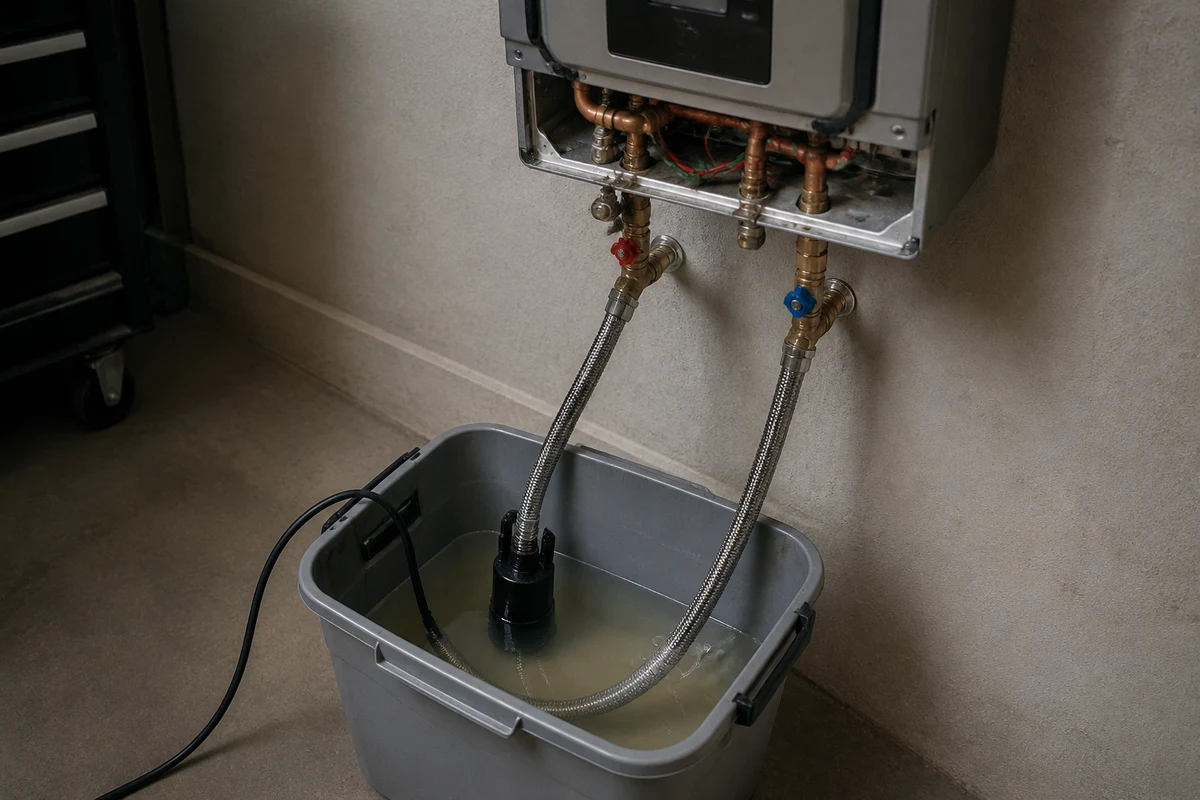
Nothing exotic. A submersible utility pump (the small ones sold in descaling kits move plenty), two washing-machine-style hoses, a five-gallon bucket, and three to four gallons of plain white vinegar. Vinegar at 5% acidity is food-safe, cheap, and dissolves lime without the fume-and-glove hazard of muriatic or commercial descaler. Some pros prefer a purpose-made descaling solution because it works faster, but for a home unit vinegar is fine and there is nothing to neutralize afterward. Skip anything with bleach; mixing it near the acid is dangerous and it does nothing for scale.
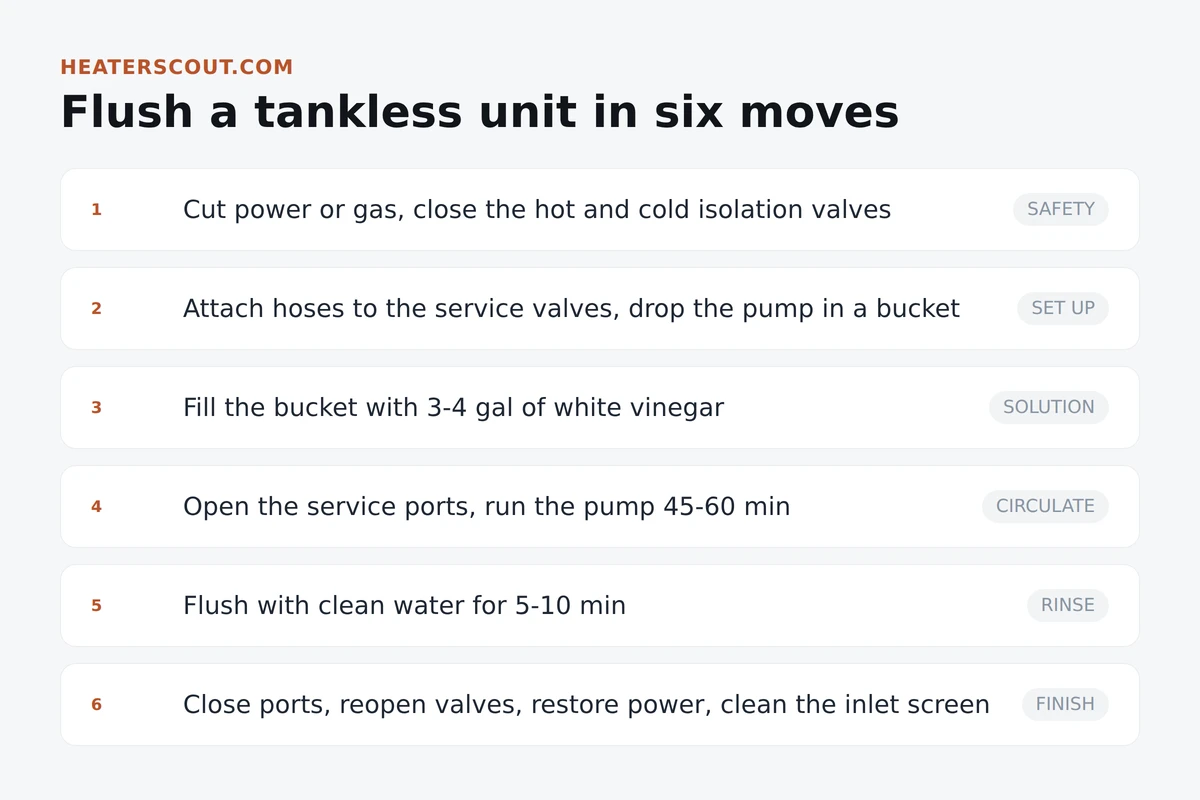
The flush, step by step
What descaling will not fix
Descaling clears mineral scale. It does not fix a failing flame rod, a bad igniter, a blocked vent, or an undersized gas line. If your tankless unit throws an ignition or flame code rather than a scale or flow code, flushing it wastes an afternoon — the problem is on the combustion side, not the water side. Read the exact code before you reach for the vinegar. A Rinnai code 12, for instance, is flame failure and has nothing to do with scale.
Descaling also will not rescue a heat exchanger that has already cracked or corroded through from years of neglect. If the unit leaks water internally after a flush, or the flow never recovers, the exchanger itself may be done. At that point the repair-or-replace math depends on the unit's age; a heat exchanger is the single most expensive part in the machine.
Keeping the interval you set
The reason most people descale too late is that there is no reminder built in. Pick a date you will remember — a birthday, the start of a season — and tie the flush to it. Write the date on a bit of tape stuck to the unit each time. If you are on hard well water, a softener or a scale-inhibiting cartridge upstream buys you a much longer interval and pays for itself in exchanger life. The unit that gets flushed on schedule outlasts an identical unit that never does, often by years.
Frequently asked
How often should I descale a tankless water heater?
It depends on your water hardness. On city water under 7 grains per gallon, once a year is enough. Between 7 and 12 grains, every eight to ten months. On hard well water above 12 grains, every six months. A whole-house softener ahead of the heater can stretch the interval to two years.
Can I use vinegar to descale a tankless water heater?
Yes. Three to four gallons of plain white vinegar at 5% acidity is the standard home descaling solution. It dissolves lime and calcium, is food-safe, cheap, and leaves nothing to neutralize. Purpose-made descaler works faster but is not required for a home unit. Never use bleach.
How long does it take to flush a tankless water heater?
About an hour of active work if the unit has isolation valves. You circulate vinegar for 45 to 60 minutes, then rinse for five to ten minutes and clean the inlet screen. Without pre-installed service valves the job takes longer, which is why adding them is worth it.
Do I need isolation valves to descale a tankless heater?
They make it far easier. Isolation (service) valves let you hook a pump straight to the unit and circulate solution without disturbing the house plumbing. If your unit lacks them, have a plumber add a set. Do not try to improvise with the main supply lines.
Will descaling fix a tankless water heater error code?
Only if the code is scale or flow related, such as a Rheem code 11 or a maintenance light. Descaling does nothing for ignition, flame, or venting codes like a Rinnai code 12. Read the exact code first; flushing a combustion fault wastes your time.
Is it safe to descale a tankless water heater myself?
Yes, if you follow the order: turn off gas or power, close the isolation valves, and only then open the service ports. Never open a service port with the house water valves open or the power live. The solution is just vinegar, so there are no hazardous chemicals involved.
What happens if I never descale my tankless water heater?
Scale keeps building in the heat exchanger, reducing flow and efficiency and eventually cracking or corroding the exchanger, the most expensive part in the unit. Many manufacturers also reduce or void warranty coverage on heat exchangers that failed with heavy scale and no maintenance record.