An A.O. Smith gas water heater flashing its status light four times is not a pilot problem or a worn thermopile. It is the gas control valve telling you the water got too hot and it shut the burner down to stop it climbing. A.O. Smith's own support wording is blunt about it: four flashes every three seconds means the pilot is lit but the valve has detected an over-temperature condition. That puts you in high-temperature shutdown, the same safety region as an energy cut-off, and the first question is not what part to buy, it is why the water overheated in the first place.
The short version
Four flashes is an over-temperature shutdown, not a normal heartbeat. Start with the free causes: turn the temperature dial back toward the middle and let the tank cool, then flush sediment if the heater is older or on hard water. Reset on a gas model is a knob cycle to OFF and a relight, not a red button. If four flashes returns at a reasonable setting, the temperature sensor or the gas valve is at fault, and a valve that keeps over-temping gets replaced, often under warranty. Never bypass the safety to keep it running.
Where four flashes sits in the A.O. Smith code family
The green light on the gas control valve near the base of the tank is a diagnostic display, and each blink count means something specific. Four is the over-temperature code. Our full A.O. Smith status-light guide maps every pattern; the table below pulls out where four flashes lands so you are not confusing it with the thermopile or sensor codes.
| Blink pattern | What the valve is reporting | Where it points |
|---|---|---|
| 1 flash / 3 sec | Normal operation | No fault, this is the heartbeat |
| 2 flashes | Low thermopile voltage | Pilot flame or thermopile, cheap fix |
| 4 flashes | Over-temperature detected | Setpoint, sediment, sensor, or a valve not shutting off |
| 5 flashes | Shorted or failed temperature sensor | Sensor is integral to the valve |
| 7 flashes | Internal gas control valve fault | Valve assembly replacement |
Reading it this way keeps you honest. Four flashes is the only common code where the most likely cure is free, backing off the temperature or clearing sediment, rather than a part. Five and seven almost always mean the valve. Four might, but only after you have ruled out the cheap causes.
A.O. Smith 4-flash code
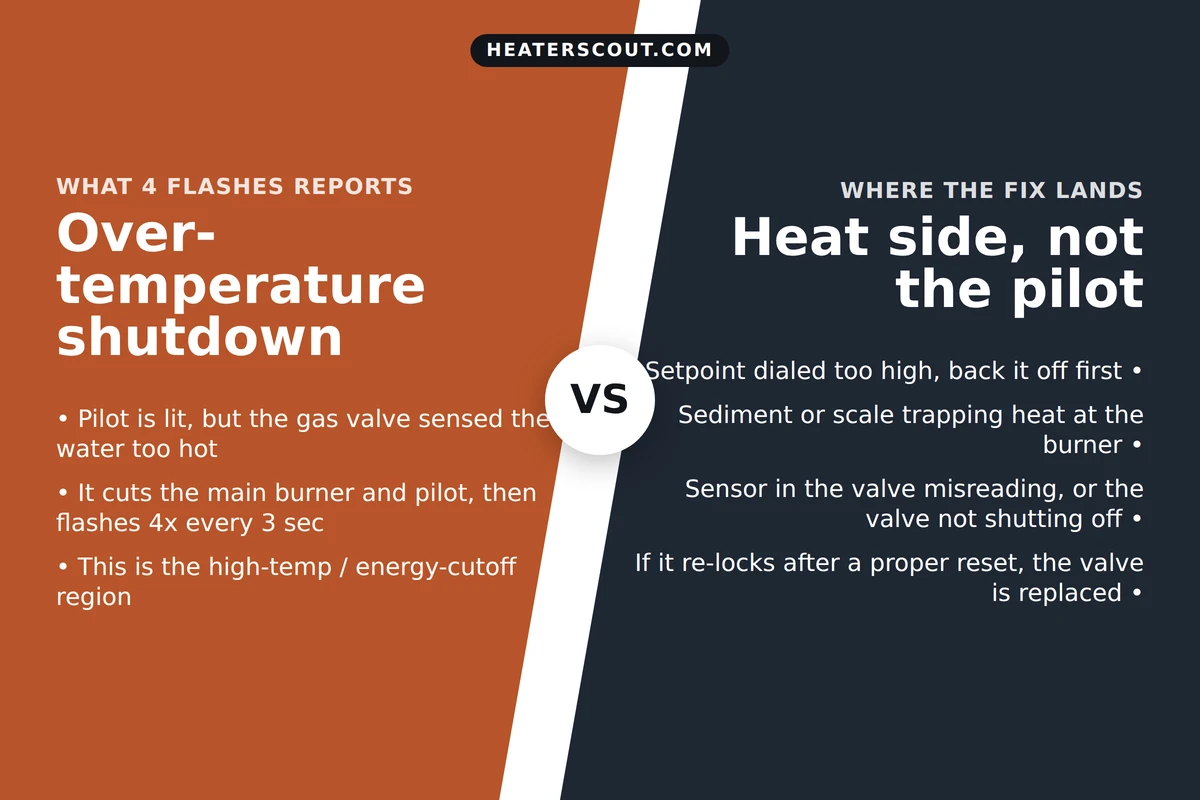
An over-temperature shutdown. The gas control valve senses the water rising past its high-temperature limit and cuts the main burner and pilot to stop it climbing, then flashes the status light four times every three seconds. It is the high-temperature safety region, the gas equivalent of an energy cut-off tripping. Because the temperature sensor on modern gas models is built into the gas control valve, there is usually no separate ECO reset button; you clear it by cycling the gas control knob and relighting. A four-flash that returns after a proper reset is a real over-temperature, driven by setpoint, sediment, a drifting sensor, or a valve that is not shutting the burner off.
Quick answer
Four flashes on an A.O. Smith gas water heater is an over-temperature shutdown: the pilot is lit but the gas control valve sensed the water too hot and cut the burner. Do this in order. First, turn the temperature dial back toward the midpoint, about 120 degrees, and let the tank cool. Second, cycle the gas control knob to OFF, wait a few minutes, and relight per the burner door to clear the code. Third, if it returns, drain and flush the tank to clear sediment. If four flashes still comes back at a sensible setting on a clean tank, the temperature sensor or the gas valve is the fault and the valve gets replaced, often under warranty. Do not bypass the safety.
Why the water actually overheated
The valve does not throw four flashes for fun. Something drove the water past the limit, and the causes stack from free to expensive. Start at the top of this list, because the first two cost nothing and account for a large share of four-flash calls.
The setpoint is the first suspect. If the dial got turned toward VERY HOT, the water can reach the high-limit legitimately, and the valve is doing exactly what it should. Back the dial to the middle, roughly 120 degrees, which is also the safe scald setting for a home. Second is sediment. On hard water a crust of lime builds on the tank bottom right over the burner. That crust traps heat and creates a hot layer the sensor reads as an over-temperature, and it forces the burner to run longer to drive heat through the scale, which stacks even more heat into the water. A tank that has gone years without a flush is a classic four-flash generator. Draining and flushing it can end the code outright.
Past those two, you are inside the valve. The temperature sensor is integral to the gas control valve on modern A.O. Smith heaters, and a sensor that drifts will misread normal water as too hot and trip the over-temp. Or the valve is failing to shut the burner off when the water reaches setpoint, so the tank genuinely overheats until the high-limit catches it. Both of those are valve faults, and both usually end in replacing the gas control valve rather than any single sub-part, because on these units the sensor and the control are one sealed assembly.
Reset, and why there may be no red button
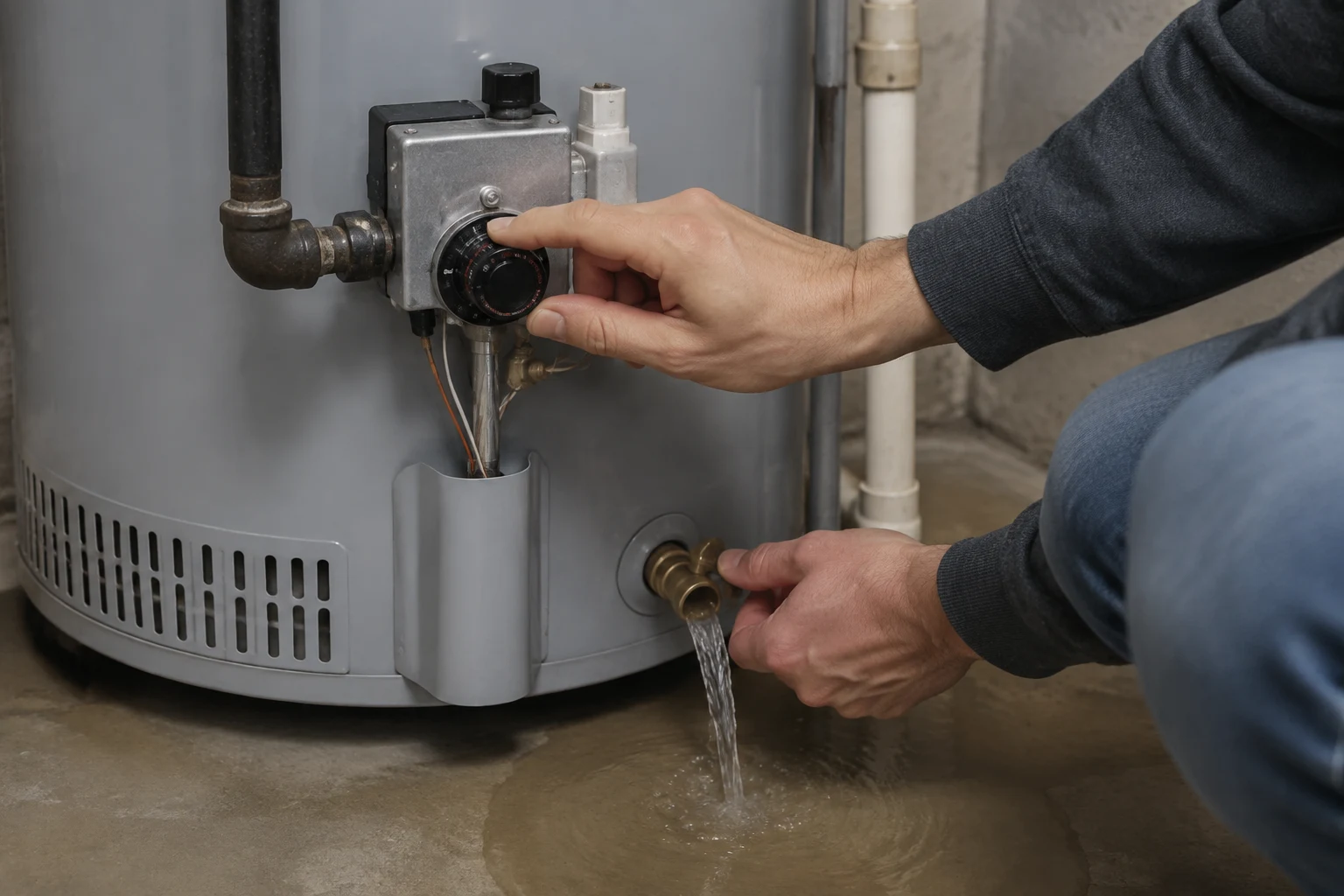
People go looking for an ECO reset button and get confused when a gas heater does not have one. Here is the split. Electric A.O. Smith heaters carry a physical energy cut-off, a red reset button behind the upper access panel that you press after a high-temperature trip. Most modern gas models do not. The high-temperature sensor is part of the gas control valve, so there is no separate button to push. On a gas unit you reset a four-flash by turning the gas control knob to OFF, waiting several minutes for the valve and water to cool, and relighting the pilot following the steps printed on the burner door. That knob cycle is the reset. If the valve has hard-locked from repeated over-temperature, no amount of cycling brings it back, and that is the signal that the valve assembly is done.
When it is a warranty call, not a DIY fix
Testing the setpoint and flushing the tank are squarely homeowner work. Replacing a gas control valve is not casual: it means draining the tank, disconnecting gas, swapping the sealed valve, and relighting, and on a gas appliance that is a job for someone comfortable with gas connections. Before anyone buys a valve, pull the model and serial number off the rating label and check the warranty. On most A.O. Smith gas heaters the gas control valve is a covered part for several years, often six to twelve on the tank with a shorter parts term. A covered valve means you pay labor, not the roughly $150 to $250 the part costs. If your heater is under warranty and throwing a repeating four-flash, that call to A.O. Smith or the dealer comes before the parts store.
Keeping four flashes from coming back
An over-temperature that returns is telling you the real driver is still live. Keep the setpoint at a sane 120 degrees rather than chasing hotter water, which also protects against scalding. Flush the tank on a schedule, once a year on hard water, so scale never builds the heat-trapping layer that fakes an over-temp and shortens the tank's life at the same time. If you have flushed the tank, held the setpoint reasonable, and four flashes still cycles back, stop resetting it and get the valve diagnosed, because a sensor drifting or a valve slow to shut off will only get worse, and an over-temperature is not a code to live with.
Frequently asked
What does 4 flashes mean on an A.O. Smith water heater?
Four flashes every three seconds means the pilot is lit but the gas control valve has detected an over-temperature condition and shut the burner down. In plain terms the water got hotter than the valve's high-limit allows, so the safety cut the heat rather than let the tank keep climbing. A.O. Smith's own support page states it directly: four flashes is the valve reporting over-temperature. It is not a pilot code, not a thermopile code, and not a normal heartbeat. One flash every three seconds is normal; four is the high-temperature shutdown. Because an over-temp fault is a safety matter, the manufacturer's guidance for a persistent four-flash is to turn the gas off and get it looked at, since something is either driving the water too hot or the valve is misreading it.
Can I reset an A.O. Smith 4-flash code myself?
You can try one clean reset. On a gas A.O. Smith the reset is not a red button the way it is on an electric model, it is a knob cycle: turn the gas control knob to OFF, wait several minutes for the water and the valve to cool, then relight the pilot following the instructions printed on the burner door. If the water simply overshot once, say the dial was cranked to the hot end, the code clears and normal operation returns. What clearing does not do is fix a cause. If four flashes comes right back at a sane setting, the over-temperature is real and repeating, and forcing more resets on it is not the move. At that point the valve or what is feeding it needs diagnosis.
Why did my A.O. Smith go into over-temperature shutdown?
Four things drive it, cheapest first. The setpoint is simply too high, someone turned the dial toward VERY HOT and the water reached the limit. Second, sediment or scale on the tank bottom traps heat right over the burner and creates a hot layer the sensor sees as an over-temp, worse on hard water and older tanks that have never been flushed. Third, the temperature sensor built into the gas valve is drifting and misreads the water as hotter than it is. Fourth, the gas valve is not shutting the burner off when it should, so the water genuinely overheats. The first two you can address yourself. The last two live inside the valve.
How do I reset the ECO on an A.O. Smith gas water heater?
This trips people up, so it is worth being exact. Electric A.O. Smith heaters have a physical ECO, the energy cut-off, a red reset button behind the upper access panel that you press after a high-temp trip. Most modern gas A.O. Smith heaters do not have that separate button. The high-temperature sensor is integral to the gas control valve, and you clear a gas over-temp by cycling the gas control knob to OFF, letting it cool, and relighting per the door instructions. So if you are hunting for a red ECO button on a gas unit and cannot find one, that is expected. The knob cycle is your reset. If the valve has hard-locked on a repeated over-temp, no button brings it back and the valve is replaced.
How much does it cost to fix an A.O. Smith 4-flash?
If it is the temperature setting or a sediment flush, the fix costs nothing but your time and a garden hose. If the gas control valve has to be replaced, the OEM valve assembly commonly runs around $150 to $250 for the part alone, and a plumber's visit to drain the tank, swap the valve, and relight typically lands somewhere around $300 to $500 all in, more in high-cost metros. The valve is one of the pricier parts on the heater, which is exactly why you rule out the free causes first. Before you buy anything, check the heater's age against its warranty. On most A.O. Smith gas models the gas control valve is a covered part for several years, so a covered valve means you pay for labor, not the part.
Is a 4-flash over-temperature code dangerous?
The code itself is the safety system working. The gas valve shutting the burner off when it senses too much heat is exactly what you want, it is the guard against a tank that keeps climbing. What is not safe is ignoring a repeating four-flash or defeating the safety to force the heater to run. A water heater that genuinely overheats can build pressure, and the temperature and pressure relief valve is the last line of defense, not the first. If four flashes keeps returning, or if you see the relief valve discharging hot water, or you find scalding water at the tap, shut the gas off and get a licensed tech on it. Never jumper or bypass the sensor to keep the burner firing through an over-temp warning.
Will flushing the tank clear a 4-flash code?
It can, if sediment is the cause. On hard water a layer of lime and scale builds on the tank bottom directly over the burner. That layer traps heat and creates a hot spot the sensor reads as an over-temperature, and it also makes the burner run longer to push heat through the crust, which stacks more heat into the tank. Draining and flushing the tank removes that layer and can end a four-flash that a sediment-choked heater throws. It will not help if the cause is a misreading sensor, a stuck valve, or simply a setpoint cranked too high. So flush the tank as part of diagnosis, but do not expect it to cure an over-temp that comes from inside the valve.
How is 4 flashes different from 5 or 7 flashes?
They point at different parts of the same gas control valve. Four flashes is an over-temperature shutdown, the water got too hot and the high-limit acted. Five flashes is a shorted or failed temperature sensor, meaning the valve cannot trust its own reading at all. Seven flashes is an internal gas-valve fault, the valve reporting it can no longer operate safely. Four is about the heat being wrong; five and seven are about the valve's electronics being wrong. All three can end in a valve replacement, but four is the one most likely to clear from a free fix, backing off the temperature or flushing sediment, before you spend on parts. The full blink map is on our A.O. Smith status-light guide.