A Whirlpool storage water heater tells you what is wrong if you know where to look, and where to look depends on whether it burns gas or runs on 240 volts. On a gas model, the blinking status light on the Honeywell gas control is the whole diagnostic; on an electric model, a red high-limit button on the upper thermostat is usually the first thing that tripped. This is the broad map of the brand: the six or so symptoms owners actually hit, what each one points at, and which fix goes with which. It is the hub, not the deep dive, so where a symptom has its own page, this sends you there.
Start by reading the symptom
Every Whirlpool tank complaint funnels into one of a handful of buckets. The trick is matching your symptom to the right diagnostic tool before you touch anything. A gas unit that is misbehaving is almost always talking through its status light. An electric unit that went cold is almost always waiting on a reset button. Leaks and noises cut across both. Work the list in order and you will usually know the cause before you pull a single panel.
No hot water at all
On gas, check the pilot and the status light first: no light means the pilot is out or starved for millivolts. On electric, check the red high-limit reset button on the upper thermostat, then the breaker and the upper element. This is the most common call and it is usually a trip, not a dead heater.
Not enough hot water, or it runs out fast
Setpoint too low or a tank too small for the household, then a broken dip tube mixing cold into the hot outlet, then on electric a dead lower element or lower thermostat, then sediment stealing capacity. Work that order.
Water too hot or scalding
Thermostat set high, or on gas an over-temp condition. If the gas control shows four flashes the over-temp sensor has tripped and the control needs replacing. Set tanks to about 120 F to avoid scald.
Pilot will not light or will not stay lit (gas)
Thermocouple or thermopile, gas supply, or the flammable vapor sensor. This one has its own dedicated walkthrough; see the Whirlpool pilot page.
Status light flashing a code (gas)
Count the flashes and read them off the label on the gas control. The full code chart has its own page; the short version is below.
Flammable vapor lockout (gas)
The low-mounted vapor sensor tripped, often from a wet floor rather than actual fumes. Clear and dry the area first, then reset, ideally through a technician.
Leaks or noises
Trace the water to a fitting, the relief valve, the drain valve, or the tank body. Rumbling and popping is almost always sediment. A leaking tank body is a replacement.
Which symptoms show up most
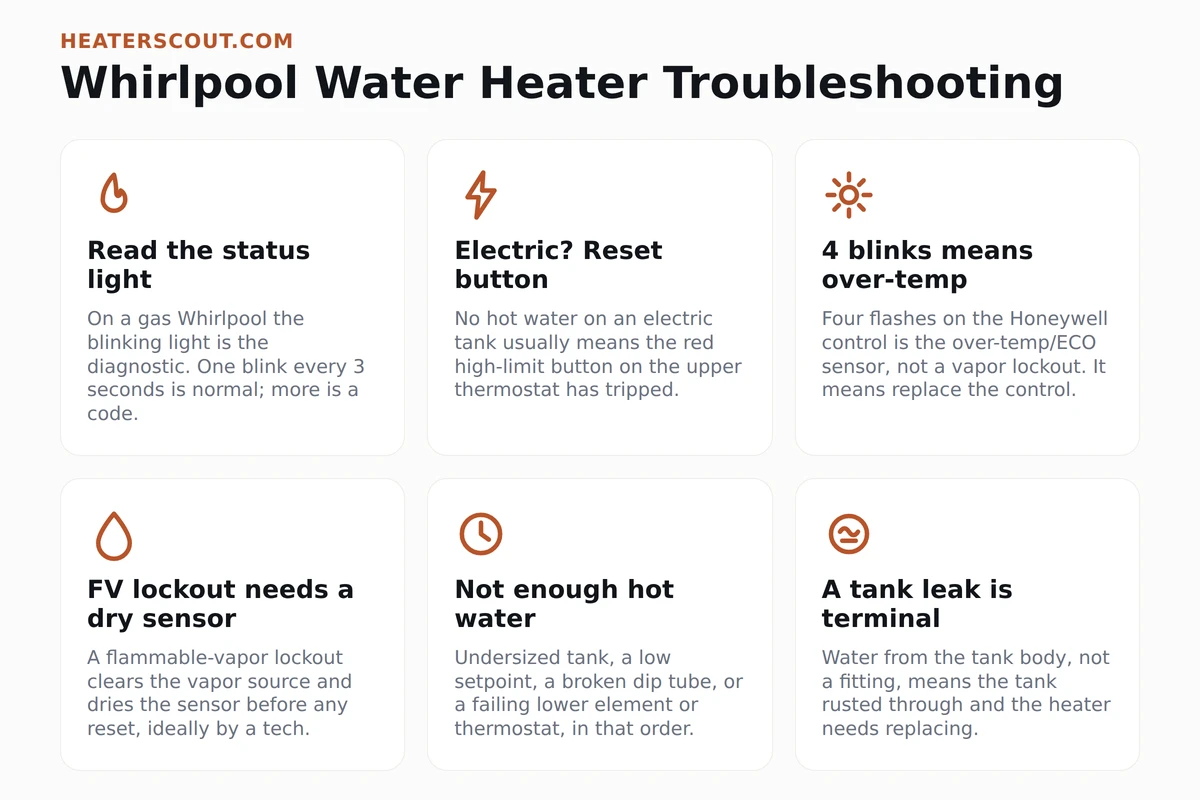
Across service calls and owner threads, the mix is lopsided. Most Whirlpool no-heat problems are safety trips and pilot outages, not failed heaters, which is good news for the DIYer. The rough frequency looks like this.
Never plug the relief valve
The temperature and pressure relief valve, the one on the side or top with a lever and a pipe running down, is a safety device, not a nuisance. If it drips, that is a signal of high pressure or high temperature, or a worn valve. Never cap it, plug it, or reroute it upward. Find out why it is opening. Capping a relief valve on a heater that is overheating is how a tank becomes dangerous.
Flammable vapor (FV) sensor
A sensor mounted low on a Whirlpool gas heater that shuts the burner down if it senses ignitable fumes near the floor, the level where gasoline and solvent vapors settle. It is a real safety feature, but it also locks out if it simply gets wet from a damp floor or a small leak. A lockout means find and remove any vapor source, ventilate, and let the sensor dry before resetting. A lockout that keeps returning is a genuine vapor problem or a failing sensor, not a glitch to clear and ignore.
The gas status-light codes, short version
On a gas Whirlpool the blinking light is the diagnostic, and the meanings are printed on a label right on the gas control. One slow blink every three seconds is normal. Everything else is a code, and several of them end the same way: replace the control. The full walkthrough lives on the status-light page; this is the reference.
| No light | Pilot is out, or not enough millivolts to hold it. Relight; check thermocouple/thermopile. |
| 1 flash / 3 sec | Normal operation. Nothing to do. |
| 2 flashes | Low millivolts to the gas control. Check wiring connections, then replace the thermopile. |
| 4 flashes | High water temperature tripped the over-temp (ECO) sensor. Replace the gas control valve. |
| 5 flashes | Sensor failure. Replace the gas control valve. |
| 7 flashes | Gas control / thermostat failure. Replace the gas control valve. |
| 8 flashes | Thermopile making power with the unit off or pilot valve stuck. Verify knob OFF, check pilot. |
The fixes you can do, and the ones you can't
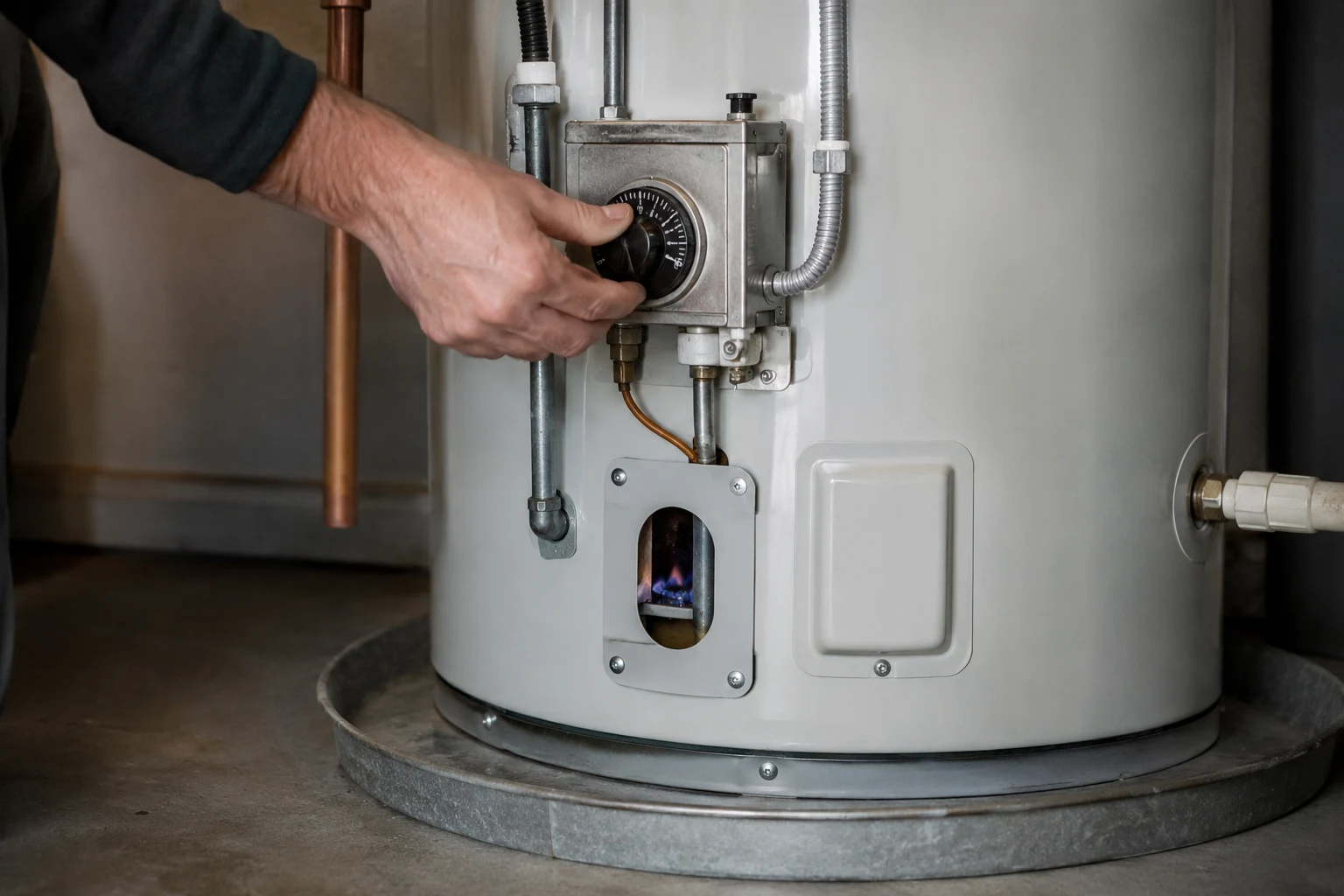
A fair amount of Whirlpool troubleshooting ends at something a confident homeowner can handle: pressing a tripped reset button, relighting a pilot, flushing sediment, replacing a dip tube, or swapping an electric element or thermostat with the power off. Some of it ends at a part order, especially the status-light codes that call for a new gas control valve, which cross-references to the Resideo WT8840 series on Flame Lock units. And some of it ends at a phone call. A flammable vapor lockout that keeps returning, a tank leaking from its body, or a gas smell are not wait-and-see items. The checklist below sorts the common symptoms by who should handle them.
- Electric no-hot-water: kill the breaker, press the red high-limit reset on the upper thermostat, check the upper element. DIY.
- Gas no-hot-water: relight the pilot per the label; if the status light shows no light after, suspect the thermocouple/thermopile.
- Not enough hot water: check setpoint, then dip tube, then lower element/thermostat on electric, then flush sediment. DIY.
- Water too hot: lower the thermostat to about 120 F; a four-flash over-temp code on gas means the control is bad, not the setting.
- Fitting or drain-valve drip: tighten or replace the fitting or valve. DIY.
- Relief valve dripping: find the cause (pressure or temperature); never cap it. Add an expansion tank if the system is closed.
- Flammable vapor lockout: clear and dry the area, then reset; a repeat lockout goes to a technician.
- Tank body leaking rust and water: no repair exists. Plan a replacement now, not later.
How to reset an electric high-limit vs a gas lockout
Resets are the most searched Whirlpool fix, and they mean two different things on the two fuels. On an electric heater, the reset is the red high-limit button, also called the ECO cutoff, on top of the upper thermostat. Shut off the breaker, pull the top access panel and fold back the insulation, and look at the button. If it has popped out, the water reached roughly 190 degrees and the safety cut power; press it firmly until it clicks. If it will not click or trips again within a day, the underlying problem is a bad thermostat, a grounded element, or sediment, and repeated resets only mask it.
On a gas heater there is no red button. The flammable vapor lockout reset is the routine owners describe and that matches the display controls: turn power off for at least ten seconds, then hold both temperature adjustment buttons on the display while you turn the gas control switch to on, and the display icons flash to confirm. Whirlpool's manuals steer flammable vapor resets toward a qualified technician, which is the right call, because the sensor tripped for a reason. Clear the gasoline, solvents, and paint out of the space, ventilate it, and let a wet sensor dry before you attempt anything. A lockout that returns is not a reset problem.
Frequently asked
What does the blinking light on my Whirlpool gas water heater mean?
The blinking light on the Honeywell gas control is the heater's diagnostic display, and the pattern is the message. One blink every three seconds is the healthy signal that says the pilot is lit and the control is working, so that steady slow blink is what you want to see. Anything faster or a set of grouped flashes is a code you read off the label on the gas control itself. On the common Whirlpool chart, two flashes means the thermopile is not making enough millivolts, four flashes means high water temperature tripped the over-temp sensor, five means a sensor failure, seven means the gas control has failed, and eight means the thermopile is producing power while the unit is off. No light at all means the pilot is out or there is not enough power to hold it. Match your flash count to the label, because several of those codes point straight at replacing the gas control valve.
Is four blinks on a Whirlpool water heater a flammable vapor problem?
No, and this trips a lot of people up. On the Honeywell gas control that Whirlpool uses, four flashes means high water temperature activated the over-temp sensor, not that the flammable vapor sensor detected anything. The manufacturer's fix for a four-flash code is to replace the gas control valve, because the over-temp cutoff has done its job and latched. A flammable vapor lockout is a separate condition, usually tied to the vapor sensor near the base of the heater getting wet or actually sensing fumes, and it has its own reset routine rather than a four-flash code. If you read the flash count carefully against the label on your own control and see four, treat it as over-temp and stop looking for a gasoline smell.
How do I reset the flammable vapor sensor lockout on a Whirlpool water heater?
First deal with why it locked out. The flammable vapor sensor sits low on the heater and shuts the unit down if it senses fumes or, very often, if it simply got wet from a damp floor or a small leak. Before any reset, clear the area of gasoline, solvents, and paint, ventilate the space, and let the sensor dry. The reset sequence owners report and that matches the display-equipped controls is to turn power off for at least ten seconds, then hold both temperature-adjustment buttons on the display while you turn the gas control switch to on, at which point all the display icons flash to confirm. Whirlpool's own manuals lean toward having a qualified technician reset a flammable vapor lockout, and that is the safe default, because a lockout that keeps coming back means there is either a real vapor source or a failing sensor, not a glitch to be cleared and forgotten.
Why does my Whirlpool electric water heater have no hot water?
On an electric tank the first thing to check is the red reset button, the high-limit or ECO cutoff, on top of the upper thermostat behind the top access panel. Kill the breaker first, pull the panel, and look at that button. If it has popped out, the water got hot enough, around 190 degrees, to trip the safety, and pressing it back in with an audible click restores power. If it did not trip, you are looking at a bad upper thermostat, a failed upper element, or a tripped breaker. A reset button that trips again within a day or two is telling you something is actually wrong, most often a grounded or shorted element, a faulty thermostat that will not shut the element off, or heavy sediment holding heat against the cutoff, and that needs a real repair rather than repeated resets.
Why is my Whirlpool water heater not making enough hot water?
Not enough hot water is a different problem from no hot water, and the causes stack up in a rough order. Start with the simple ones: a thermostat set too low, or a household that outgrew a 40-gallon tank. Then the mechanical ones. A broken or shrunken dip tube lets incoming cold water mix straight into the outgoing hot, so the tank never delivers a full draw of hot water even though it is heating. On an electric unit, a dead lower element or lower thermostat leaves you with only the top of the tank hot, which feels like running out fast. Sediment on the tank floor insulates the burner or lower element and steals capacity. Work from setpoint, to demand, to dip tube, to elements, to sediment, and you will usually land on it without throwing parts at the heater.
Where is the reset button on a Whirlpool water heater?
It depends on the fuel. On an electric Whirlpool the reset is the red high-limit button on top of the upper thermostat, hidden behind the upper access panel and its insulation, and you press it to clear an over-temp trip after shutting off the breaker. On a gas Whirlpool there is no red button like that; the equivalent is the gas control valve itself, which you reset by turning the control knob or switch off, waiting, and relighting per the lighting instructions, and by reading its status light for what actually went wrong. People searching for a gas reset button are usually looking at either a pilot outage or a status-light code, both of which are handled at the gas control, not at a separate button.
My Whirlpool water heater is leaking. Is it fixable?
Trace where the water is coming from before you decide, because the source is everything. Water dripping from the temperature and pressure relief valve or its discharge pipe usually means the valve is doing its job on high pressure or high temperature, or the valve is worn, and that is a repairable and important signal, never something to cap off. A wet drain valve at the bottom or a loose inlet or outlet fitting is a straightforward tighten or replace. But water seeping from the body of the tank itself, showing up as rust and a puddle with no fitting to blame, means the steel tank has corroded through from the inside, and there is no repair for that. A leaking tank is a replacement, and the sooner the better before it lets go.
What gas control valve does a Whirlpool water heater use?
Whirlpool gas storage heaters built around the Flame Lock system use a Honeywell, now Resideo, gas control with the status light and the flammable vapor sensor. The current trade replacement is the Resideo WT8840 series; the Reliance trade number 100112336, for example, cross-references to a WT8840B control. That control has an integrated temperature sensor and an over-temp cutoff that latches around 189 degrees. Because several of the status-light codes, the four, five, and seven flash patterns, all end in replacing the gas control, matching the exact part to your model matters. Read the numbers off your existing valve and confirm the cross-reference rather than guessing, and if the unit is under warranty, call Whirlpool before buying a valve outright.