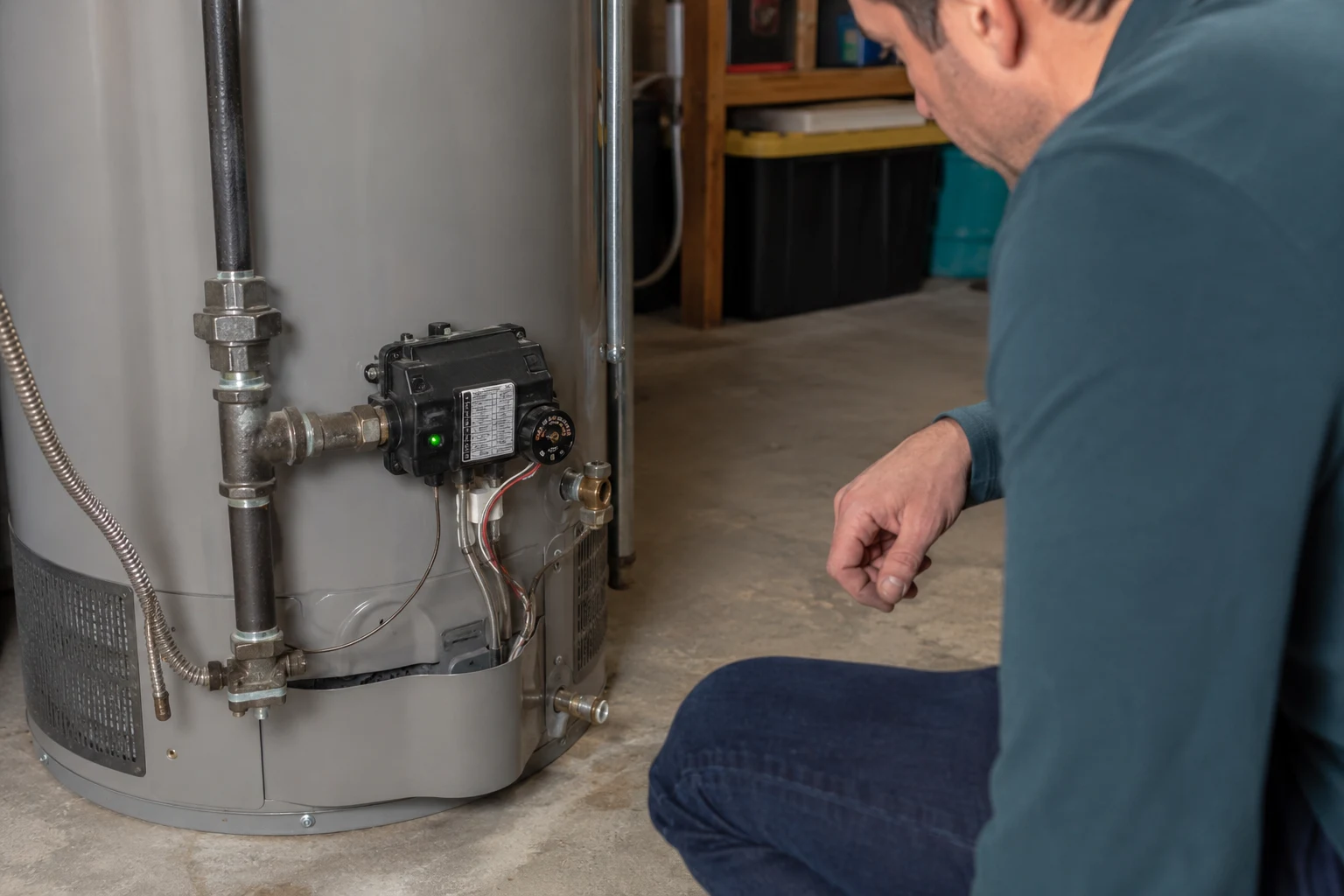
Someone is kneeling at the base of a Whirlpool gas water heater, flashlight in hand, watching a small light on the gas control valve blink at them. It flashes, pauses, flashes again, and the first instinct is that a blinking light means trouble. Most of the time it does not. On these Whirlpool heaters, one flash every three seconds is the healthy heartbeat, and the codes you actually worry about come in bursts of two, four, five, or seven. The good news is that Whirlpool gas heaters were built by American Water Heaters, an A.O. Smith division, so the flash chart is a known quantity and every count routes to a specific part.
Quick answer
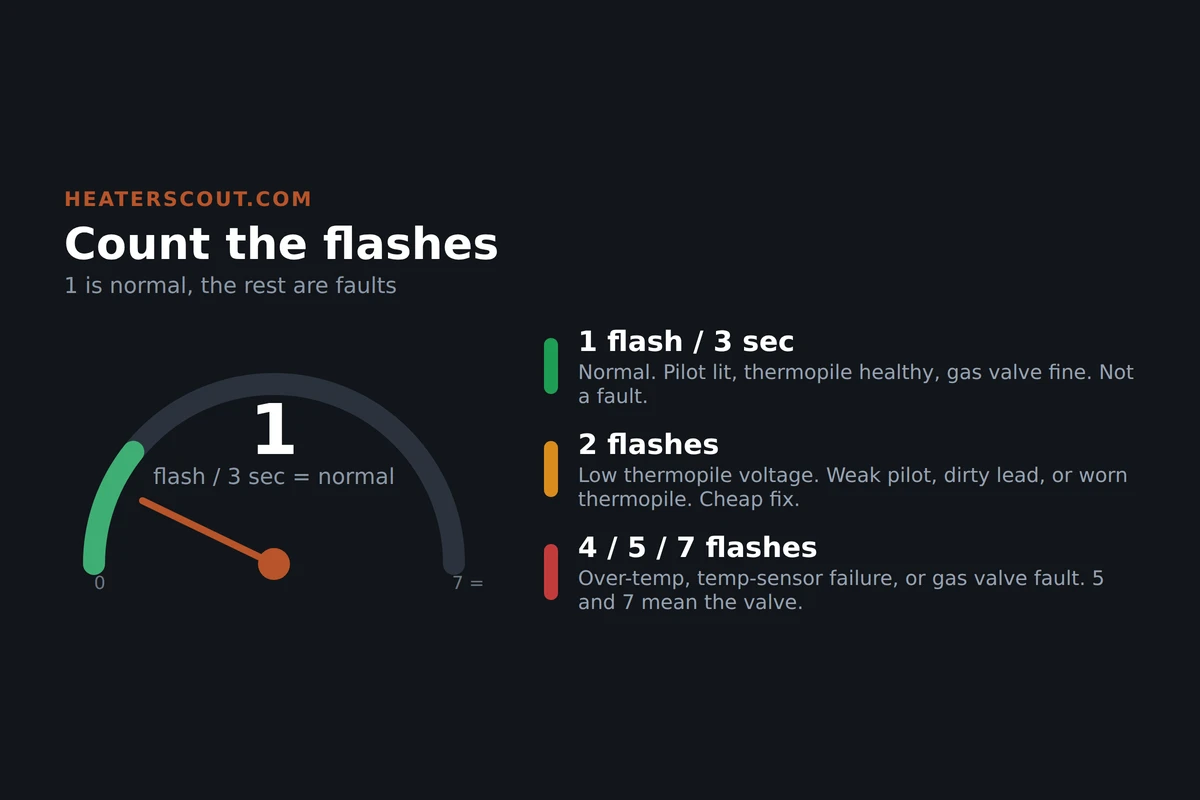
On a Whirlpool gas water heater, one flash of the status light every three seconds is normal: the pilot is lit, the thermopile is healthy, and the gas control valve is fine. It is not a fault. Any burst of more than one flash is a code. Count the quick flashes in a single burst, wait for the roughly three-second pause, confirm the same count on the next burst, and match it: 2 is low thermopile voltage, 4 is over-temperature, 5 is a temperature-sensor failure, and 7 is a gas control valve fault.
| Flashes | Meaning | Fix |
|---|---|---|
| 1 / 3 sec | Normal. Pilot lit, thermopile healthy, valve fine. | Nothing. This is not a fault, so do not reset it. |
| 2 | Low thermopile voltage: weak or dirty pilot, loose or dirty lead, worn thermopile. | Homeowner work. Clean the pilot and lead, replace the thermopile. Part usually under $50. |
| 4 | Over-temperature: the high limit tripped. Often a high setpoint or sediment trapping heat. | Lower the dial to about 120 F, let the water cool, flush the tank. Pro if it returns clean. |
| 5 | Temperature-sensor failure. The sensor is built into the gas valve on modern units. | Usually a gas control valve replacement. Check warranty first. |
| 7 | Gas control valve internal fault. | Replace the valve assembly. Rarely clears with a reset. Check warranty first. |
How to count the flashes without fooling yourself
Miscounting is the fastest way to buy the wrong part. The flashes come quick and the pause runs long, so it is easy to count a pause as a flash or to lose your place from one burst to the next. The status light sits low on the gas control valve near the base of the tank, so kneel down or grab a flashlight and look at the light itself, not a reflection off the metal, because a reflection can smear two fast flashes into what looks like one. Let one full burst and pause go by first without counting, just to feel the rhythm. Then count only the quick flashes inside a single burst and stop at the long pause. Two quick flashes then a pause is a two. Four quick flashes then a pause is a four. Watch the next burst and make sure you get the same number, because a real code repeats identically. Write the count down before you reset anything, since cycling the knob clears the readout and you lose the code you were reading.
Whirlpool is American and A.O. Smith under the badge
Here is the piece that unlocks everything else. Whirlpool gas storage water heaters were sold at Lowe's, but they were built by American Water Heaters, which is a division of A.O. Smith. They use the same Resideo, formerly Honeywell, gas control valve as A.O. Smith, Reliance, State, and American branded units. On many natural-gas models the valve even carries the same cross-brand part number, Resideo 100112336. Same valve means the same status-light logic, so the Whirlpool chart is the A.O. Smith chart: one flash normal, two thermopile, four over-temperature, five sensor, seven valve. That is why a generic A.O. Smith troubleshooting chart, a cross-referenced thermopile, or a forum thread about a State heater all apply to your Whirlpool. When you go for a part, you match it to the American or A.O. Smith equivalent by your exact model number.
The Flame Lock caveat on older Whirlpool units
Not every Whirlpool is identical under the door. Older Whirlpool heaters use the Flame Lock design, Whirlpool's name for the FVIR flammable-vapor system that seals the burner chamber so gasoline or solvent fumes near the heater cannot flash back to the flame. Those older units run the older white Honeywell valve, and its burner-door legend can read a little differently from the newer red-valve units, both in wording and in how it describes a lockout. That is why the legend printed on your own burner door is the final authority for your exact model. If a generic chart says one thing and the label on your heater says another, trust the label on the heater. When a Flame Lock unit locks out on fumes, you clear it by ventilating the space and removing the source, not by forcing the reset again.
Warranty, and why the count decides your bill
Whirlpool sold six, nine, and twelve year warranty lines, and the model and serial number are on the rating label on the side of the tank. The warranty matters most on the five-flash and seven-flash codes, because those are the valve, and the valve is a covered part on most Whirlpool gas heaters for years. The serial number encodes the build date, and coverage runs from your installation date, so a seven-flash valve fault on a three-year-old heater is likely still covered and you pay only for a plumber's hour to swap it. The two-flash thermopile job is cheap and DIY either way, the four-flash over-temperature often costs nothing to clear, and the valve codes are where pulling the full model and serial before you buy anything can turn a part-plus-labor bill into labor only. Whirlpool heaters are discontinued at Lowe's, but with millions still installed the parts are easy to source through the American and A.O. Smith cross-reference.
- Pilot flame is a strong, steady blue that fully wraps the thermopile tip, not a weak yellow lick.
- Thermopile lead is clean and tight where it screws into the gas control valve.
- Temperature setpoint is at about 120 F before you blame the heater for a 4-flash over-temp code.
- Tank has been flushed, so sediment on the bottom is not trapping heat and tripping the high limit.
- You read the flash legend printed on your own burner door and matched it to your count.
- You have the complete model and serial number off the rating label before calling for a part.
Never keep resetting a 4-flash over-temp
A four-flash over-temperature code is a safety trip, not a glitch. The valve cut the burner because the water climbed past its high limit. Reset it once after you lower the dial to about 120 F and let the water cool, then diagnose it. Do not keep cycling the knob to clear a 4-flash that returns, and never bypass or jumper a safety to force the burner to run through the code. Scalding water and a runaway burner are exactly what that limit is there to stop.
Frequently asked
What do the flashing lights on my Whirlpool water heater mean?
The little status light low on the gas control valve is a diagnostic readout, and the count of quick flashes in each burst is the code. One flash every three seconds is normal: the pilot is lit, the thermopile is healthy, and the valve is fine, so that steady single blink is not a warning no matter how much it looks like one. Bursts of more than one flash are faults. Two flashes is low thermopile voltage, four is an over-temperature trip, five is a temperature-sensor failure, and seven is a gas control valve fault. Count the flashes in one burst, wait for the roughly three-second pause, confirm the same count on the next burst, and match it to the legend printed on your own burner door.
Why is my Whirlpool water heater flashing twice?
Two flashes means low thermopile voltage, and it is the friendliest code on the heater. The thermopile is the little bundle of thermocouples that the pilot flame heats to make the small DC voltage that runs the gas valve. When the pilot burns weak or dirty, when the thermopile lead is loose or sooted at the valve, or when the thermopile itself is worn out, the voltage sags below the valve's holding point and the burner will not fire. Check that the pilot is a strong steady blue that wraps the thermopile tip, clean and retighten the lead, and if a meter still reads low, replace the thermopile. The part is usually under fifty dollars and it is homeowner work with a screwdriver and a wrench.
Who makes Whirlpool water heaters?
Whirlpool gas water heaters were built by American Water Heaters, which is a division of A.O. Smith, and they were sold through Lowe's. That is why the status-light chart matches the A.O. Smith chart exactly: the heaters share the same Resideo, formerly Honeywell, gas control valve as A.O. Smith, Reliance, State, and American branded units. The natural-gas valve even carries the same cross-brand part number, Resideo 100112336, on many models. Whirlpool water heaters were discontinued at Lowe's, but millions are still installed and running, and when you need a part it cross-references to the American or A.O. Smith equivalent. So a generic A.O. Smith flash chart or thermopile applies to your Whirlpool.
How do I reset a Whirlpool water heater?
On a gas Whirlpool the reset is the gas control knob, not a red button. Turn the gas control knob to OFF, wait about five minutes so the valve and the water settle, then relight the pilot following the lighting instructions printed on the burner door and turn the knob back to your temperature setting. That clears a one-time fault. It does not fix the cause. Reset once, not over and over. If the same flash count comes right back after a clean reset, the fault is real and repeating, and you should chase the part behind it. Never keep resetting a four-flash over-temperature code or a seven-flash valve code, because those are safety states, not glitches to clear.
Does 7 flashes mean I need a new gas valve on my Whirlpool?
Almost always, yes. Seven flashes is the gas control valve reporting an internal fault, meaning it can no longer run the burner safely. Unlike the two-flash thermopile code, seven flashes rarely clears with a reset and rarely comes down to a cheap part, so it usually ends in replacing the whole gas control valve assembly. Before you buy one, pull the complete model and serial number off the rating label on the side of the tank and check your warranty, because the valve is a covered part on most Whirlpool gas heaters for years. Whirlpool sold six, nine, and twelve year lines, so a three-year-old unit is likely still covered and you would pay only for the labor to swap the valve.
Are Whirlpool flash codes the same as A.O. Smith?
Yes, for the practical codes, because they are the same hardware. Whirlpool gas heaters were built by American Water Heaters, an A.O. Smith division, and they use the same Resideo gas control valve as A.O. Smith, State, Reliance, and American. Same valve means the same status-light logic: one flash normal, two low thermopile, four over-temperature, five temperature sensor, seven gas valve. What can differ is the wording on the rating label and the exact behavior of the uncommon higher counts, and older Whirlpool Flame Lock units use an older white Honeywell valve whose burner-door legend reads a little differently. When a generic chart and your own door legend disagree, the legend on the heater in front of you wins.
Where is the model and serial number on a Whirlpool water heater?
On the rating label, a printed plate stuck to the side of the tank, usually toward the top or on the front above the burner door. It lists the complete model number, the complete serial number, the gas type, and the BTU rating. Write down both the full model and the full serial before you call for a part or a warranty claim, because Whirlpool parts cross-reference to American and A.O. Smith by the exact model, and the serial number encodes the build date that decides whether you are still inside the six, nine, or twelve year warranty window. Having your installation date handy helps too, since coverage runs from when the heater went in, not from the day it was made.