Your Whirlpool water heater from Lowe's is nine years old and the pilot will not stay lit. Look past the model badge for a second. That heater was built by A.O. Smith at the American Water Heater plant in Johnson City, and the little green LED down at the base of the tank is a Honeywell WV8840A gas control valve, current OEM part number Resideo 100112336. Same guts as an A.O. Smith Signature or an American Proline, at a lower price. Most reasons a Whirlpool pilot refuses to light or hold show up as a blink count on that LED, but the meaning of a given count varies by control generation, so read the legend printed on your own valve rather than a generic chart. Two flashes is a weak thermopile and seven is the valve itself on the builds where that holds. One code you must never keep resetting is a four-flash over-temperature (ECO) shutdown, because that signals a real overheat. Before you unbox any part, count the light and read your own legend.
Over-temp is a real overheat, not a nuisance
A four-flash code on the Whirlpool Flame Lock control is an over-temperature (ECO) shutdown, not a nuisance trip. It means the water actually got hotter than the control allows. Do not keep clearing it and relighting, because that overrides a safety and lets the tank run hot again. Back the setpoint to 120 F, flush sediment, check the temperature sensing, and call for service if it returns. And never reach into the burner or combustion area to reset anything; the lockout reset is a display button sequence, not a red button at the burner.
- Model tag reads N40T61-343, N50T61, or similar N-prefix: A.O. Smith build, WV8840A valve.
- LED does one slow flash every three seconds: normal standby, pilot lit, nothing to fix.
- Steady green with no flashes: valve healthy and burner has heat call satisfied.
- Pilot lights on the knob and dies on release: thermopile suspect first, not the valve.
- No spark at the pilot when you click the piezo button: igniter or wire, fifteen-dollar fix.
- Weak yellow pilot flame instead of a crisp blue cone: pilot orifice or tube clogged.
- Four-flash over-temp (ECO) code: a real overheat, diagnose it rather than repeatedly resetting.
- Newly installed unit fed LP without the correct orifice swap: pilot will not stay on natural-gas jets.
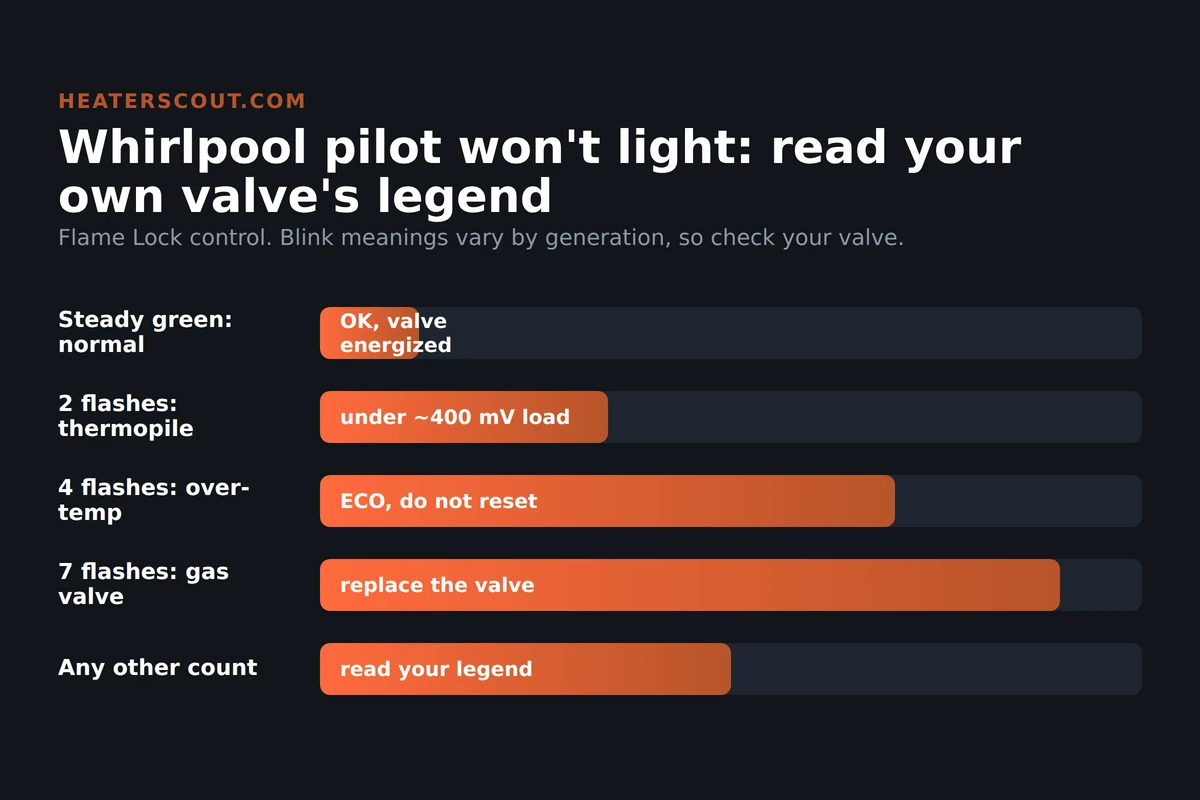
Four flashes and the water was scalding
The LED is flashing four and the last hot water out of the tap was too hot. On the Flame Lock control four flashes is an over-temperature (ECO) shutdown, a real overheat, not a nuisance. Do not just clear it and relight. Back the setpoint to 120 F, drain and flush sediment, and check the temperature sensing. Clear the lockout with the display button sequence, and if four flashes returns on a clean tank at 120, call for service instead of resetting again.
Pilot dies the moment you let go of the knob
An N40T61-343 that has been running since the Obama administration is not broken, it is just worn. Two flashes on the LED, or the pilot lighting on the button and dying on release, is a thermopile at the end of its life. Meter DC millivolts on the TP terminals: under about four hundred under load is a replacement, and the part is under fifty dollars and swaps out in an hour.
Fresh install, will not light at all
A Whirlpool set for natural gas fed with propane never runs a stable pilot, because the pilot orifice bore is too large for LP and the flame lifts off the thermopile. If your unit is stamped NG on the rating plate and the house is on a buried LP tank, stop trying to light it and order the correct LP conversion kit for that model, or pull the heater and get the LP version.
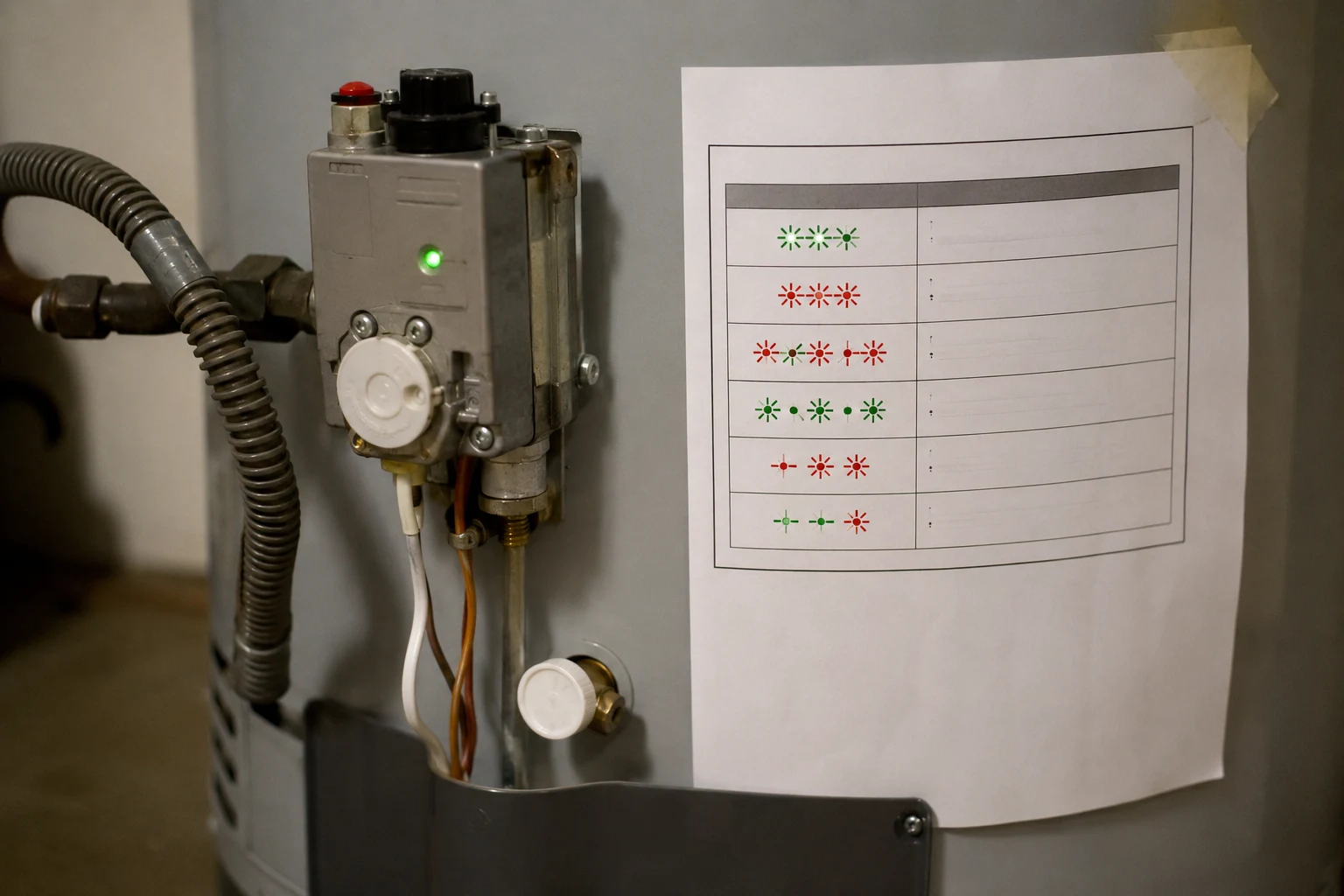
The short version
Your Whirlpool from Lowe's is an A.O. Smith build with a Honeywell WV8840A valve, now sold as the Resideo 100112336. Watch the green LED, but read the meaning off the legend on your own valve, since counts vary by control generation. Steady green is normal. Two flashes is a weak thermopile, the cheap fix. Four flashes is an over-temperature (ECO) shutdown: a real overheat, so back the setpoint to 120 F, flush sediment, check the temperature sensing, and do not keep resetting it. Seven flashes is the valve itself, roughly two hundred dollars to swap. Replace the valve last, only after the pilot and the thermopile check out. Clear a lockout with the display button sequence, never a red button at the burner.
Steady green or 1 flash every 3 seconds
No fault. If the burner will not fire on a call for heat with the LED behaving, the thermostat setpoint is below tank temperature, the dial is off, or the main gas is closed. Nothing to reset.
2 flashes: weak thermopile
Meter DC millivolts across the TP and TP TH terminals. Open circuit should be 700 to 900 mV, and under load with the burner firing should be 500 to 700 mV. Below about 400 mV under load, replace the thermopile. First confirm a crisp blue pilot that fully envelops the thermopile tip and clean the pilot orifice.
4 flashes: over-temperature (ECO) shutdown
This is a real overheat, not a nuisance trip, so do not just clear it and relight. The control saw water past its high limit. Back the thermostat dial to 120 F, drain and flush sediment from the tank, and confirm the dip tube and mixing valve are not letting cold bypass the sensing. If four flashes returns on a clean tank at 120, stop resetting it and call for service.
7 flashes: gas valve failure
Internal valve fault. Rarely clears with a reset and never with more than one try. Order the Resideo 100112336, roughly one hundred eighty to two hundred fifty dollars, and swap the valve. Check the warranty on the tank first, because the valve is a covered part for several years on Whirlpool gas heaters and you may pay labor only.
Any other count
The meaning of a given blink count varies by control generation, so match it against the legend printed on your own valve or under the jacket rather than a generic online chart. Do not force a relight through a code you have not identified, since some are safety trips. If in doubt, call Whirlpool or A.O. Smith tech support with the full model and serial.
Frequently asked
Is the Whirlpool water heater from Lowe's the same as A.O. Smith?
Yes. Whirlpool gas water heaters were manufactured for Whirlpool by A.O. Smith and its subsidiary American Water Heater, out of the plants in Ashland City and Johnson City. Lowe's carried the Whirlpool badge as its store brand until Lowe's pulled the line from new inventory around 2022, but millions of those tanks are still installed. The N40T61-343 and the N50T61 are the everyday models that show up in garages, and both use the same Honeywell gas control valve, burner, thermopile, and flammable-vapor sensor as their A.O. Smith Signature and American Proline cousins. When you shop for a part, cross-reference the A.O. Smith number, because it is the same physical piece coming down the same line.
What is the Resideo replacement for the WV8840A gas valve on a Whirlpool?
Resideo 100112336. Resideo bought the Honeywell home comfort business, and part 100112336 is the current production version of the WV8840A gas control valve that Whirlpool, A.O. Smith, American, and State fitted to the N40T61 and N50T61 family of atmospheric-vent gas storage heaters. It has the same green LED, the same PILOT and ON knob, the same TP and TP TH thermopile terminals, and the same wiring for the piezo igniter and the flammable-vapor sensor. It drops straight onto the old valve's tapping. A genuine 100112336 runs about one hundred eighty to two hundred fifty dollars, well under what an OEM Whirlpool-badged valve used to cost, and it is what most plumbers show up carrying for a seven-flash code.
How do I clear a lockout on a Whirlpool water heater with the Flame Lock control?
On the electronic Flame Lock control the lockout reset is a display button sequence, not a red button at the burner. Turn the control power off for about ten seconds, then hold both temperature-adjust buttons on the front of the control while you turn it back on. There is no red reset button to reach for at the burner air-intake, and you should never put your hands into the burner or combustion area to clear a code. Before you clear anything, know what the code is: read the legend printed on your own valve or under the jacket, since the blink-count meaning varies by control generation. If the code is a four-flash over-temperature (ECO) shutdown, do not just clear it and relight, because that is a real overheat condition. Back the setpoint to 120 F, flush sediment, and check the temperature sensing before you reset, and call for service if it returns.
My Whirlpool water heater blinks 2 times, what does that mean?
Two flashes on the green status LED, in bursts separated by a pause, is the Honeywell WV8840A telling you the thermopile voltage is too low to hold the gas valve open. The thermopile is the small bundle of thermocouples the pilot flame heats to generate the millivolt signal that runs the valve, and when it sags below the valve's holding threshold you get the classic Whirlpool complaint of a pilot that lights while you hold the knob down but dies the moment you release. Put a multimeter set to DC millivolts on the TP and TP TH terminals at the valve. A healthy thermopile reads roughly seven hundred to nine hundred millivolts open circuit and five hundred to seven hundred under load with the burner calling. Anything under about four hundred under load is a replacement. The part is inexpensive and the swap is a screwdriver-and-wrench job at the burner door.
Can I replace the gas valve on a Whirlpool water heater myself?
Physically yes, if you are comfortable turning off gas and pulling a burner. Legally it depends on your local code, because some jurisdictions require a licensed plumber for any gas connection. The job: shut the gas, kill any electric feed to a power vent, disconnect the thermopile and pilot tubing at the valve, unplug the piezo igniter lead, and back the valve out of the tank tapping with a large pipe wrench. Old valves are pipe-doped in tight, and gentle heat from a heat gun on the fitting breaks the seal without cooking the tank. Thread the Resideo 100112336 in with fresh gas-rated dope, reconnect everything, leak-check every joint with soapy water under pressure, and relight per the label.
What if the pilot ignitor button does nothing on my Whirlpool?
If you press the piezo igniter button and get no click and no spark at the pilot, the piezo unit or its wire has failed. Two cheap parts fail here: the piezo generator behind the button, which cracks internally and stops producing the high-voltage pulse, and the thin insulated wire that runs from the button to the electrode at the pilot, which chafes or breaks where it enters the burner box. A universal piezo replacement kit at any hardware store runs about fifteen dollars and swaps in with a screwdriver. To confirm the rest of the heater is fine before you order it, you can light the pilot manually with a long barbecue lighter through the sight port, holding the gas knob down at PILOT for the usual sixty seconds. If the pilot lights and holds on a manual light, the only thing wrong is the piezo.
Why does 4 flashes keep coming back on my Whirlpool after I reset it?
On the Whirlpool Flame Lock control, four flashes is an over-temperature (ECO) shutdown, not a vapor code, and a code that returns after you clear it is telling you the water is genuinely getting too hot. That is the whole point of the safety, so do not keep resetting it. The usual causes are a setpoint left too high, heavy sediment in the tank trapping heat against the sensor, or a temperature-sensing part or gas valve that is no longer regulating. Back the thermostat down to about 120 F, drain and flush sediment, and confirm nothing is letting the water run past the high limit. If four flashes still comes back on a clean tank set at 120, stop clearing it and call for service, because repeatedly overriding an over-temp lockout means running the tank hot on purpose. And do not trust a generic online chart to identify the code: read the legend on your own valve, since the count meaning varies by control generation.