The number stamped on a tankless unit, say 9.8 GPM, is not the number you actually get. That rating assumes warm incoming water and a small temperature rise. In a cold-climate January the same unit might deliver half of it. Sizing a tankless heater is really about two figures, and one of them changes with the seasons.
Quick answer
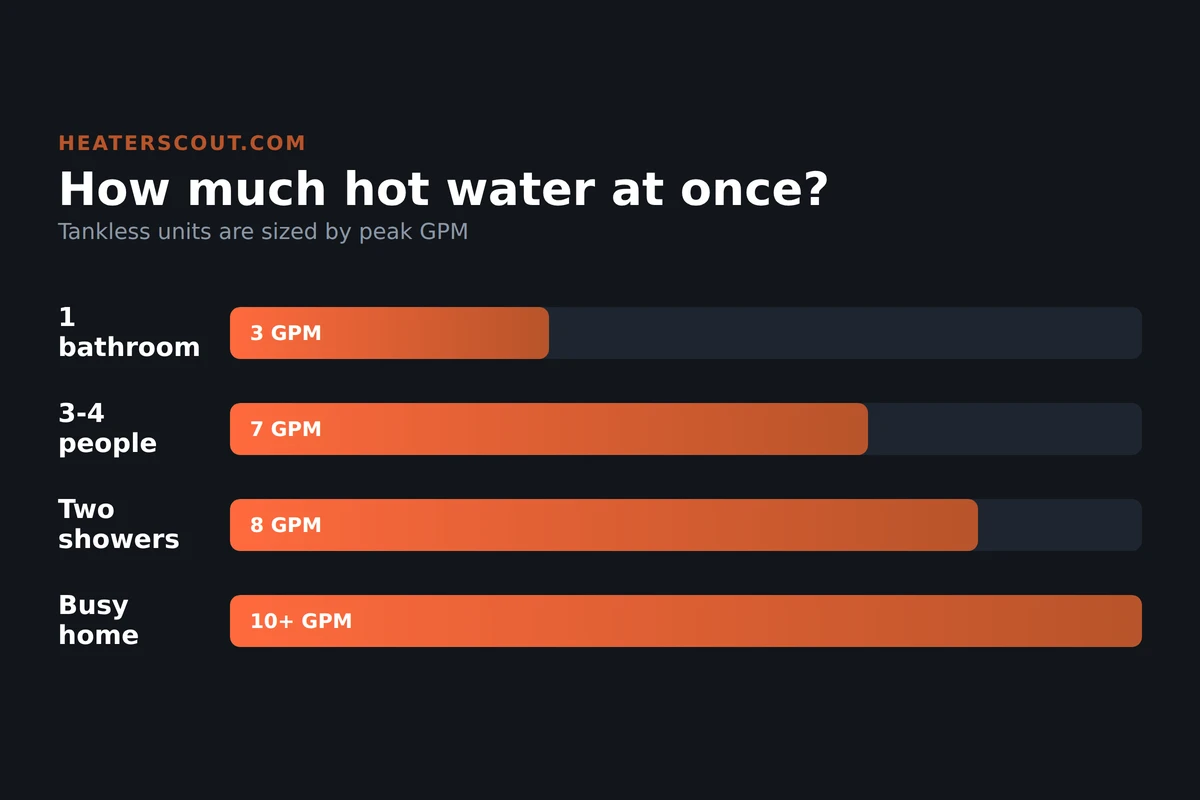
Add up the flow of the fixtures you would run at the same time to get your peak GPM. Then subtract your winter groundwater temperature from your target of 120 degrees to get your temperature rise. Pick a unit that delivers that GPM at that rise, not its headline number. Most homes need 6 to 10 GPM.
Why a tankless unit is sized so differently from a tank
A tank water heater is sized by volume. You buy 40 or 50 gallons of stored hot water, and its real number is the first-hour rating, meaning how much hot water it can deliver in a busy first hour before it runs low. Run it dry and you wait for it to reheat. A tankless unit has no tank and stores nothing. It heats water on the fly as it flows through, which means it never runs out, but it also means it can only heat so much water so fast.
That flips the whole sizing question. With a tankless heater you are not asking how many gallons you need stored. You are asking how many gallons per minute it can heat while keeping them hot enough. That is the GPM rating. And because heating water on the fly gets harder the colder the incoming water is, the same unit has a different real capacity in Texas than it does in Minnesota. Two numbers, peak flow and temperature rise, decide everything, and one of them is set by your climate, not your household.
Step one: your peak flow in GPM
Tankless units are rated by gallons per minute, so start by adding up what runs together at your busiest moment. You are not adding every fixture in the house, just the ones realistically on at once. The mistake here goes both ways. Add up every faucet in the house and you will buy a unit twice as big as you need. Size for a single shower and you will get a cold surprise the first morning two people are getting ready at once.
| Shower | 1.5 to 2.5 GPM |
| Bathroom faucet | 0.5 to 1.5 GPM |
| Kitchen faucet | 1.0 to 1.5 GPM |
| Dishwasher | 1.0 to 2.5 GPM |
| Washing machine | 1.5 to 3.0 GPM |
Pick the cluster you would use together. Two showers running while someone rinses dishes is roughly 2 plus 2 plus 1.5, so about 5.5 GPM of demand at that moment. A single person in a one-bathroom condo who never runs two hot fixtures at once might peak at 2 to 2.5 GPM, one shower and nothing else. A family of five on a school morning, with two showers going, the kitchen tap running, and a load of laundry filling, can spike past 7 GPM. Your number is your household at its busiest, not its average.
One shortcut helps here: low-flow fixtures have quietly cut these numbers over the years. Modern showerheads are capped at 2.5 GPM and many run at 1.8, where older ones pushed 3 or more. If your home has recent fixtures, use the lower end of each range. If it still has pre-1994 fixtures, use the higher end, because those older heads and faucets move noticeably more water.
Step two: your temperature rise
This is where geography decides the unit. Take 120 degrees and subtract the temperature of the water entering your house in winter. The colder it starts, the bigger the rise, and the less GPM any given unit can push. This is the number people skip, and it is the one that ends in cold showers.
Here is the physics in one line: heating water takes a fixed amount of energy per degree, so a unit with a fixed energy output can only heat a certain number of gallons per minute by a certain number of degrees. Ask it to raise the water further and it has to slow the flow to keep up. A unit that comfortably delivers 8 GPM at a 40-degree rise might manage only 4 GPM once you ask it for an 80-degree rise. Same unit, half the water, purely because the water started colder.
| Region | Winter incoming | Rise to 120°F | Effect on the unit |
|---|---|---|---|
| Deep South, Gulf Coast | ~65°F | ~55°F | Delivers close to its rated GPM |
| Mid-Atlantic, Midwest | ~50°F | ~70°F | Loses roughly a quarter of rated GPM |
| Northern tier, New England | ~40°F | ~80°F | May deliver only half the rated GPM |
The box number is the best case
Manufacturer GPM ratings are quoted at a small temperature rise, sometimes as little as 35 degrees. That is a summer, warm-climate number. Read the unit's GPM at 70 or 80 degrees of rise before you trust it for a cold-climate winter.
Your water utility can tell you the incoming water temperature, but you can also estimate it. In the warmest southern states groundwater enters around 60 to 70 degrees even in winter. Across the middle of the country it drops to the 40s and low 50s. In the northern tier and New England it can reach the high 30s in the dead of winter. Take your coldest realistic incoming figure, subtract it from 120, and that is the rise the unit has to deliver against, on the worst morning of the year.
Gas or electric changes the ceiling
Two tankless units can both claim 8 GPM and behave nothing alike, because the fuel sets the ceiling. Gas tankless units put out a lot of heat, which is why whole-house tankless heaters are usually gas. A big one can genuinely supply a busy house through a cold winter, but only if the gas line and venting are sized for it. Many need a three-quarter-inch gas line and dedicated venting, and undersizing either one starves the burner and quietly drops your real GPM below the label.
Electric tankless units are cleaner to install and need no venting, but their ceiling is amperage. A whole-house electric tankless can pull 100 to 150 amps, which is often more than a modest panel can spare without an upgrade. They shine as point-of-use heaters for a single sink or shower, or in warm climates where the temperature rise is small. In a cold climate, asking an electric unit for a large rise and high flow at once usually runs into the limits of the electrical service before the water limits. Decide the fuel before you fall in love with a GPM number, because the fuel decides whether that number is reachable in your house.
Match a unit to your household
4 to 6 GPM
One bathroom, rarely two hot fixtures at once. A smaller unit covers a shower plus a sink even at a high winter rise.
7 to 9 GPM
The common family case: two showers or a shower plus laundry or dishes. This is where most whole-house units land.
10+ GPM
Three or more simultaneous fixtures, or a northern climate with an 80 degree rise. Often a large single unit or two units linked together.
Put it together
Frequently asked
How many GPM does a tankless water heater need for a whole house?
Most single-family homes land between 6 and 10 GPM once you add up the fixtures likely to run at the same time. A single bathroom needs far less than a house where two showers and the kitchen run together.
What is temperature rise and why does it matter?
Temperature rise is your target temperature minus the incoming groundwater temperature. A unit is only rated to deliver its full GPM at a given rise. The colder your incoming water, the less hot water the same unit can make.
Why size for winter instead of summer?
Groundwater is coldest in January and February, exactly when demand is highest. A unit that delivers plenty in August when the water enters at 65 degrees can go lukewarm in January when it enters in the 40s. Always size to the winter rise.
Do I need a bigger tankless unit in a cold climate?
Yes. The same household in Maine needs a unit rated 30 to 50 percent higher in GPM than one in Texas, purely because the incoming water starts so much colder and needs a bigger temperature rise.
Will one tankless water heater run two showers at once?
Only if its rated GPM at your winter rise covers both. Two showers at about 2 GPM each plus a little margin means you need roughly 5 GPM of real capacity at your temperature rise, not the summer number on the box.
Deciding between tankless and a tank?
Sizing is only half the choice. The tankless-versus-tank guide weighs upfront cost, endless hot water, and the cold-water sandwich so you can pick the right type before you size it.