Heat 50 gallons of water from a 55-degree inlet to a 120-degree setpoint and you make about a gallon of extra volume out of thin air. On a closed system that gallon has nowhere to go, so an expansion tank absorbs it. The question is not whether you need one, that is settled, but how big it has to be. And the size that works turns out to depend less on your heater and more on your water pressure.
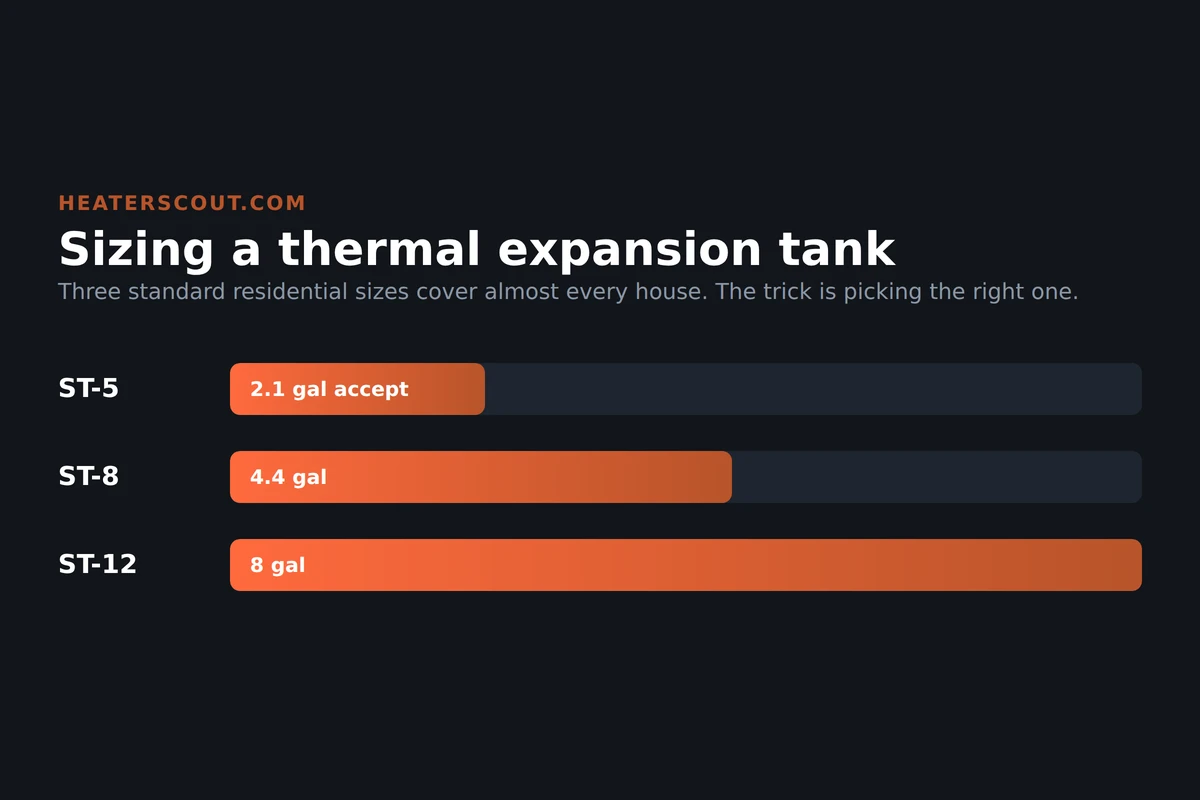
| ST-5 | 2.1 gal acceptance; typical 40 to 50 gal heater at 50 to 60 psi |
| ST-8 | 4.4 gal acceptance; 50 gal at high pressure, or 60 to 80 gal tanks |
| ST-12 | 8 gal acceptance; large or very high-pressure systems, rare in a house |
| Expansion factor | About 0.020 at 120°F, 0.023 at 130°F, 0.026 at 140°F |
| Code ceiling | 80 psi max static pressure (IPC / UPC) |
| Pre-charge rule | Set tank air pressure equal to your static water pressure |
The two numbers that decide the size
Sizing an expansion tank is not a guess and it is not the loose one-gallon-per-ten rule of thumb people repeat. It is two calculations that meet in the middle. Get both and the tank size falls out on its own.
The first number is how much water your heater actually makes when it heats. Water is nearly incompressible, but it does swell as it warms, and the amount is predictable. Take the heater volume in gallons and multiply by an expansion factor. For a 120-degree setpoint coming off a roughly 50-degree inlet, that factor is about 0.02, which is the familiar two percent. Run hotter and it grows: near 0.023 at 130 degrees and about 0.026 at 140. So a 50-gallon heater at 120 makes 50 times 0.02, one full gallon. The same heater cranked to 140 makes 50 times 0.026, about 1.3 gallons. Temperature alone moves the expansion by a third.
The second number is the part most homeowners miss, and it is the one that matters more. A diaphragm tank does not accept water for free. It only takes water while the system pressure rides between the tank's air pre-charge and the pressure ceiling the code allows, which is 80 psi. The fraction of the tank that can accept water is the acceptance factor, and it is one minus the quantity static pressure plus 14.7, all divided by max pressure plus 14.7. The 14.7 is atmospheric pressure, because the physics runs on absolute pressure, not the gauge reading. At a comfortable 50 psi static, the acceptance factor works out near 0.32, meaning about a third of the tank does useful work. Push the house to 75 psi and the factor collapses toward 0.05. Almost none of the tank is available, because you have already used up most of the room to the ceiling before the heater even fires.
Put them together and the required tank acceptance is the expansion volume divided by the acceptance factor. That gallon of expansion at 50 psi needs one divided by 0.32, about 3.1 gallons of acceptance. The same gallon at 75 psi needs one divided by 0.05, roughly 20 gallons, which no residential tank delivers and which is really the calculation telling you to install a pressure-reducing valve first. This is why two identical 50-gallon heaters can call for very different tanks. The heater sets the expansion; the pressure sets how big a vessel it takes to absorb it.
Run your own numbers
Set the three sliders to your house. Heater gallons is on the rating plate. Static pressure is what a $10 gauge reads on a hose bibb with nothing running. Setpoint is where you keep the thermostat, usually 120 for scald safety and 140 only if you have a mixing valve or a legionella concern. The tool computes the expansion volume, the required acceptance, and the smallest standard tank that covers it.
Expansion tank sizing calculator
Enter heater size, static pressure, and setpoint. Output is required acceptance and the standard model that beats it. Round up when in doubt. Not a substitute for your local inspector.
Thermal expansion
1.00 gal
Extra volume made each heating cycle
Required acceptance
3.10 gal
Expansion divided by acceptance factor
Recommended tank
ST-5
2.1 gal acceptance
—
How to size and set it, step by step
The math above is the whole idea, but installing the right tank correctly takes a short sequence. Do these in order and the tank does its job for a decade with no fuss.
Size is half the job; pre-charge is the other half
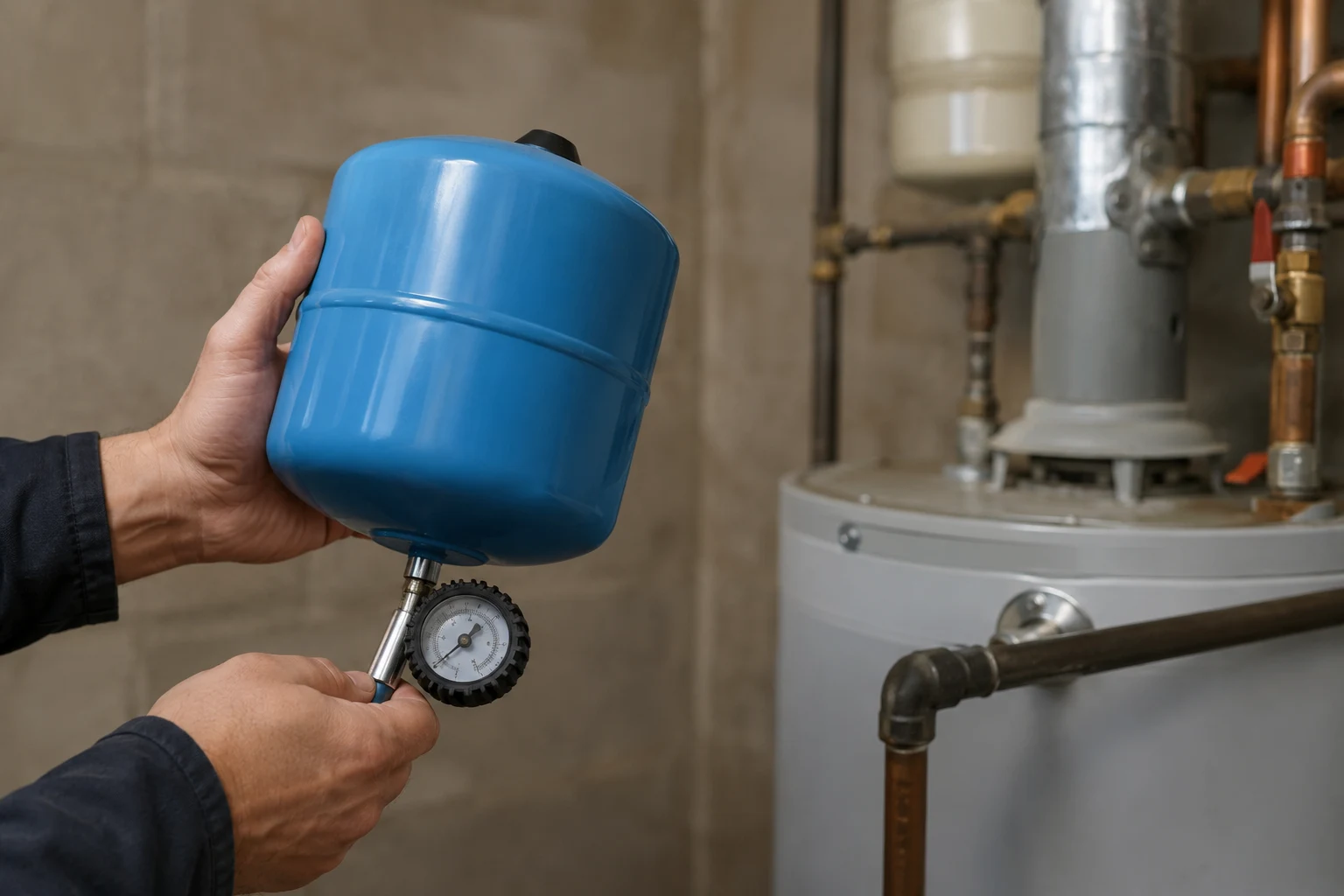
The most common real-world failure is not a wrong size, it is a wrong pre-charge. A perfectly sized ST-8 sitting at its factory 40 psi on a 70 psi house behaves like a rock: the diaphragm is already bottomed out, so system pressure climbs and the relief valve weeps as if no tank were installed. Set the pre-charge to your static pressure with the water side bled off, verify it with a tire gauge, and re-check it every couple of years, because the air side loses a few psi over time.
Can I just install the biggest tank and skip the math?
Mostly, yes, and plenty of installers default to an ST-8 for that reason. An oversized expansion tank never causes harm; the diaphragm simply flexes less. The math matters when you want to save money on a small system, when wall space or clearance is tight, or when your pressure is high enough that even a big tank will not cover it and the real fix is a PRV. Oversizing hides a pressure problem instead of solving it, so run the numbers at least once to know which situation you are in.
Does a tankless water heater need an expansion tank sized the same way?
A tankless unit holds almost no water, so the stored thermal expansion is tiny and many closed-system tankless installs use the smallest tank made or a thermal expansion relief valve instead. The sizing logic is identical, expansion volume over acceptance factor, but with a fraction of a gallon of stored water the required acceptance is small. Check your unit's manual, because some manufacturers specify a minimum tank for warranty regardless of the calculation.
Frequently asked
What size expansion tank do I need for a 50-gallon water heater?
For a typical 50-gallon heater at a normal setpoint and moderate house pressure, an ST-5 with 2.1 gallons of acceptance is usually enough. Heating 50 gallons from about 50 degrees to 120 makes roughly one gallon of expansion, and at 50 to 60 psi the tank has plenty of acceptance to swallow it. Push the pressure up toward 75 or 80 psi, or run the tank at 140 degrees, and the acceptance factor shrinks, which is when a 50-gallon heater steps up to an ST-8. Run your own numbers in the calculator, because pressure moves the answer more than gallons do.
How is expansion tank size actually calculated?
Two numbers drive it. First is the thermal expansion volume: heater gallons times an expansion factor, roughly 0.02 for a 120-degree setpoint, rising to about 0.026 at 140. That tells you how much extra water the heat makes. Second is the acceptance factor, which is 1 minus (static pressure plus 14.7) divided by (max pressure plus 14.7), where max is the 80 psi code ceiling. The required tank acceptance is the expansion volume divided by the acceptance factor. Then you round up to the next standard tank.
Why does higher water pressure mean a bigger expansion tank?
Because a diaphragm tank only accepts water while system pressure sits between the pre-charge and the 80 psi ceiling. Start at 50 psi and you have a 30 psi window to work in. Start at 75 psi and you have almost nothing left before you hit the ceiling, so the same gallon of expansion pushes pressure over the top unless the tank is physically larger. In the math, the acceptance factor drops as static pressure climbs, and required acceptance is expansion divided by that factor. High-pressure homes need bigger tanks for the exact same heater.
What is the difference between tank volume and acceptance volume?
Total tank volume is the whole shell. Acceptance volume is only the part that actually takes on water as the diaphragm flexes, and it is always smaller than the shell. An ST-5 is a 2-gallon tank rated for about 2.1 gallons of acceptance; an ST-8 is a larger shell rated near 4.4 gallons of acceptance. Manufacturers publish acceptance, not shell size, because acceptance is the number your sizing math has to beat. When you divide expansion by the acceptance factor, the answer you get is a required acceptance, so compare it to the tank's acceptance rating.
What happens if the expansion tank is too small?
Undersized, the tank fills up early in the heating cycle and then behaves like it is not there. Pressure keeps climbing, and the temperature and pressure relief valve on the heater starts to weep or discharge after hot-water draws. That is the exact symptom people install a tank to cure, so a too-small tank looks like a failed one. Going one size up costs a few dollars and removes the risk entirely, which is why the rule is to round up when you land between sizes.
Does the expansion tank pre-charge affect what size I need?
The pre-charge does not change the required acceptance, but getting it wrong throws away the acceptance you paid for. The air pre-charge has to match your static water pressure. A factory 40 psi pre-charge on a 65 psi house leaves the diaphragm already compressed at rest, so the tank has near-zero usable acceptance no matter how big the shell is. Set the pre-charge to your static pressure with the water side depressurized, and the tank delivers the acceptance its rating promises.