A Westinghouse electric tankless does not fail in mysterious ways. It is a 240-volt box with heating elements, a flow sensor, a couple of thermistors, and a control board, and when it stops making hot water the cause is nearly always one of four things: no power on one leg of the double-pole breaker, flow below the rate that fires the unit, an overheat cutoff that has tripped on scale or low flow, or an element that has quit. This guide walks the APOLO and ET series through each symptom in order, no hot water, lukewarm output, temperature swings, and breaker trips, using the real activation flows, amperages, and breaker sizes off the Westinghouse rating plates so you fix the right thing the first time.
Know your model before you touch anything
Every fix on this page depends on which Westinghouse you have, because the electric lineup spans a wide range of power and, with it, a wide range of flow and breaker requirements. The whole-home units are sold as the APOLO series and, under retailer part numbers, the ET series: ET011K, ET014K, ET018K, ET024K, and ET027K map to the 11, 14, 18, 24, and 27 kilowatt models. There is also a small 3.5kW mini for a single fixture that runs on ordinary 120-volt power. Pull the rating plate before you diagnose, because the difference between a heater that is broken and one that is simply undersized for your flow is written right there in the kilowatts.
| APOLO-11kW | 46A max · 1×50A DP breaker · 8 AWG · 0.4 GPM to start · up to 2.6 GPM |
| APOLO-14kW | 59A max · 1×60A DP breaker · 6 AWG · 0.5 GPM to start · up to 3.4 GPM |
| APOLO-18kW | 75A max · 2×40A DP breakers · 2×8 AWG · 0.66 GPM to start · up to 4.2 GPM |
| APOLO-24kW | 100A max · 3×40A DP breakers · 3×8 AWG · 0.79 GPM to start · up to 5.6 GPM |
| APOLO-27kW | 113A max · 3×40A DP breakers · 3×8 AWG · 0.79 GPM to start · up to 6.3 GPM |
| Mini 3.5kW | 120V · 30A dedicated circuit · 1/2" NPT · single point-of-use |
| Set range | 86 to 140 F, ±1 C deviation, on every whole-home model |
No hot water: start with power, then flow
No hot water at all splits cleanly into two checks, and doing them in order saves you from chasing parts. First, power. A Westinghouse whole-home tankless is a 240-volt appliance fed by a double-pole breaker, meaning two poles that trip together and must both be live. Here is the trap: the control board and display can wake up on a fraction of that voltage, so the screen lights, the WiFi connects, and it looks alive while the heating elements sit dead because one leg of the breaker has opened or a terminal has worked loose. Flip the double-pole breaker fully to OFF, then firmly back to ON. If it will not hold, or it trips the moment you draw water, you have an element or wiring fault and it is time for an electrician, not another reset.
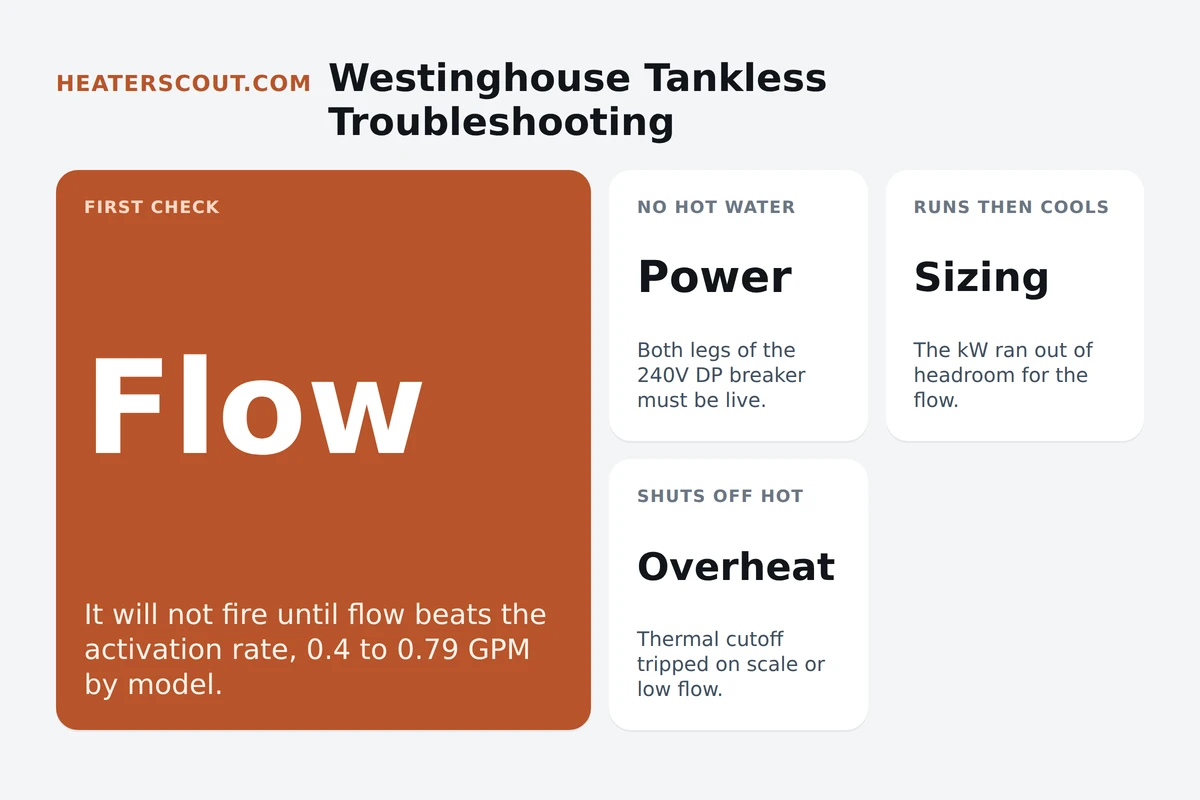
If power is solid, the culprit is flow. Every model has an activation flow, the minimum gallons per minute it must sense before the elements fire, and it ranges from 0.4 GPM on the 11kW to 0.79 GPM on the 24kW and 27kW. Fall below that and the heater never turns on, which feels exactly like a dead unit. The usual flow killers are a clogged inlet filter screen, a supply valve that is not fully open, a kinked flex line, or a heavy scale buildup narrowing the passages. Open the tap wide, confirm you are getting real flow, and clean the inlet screen.
No power at all
Both poles of the double-pole breaker are off or the circuit is dead. Reset the DP breaker. If it trips instantly, stop and get an electrician: that is a short, not a nuisance trip.
One leg dead or no flow
Screen lit but water stays cold. Either one breaker pole opened or the flow is under the activation rate. Reset the full DP breaker and clean the inlet filter screen.
Runs, then quits
It fires and then the water goes cold seconds later. Suspect the overheat cutoff tripping on low flow or scale, or a flow sensor dropping out mid-draw.
Fast checks before you open the unit
Most Westinghouse tankless complaints resolve at the water and the breaker, not inside the cover. Run this list first. It costs nothing and it clears the noise so that if you do open the unit, you are chasing a real electrical fault and not a half-closed valve.
- Confirm the double-pole breaker is fully ON, both poles, not tripped to the middle position.
- Verify the model and its ratings on the plate so you know the activation flow and breaker size.
- Open the hot tap wide and confirm real flow above the model's activation rate (0.4 to 0.79 GPM).
- Shut off the water, remove and rinse the inlet filter screen, then restore flow.
- Check the setpoint is where you want it inside the 86 to 140 F range, not left low.
- If water is hard, note whether you have ever descaled: scale drives overheat trips and low flow.
- Feel the flex connections and terminals for looseness only with power off at the breaker.
Temperature swings and lukewarm water: it's usually sizing
Two different complaints get blamed on a broken heater when they are really the physics of electric tankless. The first is lukewarm water that never gets hot. Electric tankless output is fixed by kilowatts, and the colder your incoming water, the fewer gallons per minute the unit can lift to your setpoint. An 11kW model happily runs a single shower on 70-degree summer supply, then struggles on 45-degree winter groundwater at the same flow. That is not a fault. It is the unit running out of headroom. The tell is simple: reduce the flow slightly and watch the temperature recover. If it does, you are at a sizing limit and the fix is less flow, a lower demand, or a bigger model, not a repair.
The second complaint is temperature that swings, hot then cold then hot, the cold-water sandwich. The Westinghouse holds temperature by modulating its elements against the flow sensor and outlet thermistor readings, and anything that makes those readings jumpy makes the output hunt. A fouled flow sensor, a scaled outlet thermistor, or air pulsing through the lines all cause it. So does short-cycling the tap: cracking it open and closed repeatedly gives the modulation nothing steady to track. Hold a constant flow, clean the inlet filter, and if you have hard water, descale. A unit that still hunts at a steady, modest flow after that points at the flow sensor or a thermistor.
Breaker trips and the overheat cutoff
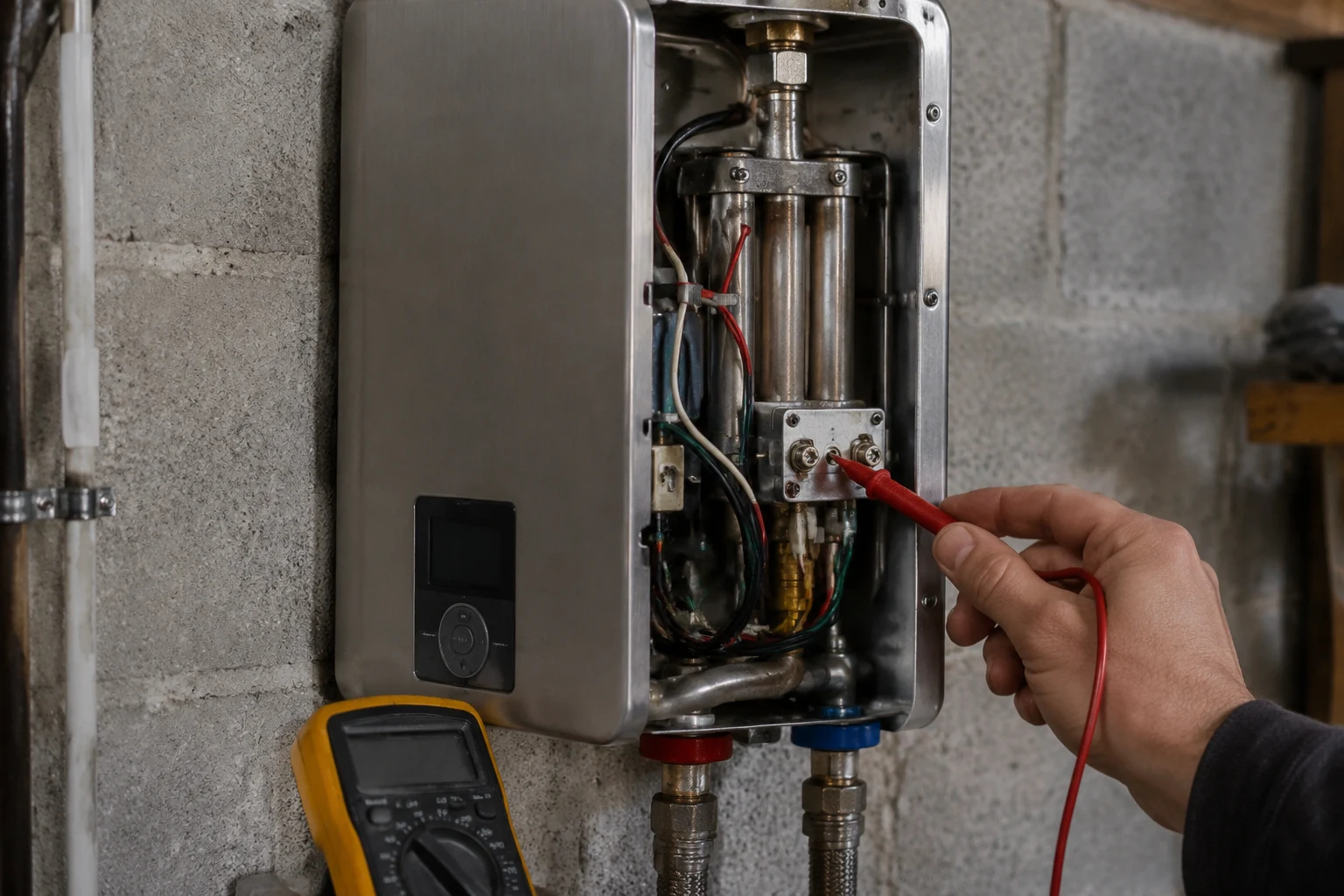
A tripping breaker and a tripping overheat cutoff feel similar, no hot water, but they are different faults with different fixes. Start with the breaker. These units pull real current, from 46 amps on the 11kW to 113 amps on the 27kW, and they demand a correctly sized double-pole breaker and matching wire: the 14kW on a 60A DP breaker with 6 AWG, the 24kW on three 40A double-pole breakers with 8 AWG. A breaker that trips the instant you call for hot water usually means a heating element has shorted to ground or a connection has failed. A breaker that trips slowly under sustained draw usually means undersized wire heating up or a tired breaker. The one thing you never do is fit a larger breaker to stop the trips. That removes the protection sized to your wire and turns a nuisance into a fire risk.
The overheat cutoff is the other trip, and it is part of the safety package Westinghouse builds into every ETL-listed electric unit alongside leakage and dry-fire protection. The overheat protection is a high-limit that cuts the elements when the outlet water climbs past its safe ceiling, which happens when flow is too low to carry the heat away or when scale on the element traps it. The dry-fire protection is its cousin: it blocks the elements from energizing with no water moving, so a drained unit or air-locked lines will not cook the elements. If your heater keeps hitting the overheat cutoff, treat it as a symptom. Restore full flow, clean the inlet screen, and descale a hard-water unit. Bypassing a high-limit that keeps tripping is how you turn a repair into a hazard.
Failed elements sit behind several of these symptoms. A whole-home Westinghouse uses more than one element staged across the flow, and when one element or its relay quits, you lose part of your heating capacity. The water goes lukewarm at any flow, which is the giveaway that separates an element failure from a sizing limit: a sizing limit recovers when you cut the flow, an element failure stays weak no matter how little you draw. A shorted element does the opposite and trips the breaker instantly. Ohming the elements and their relays with the power off at the breaker tells you which one, and on a heater still inside its warranty window that is a call to Westinghouse rather than a parts run.
Can I just install a bigger breaker to stop the trips?
No. The breaker is sized to protect the wire, not the heater. A 14kW unit on 6 AWG wire is protected by a 60A double-pole breaker; put a 90A breaker on that same wire and the wire can overheat to the point of fire before the breaker ever trips. If a correctly sized breaker keeps tripping, the fault is a shorted element, a loose connection, or undersized wire, and each of those is fixed at the cause, not by upsizing the breaker.
The reset, and when to stop resetting
There is no secret reset button on the front of a Westinghouse electric tankless. The reset is a power cycle: turn the double-pole breaker fully OFF, wait about a minute for the control board to power all the way down, then turn it back ON. That reboots the controller and clears a one-time fault. If the unit tripped its overheat cutoff, the high-limit may need the water to cool and flow to be restored before it will let the elements fire again, so run water through the unit after the reset. A reset is worth doing exactly once. If the same fault comes straight back, the cause is still present, and repeatedly cutting power to force a heater past its own tripping high-limit is the wrong move. Note what the unit does right after the reset, low flow, instant trip, lukewarm at any flow, and follow that symptom to its part.
Warranty and when to call in help
The Westinghouse electric tankless line commonly ships with a one-year limited warranty on the product pages, so an element or board that fails early is Westinghouse's problem, not yours, as long as you have the model number, serial number, and proof of the install date. That makes the rating plate worth a photo before you order any part. Draw the line at the electrical work: cleaning the inlet screen, descaling, checking the setpoint, and resetting the double-pole breaker are all homeowner tasks. Anything involving the 240-volt wiring, ohming or swapping an element, or a breaker that will not hold is licensed-electrician territory. A heater that trips its breaker instantly or trips its overheat cutoff repeatedly is not asking to be reset again. It is pointing at a specific fault, and the fastest fix is to read the symptom, match it to the part, and, if the unit is still covered, let Westinghouse warranty carry the cost of the part while you pay only for the labor to fit it.
Frequently asked
Why is my Westinghouse tankless water heater not producing hot water?
On an electric Westinghouse tankless the two things that stop hot water cold are power and flow, and both are quick to check. The unit runs on 240 volts through a double-pole breaker, so it needs both legs of that breaker live. If one pole has tripped or a wire has loosened at the terminal, the display can still light up on control voltage while the heating elements get nothing, so you feel a warm-at-best trickle that never gets hot. Reset the double-pole breaker fully to OFF and back to ON, and if it will not hold, stop and call an electrician because a 240V heater tripping instantly is a wiring or element fault. The second cause is flow. Every model has an activation flow it must see before it fires, from 0.4 GPM on the 11kW up to 0.79 GPM on the 24kW and 27kW. A clogged inlet filter screen, a half-open shutoff, or a low-flow aerator can drop you under that threshold, and below it the heater simply never turns on.
Why does my Westinghouse tankless keep giving temperature swings or cold bursts?
Temperature that surges hot then cold, the classic tankless cold-water sandwich, comes down to flow and sizing more than a broken part. A Westinghouse electric unit modulates its elements to hold the set temperature, but it can only add so many kilowatts. If you pull more gallons per minute than the model can heat for the incoming water temperature, the outlet temperature sags. The 11kW tops out near 2.6 GPM, the 18kW near 4.2, the 27kW near 6.3, and cold winter groundwater cuts those numbers hard. Swings can also be a fouled flow sensor or a scaled outlet thermistor feeding the board a jumpy reading. Clean the inlet filter, hold a steady flow rather than cracking the tap, and if your water is hard, descale the unit. If it still hunts up and down at a modest flow, the flow sensor or thermistor is the next suspect.
Why does my Westinghouse tankless water heater trip the breaker?
A breaker that trips on a Westinghouse electric tankless is telling you the circuit is drawing more than it should or that something is shorted, and the fix depends on when it trips. If it trips the instant you call for hot water, suspect a heating element that has shorted to ground or wiring that is loose or undersized for the load. These units pull serious current, 46A on the 11kW up to 113A on the 27kW, and they must land on a correctly sized double-pole breaker with the right wire: the 14kW wants a 60A DP breaker on 6 AWG, the 24kW wants three 40A double-pole breakers on 8 AWG. A breaker that trips slowly under sustained draw is usually undersized wire heating up or a breaker that is worn. Never swap in a larger breaker to stop the tripping. That defeats the protection and is a fire risk. Match the breaker and wire to the model's rating plate and have an electrician confirm the connections are tight.
How do I reset a Westinghouse tankless water heater?
The reset for a Westinghouse electric tankless is the power cycle, not a hidden button on the front. Turn the double-pole breaker feeding the unit fully OFF, wait about a minute so the control board fully powers down, then turn it back ON. That clears a one-time fault and reboots the controller. If the unit tripped on its overheat cutoff, that safety may need the water to cool and flow restored before it will let the elements fire again. A reset clears the symptom, not the cause. If the same fault returns right after a clean power cycle, the underlying problem is still there, whether that is low flow, scale on the element, a bad thermistor, or a wiring issue, and repeatedly cutting power to force it back on is the wrong move on a heater that keeps tripping its own high-limit.
What does the overheat or dry-fire protection do on a Westinghouse tankless?
Westinghouse electric tankless units are ETL listed with leakage, overheat, and dry-fire protection built in, and each one guards against a specific hazard. The overheat protection is the thermal cutoff, a high-limit that kills the elements if the outlet water climbs past its safe ceiling, which usually happens when flow drops too low to carry the heat away or when scale on the element traps it. The dry-fire protection stops the elements from energizing when there is no water moving through the unit, so a heater that was drained or has air in the lines will not cook its elements dry. If your unit keeps hitting the overheat cutoff, do not bypass it. Chase the cause: restore full flow, clean the inlet filter, and descale the heater if you have hard water. The cutoff tripping is the safety system working, not the fault itself.
How many amps and what breaker does a Westinghouse electric tankless need?
It scales with the kilowatt rating, and getting it right is the difference between a heater that works and one that trips constantly. All the whole-home models run on 240 volts through double-pole breakers. The 11kW draws up to 46A and takes a single 50A DP breaker on 8 AWG wire. The 14kW draws 59A on a 60A DP breaker with 6 AWG. The 18kW draws 75A across two 40A DP breakers on 8 AWG. The 24kW draws 100A and the 27kW draws 113A, both on three 40A double-pole breakers with 8 AWG. The mini 3.5kW point-of-use unit is different, running on a 120V 30A dedicated circuit. Always confirm against the rating plate on your specific unit, and size the wire and breaker together. Undersized wire on an oversized breaker is a fire hazard that no reset will fix.
Why is my Westinghouse tankless only lukewarm or low on hot water?
Lukewarm output almost always means the heater cannot add enough heat for the flow you are pulling at your incoming water temperature. Electric tankless heat is fixed by kilowatts, and the colder the groundwater, the fewer gallons per minute the unit can bring up to your setpoint. An 11kW unit that felt fine in summer can struggle to keep a single shower hot in a cold-climate winter. Before assuming a fault, check the set temperature is up where you want it inside the 86 to 140 F range, then reduce the flow slightly and see if the temperature recovers, which confirms a sizing limit rather than a broken element. If one element has failed you lose part of your heating capacity and the water turns lukewarm at any flow, so a unit that was always fine and suddenly went weak points at an element or its relay, not at sizing.