Put a brand new water heater on a private well and there is a decent chance it will not see its warranty out. The tank is not defective. The water is. Well water shows up carrying a load that treated city water does not: hardness minerals that bake into scale, iron and manganese that stain and choke flow, sand that clogs the drain valve, low pH that corrodes steel from the inside, and sulfate bacteria that turn your hot water into a rotten-egg smell. Each is a separate problem with its own fix, and they tend to arrive together. This page walks through all five, how to tell which ones you have, and what actually stops them, from a fifteen-dollar anode swap to a whole-house treatment train.
The short version
Well water attacks a water heater five ways at once: scale insulates the bottom and drives up bills, iron and sand clog the tank and drain valve, low pH corrodes the tank and anode fast, and sulfate bacteria feeding on the magnesium anode make the rotten-egg smell. The fixes are a flush every four to six months, an aluminum-zinc or powered anode, and whole-house treatment sized to a water test. Treat the water upstream and the tank stops dying young.
Why well water is so much harder on a water heater
A water heater is the one appliance that takes raw water, holds it, and heats it, and heat is what turns dissolved minerals and gases into real damage. On a municipal supply the utility already filtered, balanced the pH, and disinfected the water before it reached you. On a private well, whatever is in the ground shows up at your tank, and shallow wells, wells near surface water, and wells with a damaged casing carry the heaviest loads. Nothing sits between that water and your heater but the pipe.
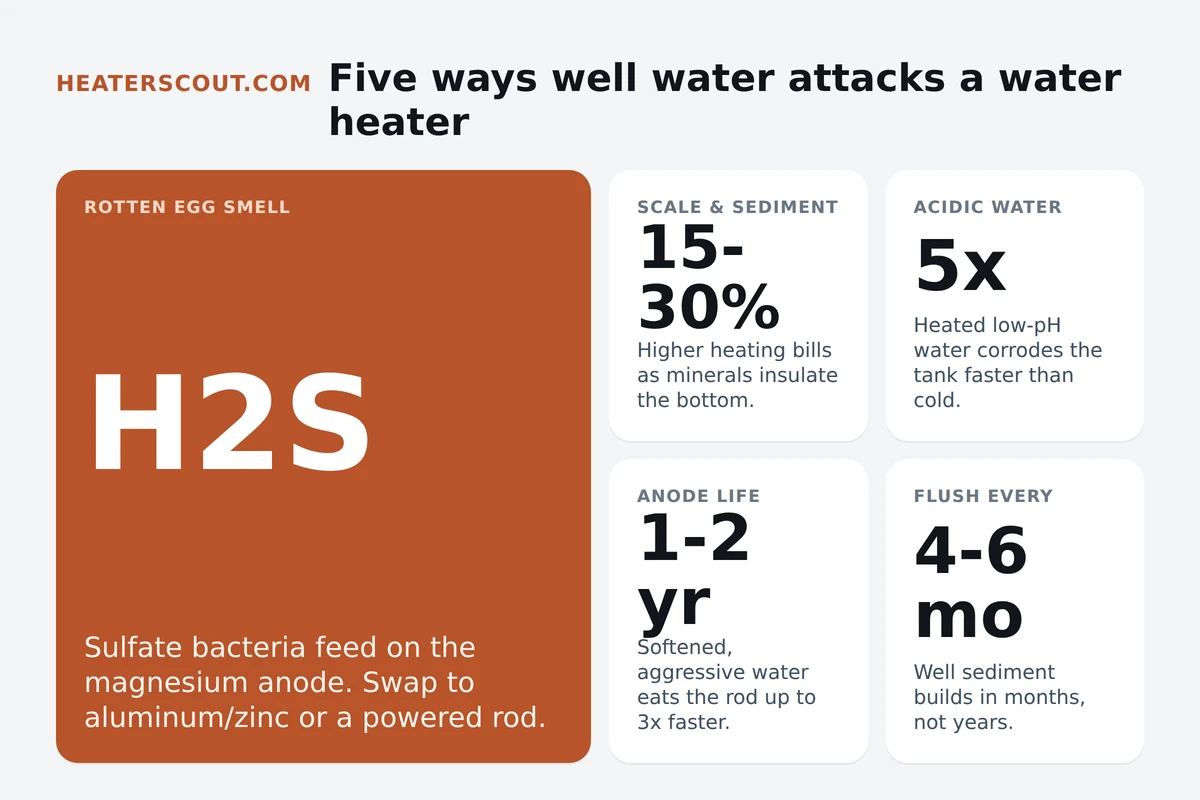
The result is a heater fighting on several fronts at once. Below is how often each shows up in real well-water service calls, so you know where to look first.
Sulfate-reducing bacteria
Anaerobic bacteria, meaning they live without oxygen, that are common in well water and thrive in the warm, still, low-oxygen environment inside a water heater. They consume sulfate in the water and, critically, feed on the hydrogen given off by a corroding magnesium anode rod. The byproduct is hydrogen sulfide gas, which is the rotten-egg smell. They are not generally a health hazard at these levels, but they are why swapping the anode, not scrubbing the tank, is what actually clears the odor.
Scale and sediment: the bill you can hear
Start with the most common one. Well water carries dissolved calcium and magnesium, the minerals that make it hard, along with iron and fine sand. Every time the heater fires, some of those minerals drop out and pack into a hard crust on the bottom of the tank. On a gas heater that crust sits between the burner flame and the water like insulation, so the burner runs longer and water-heating energy can climb roughly fifteen to thirty percent over a couple of years. You often hear it before you see it on the bill: popping or rumbling is water flashing to steam under the crust. On an electric heater the lower element gets buried in sediment, overheats, and burns out early. And sediment from untreated water voids most water heater warranties, so a failure the manufacturer traces to scale is one you pay for.
Iron, manganese, and the brown hot water
Iron is the well-water problem people notice at the sink. It stains fixtures and laundry orange, gives the water a metallic taste, and turns the hot side brown when it gets stirred up. Inside the plumbing it is quieter and costlier: iron builds up as scale inside the heater and pipes, choking flow and shortening the life of every appliance downstream, and manganese does the same in black. It hits the hot side hardest because heat drives the iron out of solution to deposit inside the warm tank. You cannot flush your way out of a heavy iron problem the way you can with plain hardness, because the iron keeps arriving with every gallon. The real fix is an iron filter on the main line ahead of the heater, sized to the parts-per-million your test shows; light iron might come out in a softener, but heavier iron needs a dedicated iron filter.
The rotten-egg smell, and why the anode is the answer
This is the well-water complaint that sends the most people looking for help, and the fix is almost always misunderstood. The sulfur, rotten-egg smell is hydrogen sulfide gas, and the telltale sign is that it comes off the hot water only while the cold runs clean, which points away from the well and toward the tank. Well water carries more sulfate and more sulfate-reducing bacteria than city water, and those bacteria settle into the warm, oxygen-poor tank and feed on the hydrogen that the standard magnesium anode gives off as it corrodes. Magnesium is doing its job protecting the steel, but in doing so it hands the bacteria exactly the fuel they need to make the smell.
That is why the durable fix is at the anode, not the faucet. Swapping the magnesium rod for an aluminum-zinc rod cuts the smell because the zinc suppresses the reaction and aluminum gives off less hydrogen. Better still is a powered, or impressed-current, anode: it protects the tank with a small electrical current instead of a sacrificial metal, so it makes no hydrogen at all and the odor usually clears within a day. A chlorine shock, one to two pints of household bleach per forty gallons left to sit a few hours and flushed, knocks the smell out short term, as does running the tank at 160 degrees for several hours to cook the bacteria, but if you leave the magnesium anode in, the smell returns. Treat the thermal method with respect, because 160-degree water scalds in seconds, so turn the thermostat back down and confirm the temperature before anyone uses a tap.
Sand, silt, and the drain valve that will not open
Wells throw sand and fine grit, especially newer wells, wells with a worn screen, or a pump pulling from a sandy aquifer. That grit settles into the tank and causes a specific, frustrating failure: it clogs the drain valve. The stock valve on most heaters is a small plastic piece with a narrow opening, and a single flake of sediment can block it so nothing comes out when you flush; opening the cold-water supply sometimes builds enough pressure to blast the clog through. The permanent answer is to replace the plastic valve with a full-port brass ball valve, which turns flushing into a non-clog event and is the first upgrade any well-water heater should get. One related tell: white or gray plastic flecks clogging your faucet screens are usually not the well but the heater's dip tube breaking apart, and the fix there is a cheap new dip tube, not water treatment.
Acidic water: the damage you cannot see
Low pH is the well-water problem that quietly destroys heaters. Water with a pH below about 6.5 is corrosive, and because heated acidic water is roughly five times more aggressive than the same water cold, the heater corrodes from the inside faster than anything else in the house, eating the anode first, then the tank lining. The clearest sign shows up outside the tank: blue-green stains where copper meets a fixture, and pinhole leaks in copper pipe. If your tanks keep failing at three to five years on the same well while everything else seems fine, suspect pH before the brand. The fix is a whole-house acid neutralizer, a tall tank of calcite media, essentially crushed limestone, that dissolves into the water and raises the pH toward neutral, protecting the heater and every pipe and fixture at once. Calcite alone handles water in the roughly 6.0 to 6.9 range; below 6.0 you blend in a stronger media called Corosex.
Anode rods burn out faster on wells, and softeners speed it up
The sacrificial anode is the rod that corrodes on purpose so the tank does not, and on well water it has a hard life. Aggressive, mineral-heavy, or low-pH water consumes it faster than city water, which is why checking the anode is not optional on a well. One twist catches people who add treatment: softened water is more conductive, which speeds up the electrochemical reaction and can consume an anode up to three times faster. That is why the anode choice matters so much on a well. Magnesium is the most reactive, depletes fastest, and feeds the rotten-egg bacteria, so it is usually the wrong pick. Aluminum resists well-water corrosion better and lasts roughly five to eight years, and the aluminum-zinc blend adds odor control. A powered anode sidesteps depletion entirely and can run close to twenty years, at around 180 to 300 dollars. On softened water, inspect the rod every one to two years whichever type you run.
| Hardness / scale | Popping and rumbling, slow recovery, rising energy bills, burned-out lower element. Flush 2 to 4x a year; add a softener. |
| Iron and manganese | Rusty or brown hot water, metallic taste, orange staining, choked flow. Whole-house iron filter ahead of the heater. |
| Sand and silt | Grit in the tank, clogged drain valve, white or gray flecks at faucets from a failing dip tube. Sediment filter; swap to a brass ball drain valve. |
| Acidic / low pH | Tank dies in 3 to 5 years, blue-green stains, pinhole leaks in copper, anode gone fast. Calcite acid neutralizer to raise pH. |
| Rotten-egg smell (H2S) | Sulfur smell on the hot side only, cold runs clean. Aluminum-zinc or powered anode; chlorine shock as a short-term reset. |
| Softener side effect | Anode consumed up to 3x faster on softened water. Check the anode yearly; use aluminum or powered. |
What to actually do about it
Every fix comes down to a water test and a short list of upgrades, done in the right order. Work it top to bottom before you buy your next heater.
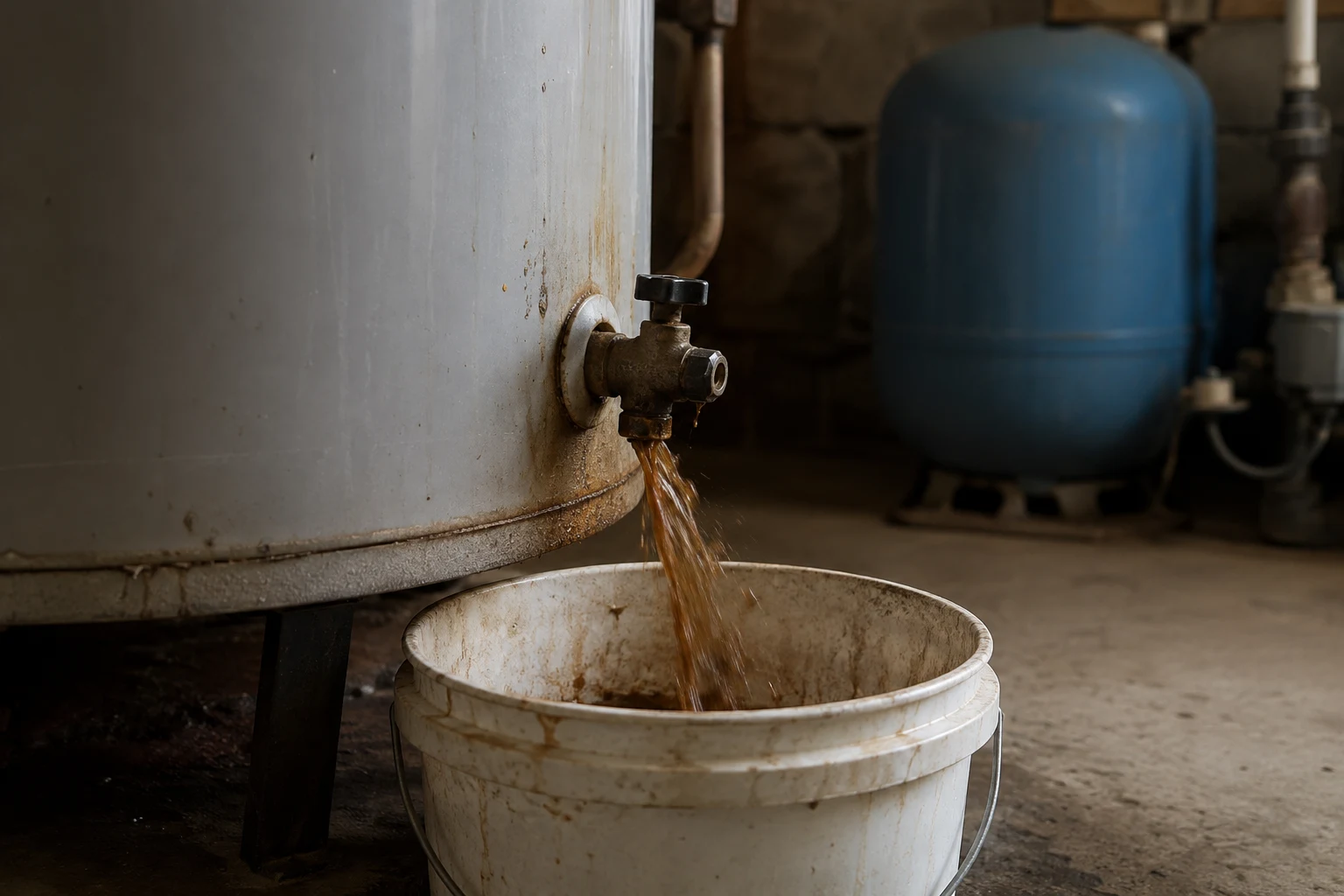
The through-line is that a water heater on a well is downstream of a water problem, and fighting it at the tank alone is a losing game. Flushing and the right anode buy the heater years and are worth doing on day one, but if the well is throwing iron, acid, or heavy sediment, the tank keeps paying for it until the water gets treated first. Test the water, treat what the numbers show, and the heater stops being the thing that dies every few years.
Chase the anode, not the faucet
The rotten-egg smell is not the well and it is not a health emergency, it is a reaction between sulfate bacteria and your magnesium anode inside the tank. Bleaching the well or buying a new heater with the same magnesium rod will not fix it for long. Change the anode to aluminum-zinc or powered and the fuel for the smell is gone.
Frequently asked
Why does my hot water smell like rotten eggs on well water?
That sulfur, rotten-egg odor is hydrogen sulfide gas, and on well water it almost always traces to a reaction inside the tank rather than the well itself. Well water tends to carry more sulfate and more sulfate-reducing bacteria, anaerobic bugs that thrive in the warm, low-oxygen tank and feed on the hydrogen the standard magnesium anode gives off as it corrodes, and the byproduct is the smell. The giveaway is that only the hot side stinks while the cold runs clean. The durable fix is to pull the magnesium anode and swap in an aluminum-zinc rod, where the zinc suppresses the odor, or a powered anode, which makes no hydrogen and starves the bacteria. A chlorine shock clears the smell short term but it comes back if the magnesium rod stays in.
How long does a water heater last on well water?
Less than it should, and how much less depends on your water chemistry. A tank that would run 10 to 12 years on treated city water can die in 3 to 5 years on aggressive well water, and low pH is one of the biggest reasons. Acidic water attacks metal from the inside out, starting with the anode and moving to the tank lining, and heated acidic water is roughly five times more corrosive than the same water cold. Iron, sand, and heavy hardness pile on with an insulating sediment layer that makes the burner or elements run hotter and longer. If your tanks keep failing early on the same well, that is the water telling you it needs treatment upstream, not another new heater every few years.
How often should I flush a water heater on well water?
Far more often than the once-a-year rule you see for city water. Well water usually carries more minerals, iron, and grit, so sediment builds up in months instead of years, and most plumbers who work on wells recommend flushing every four to six months, which is two to four times a year. The cheapest way to set your interval is a grains-per-gallon test kit from the hardware store, since the harder the water and the more iron it shows, the more often you flush. If you drain the tank and the water runs milky, rusty, or full of grit, you waited too long. Regular flushing is the single highest-payback habit on a well, because it keeps the sediment layer from ever getting thick enough to insulate the bottom and cook the tank.
What kind of anode rod is best for well water?
For most well-water homes the answer is either an aluminum-zinc rod or a powered anode, not the magnesium rod that ships in most tanks. Magnesium is the most reactive metal, so it depletes fastest and feeds the sulfate bacteria that cause the rotten-egg smell. Aluminum resists well-water corrosion better and lasts longer, roughly five to eight years, and the zinc in an aluminum-zinc blend helps hold down sulfur odor. A powered, or impressed-current, anode uses a small electrical current instead of a sacrificial metal, so it makes no hydrogen for the bacteria, kills the smell within about a day, and can last close to twenty years. It costs more up front, around 180 to 300 dollars, but on a smelly well it often pays for itself against repeated rod swaps and shock treatments.
Why is my well water heater making my energy bills go up?
The usual culprit is a sediment layer on the bottom of the tank. Well water carries dissolved calcium and magnesium plus iron and sand, and as the water heats those settle out and pack into a hard crust across the bottom. On a gas heater that crust sits between the burner flame and the water like insulation, so the burner runs longer and water-heating energy can climb roughly fifteen to thirty percent over a couple of years, often with popping or rumbling as water flashes to steam under it. On an electric heater the lower element gets buried, overheats, and burns out early. Flushing on a well-water schedule and filtering the sediment before it reaches the heater is what keeps the bills from creeping.
Does acidic well water damage a water heater, and how do I fix it?
Yes, and it is one of the most destructive well-water problems because the damage happens where you cannot see it. Water with a low pH, generally under about 6.5, is corrosive, and heated acidic water is roughly five times more aggressive than cold, so the water heater corrodes from the inside faster than any other fixture, eating the anode first and then the tank lining. Blue-green stains on fixtures and pinhole leaks in copper pipe are the outside signs that the same thing is happening inside the tank. The fix is a whole-house acid neutralizer, a tank of calcite media, essentially crushed limestone, that dissolves into the water and raises the pH toward neutral, handling water from about 6.0 to 6.9, with a Corosex blend below 6.0. Treating the pH protects the heater, the pipes, and every appliance downstream at once.
Do I need a whole-house filter or a water softener for my well?
It depends on what your water test shows, and on a well you usually need more than one piece. The problems stack, so the treatment stacks too, and the order matters: a sediment filter first to catch sand and silt, then an iron filter, then an acid neutralizer if the pH is low, then a softener for hardness, and finally carbon and sometimes UV. You do not necessarily need all of it, so get a water test and treat what the numbers show, meaning hardness in grains per gallon, iron and manganese in parts per million, pH, and sulfate. One note on softeners: softened water is more conductive and eats an anode up to three times faster, so if you add one, check the anode every year or two and consider an aluminum or powered rod to keep up.