A homeowner installs a whole-house softener, loves how the water feels, and four years later the water heater rusts through and floods the utility room. The softener did not spring a leak in the tank. It quietly ate the one part that was protecting that tank, the sacrificial anode rod, and nobody was watching it. That is the whole story of softeners and water heaters in one sentence: the same water that saves your heater from scale can wreck it from the inside if you ignore the anode. Both things are true at once, and which one you get is up to you.
Where the efficiency and life numbers come from
The scale penalty is not a vague 'it's bad for the heater.' It is a heat-transfer problem with rough numbers behind it. Here is what hard water costs a tank heater as scale accumulates, against what softened water avoids.
Read those together and the tradeoff is obvious. Softening drives the top two problems, scale and the life loss it causes, down toward zero. It drives the bottom one, anode wear, way up. You are trading a slow scale death you cannot easily see for a fast anode consumption you can check with a wrench.
Quick answer
A water softener both helps and hurts a water heater, and the two effects run through different parts. It helps by stripping out the calcium and magnesium that form limescale, so the tank floor and heating elements stay clean and the heater keeps its efficiency and lasts longer. It hurts by making the water more conductive, which speeds the electrochemical reaction that consumes the sacrificial anode rod. Net result: with a softener you get less scale but a faster-wearing anode, so you must inspect and replace the anode sooner. Do that, and a softener is a win. Ignore it, and the tank corrodes early.
With a softener, watch the anode rod
Softened water burns through the sacrificial anode rod faster than hard water does, and once that rod is spent, the water goes after the steel tank itself. Manufacturer warranties on the tank are conditioned on periodic anode inspection, and softened water shortens that interval. If you soften your water, put the anode on a schedule: inspect every two years on soft city water, yearly on softened well water or an aggressively set softener. A neglected anode that lets the tank corrode is exactly the kind of maintenance failure a warranty excludes.
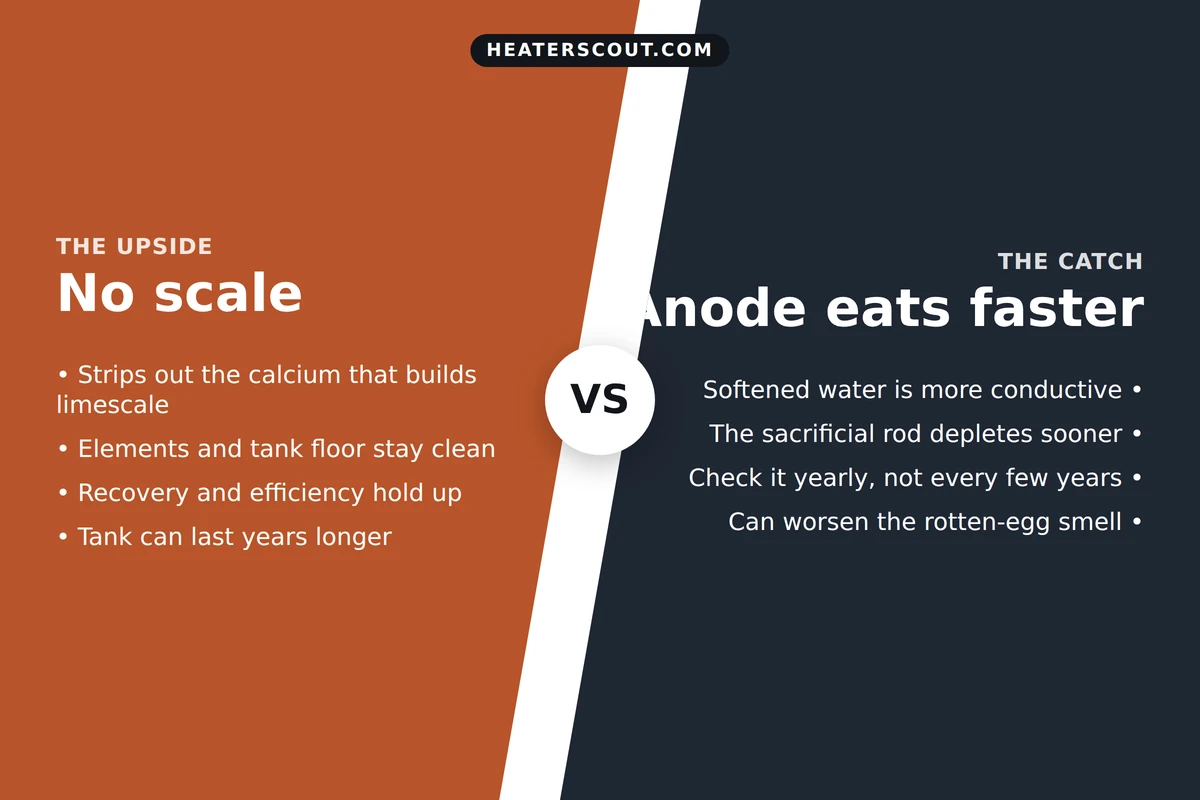
The upside: no scale, and it is a real one
Hard water is loaded with dissolved calcium and magnesium. Heat that water in a tank and those minerals drop out of solution and bake onto the hottest surfaces, the bottom of the tank and the heating elements. That crust is limescale, and it does two bad things. It insulates the metal from the water, so the burner or elements run longer and hotter to move the same heat, and it traps heat against the steel, which stresses the tank. The efficiency hit is measurable. A common figure in the trade is roughly a four percent loss in heating efficiency for every five grains per gallon of hardness, and heavy scale left for years can cut a heater's useful life by a large fraction, some estimates put it near half.
A softener runs the incoming water through a resin that swaps calcium and magnesium for sodium. The target is soft water, zero to three grains per gallon, down from the seven-plus that counts as hard and the eleven-plus that counts as very hard. With the hardness gone, there is nothing to precipitate onto the elements. No new scale forms, existing scale slowly loosens, and the heater keeps recovering at full speed. On that count alone, softening genuinely extends a heater's life. This is not marketing.
| What happens | Softened water (0-3 gpg) | Hard water (7+ gpg) |
|---|---|---|
| Limescale on elements/tank floor | Almost none; existing scale loosens over time | Builds steadily, insulates the metal, drops efficiency |
| Heating efficiency over years | Holds near new | Falls; roughly 4% lost per 5 gpg of hardness |
| Sacrificial anode rod | Consumed faster; conductive water speeds the reaction | Consumed slower; lasts closer to the factory interval |
| Steel tank once the anode is gone | Corrodes fast if the anode is not replaced | Also corrodes, but the anode lasts longer to protect it |
| Rotten-egg (sulfur) smell | Can appear or worsen with a magnesium anode | Less commonly triggered by the water itself |
| What the maintenance ask becomes | Watch and replace the anode more often | Flush the tank regularly to clear scale |
The catch: why soft water eats the anode
Every steel tank heater ships with a sacrificial anode rod, a magnesium or aluminum rod threaded into the top of the tank. It works by galvanic corrosion. The anode metal is more reactive than the steel, so the water corrodes the rod instead of the tank. The anode is meant to be eaten. That is its whole job, and it is why the tank does not rust from the inside for years.
Sacrificial anode rod
A rod of magnesium or aluminum, more electrochemically reactive than the tank's steel, threaded into the top of a water heater. Through galvanic action the water corrodes the rod in place of the tank walls, so the rod is consumed while the steel stays protected. It is a wear part by design and must be inspected and replaced before it is gone. Softened water is more conductive because the ion-exchange process leaves it sodium-rich, and higher conductivity speeds the galvanic reaction, so the anode is consumed noticeably faster in a home with a softener. When the rod is spent and not replaced, the water turns on the bare tank and corrosion, then a leak, follow.
Softened water is more conductive than hard water. The ion exchange that removes calcium and magnesium leaves behind sodium, and that raises the water's conductivity, which is exactly what a galvanic cell feeds on. Higher conductivity means a faster corrosion reaction at the anode, so the rod that might last four or five years on ordinary city water can be down to the bare steel core wire in one to two years under softened water. Bradford White states it directly in its installation manual: the use of a water softener may increase the speed of anode consumption, and more frequent inspection of the anode is needed with softened or phosphate-treated water. Rheem and A.O. Smith carry the same theme, tighter inspection intervals for softened supply.
The rotten-egg smell, and the anode swap that fixes it
There is a third wrinkle that catches people off guard: after a softener goes in, the hot water starts smelling like rotten eggs. That is hydrogen sulfide gas, and it usually comes from sulfate-reducing bacteria in the water reacting with a magnesium anode. The magnesium supplies electrons that help convert sulfate into hydrogen sulfide, and because softened water speeds the anode's reaction, it can crank up the gas. The tell is that the cold water smells fine while the hot side reeks. The fix is not to yank the anode out, which would leave the tank unprotected, but to change what it is made of.
Aluminum-zinc alloy anode
- Drop-in replacement for the magnesium rod
- Still protects the tank galvanically
- The zinc curbs the sulfide-producing reaction
- Cheap, and the usual first thing to try
Powered (impressed-current) anode
- Uses a small electric current, not a sacrificial metal
- No magnesium to feed the smell reaction
- Does not wear out, so no more anode replacements
- Costs more up front; eliminates the recurring job
An aluminum-zinc rod is the cheap first move and clears the smell in a lot of homes. A powered anode is the permanent answer, because it protects the tank with electric current instead of a dissolving metal, so there is nothing left to react with the bacteria and nothing to replace on a schedule. Under the Magnuson-Moss Warranty Act a maker generally cannot void your tank warranty just for fitting an aftermarket anode, so upgrading the rod is a legitimate move, not a warranty gamble.
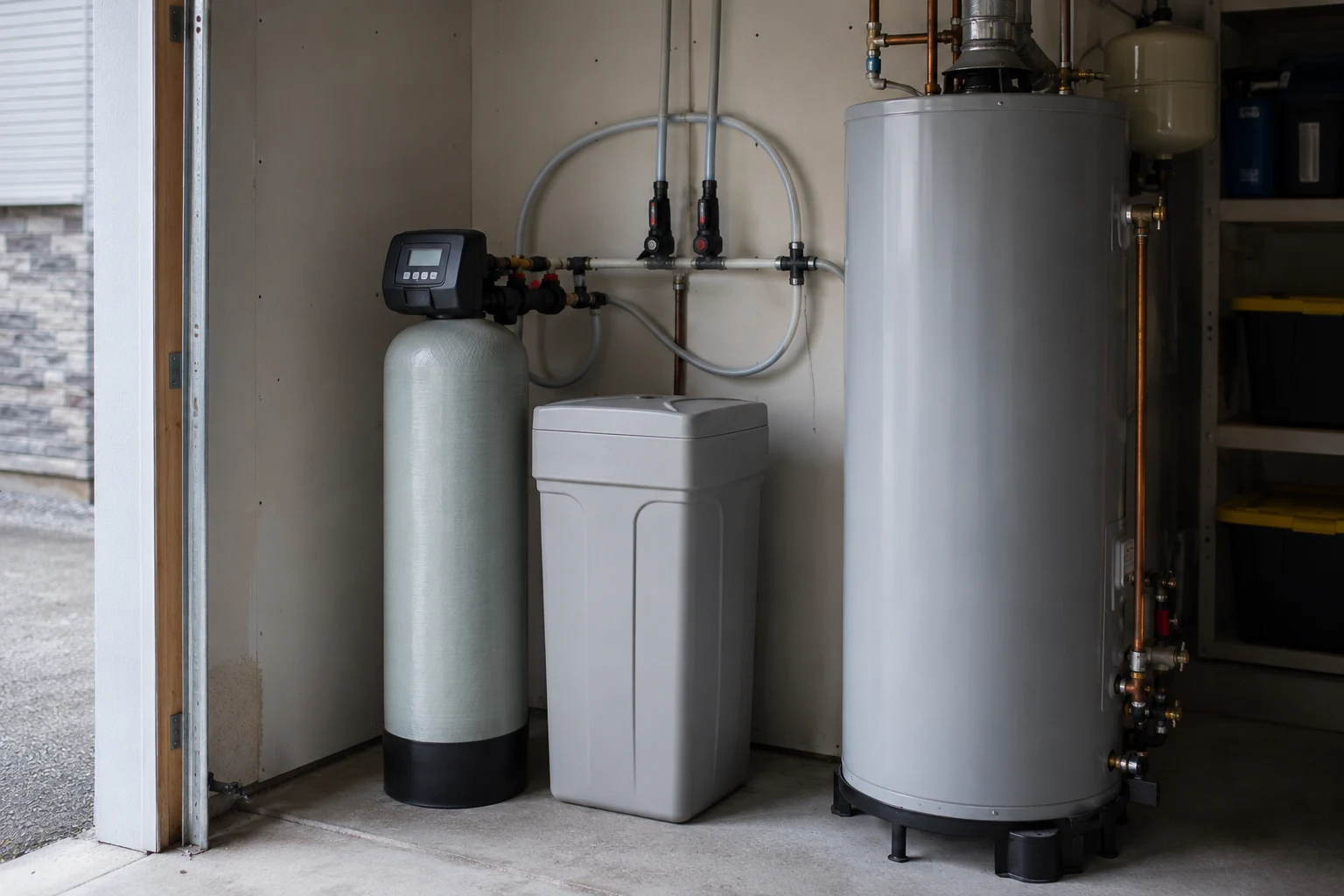
What to actually do if you have both
None of this means rip out the softener. It means match the maintenance to the water. If you are running softened water into a tank heater, the anode is your job now, not an afterthought. Here is the practical schedule.
| Soft city water | Inspect the anode every 2 years; replace when the core wire shows or it thins to pencil width. |
| Softened well water / aggressive softener | Inspect yearly; softened well water is the hardest on the rod. |
| Rotten-egg smell in the hot water | Swap magnesium for an aluminum-zinc rod, or go to a powered anode. |
| Tired of replacing anodes | Fit a powered anode once; it does not wear out and skips the cycle. |
| Only softening for the heater | Consider leaving a few grains of hardness, or skip softening below ~7 gpg. |
| Tankless heater on softened water | No anode to watch; enjoy the reduced scale and descale less often per the manual. |
The short version: a water softener is good for a water heater and bad for it at the same time, and the anode rod is the hinge. Watch that rod, or hand it off to a powered one, and softening quietly buys you a longer-lived heater. Forget it, and the same soft water that kept the scale away will find the steel.
Frequently asked
Does a water softener void my water heater warranty?
No, a softener by itself does not void the warranty, but it changes what you have to do to keep the warranty valid. Every major maker, Rheem, A.O. Smith, and Bradford White, ties the tank warranty to periodic anode rod inspection, and softened water burns through the anode faster. Bradford White says it plainly in the manual: the use of a water softener may increase the speed of anode consumption, so more frequent inspection is needed. Translate that to a schedule. On soft city water a common guideline is checking the anode every two years; on softened well water or heavily softened supply, check it yearly. Miss that and let the anode run to nothing, and the corrosion that eats the bare tank is exactly the kind of neglect that warranties exclude. The softener is not the problem. Skipping the anode checks it demands is.
Will a water softener make my water heater last longer or fail sooner?
It can do either, and which one you get depends entirely on the anode rod. On the scale side, softening helps. Hard water lays down limescale on the tank floor and heating elements, that scale insulates the metal, and the heater works harder and dies sooner. Strip the hardness out and that whole failure path goes away. But softened water is more conductive, so it drives the sacrificial anode down faster, and once the anode is gone the steel tank is the next thing the water attacks. So the honest answer is this: a softener plus a fresh anode you actually watch gives you a longer-lived heater; a softener plus an ignored anode gives you a rusted-through tank ahead of schedule. Same water, opposite outcomes, decided by a fifty-dollar rod.
Why does my hot water smell like rotten eggs after installing a softener?
That smell is hydrogen sulfide gas, and a softener can make it show up or get worse. The usual chain is sulfate-reducing bacteria in the water plus a magnesium anode rod. The magnesium feeds electrons into a reaction that converts sulfate to hydrogen sulfide, which is the rotten-egg odor you notice most in hot water. Softened water is more conductive, so it speeds the anode's reaction, and that can crank up the amount of gas produced. Cold water usually smells fine while the hot side reeks, which is the tell that it is happening in or around the tank. The common fix is swapping the magnesium anode for an aluminum-zinc alloy rod, which protects the tank without feeding the smell as hard, or going to a powered anode that uses a small electric current instead of a sacrificial metal, so there is no magnesium to react at all.
How often should I replace the anode rod if I have a water softener?
More often than the factory schedule assumes, because that schedule is written for average municipal water. A rough rule: pull and inspect the anode every two years on soft city water, and every year if you are on softened well water or your softener is set aggressively low. Inspect, do not just replace on a calendar. Unscrew it and look. If the steel core wire is showing through along more than about six inches, or the rod has thinned to pencil width, or it is caked and crumbling, it is spent and the tank is no longer protected. A standard magnesium or aluminum rod runs a few years in normal water but can be eaten in one to two years under softened water. If you hate the recurring job, a powered anode does not wear out and skips the whole replacement cycle.
Should I set my softener to leave a little hardness in for the water heater?
Some plumbers do exactly that, and it is a reasonable middle ground. A softener does not have to drive water all the way to zero. Blending or setting it to leave a few grains per gallon keeps most of the scale protection while easing off on how hard the water pushes the anode and how conductive it gets. Zero-hardness water is what most aggressively consumes the anode and, in the wrong tank, worsens the sulfur smell. If your only reason for softening is the water heater, you may not need a softener at all until you are up in genuinely hard territory. If you are softening for the whole house anyway, leaving a small residual hardness at the heater is a quiet way to split the difference. The bigger lever, though, is still watching the anode.
Is soft water or hard water actually worse for a water heater?
They damage it in opposite ways, so there is no single winner. Hard water is a slow scale problem: calcium and magnesium bake onto the elements and tank floor, that layer insulates and traps heat against the metal, efficiency drops, and the heater burns out early. Figure on the order of a few percent efficiency lost for every five grains per gallon of hardness, and heavy long-term scale can cut a tank's useful life substantially. Soft water is a corrosion problem: it protects against scale beautifully but eats the anode fast and, once that rod is gone, goes after the tank steel, sometimes with a sulfur smell riding along. Neither is 'safe' and forgettable. Hard water asks you to flush the tank regularly; soft water asks you to watch and replace the anode. Do the maintenance each one demands and either water can run a heater to a long life.
Do tankless water heaters have this same softener tradeoff?
The scale half applies hard, the anode half mostly does not. A tankless heater has no big steel tank and no sacrificial anode rod to consume, so the conductivity and rotten-egg-smell concerns that come with softened water are largely a tank-heater story. What a tankless unit hates is scale. The heat exchanger is a maze of narrow passages, and even a thin limescale coating there chokes flow, drives up outlet temperature, and trips error codes, which is why makers like Rinnai and Navien call for regular descaling flushes in hard water. So on a tankless, softening is mostly upside: it slashes the scale that fouls the exchanger and stretches the interval between descaling flushes. You lose the anode headache because there is no anode. You still follow the manual on flushing, just less often.