A water heater does not whistle for fun. That thin, steady note is air or water being forced through a gap that got too small, and the pitch is telling you something is restricted. Nine times out of ten the culprit is a valve someone left half closed, sediment choking the tank ports, or a relief valve venting because the tank is running hotter or higher than it should. The last of those is the one you do not sit and wonder about. A whistling temperature and pressure relief valve can mean the tank is over pressure or over temperature, and that is the exact condition a safety valve exists to relieve before it becomes a burst tank.
| At the cold inlet / shutoff valve | A partly closed valve. Water squeezes past a gate that is not fully open and the valve sings under flow. Open it all the way. Easiest fix on the list. |
| At the T&P relief valve | Escaping steam or water over 150 PSI / 210 F. Danger: possible overpressure or overtemp. Shut the heater down and call a pro before you relight. |
| From the tank body | Sediment or scale narrowing the dip tube outlet and drain port, usually with popping and rumble. Flush the tank; replace a corroded dip tube if needed. |
| From a tankless heat exchanger | Scale coating the narrow passages so water races through and sings. Descale the exchanger through the service ports on the maker's schedule. |
| From a flex connector or pipe | A kinked, crimped, or undersized flex line forcing water through a pinch. Re-run it without the kink or upsize the connector. |
| From the expansion tank | A leaking Schrader air valve or a waterlogged bladder that has lost its air cushion. Check the air charge; replace the tank if the bladder failed. |
A whistling T&P valve means shut it down
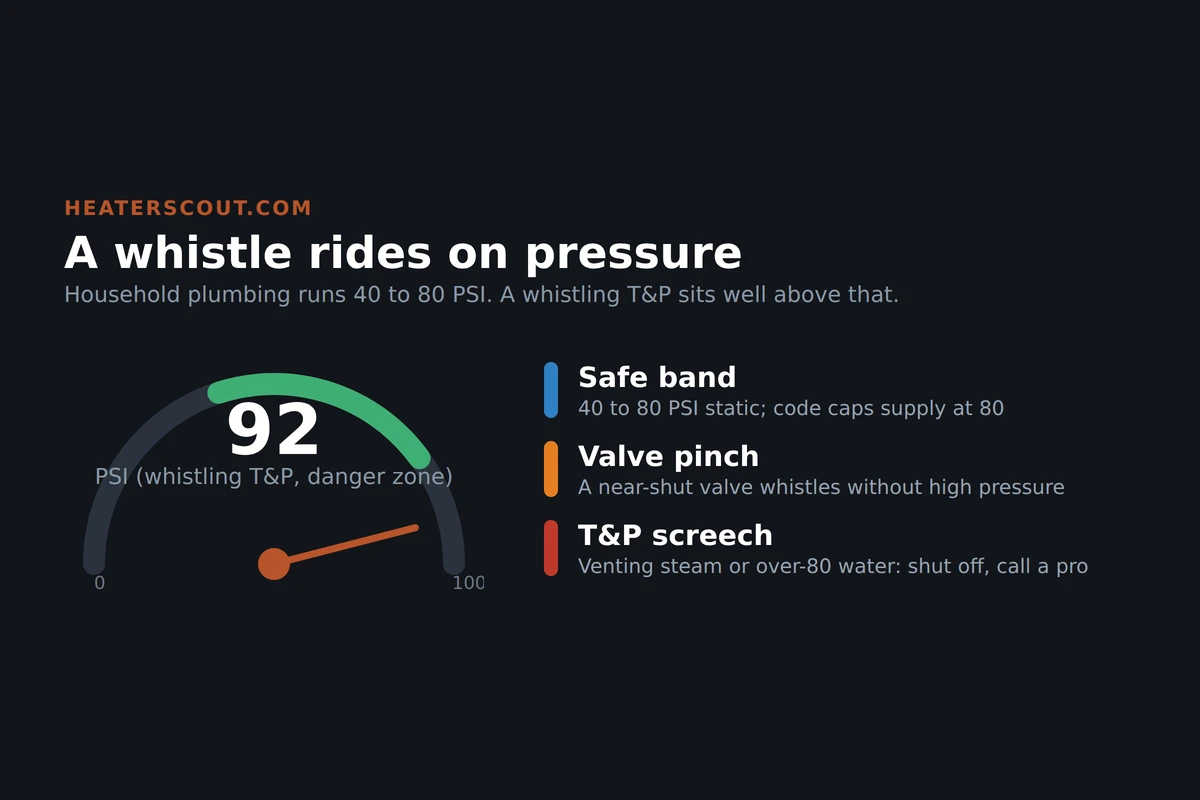
A whistling, hissing, or screeching temperature and pressure relief valve is not a nuisance noise. The T&P valve opens when the tank passes roughly 150 PSI or 210 degrees Fahrenheit, so if it is singing or venting, the tank may be over pressure or over temperature right now. Shut the heater off at the gas control or the breaker, close the cold water inlet, and keep people away from the discharge pipe, which can spray scalding water or steam. Do not cap, plug, or gag the valve to quiet it, and do not relight the heater. If the discharge line feels hot, you likely have an overheating tank from a stuck thermostat or a failed control, and that needs a licensed pro, not a guess.
Start by finding where the note is coming from
The mistake is to treat every whistle the same and start replacing parts. A whistle from the inlet valve and a whistle from the T&P valve are worlds apart in urgency and in what fixes them. Before you buy anything, localize the sound. Run a hot tap so water is actually moving, because a restriction only whistles under flow, then work your ear along the heater from top to bottom.
A Rheem or A.O. Smith tank that whistles
On a standard tank the whistle almost always sits at the top or the side. Check the cold inlet and shutoff valve first: half closed valves are the number one cause and cost nothing to fix. Next, put your ear to the tank body. A whistle down low, mixed with popping and a rumble like gravel in a pan, is sediment boiling under the burner and choking the ports. That is a flush. A whistle or hiss at the T&P valve on the side is the one you stop for: shut the heater down and treat it as an overpressure or overtemp fault until a pro clears it.
A Rinnai, Navien, or Noritz that sings when it fires
A tankless unit has no tank to hold sediment, so a whistle points straight at the heat exchanger. Scale narrows the copper or stainless passages until water races through and whistles under the burner, and the same scale drives the outlet temperature up and can trip error codes. The fix is a descaling flush through the isolation valves and service port, vinegar or a commercial descaler circulated for roughly an hour. Check the inlet filter screen too, because a clogged screen starves flow and can sound the same.
A pinched valve or a kinked connector
If opening the shutoff valve all the way kills the whistle, you are done: someone had left it half seated. If not, look at the flex connectors between the pipe and the tank. A braided or corrugated connector that got kinked, crimped, or was undersized on install forces water through a pinch point and whistles under flow. Re-run it without the bend or step up a size. This is the cheapest whistle to chase and the one people overlook because they stare at the tank.
Read the noise like a symptom, not a sound
A whistle rarely comes alone. The other noises around it, and when it shows up, narrow the cause faster than the pitch does. Match what you hear to the rows below.
Whistle only with a hot tap open, stops when you close it
A flow restriction, and it is downstream of moving water. Start at the shutoff valve and open it fully. If it persists, chase a kinked flex line, a scaled tankless exchanger, or sediment in the tank ports. The fact that it tracks flow exactly is your best clue: no flow, no whistle, means a pinch in the path.
Whistle or hiss at the T&P valve, discharge pipe warm or dripping
A safety event, not a nuisance. The relief valve is venting because the tank is at or past 150 PSI or 210 F. Shut off the gas or breaker, close the cold inlet, and get a pro. A warm discharge line means overtemp, usually a stuck thermostat or failed control. Do not plug the valve to silence it.
Whistle low on the tank with popping and rumbling
Sediment. Scale on the tank floor boils under the burner and narrows the dip tube outlet and drain port. Flush the tank through the drain valve; if the drain is clogged, break the bed loose with a wand. A corroded dip tube that has crumbled can also whistle and needs replacing.
Whistle that follows firing on a tankless unit
Scale in the heat exchanger. Narrow passages plus a hot burner make the water sing. Descale through the service ports on the maker's schedule. If descaling does not touch it, check gas supply and venting, because a starved burner can mimic a restriction.
Hiss or whistle from the expansion tank on the cold line
A leaking Schrader air valve or a failed, waterlogged bladder. Tap the tank: hollow up top and solid below is healthy; solid all the way through means the bladder is shot. Check the air charge with a tire gauge against your household static pressure and replace the tank if the bladder failed.
The physics behind the note
Every one of those causes is the same thing wearing a different hat. Water or air moving from a wide space into a narrow one has to speed up, and fast fluid through a tight gap sheds energy as sound. The pitch rises as the gap tightens. That is why you localize first: the sound does not tell you which gap, only that there is one.
Flow restriction
Any narrowing in the water path that forces the same volume through a smaller opening. Because the flow rate stays roughly constant while the area drops, the velocity through the pinch spikes, and high-velocity flow across an edge generates the audible whistle. In a water heater the pinch can be a partly closed valve, scale in the tank ports or a tankless exchanger, a kinked flex connector, or a relief valve cracked open by pressure. Remove the pinch, whether by opening the valve, flushing the scale, straightening the line, or fixing the overpressure, and the whistle goes with it.
What you can fix yourself and what you cannot
Two of these are honest DIY jobs. Opening a shutoff valve fully is a ten-second fix, and re-running a kinked flex connector is a hand-tools afternoon. Flushing a tank is DIY if you are comfortable draining it, and descaling a tankless unit is DIY if it has isolation valves and you follow the manual. The one line you do not cross alone is an overheating tank. If the T&P valve is venting because the water is over temperature, the underlying fault is a safety repair. Shut it down and call a licensed plumber.
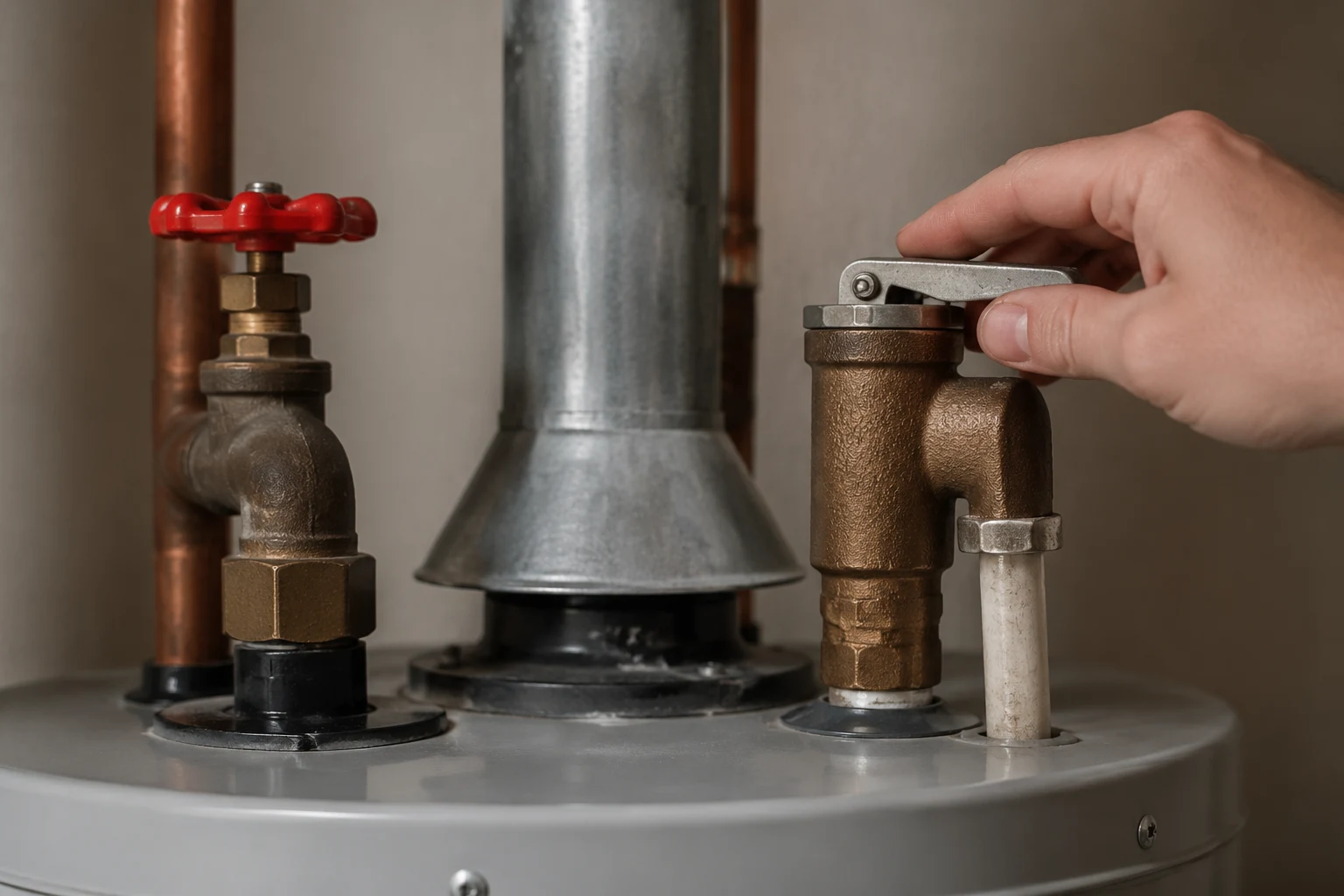
Chase the easy ones first and you will silence most whistles in an afternoon. But keep the order in your head: localize, then fix, and if the note is coming from the safety valve, the tool you reach for is the shutoff, not the wrench.
Frequently asked
Why does my water heater whistle only when a hot tap is running?
That is the signature of a flow restriction, the most common reason a heater whistles. A whistle is air or water forced through a gap that is too small, so it only sings when water is actually moving. Trace it to the cold inlet or shutoff valve first. If someone bumped that valve half closed, water squeezes past the partly seated gate and the valve whistles under flow, then goes silent the second you close the tap. Open it fully and listen again. If it still whistles with a tap open, move down the line to a kinked flex connector, a scaled tankless heat exchanger, or sediment narrowing the tank ports. The tell is that the sound tracks flow: it starts when water runs and stops when it stops.
Is a whistling temperature and pressure relief valve dangerous?
Yes, treat it as an emergency until you prove otherwise. The T&P valve is a safety device that opens when the tank exceeds about 150 PSI or 210 degrees Fahrenheit. If it is hissing, screeching, or dripping from the discharge tube, the tank may be running overpressure or overtemperature, and that is the exact condition the valve exists to prevent from becoming a rupture. Shut the heater down. On a gas unit turn the control to Off; on an electric unit flip the breaker. Shut the cold water inlet. Then feel the discharge pipe: if it is hot, you have an overtemp problem, likely a stuck thermostat or failed control, and you want a pro on it before you relight. A T&P that only weeps a little may just be a bad valve or a missing expansion tank, but you do not diagnose an overheating tank by guessing. Kill the energy first.
What does sediment have to do with a whistling tank?
Hard water leaves calcium and lime scale on the tank floor, and over years it builds up around the cold-water dip tube outlet and the drain port. Those are narrow passages to begin with. Choke them with scale and the water flowing through has to accelerate, and fast water through a tight gap whistles or hisses, often paired with the popping of sediment boiling from underneath. You will not fix a scale whistle with a new valve. Flush the tank through the drain valve, and if the buildup is heavy you may need to break it loose with a wand or replace a corroded dip tube. On a tankless unit the same scale coats the heat exchanger passages, and there the fix is a descaling flush on the schedule the maker prints in the manual.
My tankless Rinnai or Navien whistles when it fires. What is wrong?
On a tankless heater a whistle almost always points to the heat exchanger or the flow through it. Scale is the usual culprit in hard-water areas. The exchanger is a maze of narrow copper or stainless passages, and even a thin lime coating narrows them enough to make the water sing as it races through under the burner. That same scale drives the exit temperature up and can trip error codes. Descale it: most Rinnai, Navien, and Noritz units have isolation valves and a service port for exactly this, and you circulate white vinegar or a descaler through the exchanger for 45 minutes to an hour. If descaling does not touch it, check the inlet filter screen for debris and confirm the gas and venting are correct, because a starved burner and a restricted exchanger can sound alike.
Could the whistle be coming from the expansion tank instead of the heater?
It can, and people miss this because the expansion tank sits off to the side on the cold line. It has a rubber bladder with an air charge behind it, set through a Schrader valve like a tire valve on the bottom cap. If that air valve leaks, or the bladder has failed and the tank is waterlogged, you can get a hiss as air escapes or as water is forced into a tank that has lost its cushion. Tap it: the top half should ring hollow and the bottom should sound solid. If the whole thing sounds full and heavy, the bladder is shot and the tank needs replacing. Check the air charge with a tire gauge; it should match your household static pressure, usually 40 to 60 PSI, set with the tank isolated and drained.
How do I tell whether the whistle is the valve, the tank, or the pipe?
Localize it before you fix anything, because each source has a different repair. Run a hot tap and put your ear near three places in turn: the cold inlet and shutoff valve at the top, the tank body and the T&P valve on the side, and the flex connectors. A whistle at the inlet valve that stops when you fully open it is a pinched shutoff, the easy one. A whistle or hiss at the T&P valve, especially with heat or drips at the discharge, is a safety issue and you shut down. A whistle from the tank body, paired with popping, is sediment and calls for a flush. A whistle from a flex line usually means it is kinked or undersized. A long screwdriver held to your ear against each spot will sharpen the direction.
Will flushing the tank stop the whistling for good?
It stops the whistle if scale in the tank was causing it, and on a tank that has never been flushed that is a good bet. Draining and flushing clears the sediment bed that narrows the ports and boils under the burner. It will not help if the noise was a pinched valve, a bad T&P, a failed expansion tank, or a scaled tankless exchanger, so localize first. And flushing is maintenance, not a one-time cure. In hard water, plan on flushing a tank heater once a year. Rheem and A.O. Smith both call out annual flushing in their manuals, and skipping it is how a quiet heater turns into a whistling one a few winters later.