The tank cracked eleven years in. The twelve-year warranty covers the replacement tank. The plumber's labor to drain it, break the water and gas lines, haul the old one out, and set the new one runs six hundred fifty dollars, and that six hundred fifty is not the manufacturer's problem. This is the shape of nearly every residential water heater warranty in the United States: parts covered, labor on you, coverage narrower than the sticker suggests, and a stack of paperwork and installer conditions that decide whether the tank you paid a premium for actually gets replaced at all. The good news is the system is not mysterious. It is just specific.
Before you call for a warranty claim
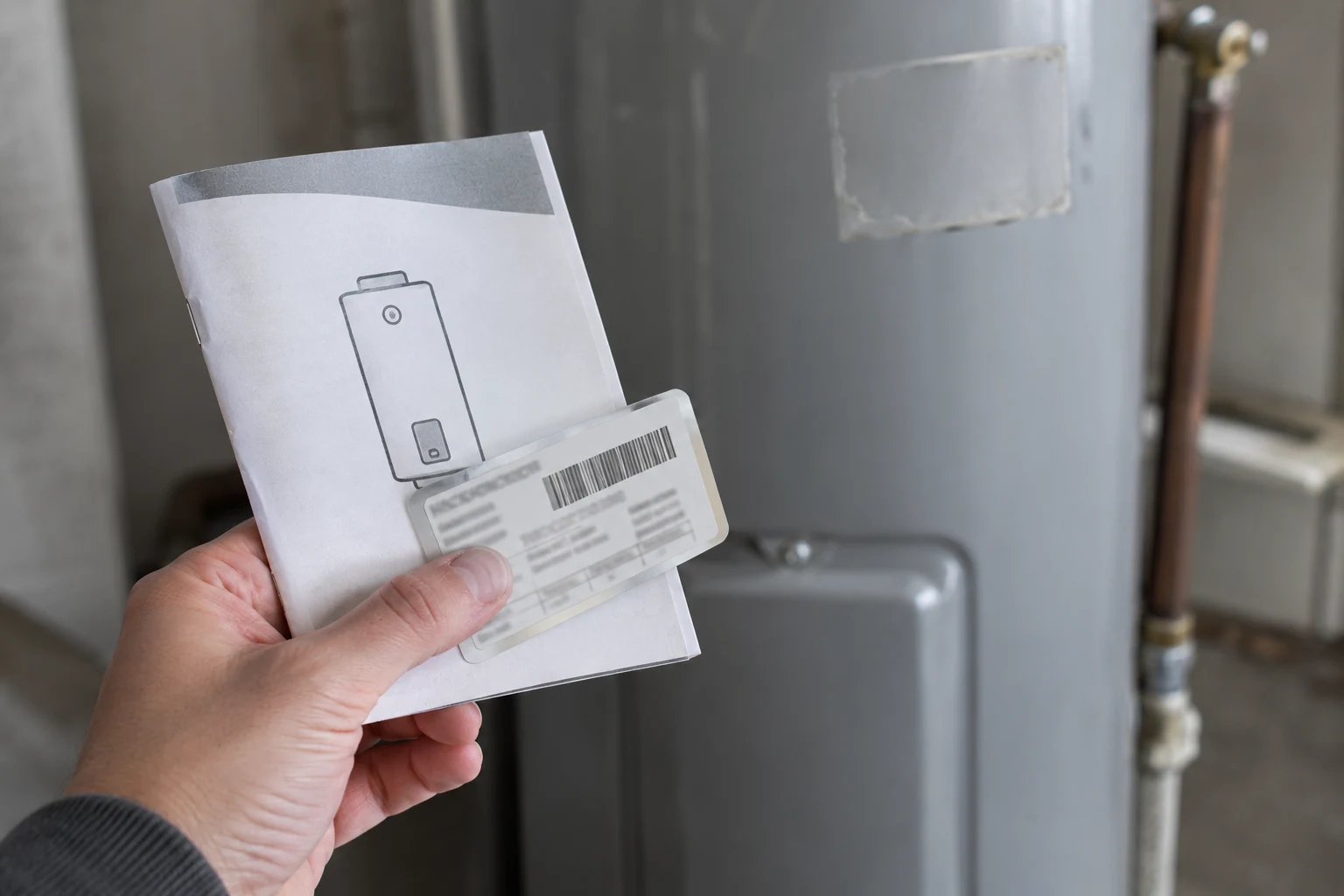
Find the model number and serial number off the rating plate on the side of the tank. Bring the original invoice with the install date. Bring a water report if you have one. Nothing moves without those three.
Parts warranty versus labor warranty
Two separate things, and only the first one is usually included. The parts warranty is what covers the tank itself and internal components like the gas valve, thermostats, or elements, and it is what the six, nine, or twelve year number on the sticker refers to. The labor warranty is what pays the plumber to remove the failed unit and install the replacement, and nearly every residential water heater ships with either no labor coverage at all or a token one or two year window. Anything after that, labor is on you, which is why a warranty claim at year eight can still cost several hundred dollars even when the tank itself is free.
The 6 vs 9 vs 12 year tank is real hardware
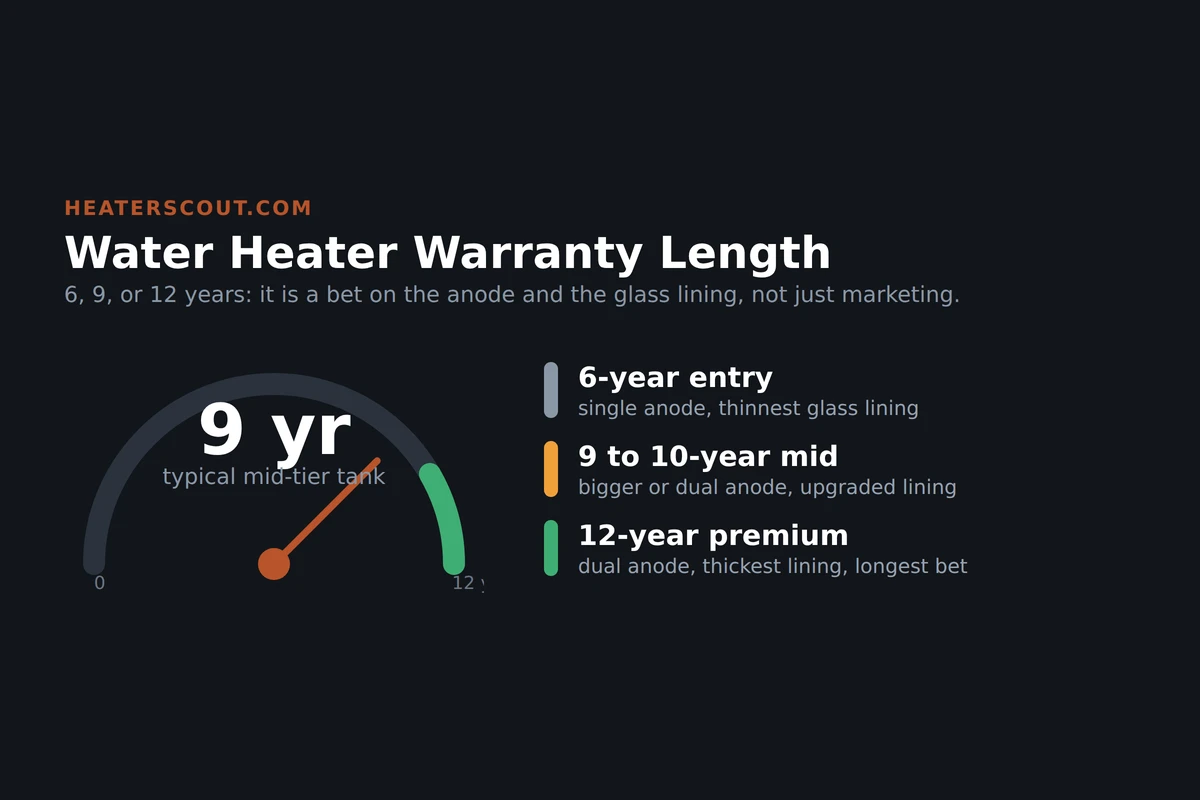
Walk down the water heater aisle and you will see the same brand offering the same nominal capacity in three warranty flavors, typically six, nine, and twelve years, with a hundred to two hundred dollars of price gap between each tier. Those are not marketing tiers with identical guts. The manufacturer builds them differently, and the differences map directly onto which tank rusts through first. The six-year entry tank gets a single magnesium or aluminum anode rod, the thinnest acceptable glass or porcelain lining on the tank interior, and the lightest steel gauge in that product family. The nine-year tank gets a bigger anode or a second one, an upgraded lining, and often slightly heavier steel. The twelve-year tank typically carries dual anodes, the thickest lining, and the heaviest gauge shell.
Anode rods are the whole game here. The anode is a sacrificial piece of metal that corrodes in place of the steel tank, and once it is used up the tank starts corroding. A bigger anode or two anodes buys years, plainly. The glass lining is the other line of defense, sealing the water off from the steel where the lining is intact, and a thicker lining has fewer pinholes and covers welds more completely. When a manufacturer bets twelve years on a tank, they know from field data that this combination survives twelve years for most water conditions in most homes, and when they bet six they know the same about the leaner build. The install labor to swap either one is the same, which is exactly why the twelve-year model is the better value in most homes even before you count the warranty itself.
What you get in a 6-year tank
- One anode rod, typically magnesium in soft water or aluminum in hard, sized for six years of average water and no more.
- The thinnest acceptable glass lining on the tank interior, which is enough to keep the steel dry but leaves less margin for hairline defects.
- Lightest allowable steel gauge in the family. Price is the lowest, standby loss is similar to the bigger tiers, and everything downstream depends on your water.
What the 12-year tank actually adds
- A second anode, or a single anode that is physically larger, which roughly doubles the corrosion-resistance clock on the tank.
- A thicker glass lining and better coverage over welds and fittings, the places where leaks statistically start on a lean-lined tank.
- Slightly heavier steel and a longer manufacturer bet. Costs about one hundred fifty to two hundred dollars more than the six-year, and labor to install is identical.
Does the warranty cover a leaking tank in year eight?
It depends on the tier. A six-year tank at year eight is out of warranty entirely, so a leak is a full out-of-pocket replacement. A nine-year tank at year eight is likely inside the term but may be in the pro-rated portion, meaning partial credit rather than a free tank. A twelve-year tank at year eight is often still in a full-replacement window and yields a free tank, though you still pay a plumber to swap it. Read the schedule in your own warranty document rather than assuming; the difference between full replacement and pro-rated at year eight is what makes stepping up to a twelve-year worth its extra cost.
What actually matters
Register the heater within 60 to 90 days if the brand requires it, or watch a twelve-year warranty silently become a five. Keep the original invoice and photograph the rating plate the day the tank goes in. Know your water: sediment, hardness, or a pH outside about 6.5 to 8.5 is a common denial reason and manufacturers can request a water report. Insist the installer sizes the expansion tank correctly and pipes the T and P discharge tube down, because installer errors void more claims than any single failure mode. Nearly every residential warranty is parts only, so budget five to seven hundred dollars of labor into any future claim regardless of what the sticker on the tank promises.
Registration is the quietest way a warranty gets shorter
Rheem and AO Smith both ask you to register the heater online within sixty to ninety days of installation to activate the full advertised warranty. Skip it and the coverage silently reverts to a shorter default, commonly five years, on a heater the box promised twelve years on. There is no notification. There is no reminder. The clock runs down and if you file at year eight against a registration record that was never created, the manufacturer looks up your serial number, sees the default term, and closes the file. Registration takes about ten minutes, needs the model number and serial number off the rating plate plus the installer name and install date off the invoice, and returns a confirmation email you save with the invoice.
Some brands do not require registration but still ask you to file it as a convenience. Register anyway. It costs nothing and gives you a dated, timestamped record the manufacturer cannot dispute. If the installer offers to register for you, verify the confirmation email arrives at your address, because installers sometimes use their own email and there is a real category of denied claims where the homeowner assumed it was handled and neither party has a record.
Water chemistry and installer errors are the two big denials
The two most common categories of denied claim are things the manufacturer never sees until the tank fails, and both are surprisingly easy to head off. The first is water quality. Warranty documents nearly always exclude damage from sediment, hardness above a stated grain count, or aggressive water outside a pH range of about 6.5 to 8.5, and the manufacturer can request a water report at claim time. If you know your water is hard or acidic, a softener or a neutralizer upstream of the heater is not just for the plumbing generally, it is specifically what keeps a warranty claim alive. Well water and older municipal systems in some regions push right up against or past the acceptable range, and the tank pays for it.
The second category is installer error. An undersized or missing expansion tank on a closed-loop system is the classic. When the incoming water main has a check valve, backflow preventer, or pressure-reducing valve without an expansion tank, water heated in the tank has nowhere to expand into, and the pressure spikes cycle the T and P valve or fatigue the tank welds. Manufacturers see the failure pattern and know exactly what it means. Other common installer voiders: a T and P valve with no discharge tube piped down toward a drain, wrong incoming gas pressure on a gas unit, a vent that slopes flat or backward instead of upward, and dielectric unions that are not actually dielectric. Any of those can turn a covered tank leak into an uncovered installer problem in the manufacturer's file.
The commercial-use clause burns a small number of buyers hard. A residential water heater installed in a commercial building, even a small office or a multi-unit rental, voids the residential warranty entirely. The same physical tank is often sold as a commercial SKU with a shorter commercial warranty, and that is the SKU that has to go in. Do not buy the residential version at a lower price hoping to save.
Lifetime, extended, and the claim itself
Lifetime warranties on water heater tanks are real and rare. The Rheem Marathon is the clearest example: it uses a non-metallic polybutene tank that does not corrode the way steel does, so Rheem writes a genuine lifetime tank warranty on it. Some heat-pump models carry lifetime language on portions of the unit, but read the fine print because that lifetime usually means first-owner only, at the original address, and often excludes the compressor or refrigerant system that is the expensive failure mode. If the tank is not a Marathon or a specifically-called-out heat-pump model, the warranty is a numeric term of years and treating it otherwise sets you up for a disappointing phone call.
When a covered failure happens, the process is roughly the same across the major brands. You call the manufacturer's customer service line with the model and serial from the rating plate, the install date from the invoice, and a description of the failure. For a tank leak they ask for photos of the tank, the leak point, and the rating plate. For a component failure like a gas valve or element they often ask you to remove and return the failed part or bring it to a dealer for an over-the-counter exchange. You get a return goods authorization, an RGA, that tracks the claim, and the replacement ships either to your address or to the nearest supply house. Labor is on you unless a specific labor policy applies, so budget five to seven hundred dollars for a typical residential tank swap. Manufacturers replace with the same-tier equivalent, not an upgrade, so if you want a bigger or better tank that is a purchase, not a warranty.
Frequently asked
Do I have to register the water heater to get the full warranty?
For several brands, yes. Rheem and AO Smith both ask for online registration within roughly 60 to 90 days of installation to activate the full advertised warranty, and if you skip it the coverage silently reverts to a shorter default, often five years, no matter what the box promised. Registration is free and takes about ten minutes: model and serial off the rating plate plus install date and installer name off the invoice. Do it the day the heater goes in, not the day it fails, because a missing registration record is the easiest denial the manufacturer can make. Save the confirmation email with the invoice.
What voids a water heater warranty?
Aggressive water, meaning a pH below about 6.5 or above 8.5, plus heavy sediment or hardness, is a standard exclusion, and the manufacturer can ask for a water report on a claim. Installer errors are the other big category: an undersized or missing expansion tank on a closed-loop system, a T and P valve without a full discharge tube piped down toward a drain, wrong incoming gas pressure, or a vent that slopes flat or backward. Installing a residential SKU in a commercial building voids residential coverage entirely. Missing registration, missing proof of purchase, and evidence the anode was ignored when the tank called for it round out the list.
Does a water heater warranty transfer to the next owner?
Usually not. Nearly every residential warranty runs to the original purchaser at the original installation address, and selling the house ends it. A few premium lines and a couple of true lifetime tank policies, notably the Rheem Marathon, transfer to a second owner for a partial period, but treat transfer as the exception, not the rule. If you are buying a house with a newer heater, get the install date and check the brand's fine print rather than assuming coverage carries over. If you are selling, do not price the remaining warranty into the sale unless you have confirmed in writing that it transfers.
What does pro-rated mean for a water heater tank replacement?
It means the manufacturer credits you a shrinking share of a new tank based on how far into the warranty you are. A full-replacement window covers the first several years, and after that a tank leak yields a credit that goes down each year toward zero at term end. A leak in year three under a twelve-year warranty is usually a straight replacement tank at no charge, minus labor. A leak in year ten under the same warranty may only yield a small credit toward the price of a new unit, and that credit is often applied at retail, so the real-world value is less than it looks.
Is the extended dealer warranty on a water heater worth it?
Rarely. A dealer or retailer extended warranty on a water heater is usually a parts-only extension, taking six-year manufacturer coverage out to ten or twelve years for eighty to a hundred fifty dollars. It almost never covers labor, which is the part of a warranty claim that costs real money because a plumber to swap a tank runs several hundred dollars regardless of who supplies the tank. If labor is the worry, ask specifically for a labor-warranty add-on in writing. Otherwise the extended parts warranty just duplicates coverage you can buy up front by choosing a nine or twelve year tank in the first place.
What is the difference between a 6-year and a 12-year water heater physically?
They are not the same tank with different paperwork. Manufacturers build the longer-warranty tanks with more or bigger anode rods, sometimes two anodes instead of one, a thicker glass or porcelain lining on the tank interior, and often slightly heavier gauge steel. All three of those changes buy years of corrosion resistance, which is the failure mode that decides when a tank leaks. The manufacturer bets a longer warranty on hardware that statistically survives longer, and the hundred to two hundred dollars extra on the price tag is what buys you that hardware. Labor to install either tank is identical.