A single-wall vent connector needs 6 inches of clearance to wood framing. Swap that same run to Type B double-wall vent and the clearance drops to 1 inch. That one number, the gap between a hot pipe and the stud behind it, is the kind of detail that decides whether a water heater install passes or becomes a fire path. Gas water heaters get exhausted four different ways, and each way carries its own pipe material, its own pressure, and its own set of rules in the code. Get the category right first, and the sizing, the clearances, and the draft test all follow from there.
The four venting categories at a glance
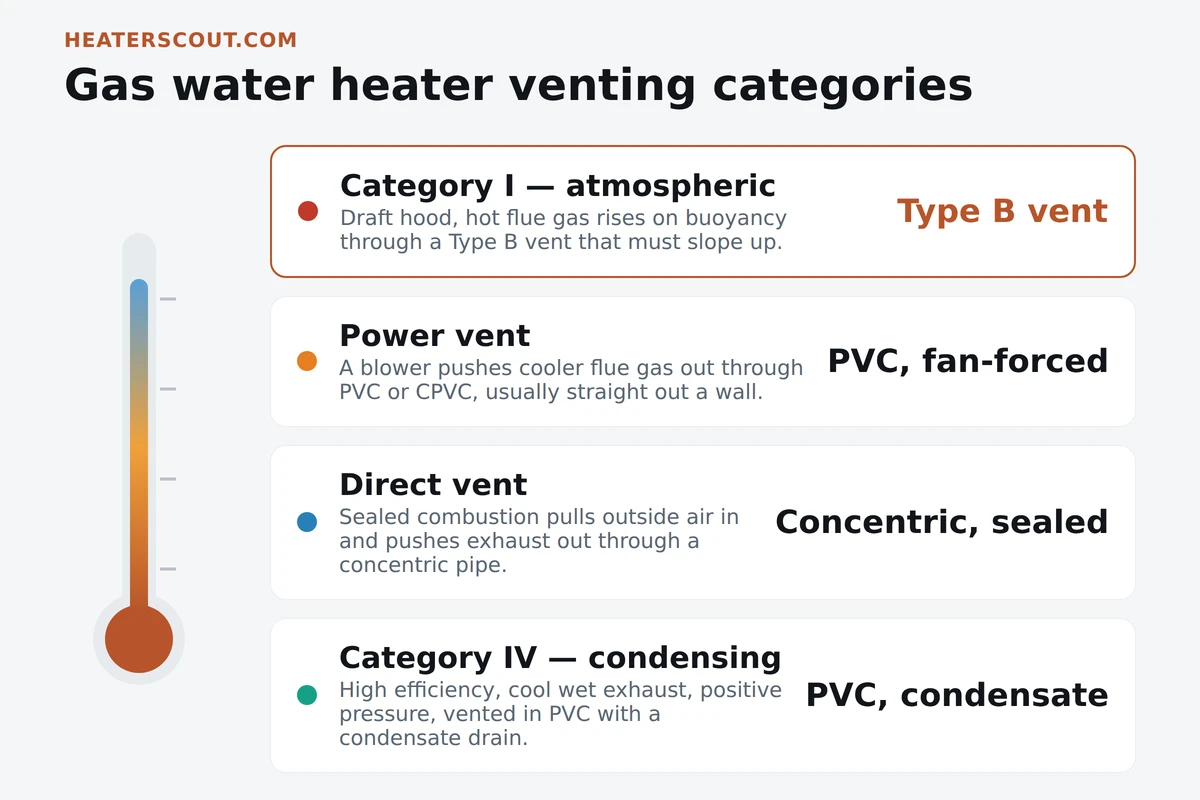
Every gas water heater falls into a venting category defined by two things: whether the flue gas is above or below its dew point, and whether it moves under negative or positive pressure. The rating plate on the side of the tank tells you which one you have. That category, not the brand or the gallon count, dictates the pipe you are allowed to use and the code path you follow.
| Atmospheric (draft hood) | Category I, non-condensing, negative pressure. Vents in Type B double-wall metal vent or a listed lined masonry chimney. Relies on buoyancy, so the vent must rise and slope up the whole way. |
| Fan-assisted (induced draft) | Still Category I in most residential tanks. A small fan helps start the draft, but the flue gas is hot and vents in Type B or a lined chimney, sized off the tables. |
| Power vent | Category III, fan-forced, cooler exhaust. Vents in PVC or CPVC, usually straight out a side wall. Sized by the manufacturer's maximum equivalent length, not the buoyancy tables. |
| Direct vent | Sealed combustion. Pulls outdoor air in and pushes exhaust out through a concentric or two-pipe system. Uses no indoor air, so it tolerates tight houses. |
| Condensing | Category IV, positive pressure, wet exhaust below the dew point. Sealed PVC or CPVC with a condensate drain because water forms inside the pipe. |
The line that trips up the most installs is the one between Category I and Category IV. A Category I appliance moves hot, dry gas under negative pressure and wants a Type B vent that slopes up. A Category IV appliance pushes cool, wet gas under positive pressure and needs sealed plastic pipe with a drain. Vent one into the other's pipe and you get either a melted vent or flue gas leaking out every joint. The IFGC and NFPA 54 organize their venting rules around these categories for exactly this reason.
Vent connector
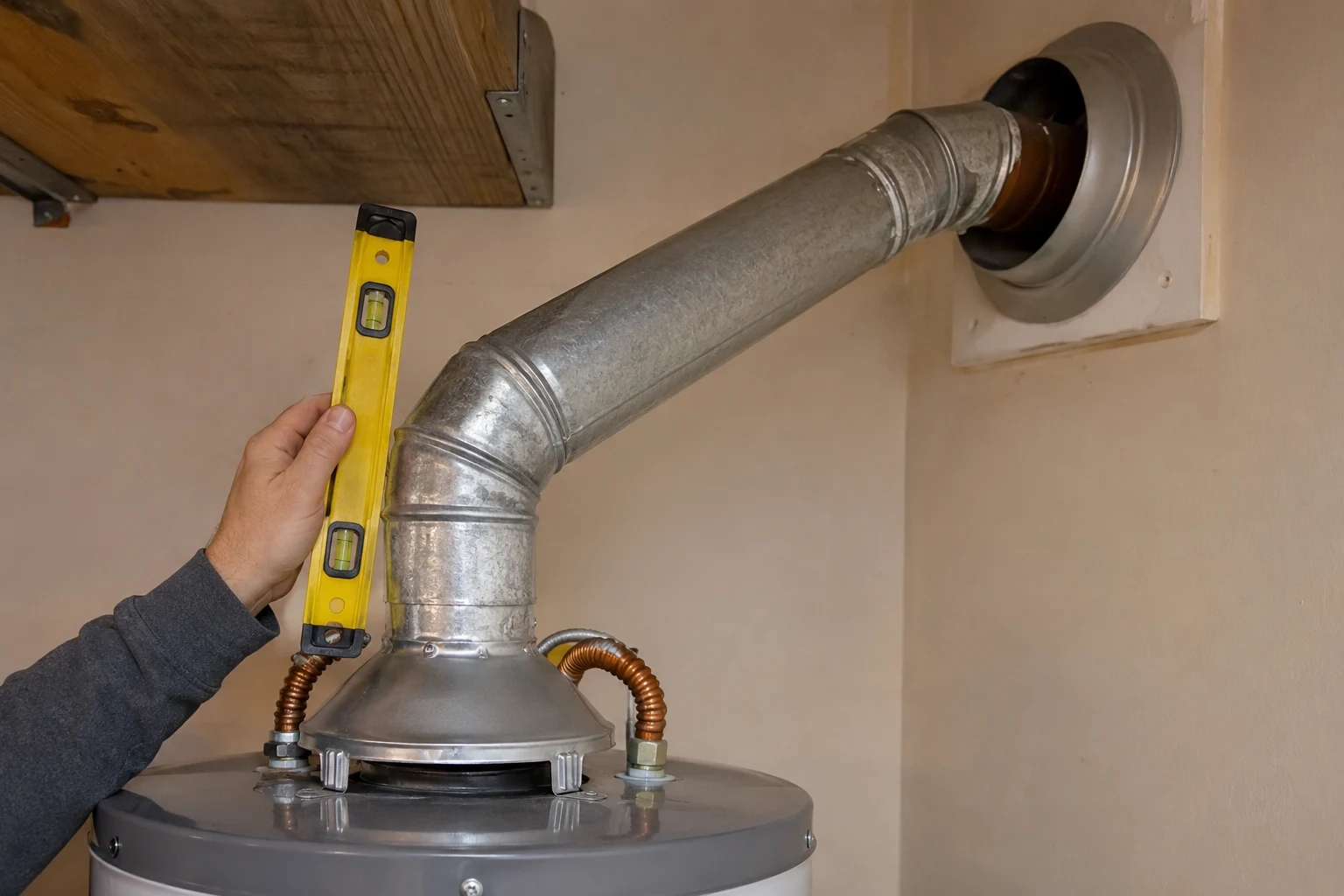
The pipe that carries flue gas from the appliance's draft hood or flue outlet to the vertical vent or chimney. On an atmospheric tank it is the short run between the top of the heater and the point where the gas turns to go up. Code holds it to a minimum rise of a quarter inch per foot of horizontal run, limits its total length relative to the vent height, and sets clearance to combustibles by material: 6 inches for single-wall, 1 inch for Type B double-wall.
Draft on an atmospheric appliance is fragile. It runs on nothing but the buoyancy of hot gas, so every foot of connector that runs flat or downhill lets that gas cool and stall. A quarter inch per foot is the floor, not the goal, and each elbow both restricts flow and cools the gas.
Common venting with a furnace, and the orphaned-flue trap
In a lot of older houses the water heater shares a single Type B vent with the furnace up through the roof. That is legal when both appliances are atmospheric or fan-assisted Category I units and the shared vent is sized off the NFPA 54 combined vent tables for the two of them together. The tables account for the total input of both appliances, the height of the vertical vent, and the rise and length of each connector. It works fine until someone changes one appliance.
Here is the trap. The 80 percent furnace fails and gets replaced with a 90-plus condensing model that vents in PVC out the side wall. Now the water heater is alone on a chimney sized for two appliances, a flue two or three times bigger than the tank needs. It runs cold, the draft goes weak, and the tank starts spilling combustion gas back into the room through its own draft hood. The fix is not optional: when you orphan a water heater on a common vent, you almost always have to resize the vent, and often reline the chimney with a smaller metal liner, so the single appliance can still develop draft. Skipping that step is how a routine furnace swap turns into a carbon monoxide problem.
Sizing off the vent tables
You do not guess at vent size on an atmospheric appliance. NFPA 54, in the IFGC and the IRC, carries tables that cross-reference the appliance input in thousands of BTU per hour, the total height of the vertical vent, and the rise and length of the connector. You find the row for your vent height, read across to your appliance input, and the table gives the minimum vent diameter that will still draft. Single-appliance vents, connectors, and combined vents each have their own tables.
The counterintuitive part is that bigger is not safer here. An oversized vent on an atmospheric appliance runs cold, condenses, and drafts poorly, which is exactly the orphaned-flue failure. The table gives you a minimum diameter for draft and a maximum for staying warm, and you want to land inside that window. Power-vent and direct-vent heaters ignore these tables entirely: their venting is set by the manufacturer's maximum equivalent length, counting the straight PVC run plus a deduction for each elbow.
A code-compliance walk-through
Before you sign off on any gas water heater vent, run through the checks below. They map to the IFGC and NFPA 54 requirements and catch the failures inspectors and combustion analyzers find most often.
- The vent material matches the appliance category on the rating plate: Type B or lined chimney for Category I atmospheric, listed PVC or CPVC for power-vent and Category IV condensing. Never PVC on an atmospheric tank.
- The vent connector rises at least a quarter inch per foot of horizontal run, with more rise where you can get it, and no section runs flat or downhill.
- Total horizontal connector length stays within limits relative to the vertical vent height, roughly 75 percent of the vent height as a working ceiling, shorter for single-wall.
- Clearance to combustibles is held: 6 inches for single-wall connector, 1 inch for Type B double-wall vent, per the listing.
- An atmospheric vent is sized off the NFPA 54 tables for the actual appliance input and vent height, not oversized, and not left orphaned on a flue sized for two appliances.
- A power-vent or direct-vent system stays under the manufacturer's maximum equivalent vent length, counting the straight run plus each elbow's deduction, at the listed pipe diameter.
- Condensing and Category IV terminations have a condensate drain and all joints are sealed for positive pressure.
- The termination clears windows, doors, soffit vents, and the ground or snow line by the listed distances, and a spillage test passes under worst-case depressurization.
Spillage means CO in the room
An atmospheric water heater that spills combustion gas is dumping carbon monoxide into the living space, and you often cannot smell it. The most common cause is an orphaned flue: the furnace was upgraded to side-wall PVC and the tank was left on a chimney sized for two appliances, so the vent runs cold and the draft dies. Run a spillage test with every exhaust fan on and the doors and windows shut. If a match or smoke stream at the draft hood blows out toward you instead of pulling up, the appliance is spilling. Shut it down and fix the vent before anyone uses it.
Direct vent and power vent when you have no chimney
Plenty of houses have no usable chimney, or the water heater sits where a vertical vent cannot reach. That is where power-vent and direct-vent tanks earn their price. A power-vent heater puts a blower on top of the tank and pushes cooler flue gas out through PVC, typically straight through the nearest exterior wall, so the vent runs horizontally and does not need to rise. Rheem, A.O. Smith, and Bradford White all build them, and each lists a maximum equivalent PVC length with a per-elbow deduction.
A direct-vent tank goes a step further with sealed combustion. It pulls combustion air from outdoors through one pipe and exhausts through another, often as a concentric pipe-in-pipe run through a single wall penetration. Because it never uses indoor air, it tolerates a tight, weatherized house that would starve an atmospheric appliance. For a finished basement or a closet with no chimney, sealed combustion is frequently the only thing that both fits and passes.
What the code actually asks of you
Strip away the tables and the categories and the venting rules come down to a short list. Move the flue gas out reliably, use pipe that survives that gas, keep hot pipe off combustible framing by the listed distance, and prove the appliance drafts instead of spilling. The category on the rating plate is where every decision starts, so read it first and let the rest follow.
Frequently asked
What is the difference between Category I and Category IV venting on a water heater?
The two categories describe the pressure and temperature of the flue gas, and that dictates the vent material. A Category I heater is atmospheric and non-condensing: the flue gas leaves hot and dry, moves under negative pressure on its own buoyancy, and needs a Type B double-wall metal vent or a lined masonry chimney that slopes up so the draft can develop. A Category IV heater is condensing and runs under positive pressure: the blower pushes cool, wet exhaust out, so it vents in sealed PVC or CPVC and needs a condensate drain because water forms inside the pipe. You cannot mix them. A Category IV appliance vented into B-vent leaks flue gas at the joints, and a Category I appliance vented in PVC melts the pipe. Match the vent to the category on the rating plate, every time.
Can I common-vent a gas water heater with my furnace?
You can, but only when both appliances are atmospheric draft-hood or fan-assisted Category I units, and only if the combined vent is sized off the NFPA 54 vent tables for the two together. The classic setup is an 80 percent furnace and an atmospheric tank sharing a single Type B vent through the roof. The trouble comes when the old furnace gets replaced with a 90-plus condensing model that vents in PVC out the side wall. The water heater is suddenly orphaned on a chimney sized for two appliances. That oversized flue runs cold, the draft is weak, and the tank spills combustion gas back into the room. If you pull one appliance off a shared vent, the remaining appliance almost always needs the vent resized, and often relined, to keep drafting.
How much rise does a vent connector need, and how long can the horizontal run be?
The connector runs from the appliance draft hood to the vertical vent, and it has to gain height so hot gas keeps moving up. NFPA 54 and the IFGC call for a minimum of a quarter inch of rise per foot of horizontal run on a natural-draft connector, and more rise always drafts better. The total horizontal length is limited too. As a working rule the connector should not run horizontally more than 75 percent of the height of the vertical vent it feeds, and single-wall connectors are held to shorter runs than double-wall Type B because they lose heat faster. A connector that runs long and flat lets the flue gas cool and stall, which kills the draft. When in doubt, shorten the lateral, add rise, and keep the run straight with a minimum of elbows.
Why does clearance to combustibles matter for single-wall versus B-vent?
Because the two pipe types run at very different surface temperatures. A single-wall metal connector is one layer of steel, so its outside gets nearly as hot as the flue gas inside, and code requires a full 6 inches of clearance from that pipe to any combustible framing, drywall backing, or insulation. Type B double-wall vent has an air gap between an inner and outer wall, so the outside stays much cooler and the listed clearance drops to 1 inch. That is why B-vent can pass through a framed chase or a ceiling with a listed firestop while single-wall pipe cannot go near the same framing. Getting that clearance wrong is a real fire path, not a paperwork detail.
What is a backdraft or spillage test and how do I do one?
It is a quick check that the appliance is drafting up the vent instead of spilling combustion gas into the room. Close the doors and windows, then turn on every exhaust fan in the house so the space is under the worst-case negative pressure it will ever see. Fire the water heater and hold a lit match, a smoke pencil, or a strip of tissue at the edge of the draft hood. If the flame or smoke pulls up into the hood, the vent is drafting. If it blows out toward you and hangs there, the appliance is spilling. Persistent spillage means flue gas, including carbon monoxide, is entering the living space. Do not use the appliance until the cause is fixed, whether that is an oversized orphaned flue, a blocked vent, a downhill connector, or a house too tight for an atmospheric appliance.
Do power-vent and direct-vent water heaters follow the same vent tables?
No. The vent tables in NFPA 54 are written for natural-draft and fan-assisted Category I appliances that rely on buoyancy and a vertical vent. Power-vent and direct-vent heaters are Category III or IV, mechanically vented, and their venting is governed by the manufacturer instructions, not the buoyancy tables. Rheem, A.O. Smith, and Bradford White each publish a maximum equivalent vent length for their models, stated in feet of PVC with a deduction for each elbow, plus the required pipe diameter and termination clearances. You size those systems by staying under the listed maximum. The listing is the code.
Can I vent a standard atmospheric water heater with PVC to save money?
No, and this is one of the more dangerous shortcuts in the trade. A standard atmospheric tank is a Category I appliance. Its flue gas leaves the draft hood at several hundred degrees, well above what PVC can survive, so PVC vent pipe will soften, sag, and eventually fail on an atmospheric heater. PVC and CPVC venting is only listed for the cooler exhaust of condensing and some power-vent appliances built and rated for it. If you want PVC venting, buy a power-vent or condensing water heater designed for it. Use Type B vent or an approved lined chimney for an atmospheric unit, and match the material to the rating plate.