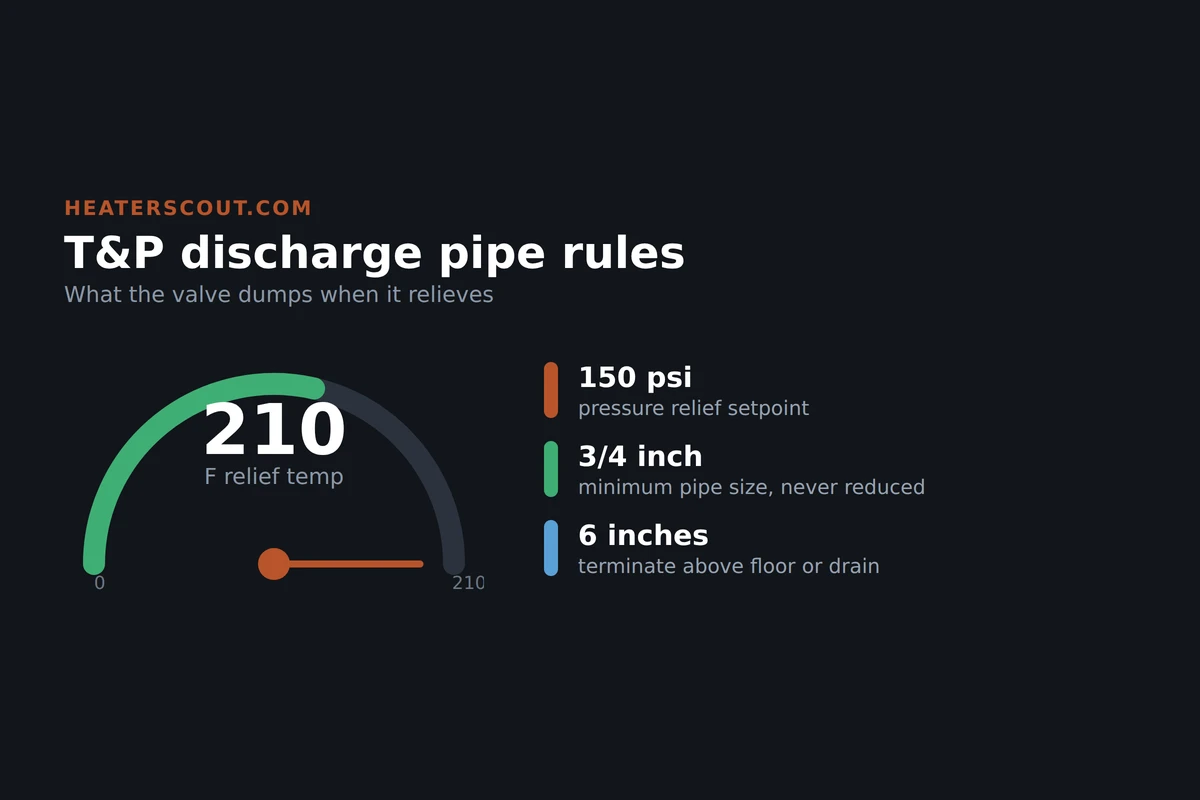
A temperature and pressure relief valve does not gently leak when it finally opens. It dumps. When the valve on top of a water heater trips, it can pass water at up to 150 psi and around 210 degrees Fahrenheit, all at once. The pipe bolted to that valve is the only thing standing between that release and whoever happens to be near the tank. Get the pipe wrong and you have taken the tank's last safety device and pointed it at the room, or worse, sealed it off entirely.
What the discharge pipe is actually for
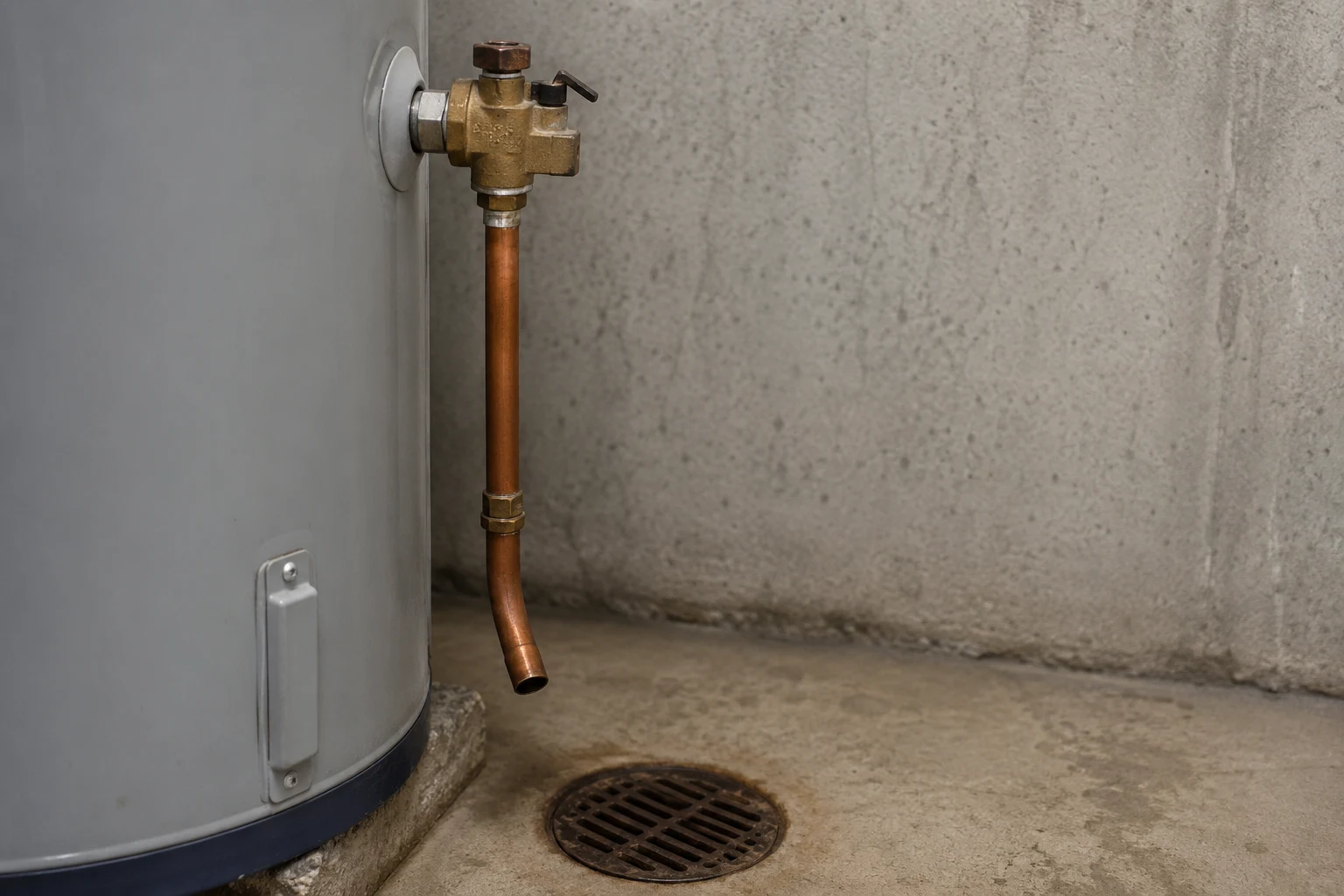
The temperature and pressure relief valve, the T&P, is the last line of defense on a water heater. If the thermostat fails and the burner or element keeps firing, temperature and pressure climb until something has to give. The T&P valve gives first, on purpose, opening to release water and drop the tank back to a safe state before the tank itself can rupture. That is the whole job. But an open valve at the top of a tank spraying 200-degree water sideways would just trade one hazard for another. The discharge pipe is what turns a dangerous release into a controlled one: it takes the relief flow and routes it down to the floor, into a drain, or outside, where it can dump without scalding a person or hiding itself behind the tank.
Because that pipe is a safety component and not just a drain line, the plumbing codes spell out exactly how it has to be built. The requirements are consistent across the International Plumbing Code, the Uniform Plumbing Code, and the International Residential Code, though the wording and a few numbers vary. Treat what follows as the general shape of US code. The jurisdiction you build in governs the specifics, and the local inspector has the final say on your particular installation.
The spec sheet
Six numbers and materials facts cover most of what the code asks of this pipe. None of them are arbitrary; each one exists because someone learned the hard way what happens when it is missing.
| Minimum diameter | 3/4 inch, and never smaller than the valve outlet |
| Material rating | Rated for 210 degrees F: CPVC, copper, galvanized, or listed. Not standard PVC |
| Slope | Downhill the entire run, no traps, sags, or uphill sections |
| Termination height | About 6 to 24 inches above the floor or an approved drain |
| Air gap | Required at the termination, not directly connected to drainage |
| Terminal end | Unthreaded, no cap, and no valve or shutoff anywhere in the line |
| Discharge point | Visible and to a safe location where it cannot scald a person |
The material line is the one most people trip over. On the shelf, white PVC and off-white CPVC look almost identical, and PVC is cheaper and more common, so it ends up on a lot of discharge pipes that should never have it. Standard PVC is rated well below the 210 degrees F a T&P valve can produce. Push near-boiling water through it and it softens, sags, and can let go at the glued joints, which is precisely the failure you cannot afford during an actual relief event. Read the printing stamped along the pipe. If it does not say CPVC, or you are not using copper, galvanized, or a material specifically listed for relief discharge, it does not belong on that valve.
Code-compliant versus what actually gets installed
Inspectors see the same handful of mistakes over and over. Setting the right way next to the common violation makes it easy to spot which one is bolted to your tank.
| Requirement | Code-compliant | Common violation |
|---|---|---|
| Material | CPVC, copper, galvanized, or listed, rated 210 F | Standard white PVC that softens under relief heat |
| Size | Full 3/4 inch, never reduced below the valve outlet | Reduced to 1/2 inch or bushed down to fit a drain |
| Slope | Runs downhill the whole way, self-draining | Loops up over an obstacle, forming a trap that holds water |
| Termination | Ends 6 to 24 inches up with a visible air gap | Hard-piped straight into the sanitary drain, no gap |
| Terminal end | Left unthreaded so it cannot be capped | Threaded end with a cap screwed on to stop a drip |
| Valves in line | None, the path is always open | A shutoff added to stop a weeping valve from dripping |
| Location | Visible, aimed at floor or drain, away from people | Routed to a hidden spot where a leak goes unnoticed |
Two of those violations come from good intentions gone wrong. A T&P valve that weeps a little is annoying, and the tempting fix is to stop the drip: cap the end, or add a small valve to shut it off. Both are dangerous. A weeping valve is telling you something, usually thermal expansion or a valve at the end of its life, and the answer is to fix that cause, not to seal the relief path. Capping or valving the discharge line does not stop the pressure. It just removes the one place that pressure was allowed to escape.
Inspect your own pipe
You do not need to be a plumber to walk your own discharge line and check it against the code. Stand at the water heater, find the T&P valve near the top or on the upper side of the tank, follow the pipe screwed into it, and run down this list.
- Trace the pipe from the T&P valve all the way to where it ends. It should be one continuous line to the floor, a drain, or outside.
- Read the printing on the pipe. It should say CPVC, or be copper or galvanized. If it is plain PVC, it is the wrong material.
- Confirm it is at least 3/4 inch and never gets smaller. Look for bushings, reducers, or a step down into a narrower fitting.
- Follow the slope. The pipe should head downhill the whole way with no loops, humps, or low sags that would trap water.
- Check the end height. It should stop roughly 6 to 24 inches above the floor or the drain it discharges over, not buried in it.
- Look for an air gap at the end. The pipe should not be hard-connected into the drainage system; there should be a visible gap.
- Check the terminal end for threads or a cap. There should be no cap, no plug, and no threads that would let someone add one.
- Scan the entire run for any valve, shutoff, or stopcock. There must be none. The line is always open, end to end.
- Confirm the discharge is visible and aimed somewhere safe, not at a spot where a person could be standing or where a leak would hide.
If any single item on that list fails, the pipe needs correcting, and most of these are inexpensive fixes. Swapping a section of PVC for CPVC, re-sloping a run, or removing a cap costs little and takes an hour. The one thing not to do is leave it, or paper over a symptom by sealing the line. Every item here protects the same thing: an open, downhill, heat-rated path from the valve to a safe spot.
Do not seal the relief path
Never cap, valve, plug, or reduce the T&P discharge line, and never route it uphill. The valve on your tank is the last device standing between a runaway heater and a burst tank. If it can dump 150 psi water at 210 degrees F but the pipe cannot carry that release away, the safety device is there in name only. A weeping valve is a problem to diagnose, never a drip to seal off. Fix the cause; keep the relief path open.
Can I use PVC for the discharge pipe?
No. Standard PVC is not rated for the temperature the valve can produce. The T&P trips at 210 degrees F, and the water leaving it can be that hot, which softens and deforms plain PVC and can fail its joints under a real relief event. Use a material rated for 210 degrees F: CPVC, copper, galvanized steel, or a material specifically listed for relief-valve discharge. CPVC and PVC look alike on the shelf, so read the pipe printing rather than trusting the color.
Why the code is this specific
Every requirement on this pipe answers a way the relief can go wrong. Full size and no reductions keep the flow rate the valve was designed to pass, so pressure does not back up behind a choke point. The 210-degree material rating means the pipe survives the heat instead of sagging shut. Downhill slope with no traps keeps the path clear and keeps water from freezing or corroding in a low spot. The air gap and the ban on connecting directly to drainage stop contaminated or hot water from siphoning back. The unthreaded end and the prohibition on any valve exist for one reason: to make it impossible for a well-meaning homeowner to close the very line that keeps the tank from becoming a bomb. And the visible, safe termination means a slow failure gets caught early, by eye, before it becomes a fast one.
A water heater that cannot relieve pressure or temperature is a pressure vessel with a heat source and no way out. That is the scenario every one of these rules is written to prevent. When you look at your own discharge pipe, you are really checking whether the tank's last safety device still has a working exit on the day it is finally needed. Codes vary by jurisdiction and the numbers shift a little from one to the next, so where your local code and this general guidance differ, follow your local code and let the inspector make the call.
Frequently asked
Can I use PVC for the T&P discharge pipe?
No. Standard white PVC is not rated for the temperatures a T&P valve can produce. The valve trips on temperature at 210 degrees F, and the water leaving it can be at or near that. PVC begins to soften and deform well below that point, so under a real relief event the pipe can sag, distort, or fail at the joints exactly when you need it to hold. Use a material rated for 210 degrees F: CPVC, copper, galvanized steel, or a piping material specifically listed for relief-valve discharge. CPVC and PVC look similar on the shelf, so read the printing on the pipe, not the color.
How big does the discharge pipe have to be?
At least 3/4 inch, and never smaller than the valve's outlet. Most residential T&P valves have a 3/4 inch outlet, so the pipe matches it the whole way. You are not allowed to reduce the line anywhere along its run, not with a bushing, not with a reducing coupling, not by tying into a smaller drain. A restriction chokes the flow rate the valve was sized to pass, which lets pressure back up behind it during a relief event. If the valve outlet is larger than 3/4 inch, the pipe steps up to match, never down.
How high above the floor should the discharge pipe end?
It terminates between about 6 and 24 inches above the floor or above an approved drain, with an air gap. Six inches is the common floor clearance; some jurisdictions allow up to two feet. The point is a visible gap between the end of the pipe and whatever catches the water, so hot discharge cannot siphon back and so the pipe is not directly connected to the drainage system. Low enough that scalding water is not sprayed at head height, high enough to keep the end clear of standing water. Your local code sets the exact number and the inspector has the final say.
Does the discharge pipe need to slope downhill?
Yes. It has to drain by gravity for its entire length, downhill from the valve to the termination, with no traps, sags, or uphill sections that could hold water. Trapped water sits in the line and can freeze, corrode the pipe, or block the path when the valve trips. A downhill run also means the pipe empties itself after a discharge instead of staying full. If the geometry of your space forces the pipe to run up before it can run down, the layout is wrong and needs to be reworked, not fudged.
Can I put a shutoff valve or a cap on the discharge line?
No, never. There must be no valve, shutoff, plug, or cap anywhere on the discharge pipe, including its end. The terminal end is left unthreaded on purpose so nobody can screw a cap onto it later. Anything that can close the line defeats the entire safety function: a capped or valved discharge pipe turns the relief valve into a dead end, and the tank has no way to shed pressure or temperature. If you have ever seen a threaded cap on the end of one of these pipes, remove it. That single fitting can turn a water heater into a pressure vessel with no relief path.
Where is the discharge pipe supposed to end?
At a safe location where a sudden release of very hot water will not scald anyone or cause damage, and where the discharge is visible. Common targets are a floor drain, a drain pan routed outside, or a spot near the floor in the same room. It must not be routed somewhere a person could be standing, and it must not be directly connected to the sanitary drainage system; the air gap at the termination handles that. Visible matters: if the line dumps where you can see it, a valve that has started to weep gets noticed and dealt with before it becomes a bigger problem.
What happens if the discharge pipe is wrong?
The relief valve is the last safety device on the tank, and the discharge pipe is what lets it work without hurting anyone. When the valve relieves, it can dump water at up to 150 psi and around 210 degrees F. If the line is capped, valved shut, run uphill into a trap, or built from a material that fails under heat, the relief path is compromised at the worst possible moment. In the extreme case, a tank that cannot relieve pressure or temperature becomes a genuine explosion hazard. Everything the code asks of this pipe traces back to keeping that relief path open, downhill, and pointed somewhere safe.