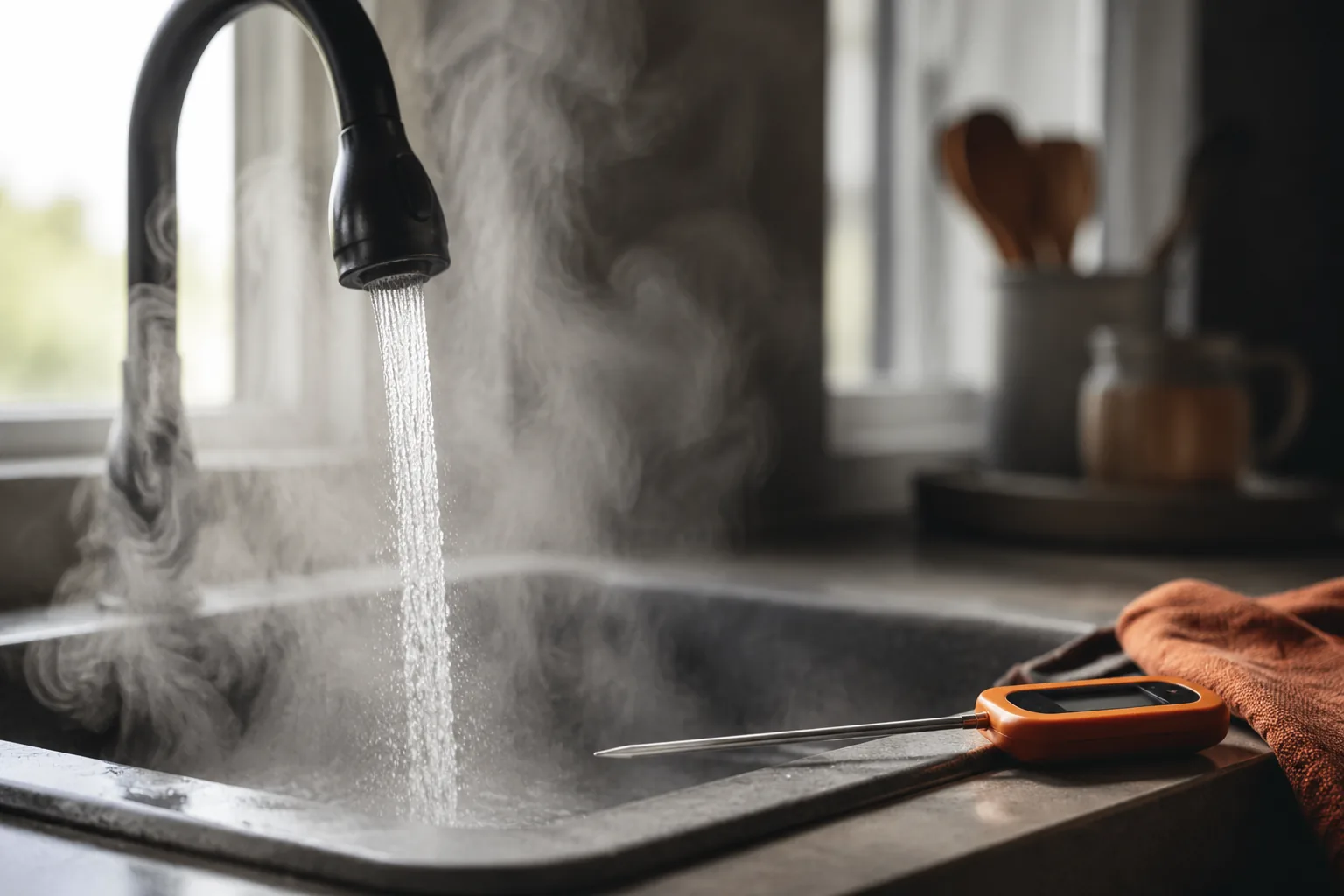
At 140°F, tap water gives a small child or an older adult a third-degree burn in about 5 seconds. Set the same tank to 120°F and that same splash needs roughly five minutes to do the same damage, which is the whole reason the number on the dial matters more than it looks.
Numbers on a page are easy to skim past, so drag the slider below and watch how fast the burn window closes as the water climbs. The jump from 120°F to 140°F is only twenty degrees, but the time to a serious burn falls from minutes to seconds.
How fast does this water burn?
Drag to set a water temperature. The readout shows roughly how long it takes to cause a third-degree burn, and the color shifts toward red as the danger rises.
Burn times are approximate and based on published scald-injury data for adult skin. Children, older adults, and anyone with reduced sensation burn faster at every temperature.
Quick answer
Most too-hot tanks are simply set high. Turn the dial to 120°F, wait an hour, and measure at the tap. If the water still scalds after you have lowered the dial all the way, the thermostat has failed on, a heating element is grounded and heating nonstop, or the high-limit safety is not cutting power. A tank that rumbles, hisses, or vents steam from the relief valve is overheating past its safe ceiling. That is a stop-using-it situation until it is fixed.
The causes, ranked by how often they are the answer
Too hot is not one problem, and the fixes are not equally likely. Work the list in order, because the first cause explains the large majority of complaints and the last one is rare but dangerous. Naming your pattern first saves you from pulling a thermostat that was never broken.
1. The dial is set high (most common by far)
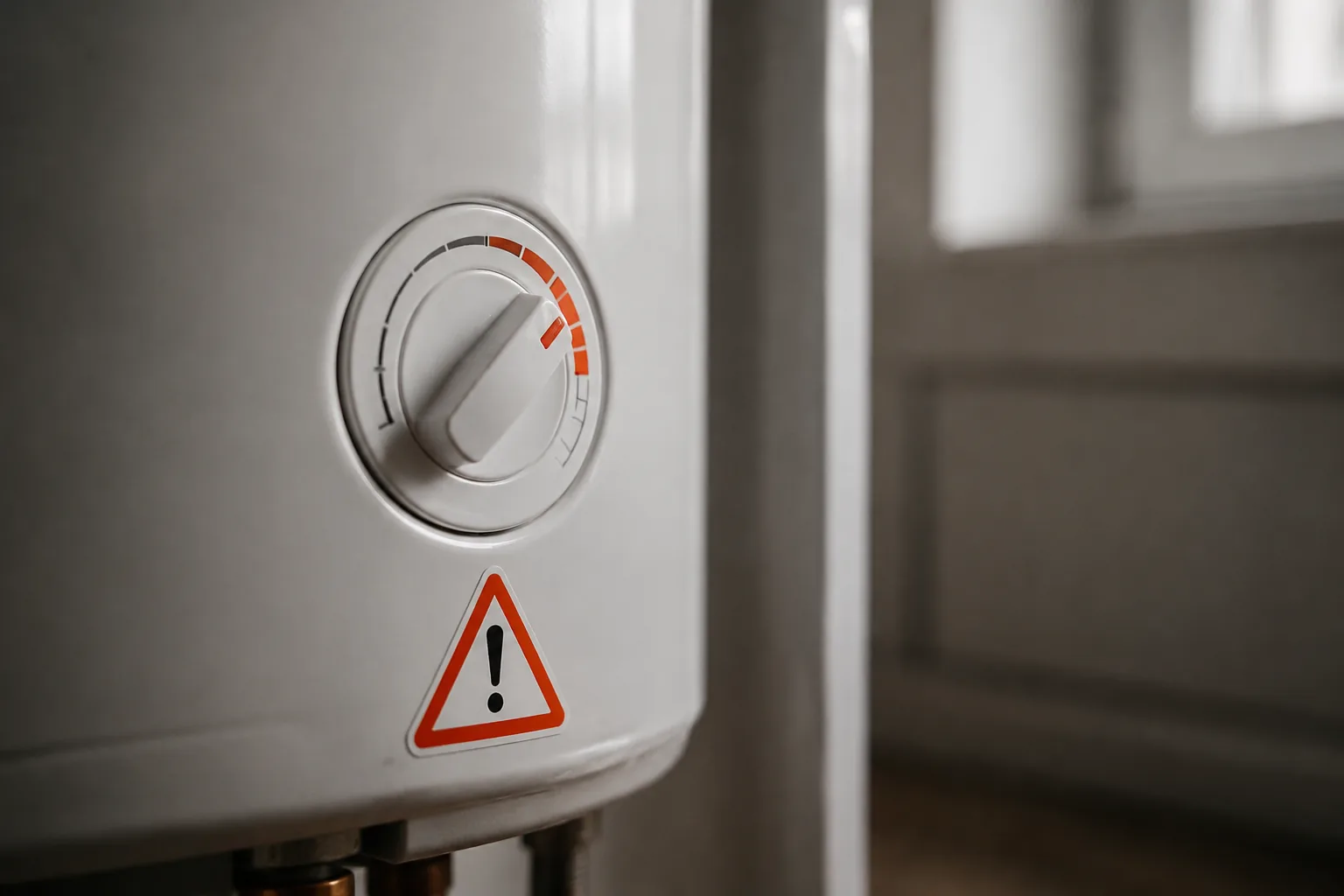
Nine times out of ten, a too-hot tank is not broken at all. Someone turned it up chasing more hot water for a deep tub, or it never got lowered from the factory default. Water heaters commonly ship set to 130°F or 140°F because a hotter tank stores more usable hot water and resists Legionella bacteria growth. The tradeoff is scald risk and wasted standby energy, since the tank reheats to that high mark around the clock. Lowering it to 120°F is the single change that fixes most too-hot complaints, and it trims the heating bill at the same time.
On an electric tank there are two thermostats behind two access panels, and they must match. The upper thermostat governs the top of the tank, the lower governs the bulk of it, and if you drop only one you can still draw scalding water. Kill the breaker before you pop a panel, because those terminals sit at 240V. On a gas tank the control is a single dial on the valve at the bottom, often labeled with letters or a warm-to-hot arc rather than degrees; the setting just below the midpoint usually lands close to 120°F. After any change, wait a full hour for the tank to settle, then measure the water at the tap with a cooking thermometer rather than trusting the dial print. A normal thermostat swings about ±10°F between cycles, so a reading of 115°F to 125°F is expected, not a fault.
2. A thermostat that has failed closed
This is the most common internal fault, and the tell is simple: you lowered the dial all the way, waited an hour, and the water is still scalding. A working thermostat cannot do that. A thermostat is just a switch that opens when the water reaches the set temperature. Its contacts can weld shut from years of arcing, and once welded, the switch never opens. The element or burner then runs without end, driving the water far past whatever the dial says. No amount of turning the knob down will help, because the knob is no longer connected to anything that can stop the heat.
Confirming it takes a multimeter with the power off. You are checking whether the thermostat passes current when it should be open. On an electric tank, remember both thermostats must be at minimum before you blame the part; the lower one heats most of the tank, so a high lower thermostat can keep the water hot even with the upper turned down. A thermostat that ignores its setting gets replaced, not recalibrated, because you cannot un-weld a contact. The part is inexpensive and clips onto the tank behind the panel, which makes this a moderate DIY job for anyone comfortable working near 240V with the power confirmed off.
3. A grounded heating element
Less common than a stuck thermostat, but it produces the same runaway heat. When a heating element's internal coil shorts to its metal sheath, it can pull current and generate heat even when the thermostat has commanded it off. The tank climbs regardless of any setting because the element is no longer under the control of the switch. You find this the same way you find a welded thermostat: with the power off, a multimeter reads a short between the element terminal and the tank body. A grounded element also tends to trip the breaker or the high-limit reset, so if resetting never holds for long, suspect the element along with the thermostat. It is a replace-the-part fault, not a reset.
4. The high-limit safety (ECO) that should have caught the others
The last item is not really a separate cause so much as the safety that is supposed to stop the first three from becoming dangerous. On an electric tank the upper thermostat carries a red high-limit reset, the ECO, wired to cut all power the instant the water passes roughly 170°F to 180°F. In a healthy tank, a stuck thermostat or grounded element trips the ECO within minutes, and you get no hot water rather than scalding water, which is the safe failure mode. So if your tank actually reached the boiling, steaming, relief-valve stage, the ECO did not do its job and is suspect too. Replacing a stuck thermostat without confirming the ECO leaves the tank able to run away again. On gas equipment the analog is a failed gas control valve or a bad temperature sensor, and that diagnosis belongs to a licensed tech because it sits on the combustion and gas-shutoff side of the unit.
When the tank is doing more than running hot
Everything above assumes water that is merely too warm. The moment the tank rumbles, hisses, or pushes the relief valve open, you are past a settings problem and into an emergency. Overheated water builds pressure, and a tank that cannot shed it is dangerous. If the temperature-and-pressure relief valve on the side or top of the tank is dripping or discharging, or you hear boiling that will not stop, shut off power or gas to the unit and let it cool before doing anything else. Boiling, a rumble that will not quit, or a relief valve that keeps discharging means the water is well above the safe ceiling, often 180°F or higher.
At that point the diagnosis is no longer a single part. You may be looking at a welded thermostat, a grounded element, and an ECO that failed to trip, all at once. That combination is a scald and pressure hazard, and getting it wrong leaves that hazard in the house. This is the case to bring in a pro, and to keep the power or gas off until it is fixed so the tank cannot climb again. Do not just press the reset button back in and walk away; if the underlying part keeps cooking the water, the reset only buys minutes before it trips again.
How to lower the temperature safely, step by step
For the ordinary too-hot tank, the fix is short. On an electric unit, turn off the breaker first, always, since you will be near live terminals. Remove the upper access panel, fold back the insulation, and find the thermostat dial. Set it to 120°F. Do the same at the lower panel so both match. Restore power, wait an hour, and measure the water at the nearest tap. On a gas tank there is no panel to open; just turn the dial on the control valve toward the lower end of its range, wait, and measure. If the tap reads within about 10°F of your target after it settles, the thermostat is doing its job and you are done.
What tells you the thermostat itself has failed is the tank ignoring this whole process. You set both controls to minimum, you wait, and the water still comes out scalding. If the dial is at its lowest and the water is still 140°F or hotter, the switch is no longer opening. At that point stop resetting and stop adjusting, because there is nothing left to adjust. Test the part with a multimeter, condemn whatever reads wrong, and replace it. Households with a compromised immune system sometimes keep the tank hotter than 120°F for Legionella reasons; the safe way to do that is a thermostatic mixing valve at the tank outlet that blends the stored hot water down to 120°F at the taps, so you get bacteria control without the scald risk at the faucet.
Frequently asked
What temperature should my water heater be set to?
Set it to 120°F. That is the setting most manufacturers and safety groups recommend, because it delivers comfortable hot water while sharply cutting scald risk. At 120°F a serious burn takes about five minutes of exposure, while at 140°F it takes about 5 seconds. Lowering the dial from a factory 130°F or 140°F to 120°F also trims standby heating cost. Households with a compromised immune system sometimes keep it higher for Legionella concerns and manage scald risk with a mixing valve instead.
Why is my water scalding hot even after I turned the dial down?
The thermostat is no longer controlling the tank. A thermostat is a switch that should open when the water hits the set temperature; if its contacts have welded shut, it never opens and the element or burner runs continuously no matter where the dial sits. A grounded heating element does the same thing, heating even when commanded off. On electric tanks confirm you lowered both the upper and lower thermostats, wait an hour, and if it is still scalding the part has failed and needs replacing.
How hot is too hot for a water heater?
Anything that scalds on contact is too hot, and 140°F is the line where a third-degree burn happens in about 5 seconds. At 150°F it is closer to 2 seconds. If the tank pushes past its safe ceiling, roughly 170°F to 180°F, the high-limit safety should cut power. Water that rumbles, hisses, boils, or forces the relief valve to discharge is dangerously overheated. Treat that as an emergency, shut off power or gas, and let the tank cool before diagnosing.
Can a bad thermostat make water too hot?
Yes, and it is the most common internal cause. When a thermostat's contacts weld shut, the switch can no longer open to stop the heat, so the element or burner stays on and the water climbs past the setting. This is different from a thermostat that fails open, which gives you no hot water at all. A thermostat stuck closed is a scald hazard because it ignores the dial, and it gets replaced rather than adjusted.
Why does my water heater keep overheating and tripping the reset?
The red reset is the ECO, the high-limit safety that cuts power when the water passes about 170°F to 180°F. If it keeps tripping, the safety is doing its job because something is overheating the tank, usually a thermostat stuck closed or a grounded element that heats nonstop. Pressing the button back in only buys time; the underlying part keeps cooking the water and trips it again. The fix is replacing the failed thermostat or element, not repeatedly resetting.
Is it safe to lower my water heater temperature myself?
Lowering the dial is safe homeowner work. On a gas tank you just turn the control valve dial toward the lower end and wait. On an electric tank, turn off the breaker first because the thermostats sit at 240V, then open both access panels, set both thermostats to 120°F, restore power, wait an hour, and measure at the tap. What is not DIY is a tank that overheated past the dial, since that involves a failed safety, a possible grounded element, or a gas control valve, all of which warrant a pro.