Put a timer on your electric water heater and stop paying to keep water hot all night: it sounds like free money, and the sales pages lean on that. The reality is narrower. A timer only cuts standby loss, the heat a full tank bleeds off while nobody draws hot water, and on a modern well-insulated tank that loss is already small, roughly half a kilowatt-hour to a kilowatt-hour and a half a day. Worse, on a flat electricity rate, turning the heater off overnight does not erase that energy. The water cools a little and the tank simply spends it reheating in the morning. This page runs the honest numbers: where a timer actually saves money, where it barely moves the bill, why it is pointless on gas and tankless units, and which cheaper moves usually beat it.
So is a timer ever worth installing?
Yes, in two clear cases: an old or poorly insulated tank, or one in a cold garage, where standby loss is genuinely large; and a time-of-use electricity plan, where the timer shifts your heating into cheap off-peak hours. On a modern tank with a flat rate, the payoff is small and a blanket usually beats it.
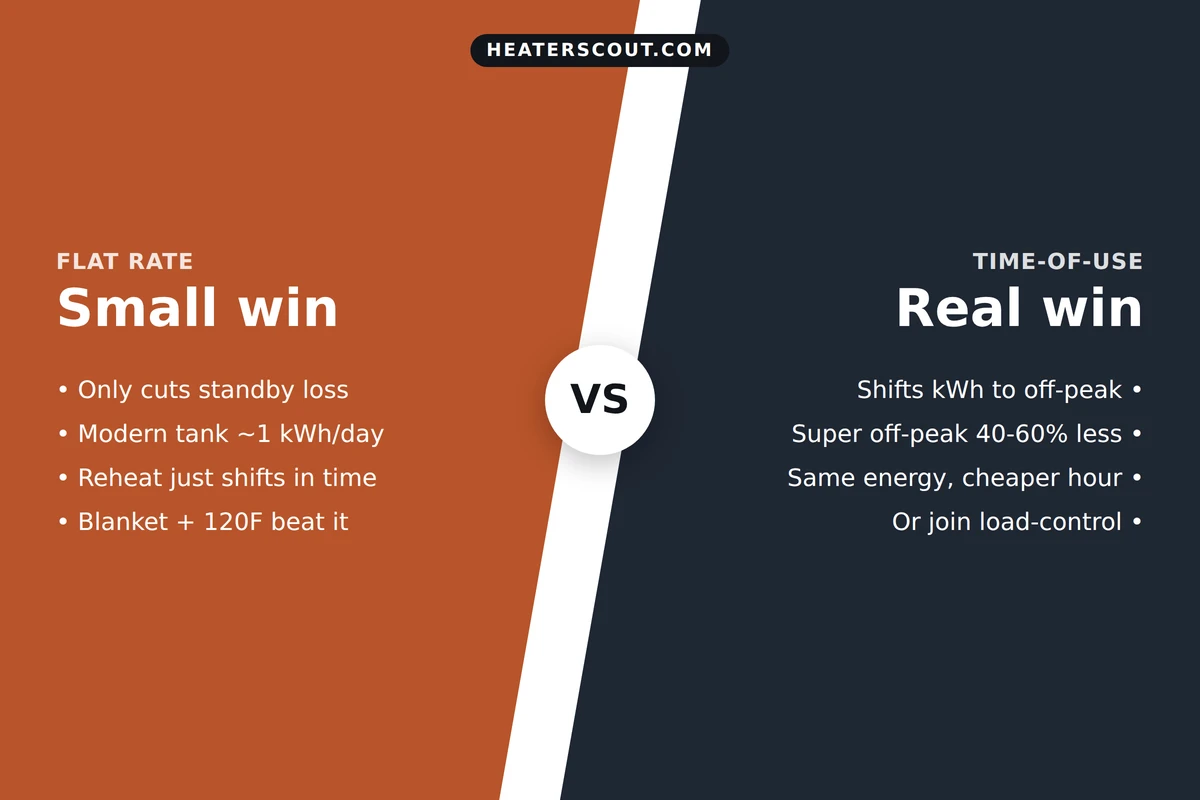
What a timer can and cannot do
A water heater timer does exactly one thing: it interrupts power to the heating elements on a schedule so the tank is not energized when you set it off. That means the only cost it can attack is standby loss, the energy a full tank uses to replace heat it slowly leaks through its walls while sitting idle. It does nothing about the energy you spend actually heating the water you use, which is most of the bill. Water heating runs the average US home somewhere around 400 to 600 dollars a year and makes up 15 to 25 percent of household electricity, per Department of Energy figures, but only a slice of that is standby loss for a timer to touch.
How big that slice is depends on the tank. The Department of Energy puts standby loss at 20 to 45 percent of water-heating energy, but that spread hides a huge difference between old and new units. A modern tank built after 2004, with R-24 foam insulation, loses only about half a kilowatt-hour to a kilowatt-hour and a half a day sitting idle. An older thin-insulation tank can bleed two to four kilowatt-hours a day, and one in an unconditioned garage in winter loses more still. That is why the same timer that barely registers on a five-year-old basement tank can pay off on a twenty-year-old garage tank.
The reheat problem: why flat-rate savings are small
Here is the part the sales pages skip. On a flat electricity rate, where every kilowatt-hour costs the same around the clock, shutting the heater off overnight does not delete the energy you would have spent. The water in the tank cools a few degrees while the power is off, and the moment the timer switches the heater back on, it draws that same energy to bring the tank back to temperature. You did not avoid the cost. You moved it a few hours. The only real saving on a flat rate is the sliver of standby loss you genuinely skipped, and on a modern tank that is small to begin with.
It gets thinner in practice. A modern tank does not run all day anyway. A well-insulated unit typically fires only about one to three hours a day, some post-1997 models a little over an hour, because it is not losing much heat to make up. If the tank is barely running, there is little idle time for a timer to claw back, and any hot water drawn during the off window forces a reheat regardless. On a flat rate with a modern tank, the honest expectation is a few dollars a month at most, which is why so many people install a timer and never see the bill move.
Standby loss
The energy a storage water heater uses to replace heat that leaks out through the tank walls while it sits full and idle, with no hot water being drawn. It is the only cost a timer can reduce. On a modern R-24 insulated tank it is roughly 0.5 to 1.5 kWh per day; on an old, thinly insulated, or cold-garage tank it can be two to four kilowatt-hours a day or more, which is why timers help old tanks far more than new ones.
When a timer genuinely pays off
Two situations flip the math in the timer's favor. The first is a tank with large standby loss: old, poorly insulated, or sitting somewhere cold like a garage or unheated utility room. There the idle bleed is big enough that skipping even part of it saves meaningful energy, and the reheat penalty does not eat all of it. The second, and the stronger case, is a time-of-use electricity rate. On a TOU plan the price of power changes by the hour: expensive during peak demand in the late afternoon and evening, cheap overnight and on weekends, with some utilities offering a super off-peak window around midnight to 6 a.m. that runs 40 to 60 percent below the standard rate.
On a TOU plan the timer does something a flat-rate timer cannot. Instead of only saving the standby loss you skip, it lets you heat the same amount of water during the cheap hours. You set the heater to reheat the tank overnight in the off-peak window, then coast on that stored hot water through the expensive afternoon and evening with the elements off. The energy is the same; the price you pay for it drops. Since water heating is 15 to 25 percent of a home's electricity, shifting that whole load out of the peak window is where a timer earns real money. If you are on a TOU rate, a timer or a smart water-heater controller is one of the easiest peak loads to move.
| Situation | Timer payoff | Why |
|---|---|---|
| Modern tank, flat rate | Small | Little standby loss to cut, and reheat just shifts the cost in time |
| Old or garage tank, flat rate | Moderate | Large standby loss, so skipping idle time saves real energy |
| Any electric tank on a TOU rate | Good | Shifts the same heating load into cheap off-peak hours |
| Gas tank heater | None | Cheap standby loss and no 240V circuit for the timer to interrupt |
| Tankless, gas or electric | None | No stored tank to keep hot; it fires only on demand |
| Utility load-control member | Redundant | The utility already shifts your heater off peak for a credit |
Why timers are pointless on gas and tankless
The whole premise of a timer is a large volume of stored hot water sitting energized, which is why it is an electric-storage-tank tool and nothing else. A gas tank heater does keep water hot, but the standby loss is inexpensive to replace because gas costs far less per unit of heat than electricity, and there is no 240-volt circuit for a standard timer to switch. The common mechanical timers, like the Intermatic units, interrupt an electric circuit; a gas burner controlled by a thermostat and gas valve is not something they wire into. So a timer on a gas tank saves little and usually is not even installable in the ordinary sense.
Tankless heaters, gas or electric, remove the premise entirely. There is no stored tank to keep hot. A tankless unit sits cold and fires only when a tap opens, heating water as it flows, so its standby loss is essentially zero and there is nothing for a timer to turn off. Putting a timer on a tankless heater at best does nothing and at worst blocks hot water when you want it. If someone is selling you a timer for a tankless or a gas unit, that is the moment to walk away.
Cheaper moves that usually beat a timer
Before buying and wiring a timer, run the easy wins, because on a modern flat-rate tank they typically save more for less. Turning the thermostat down from 140 to 120 degrees costs nothing, cuts standby loss because the tank holds a smaller temperature difference against the room, and lowers scald risk at the tap. Wrapping an older tank in an insulation blanket cuts standby loss by roughly 25 to 45 percent, which works out to about 7 to 16 percent of the water-heating cost, for 20 to 40 dollars and a payback often inside a year. For most homes a blanket plus the temperature setback out-saves a timer, and it does not require opening the panel.
If your motivation is peak pricing, look at your utility's load-control or demand-response program before you buy hardware. Many pay a bill credit or annual incentive to let them briefly cycle your water heater off during peak events, often through a communication module in the heater's control port. That captures the same peak-shifting benefit a TOU timer gives you, without buying or wiring anything. And if the tank is old and heading toward replacement anyway, the biggest saver is not a timer at all: a heat pump water heater uses roughly two to three times less energy than a standard electric tank, which dwarfs anything a timer, a blanket, or a setback can do.
If you still want a timer, how to do it right
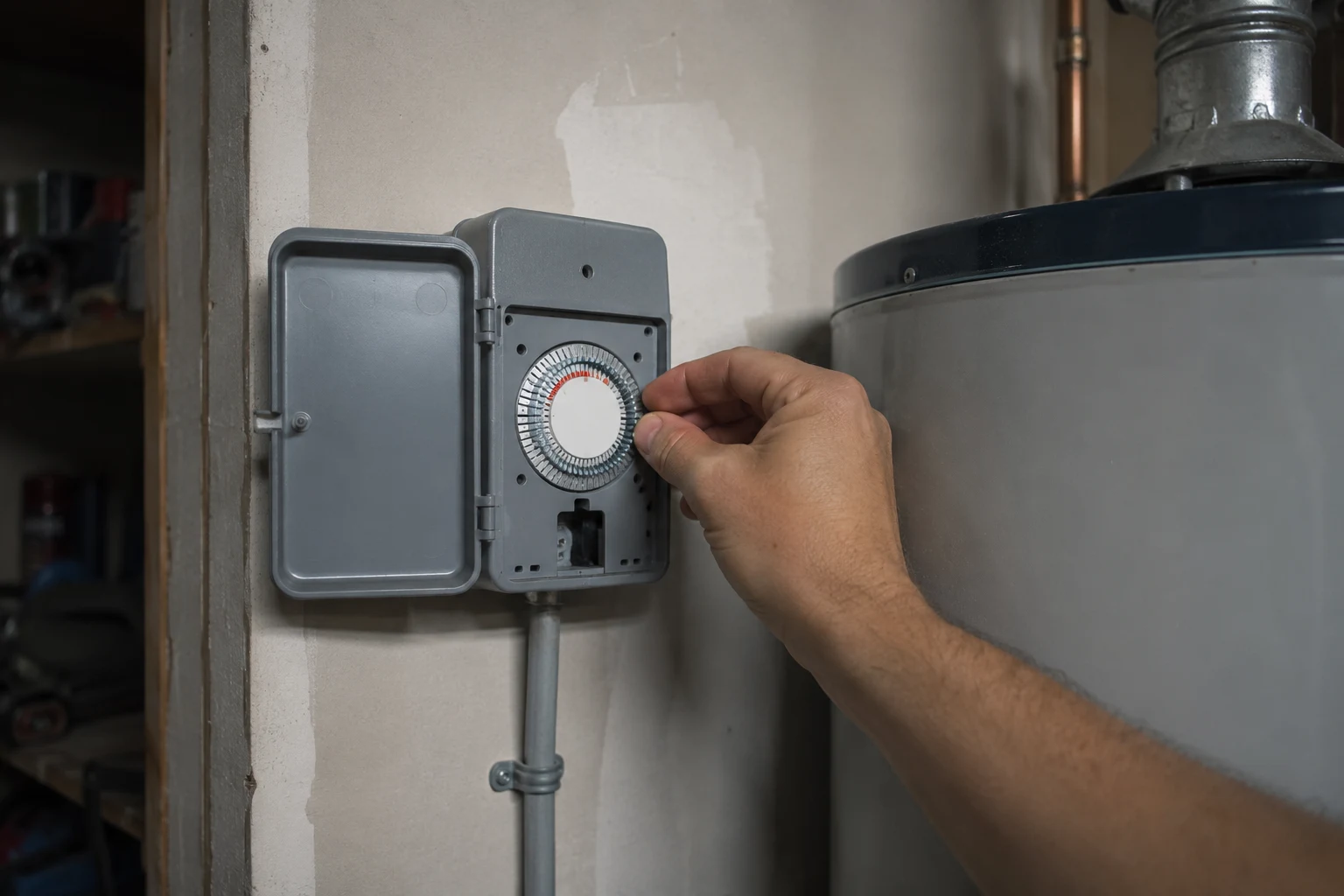
Say you are on a TOU rate, or you have an old garage tank, and the timer makes sense. The device itself is simple. The standard choice is a mechanical 240-volt time switch such as the Intermatic WH40: a 24-hour dial rated for 208 to 250 volts and 40 amps, about 10,000 watts, with a double-pole switch that cuts both hot legs and a one-hour minimum on-and-off setting. You set trippers on the dial for the windows you want the heater energized, usually the off-peak hours. A digital or smart timer costs more but holds multiple schedules and adds vacation and app control, which is genuinely useful for hitting a tight off-peak window.
The honest bottom line
A water heater timer is not a scam, but it is oversold. On a modern, well-insulated electric tank on a flat rate, it cuts a small standby loss and mostly just shifts the reheat cost in time, so the bill barely moves and a 30-dollar insulation blanket usually saves more. The timer becomes genuinely worthwhile in two cases: an old, poorly insulated, or cold-garage tank with large standby loss, and a time-of-use rate where it shifts your whole water-heating load into cheap off-peak hours. It is pointless on gas and on tankless, because there is either no expensive standby loss or no tank to keep hot.
So do this in order. Check whether you are on a flat or time-of-use rate, since that single fact determines most of the answer. Turn the thermostat to 120 and, on an older tank, add a blanket, because those are cheaper and often larger wins. Ask your utility about a load-control program that pays you to let them shift the heater at peak. Buy a timer only if you are on a TOU rate or nursing an old high-loss tank, and if the tank is near the end of its life, price a heat pump water heater instead, because it saves more than every timer and blanket combined.
Frequently asked
Do water heater timers actually save money?
Usually less than the ads promise, and on some homes almost nothing. A timer only attacks standby loss, the heat a full tank bleeds off while nobody uses it. On a modern well-insulated electric tank that loss is small, roughly half a kilowatt-hour to a kilowatt-hour and a half a day, so there is not much to cut. The bigger problem on a flat rate is that turning the tank off overnight does not delete the energy, it just delays it: the water cools a bit, and when the timer switches the heater back on it draws that same energy to reheat. You mostly move the cost in time rather than remove it. Where a timer earns real money is an old or poorly insulated tank with heavy standby loss, a tank in a cold garage, or a home on a time-of-use electricity plan where off-peak power is genuinely cheaper.
How much can a water heater timer save per year?
It depends entirely on your tank and your rate, and the honest range runs from almost nothing to something worth doing. Water heating is about 15 to 25 percent of a home's electricity and costs the average US household somewhere around 400 to 600 dollars a year, per Department of Energy figures. A timer only touches the standby-loss slice of that. On a newer tank losing about a kilowatt-hour a day, you might save a few dollars a month at most on a flat rate, and even that shrinks because the reheat claws some of it back. On an old, thinly insulated tank losing two to four kilowatt-hours a day, or on a time-of-use plan where you shift heating into a cheap overnight window, the savings become real, on the order of ten percent or more of the water-heating bill. Do not assume a headline percentage applies to your setup.
Are water heater timers pointless for gas and tankless heaters?
For practical purposes, yes to both. A gas tank heater keeps water hot too, but its standby loss is cheap to make up because gas is inexpensive per unit of heat, and there is no 240-volt circuit for a standard electric timer to interrupt, so a mechanical timer like the common Intermatic units simply does not apply. A tankless heater, gas or electric, has no stored tank to keep hot in the first place. It fires only when a tap opens and sits cold the rest of the time, which means it already has essentially zero standby loss and there is nothing for a timer to switch off. Timers are an electric storage tank tool, and even there the payoff is modest unless the tank is old or you are on a time-of-use rate.
What is a time-of-use rate and why does it change the math?
A time-of-use, or TOU, rate charges different prices for electricity depending on the hour. Power costs the most during peak demand, often late afternoon and early evening, and the least overnight and on weekends. Some utilities have a super off-peak window, commonly around midnight to 6 a.m., where the rate can run 40 to 60 percent below the standard price. On a flat rate a timer can only save the standby loss you skip, which is small. On a TOU rate the timer does something more valuable: it lets you heat the same amount of water, just during the cheap hours, so a load that is 15 to 25 percent of your electricity moves out of the expensive window. That shift, not standby loss, is where a timer genuinely pays off, and it is why timers make far more sense for TOU customers than for flat-rate ones.
What is the best timer for an electric water heater?
For a standard hard-wired electric tank, the workhorse is a mechanical 240-volt time switch such as the Intermatic WH40. It is a 24-hour dial rated for 208 to 250 volts and 40 amps, about 10,000 watts, with a double-pole switch that cuts both legs of the circuit and a one-hour minimum on-and-off setting. You set trippers on the dial for the windows you want the heater energized. A mechanical timer is simple and durable but holds only one repeating daily schedule; digital and smart timers add multiple schedules, vacation modes, and app control, which matters more on a TOU plan. Either way this is a 240-volt hard-wired job, so hire an electrician unless you are qualified to work in the panel.
Is there a cheaper or better way to cut water heating cost than a timer?
Often, yes, and it is worth trying the easy ones first. Lowering the thermostat from 140 to 120 degrees cuts standby loss and scald risk and costs nothing. Wrapping an older tank in an insulation blanket cuts standby loss by roughly 25 to 45 percent, about 7 to 16 percent of the water-heating cost, for 20 to 40 dollars and a payback often under a year, and for most homes that beats a timer. Many utilities also run a load-control program that pays a bill credit to let them briefly cycle your water heater at peak, which captures the peak-shifting benefit without you wiring anything. And if the tank is old and you are replacing it anyway, a heat pump water heater saves far more than any timer by using two to three times less energy.
Can I install a water heater timer myself?
Only if you are genuinely comfortable working in a 240-volt circuit, because that is what this is. An electric tank timer like the Intermatic WH40 wires into the two hot legs feeding the heater and handles up to 40 amps. That means killing the breaker, confirming the circuit is dead with a meter, and landing the conductors correctly on a double-pole switch. Done wrong it is a shock and fire hazard, and in many jurisdictions this circuit change is permit and inspection work. If you already do your own electrical, it is a straightforward afternoon; if the panel is unfamiliar territory, pay a licensed electrician.