Two safe temperatures are fighting each other inside your water heater. Legionella bacteria stop multiplying when the water sits around 140F, so the health rule says store it hot. But 140F water at a shower head burns skin in roughly five seconds, so the burn rule says deliver it cool. One thermostat dial cannot satisfy both. A thermostatic mixing valve is the small brass part that settles the argument, and it does something extra almost nobody buys it for: it gives you more hot water.
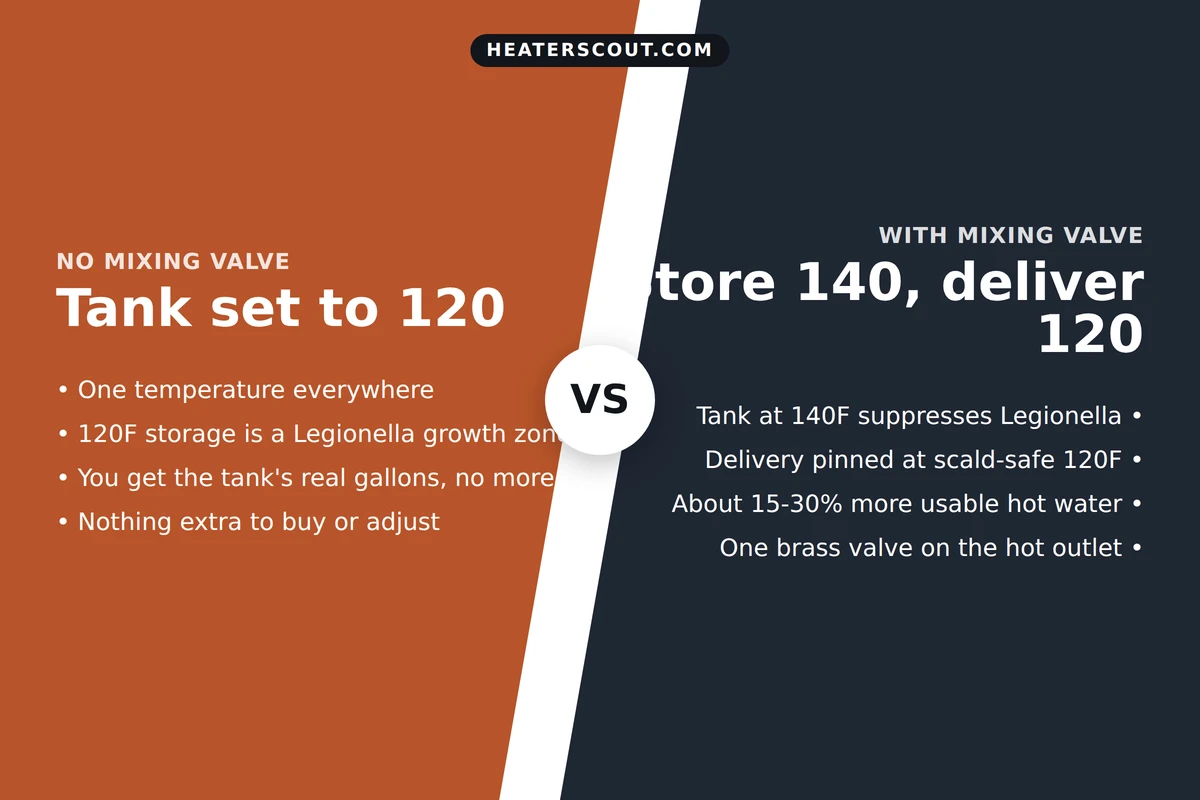
No mixing valve (tank at 120)
- One temperature everywhere, nothing to blend or adjust.
- Every tap is scald-safe by default at 120F.
- But 120F storage sits square in the Legionella growth zone.
- You get the tank's real gallons and not one gallon more.
- A reasonable, code-compliant choice for a low-risk home.
With mixing valve (store 140, deliver 120)
- Tank runs at 140F, hot enough to suppress Legionella.
- The valve holds delivery at a scald-safe 120F at every tap.
- Hotter stored water cut with cold gives 15-30% more usable hot water.
- Adds one brass valve, a small cost, and a setpoint to dial in.
- The standard approach in commercial and multifamily plumbing.
Two kinds of safe, pointing in opposite directions
Every temperature decision on a water heater runs into the same wall. The number that makes water safe from bacteria is not the number that makes it safe from burns. Legionella, the bug behind Legionnaires' disease, thrives in stagnant warm water roughly between 95 and 115F, slows above 122F, and dies off fast at 140F. That is why public-health guidance for storage leans hot. At the tap, though, 140F is dangerous. It causes a full-thickness scald in about five seconds on adult skin, and faster on a child or an older adult whose skin is thinner. Drop the water to 130F and that same burn takes closer to thirty seconds, which is still fast enough to catch someone off guard. Reach the tap at 120F and the burn time stretches to minutes, long enough to react and pull away before real damage happens. Those seconds are the whole reason 120F became the standard delivery number.
So the two honest strategies pull in opposite directions. Set the tank to 140 for the bacteria and you have turned every faucet into a burn risk. Set it to 120 for the burns and you are storing water in the exact range where Legionella likes to grow, with no capacity to spare. The mixing valve is what lets you stop choosing. It sits on the outlet, senses the water leaving the tank, and blends in cold so the tank can run hot while the taps stay cool. Store at 140, deliver at 120, and both problems are covered at once. Pressure plays into it too: the valve is designed to hold its setpoint across the normal 40 to 80 psi range of a residential supply, and it reacts to a cold-side pressure drop, such as a toilet filling, by throttling the hot side so a shower does not suddenly spike hot.
Thermostatic mixing valve
A temperature-sensing blending valve installed on the hot outlet of a water heater. Also called a tempering valve or an ASSE 1017 valve, it mixes stored hot water with cold to deliver a fixed, adjustable setpoint, typically 120F, regardless of how hot the tank is stored. A wax or bimetal element senses the outlet temperature and shifts the blend continuously, so delivery stays steady even as the tank cools during a long draw. It is the whole-house counterpart to the smaller ASSE 1070 anti-scald valves installed at individual fixtures. Store hot, deliver safe.
| Store 120 | Store 140 + mix to 120 | |
|---|---|---|
| Usable hot-water capacity | The tank's real gallons | About 15-30% more per tankful |
| Scald safety at the tap | Safe, 120F everywhere | Safe, delivery held at 120F |
| Legionella control | Weak, 120F is a growth zone | Strong, 140F storage suppresses it |
| Delivery consistency | Follows the tank as it cools | Held at setpoint by the valve |
| Up-front cost | Nothing, just turn the dial down | Valve plus install, about $200-450 |
| Parts to maintain | None | One valve that can scale or drift |
Reading the valve, the ports, and the setpoint
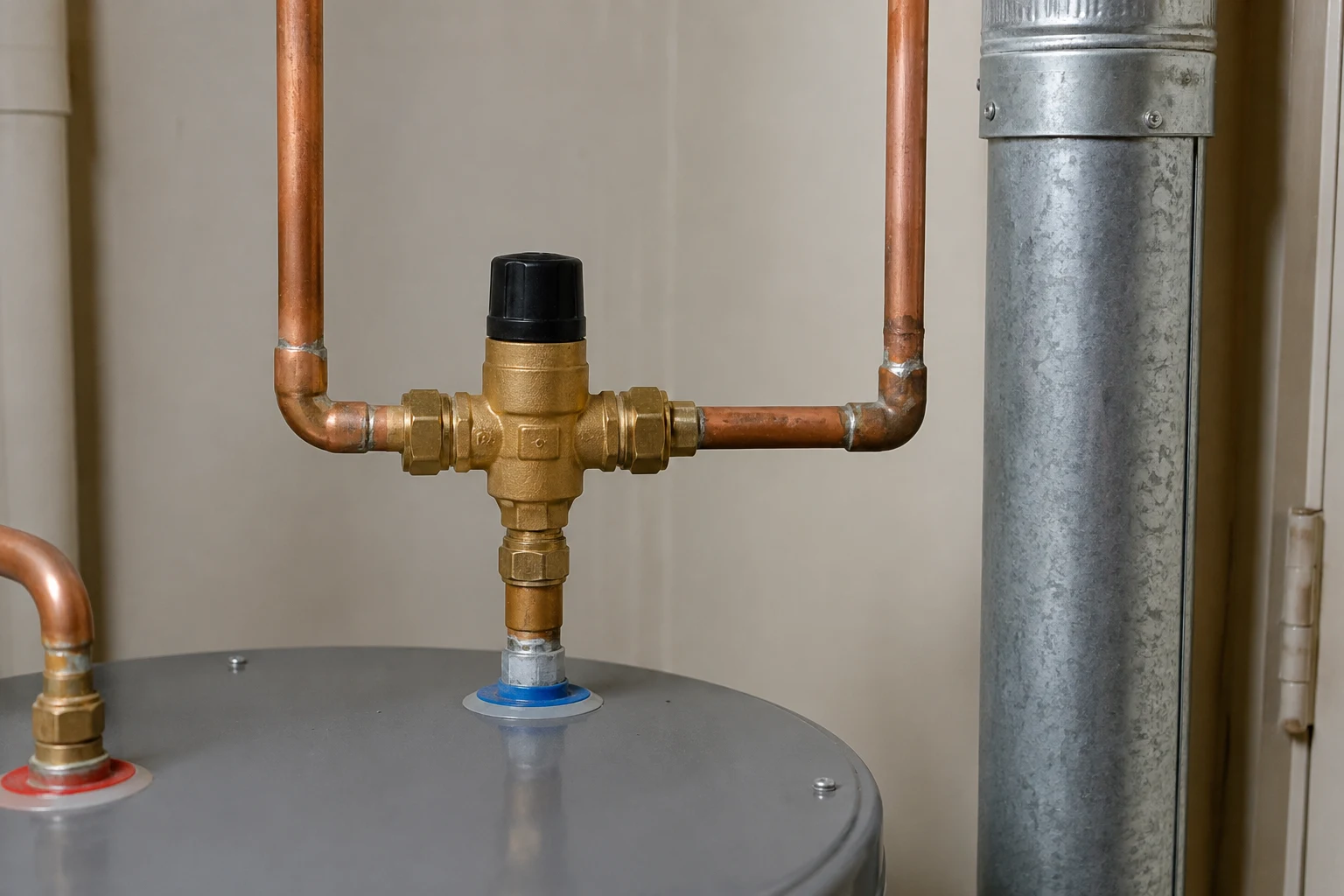
The valve does its job through three connections, and getting them in the right order is the entire installation. Hot from the tank feeds the hot port. A cold line teed off the supply feeds the cold port. The blended, tempered outlet becomes the new hot line to the house. Plumb those backward and the valve tempers nothing, which is the most common installation mistake. Orientation is not cosmetic, so follow the arrows and labels cast into the body. Once it is piped, turn the tank up to 140F, wait for it to actually reach that, then adjust the cap on the valve while a hot tap runs and a thermometer reads the stream. Dial it until delivery sits near 120F, and verify at a far fixture rather than trusting the valve alone, because a long pipe run bleeds off a few degrees on the way. Give it a couple of days and recheck, since the element settles in after first use. From then on the valve holds that number on its own. The one honest caveat: a bare trickle from a single faucet can drift a few degrees, because the valve is sized to protect against scalds during real flow, not to hold a lab constant at a dripping tap. In hard water the valve can scale and start to drift, so a thermometer check once or twice a year keeps it honest, and a valve that will no longer hold or adjust gets its cartridge or the whole body swapped out.
Who actually needs one
A mixing valve is not a universal upgrade. A two-person household with a right-sized tank and no health concerns can set the heater to 120F and be done, cheaply and safely. The valve earns its cost in specific homes, and if yours is one of them the case is strong rather than marginal. Before you buy, one distinction matters. The whole-house valve at the heater is the ASSE 1017 device this guide is about, sized to temper everything leaving the tank to a general 120F. It is different from an ASSE 1070 point-of-use valve, the smaller anti-scald unit built into a shower or lavatory to cap the temperature right at that fixture. The two work together rather than compete: the heater valve buys you hot storage and extra capacity, and the fixture valve gives a tighter final limit where a person actually stands. On the brand side, the US residential names are Honeywell and Resideo, whose AM-1 is the one plumbers reach for most, along with Watts and Cash Acme. These are the situations where storing hot and mixing down pays for itself.
A small tank under heavy demand
If mornings are a race and the last shower always runs cold, the capacity boost is the cheapest fix available. Storing at 140F and blending down turns a 40-gallon tank into the effective equal of a 50-gallon one, no larger heater required, which for a busy household is the difference between a warm rinse and a cold one.
Households with kids or elderly
Young children and older adults have thinner skin and scald in a fraction of the time a healthy adult does, seconds instead of minutes. A valve pinned at 120F delivery is a hard ceiling on burn risk at every tap, holding even if someone bumps the tank thermostat up or a fixture is left wide open.
Anyone storing at 140 for bacteria
If there is an immune-compromised member in the house, or long dead-leg pipe runs where water sits warm and stagnant, 140F storage for Legionella control is worth doing. The mixing valve is the piece that makes running the tank that hot possible without turning the taps into a scald hazard.
Store the tank hot for the bacteria, let a brass valve keep the taps honest, and pocket a bigger tank's worth of hot water on the same footprint.
Frequently asked
What is a thermostatic mixing valve and where does it go?
It is a temperature-sensing brass valve that mounts on the hot-water outlet of the tank. Plumbers also call it a tempering valve or an ASSE 1017 valve. It has three ports: hot in from the tank, cold in from the supply, and tempered out to the house. A wax element inside senses the outlet temperature and shifts the blend of hot and cold continuously, so the water leaving the valve holds a fixed setpoint even as the tank temperature drifts during a long draw. You set the tank hot and let the valve hold the taps at a safe number.
Why store water at 140F if 120F is the safe delivery temperature?
Because those two numbers protect against two different dangers. Legionella bacteria multiply in stagnant water roughly between 95 and 115F and die off quickly at 140F, so public-health guidance leans toward hot storage. But 140F water at a tap causes a full-thickness scald in about five seconds, faster on a child or older adult. Storing at 140 handles the bacteria, and a mixing valve blending down to 120 handles the burns. Set the whole tank to 120 and you are safe from scalds but sitting in the bacteria growth range, with no way to have both.
Does a mixing valve really give me more hot water?
Yes, and it is the part people do not expect. Water at 140F carries more heat per gallon than water at 120F, so when the valve cuts it with cold to reach 120, each stored gallon stretches into more than a gallon of usable warm water. In practice a 40-gallon tank often behaves like a 50-gallon one, roughly 15 to 30 percent more usable hot water depending on how cold your incoming supply is. It is the cheapest way to add shower capacity short of buying a larger heater.
What is the difference between a whole-house valve and a point-of-use one?
The whole-house valve is the ASSE 1017 unit at the water heater. It tempers everything leaving the tank down to a general delivery setpoint like 120F, protecting the whole system at once. Point-of-use valves are ASSE 1070 devices installed at a single fixture, such as inside a shower or lavatory, and they hold a tighter, lower temperature right at that outlet for anti-scald protection. Many homes use the whole-house valve for storage safety and capacity, then rely on the fixture's own valve for the final scald limit at the shower.
How do I set and adjust a mixing valve?
Turn the tank up to 140F first and give it time to reach temperature. Then adjust the cap on the mixing valve, running a hot tap while you read the water with a thermometer, until the delivered temperature sits at your target, usually 120F. Verify at the fixtures, not just at the valve, since a long pipe run cools the water on the way. Recheck after a few days because the valve settles in. Note that a tiny trickle from one faucet can wander a few degrees off setpoint, which is normal and not a fault.
Do mixing valves need maintenance, and how long do they last?
They are simple but not maintenance-free. The internal element can stick, and in hard water the valve scales up and starts to drift off its setpoint, delivering water hotter or colder than the dial says. Check the delivered temperature with a thermometer once or twice a year, especially if your water is hard. A good brass residential valve from a brand like Honeywell or Resideo, Watts, or Cash Acme lasts many years, but if the temperature will no longer hold or adjust, the cartridge or the whole valve gets replaced rather than repaired in the field.
Is a thermostatic mixing valve required by code?
Often, yes. Many jurisdictions on recent plumbing codes require a mixing or tempering valve when a water heater is set above 120F, and it is standard in commercial and multifamily work. Even where a residential replacement does not strictly require one, it is commonly specified the moment the thermostat is turned up for Legionella control. Rules vary by state and city, so confirm with your local code or the inspector before you rely on it.
Turning the tank up but worried about burns?
A thermostatic mixing valve is the piece that lets you store hot for bacteria control and still deliver cool to the taps, with more usable hot water as a bonus. Browse the temperature and safety guides to size and set yours for your household.