Quick answer
A standard electric tank has two thermostats, and the one that fails first is usually the upper, because it is the master: it feeds the ECO high-limit switch and switches power to both element circuits. If you have no hot water at all, suspect the upper thermostat or a tripped ECO. If you get a little hot water that runs cold fast, suspect the lower thermostat or lower element. A multimeter and fifteen minutes settle it — walk the wizard below to find the failed part.
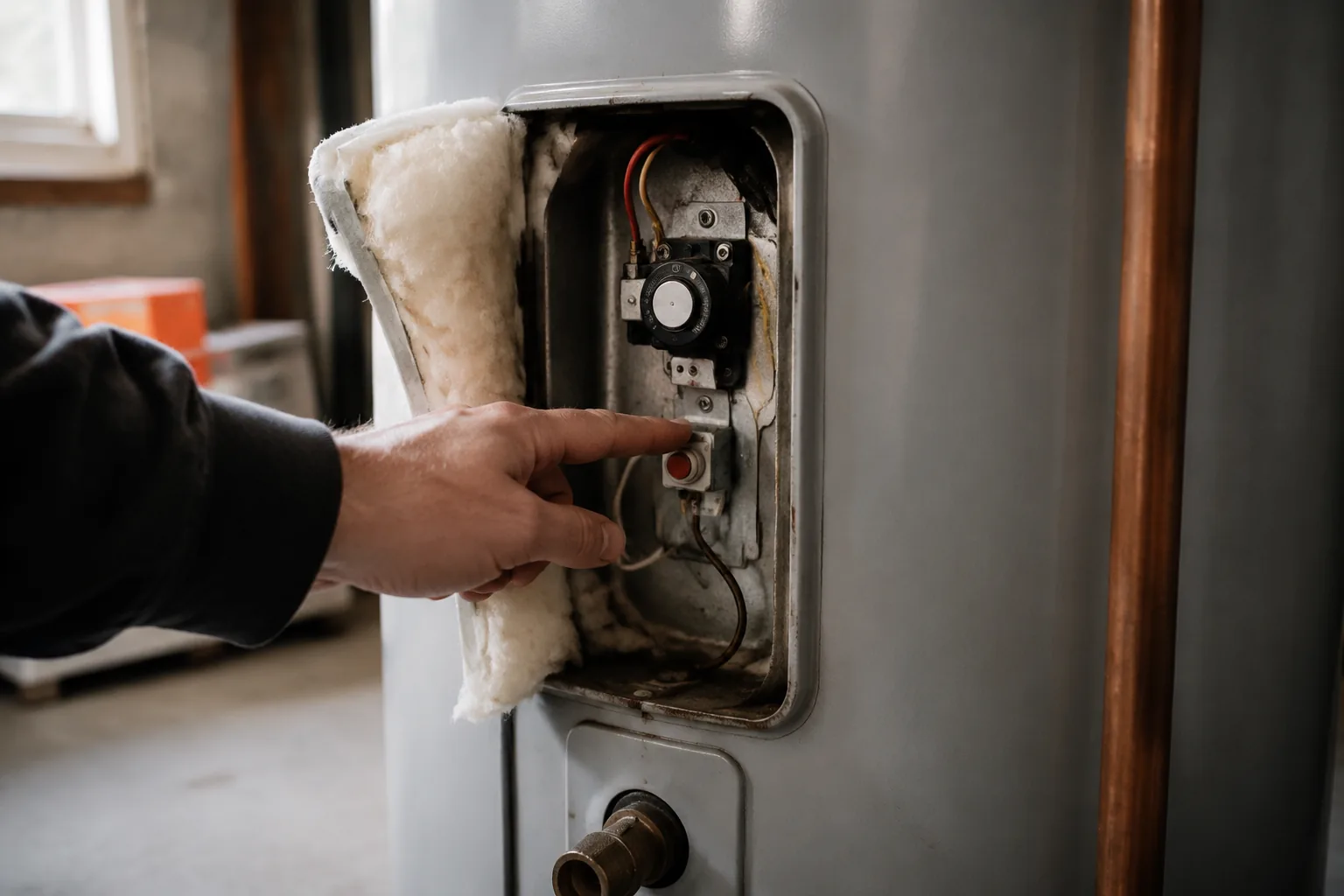
Before you touch a single terminal: switch off the water heater breaker and verify it is dead with a non-contact tester or a meter across the terminals. These heaters run on 240V, and 240V across your chest can stop your heart. Power off is not optional, and testing continuity on a live circuit will damage your meter and can hurt you.
How a dual-element heater actually works
Almost every residential electric tank in the US is a non-simultaneous, dual-element design. That phrase does a lot of work. Two heating elements sit in the tank, one high and one low, but only one ever draws power at a time. Wiring them to fire together would pull roughly 9,000 watts and trip most household circuits, so the controls deliberately hand off between them.
Here is the sequence. When you draw a full tank of hot water, the cold refill sinks to the bottom and the whole tank goes cold. The upper thermostat sees this and sends power to the upper element first, heating the top third of the tank. Once the top reaches its setpoint, the upper thermostat flips its internal switch and hands power down to the lower thermostat, which runs the lower element until the rest of the tank is hot. Then it idles. On a normal day, once the tank is up to temperature, it is almost always the lower element doing the small top-ups, because heat rises and the top stays hot longest.
Why the upper thermostat is the one that matters
The upper thermostat is not just another switch. It is the master for the entire heater. Line voltage comes into the upper thermostat, passes through the ECO (the energy cut-off, also called the high-limit switch, the thermal cut-off, or just "the reset button"), and only then reaches the two element circuits. If the ECO trips or the upper thermostat contacts fail open, nothing downstream gets power. That is why a dead upper stage gives you no hot water at all, while a dead lower stage only shortens how long the hot water lasts.
The ECO is a mechanical safety with a fixed trip point, typically around 180 to 190°F. It exists to cut power if a thermostat sticks closed and the tank runs away toward scalding or steam. When you press that red button and it clicks back in, you have reset the ECO. When it will not stay in, or trips again within minutes, the ECO is doing its job and telling you something upstream is still overheating — usually a stuck thermostat or a grounded element, not a bad ECO.
Read the symptom before you grab the meter
The pattern of the failure narrows the suspect list before you open anything:
These are tendencies, not proof. A grounded upper element can also trip the ECO and mimic a bad upper thermostat. That is exactly why the meter gets the final word: symptoms point you at a stage, continuity tells you the part.
Walk the diagnostic: a guided yes/no test
This wizard runs the same checks a technician does, in order: kill the power, check the ECO, then test each thermostat for continuity before you condemn a part. Answer what you see and it lands on a specific verdict. Keep your meter on the lowest ohms range for the switches.
Thermostat vs element test wizard
One question at a time. Power must be off at the breaker before any continuity check.
Step 1 of the test
Is the breaker off and the heater verified dead at the terminals?
Flip the double-pole breaker, then confirm zero volts across the upper thermostat terminals with a meter. 240V is lethal; do not skip this.
Step 2 — the ECO
Has the red ECO reset button tripped (popped out) on the upper thermostat?
Pull the upper access panel and fold back the insulation. A tripped high-limit sits proud of the plate and clicks when you press it in.
Step 3 — upper thermostat
With the tank cold and the dial turned up, does the upper thermostat show continuity (near 0 ohms) across its line terminals?
A cold tank is calling for heat, so a healthy upper thermostat should read closed. No continuity here, cold and calling, means the contacts have failed open.
Step 4 — lower thermostat
Does the lower thermostat show continuity to the lower element terminals when the tank is cool?
Move down to the lower access panel. With the tank below setpoint the lower thermostat should be closed and passing power to the lower element.
Step 5 — the element
Do the heating elements read a normal 10 to 30 ohms across their two terminals?
Disconnect one element wire and probe the two screws. Also check each screw to the tank shell: any continuity to ground means the element is shorted.
Kill the power first
Do not test or touch anything until the breaker is off and you have confirmed zero volts across the terminals. 240V is lethal and a live continuity test can wreck your meter.
Once it reads dead, come back and continue.
Reset the ECO, then find why it tripped
Press the red button firmly until it clicks. If it holds and heat returns, the trip may have been a one-off spike. If it trips again within minutes, the ECO is not the fault — something upstream is overheating: a thermostat stuck closed or a grounded element. Test both before you replace the high-limit itself.
Replace the upper thermostat
Cold tank, dial up, and no continuity means the master contacts have failed open. Since the upper stage feeds the ECO and both circuits, this alone explains no hot water at all. Replace the upper thermostat (it usually comes as a combined upper thermostat and ECO assembly) and confirm it seats flat against the tank so it senses temperature correctly.
Replace the lower thermostat
An open lower thermostat on a cool tank fits the classic symptom: a little hot water off the top, then it runs cold because the lower element never fires. Swap the lower thermostat, and again make sure it clips tight to the tank wall for accurate sensing.
Replace the failed element, not a thermostat
Both thermostats switch correctly, so the controls are fine. An element reading open (infinite ohms) has burned out; one showing continuity to the tank shell is grounded and will keep tripping the ECO. Drain the tank, replace that element, and your "bad thermostat" turns out to have been a bad element all along.
Both thermostats and both elements test good
If every switch closes and every element reads 10 to 30 ohms with no ground fault, the parts are healthy. Look elsewhere: a tripped breaker, a loose or burned wire nut at a terminal, or an undersized temperature setting. Retighten every connection and recheck for hot water before buying parts you do not need.
Testing continuity the right way
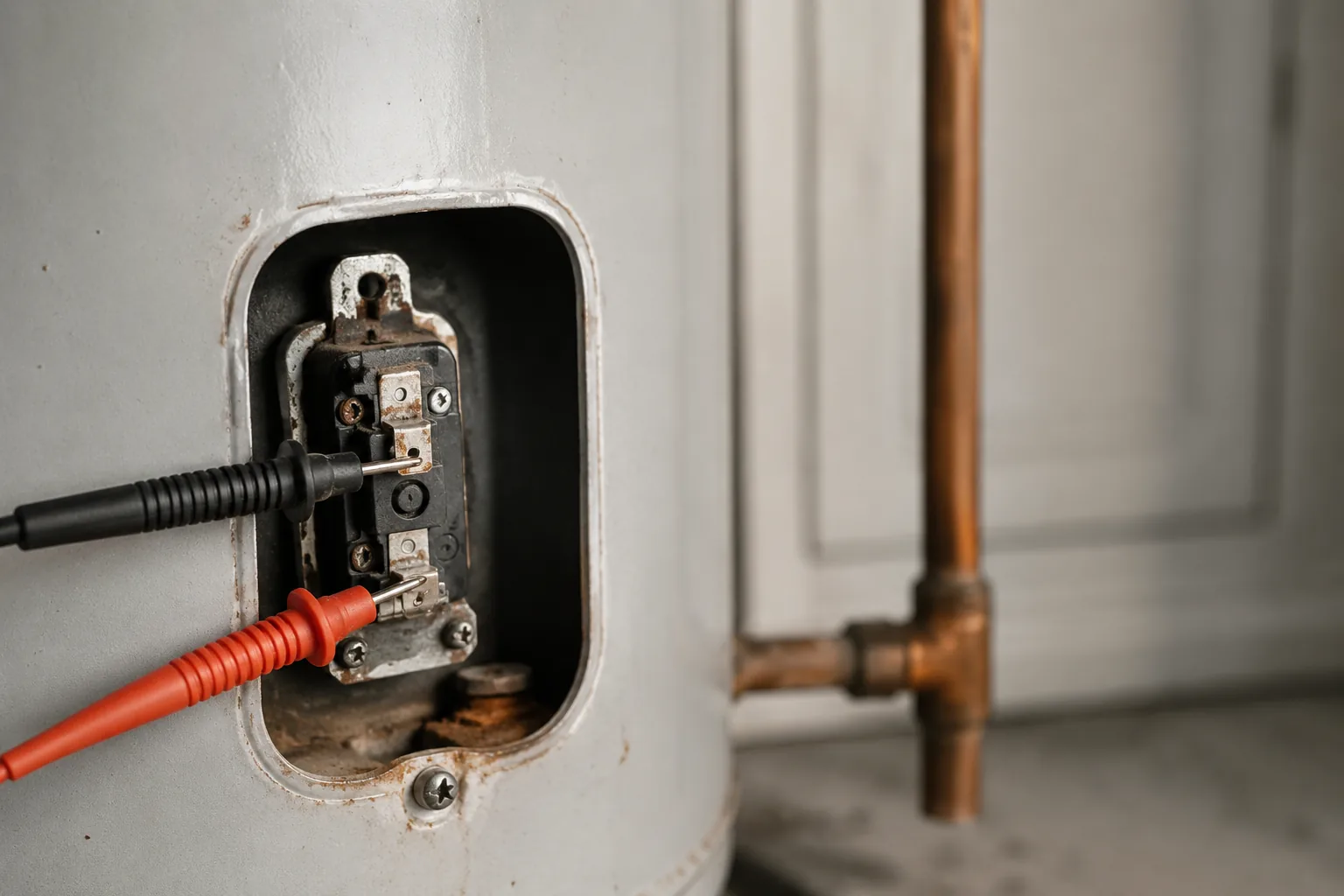
Continuity testing is just asking the meter whether current can pass. Set it to the lowest ohms range or the audible continuity mode. A closed switch or a good element reads near zero (or beeps); an open one reads OL or infinity (silence). For a thermostat, the reading depends on temperature: a cold tank with the dial up should read closed, and a tank already above the setpoint should read open, because the thermostat has satisfied and shut off. That temperature dependence is the trap that makes people condemn a good thermostat — always test cold and calling for heat.
Thermostat or element? How to tell them apart
The two failures feel similar from the shower but read very differently on the meter. A thermostat is a switch, so it should be either near 0 ohms (closed) or infinite (open) depending on temperature; a switch that will not close when the tank is cold is bad. A heating element is a resistor, so a good one always reads a steady 10 to 30 ohms no matter the temperature. An element that reads OL has an open coil and is dead; one that reads any continuity between a terminal and the tank shell is grounded and will trip the ECO every time you reset it.
Bad thermostat
- Open across line terminals with the tank cold and dial up
- No hot water (upper) or short hot water (lower)
- Reads as a switch: 0 or infinite, never a mid value
- Element itself still measures 10 to 30 ohms
Bad element
- Open coil: infinite ohms across its two terminals
- Or grounded: continuity from a terminal to the tank
- Trips the ECO repeatedly if grounded
- Both thermostats switch normally when tested
Reset the ECO once, then diagnose
It is fine to press the reset button one time. If it holds and hot water comes back, note the date and move on; a single trip can follow a power surge or a brief fault. What you should not do is reset it again and again. Each press only rearms the safety, it does not fix whatever cooked the water past 180°F. A reset that trips within minutes is a signal, not a nuisance: go test the upper thermostat for a stuck-closed condition and both elements for a ground fault. Chasing repeated trips with repeated resets is how a cheap thermostat problem turns into a ruined tank.
When to call a pro
Swapping a thermostat or an element is within reach for a careful DIYer with a meter, and the parts are inexpensive. But if the ECO keeps tripping after you have replaced the obvious suspects, if you find scorched wiring or a melted terminal block, or if you are not fully confident working next to 240V, stop and call a licensed plumber or electrician. Burned wiring points to a loose connection arcing, and that is a fire risk that a new part alone will not cure.
Frequently asked
Which thermostat fails first on an electric water heater?
The upper thermostat is the most common failure because it does the most work as the master control. It feeds the ECO high-limit switch and hands power to both element circuits, so when its contacts fail open you get no hot water at all. The lower thermostat fails less often, and when it does you get a little hot water that runs cold quickly because only the top of the tank heats.
How do I test a water heater thermostat with a multimeter?
Turn off the breaker and verify the heater is dead at the terminals, then set the meter to the lowest ohms range. With the tank cold and the dial turned up, touch a probe to each thermostat line terminal. A healthy thermostat that is calling for heat reads near 0 ohms. If it reads OL or infinity while the tank is cold, the contacts have failed open and the thermostat is bad.
What temperature does the ECO high-limit switch trip at?
The ECO, or energy cut-off, is a fixed safety that trips at roughly 180 to 190°F. Its job is to cut power to both elements if a thermostat sticks closed and the water runs away toward scalding or steam. When the red reset button pops out, the ECO has tripped. If it trips again within minutes of resetting, the ECO is working correctly and something upstream is still overheating.
How do I tell a bad thermostat from a bad heating element?
A thermostat is a switch, so it reads either near 0 ohms (closed) or infinite (open) depending on temperature. A heating element is a resistor and should always read a steady 10 to 30 ohms across its two terminals no matter the temperature. If the element reads OL it has an open coil and is dead, and if it shows any continuity to the tank shell it is grounded. Test both before you decide which part to replace.
Why does my water heater reset button keep tripping?
A reset button that keeps tripping means the ECO is repeatedly seeing water above about 180°F. The usual causes are a thermostat stuck in the closed position, so an element never shuts off, or a grounded heating element leaking current. Resetting only rearms the safety; it does not fix the cause. Test the upper thermostat for a stuck-closed condition and check each element for a ground fault before replacing the ECO itself.
Can a bad thermostat cause no hot water at all?
Yes, if it is the upper thermostat. Because the upper stage feeds the ECO and both element circuits, an open upper thermostat cuts power to everything below it and you get no hot water at all. A bad lower thermostat, by contrast, only shortens how long the hot water lasts, since the top of the tank still heats. Confirm with a continuity test on a cold tank before replacing the part.