A dark control screen on a water heater is almost never a water problem. It is a power problem wearing a scary costume. Nine times out of ten the electricity that runs the display has been cut, either at the house breaker, by a safety switch on the heater itself, or by a small fuse on the control board, and the fix is a reset or a cheap part rather than a whole new heater. The trick is to work the chain in order instead of guessing, because the wrong guess is the one that ends with a three-hundred-dollar control board you did not need. Start where the power comes in and follow it toward the screen.
Read the power chain, not the screen
The display is the last thing in a chain, so a blank screen only tells you that something in that chain broke, not what. On an electric or hybrid tank the chain runs house panel to double-pole breaker to the wires at the top of the heater, then through the high-limit ECO switch, into the control board, and finally out to the little screen. Any break upstream leaves everything downstream dark. Your job is to walk that line from the wall toward the display and find the first place the power stops. Do that and the failed part identifies itself, no guessing required.
Key takeaways
- A blank water heater display is a power problem first, a control problem second. Work the chain, do not jump to the board.
- Start at the breaker. A double-pole 240V breaker can trip on one pole only, so it looks ON but the heater is starved. Snap it fully OFF then ON.
- Verify voltage at the heater with a meter before condemning anything. About 240V across the two hots, 120V each leg to ground. Zero on both means look upstream.
- The red ECO high-limit button on the upper thermostat cuts power to the display when it opens. Reset once. If it re-trips, the cause is real.
- Inside faults, in order of likelihood: tripped ECO, blown board fuse, loose ribbon or power connector, dead control board, dead transformer.
- Standard gas tanks have no display at all. Only power-vent and condensing gas units carry a powered control that can go blank.
Walk the diagnostic in order
Do these in sequence and stop at the step that brings the screen back. Kill the breaker before you open any panel, and treat every wire as live until your meter says otherwise. If you are not comfortable with a multimeter around 240 volts, this is a fair place to call a pro, and the voltage step is the one they will do first too.
Reset the house breaker, fully
Go to the electrical panel and find the double-pole breaker for the water heater. Push it firmly to the OFF position, all the way, then firmly back to ON. Do not just nudge it. A double-pole breaker can trip on one leg while the handle still looks centered, which starves the heater and darkens the screen while everything appears normal. Wait a minute after restoring power and watch for the display to wake. On a hybrid or power-vent unit, also check for a GFCI outlet or a wall switch feeding it, since those trip too.
Verify voltage at the heater
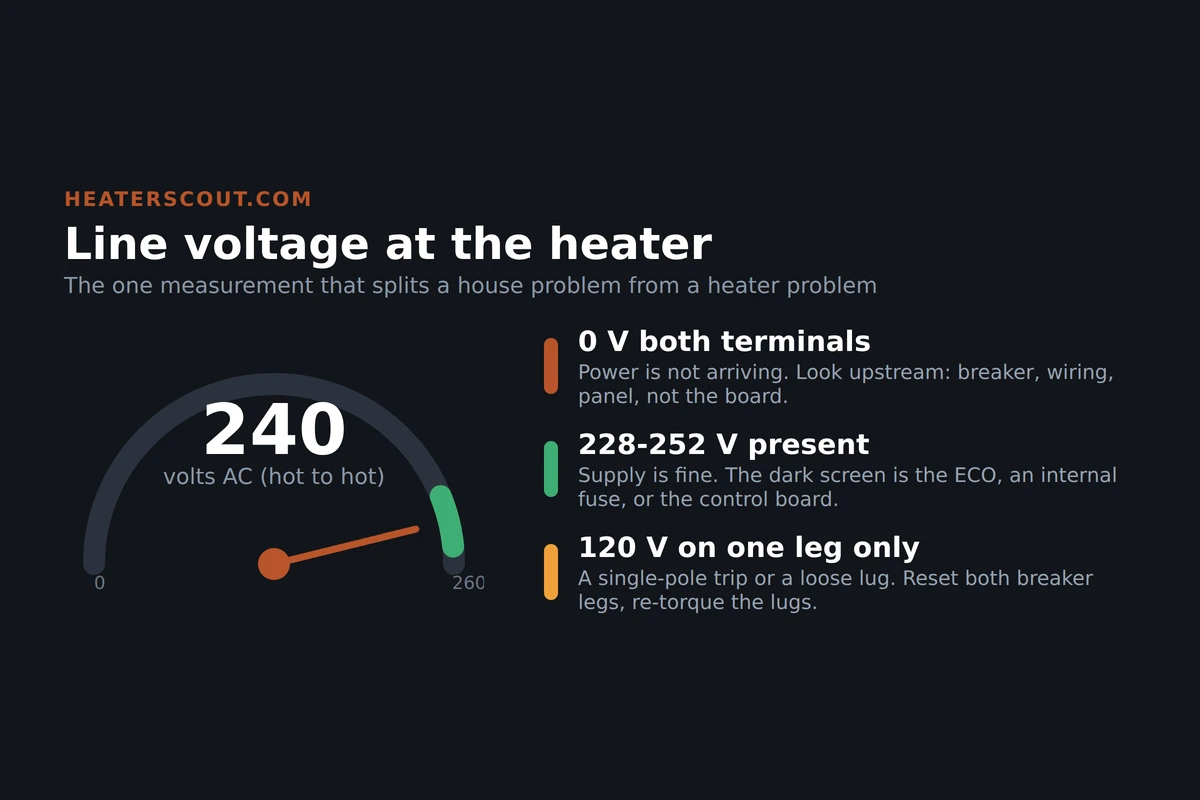
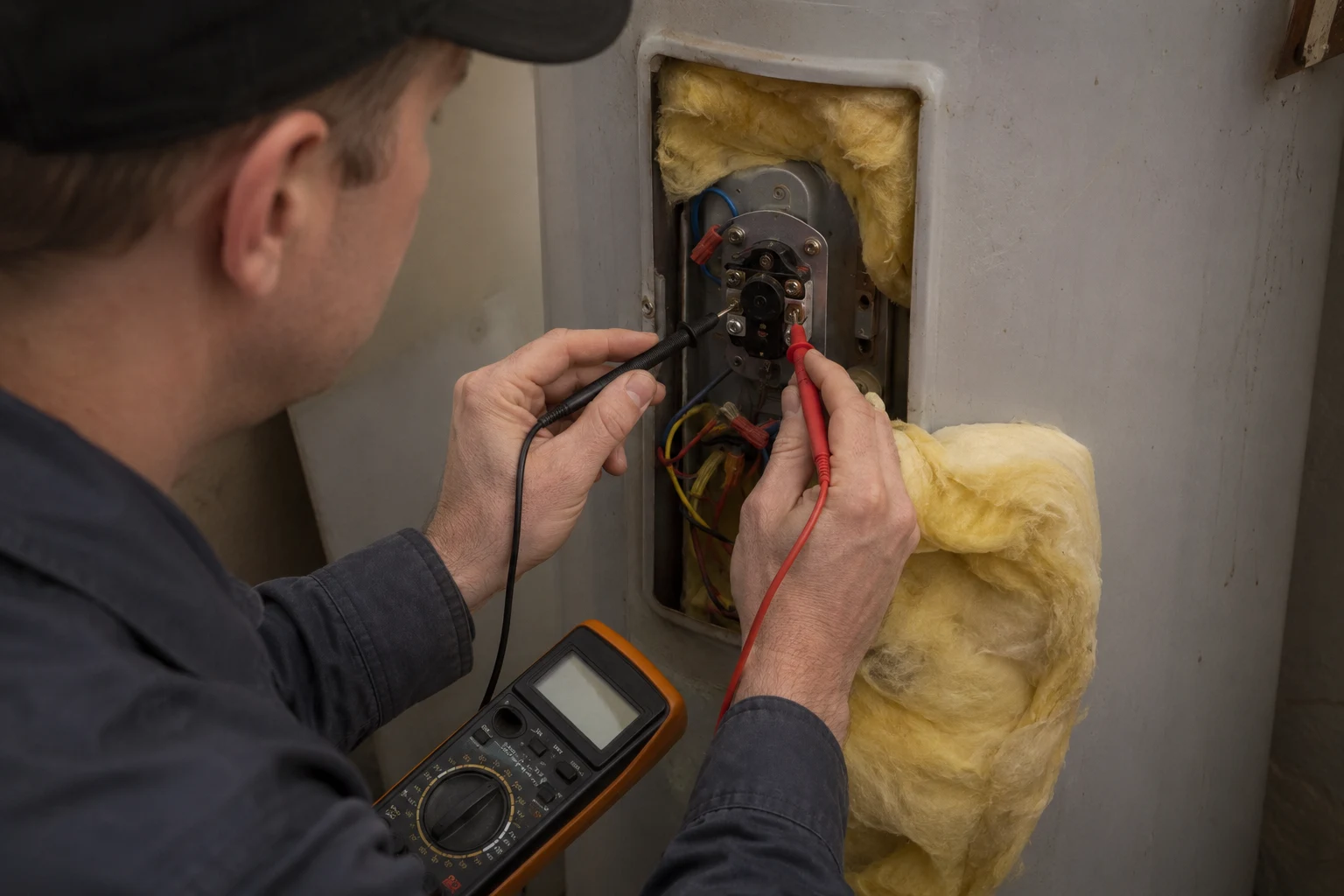
If the breaker did not do it, confirm power is actually reaching the unit. Turn the breaker off, remove the top junction-box cover, turn the breaker back on, and put a multimeter on AC across the two incoming line screws. You want roughly 240 volts hot to hot, and about 120 volts from each hot to the ground wire or bare tank. Zero on both hots means the problem is upstream in the breaker, wiring, or panel, and the board is likely fine. A healthy 240 with a dark screen means the fault is now inside the heater.
Press the ECO high-limit reset
Power reaching the unit but the screen still dark points at the safety cutout. Kill the breaker, open the upper access panel, fold back the insulation, and lift the plastic cover off the upper thermostat. Press the red ECO button in the center firmly until it clicks. This high-limit switch cuts power to the control and the elements when the water overheats, and a tripped ECO is a leading reason an electronic display goes dark. Restore power and check the screen. Reset it once, not repeatedly.
Check the control board fuse and connectors
Screen still dark with good voltage and a reset ECO means opening the control. Many boards carry a small inline or blade fuse that protects the low-voltage side, and a blown one kills the display for a few dollars. Look for a cracked or discolored fuse, and inspect the ribbon cable to the screen and the main power connector for a loose seat, a green corroded pin, or a scorched terminal. Reseat anything loose. A burnt smell or melted plastic here means the board is done, not just the fuse.
Suspect the control board or transformer
If voltage is present, the ECO is set, the fuse is good, and the connectors are seated, you are down to the electronics. The step-down transformer that feeds the low-voltage control can fail open and leave the screen dead with full 240 at the terminals. So can the control board or the separate display board. At this point you are replacing a board, so pull the model and serial and check the warranty before buying, because control and UI boards are usually covered parts on hybrid and premium electric units for years.
The ECO is the part people miss
Of all the steps, the high-limit reset is the one homeowners skip and pros check first. On an electric tank the ECO sits on the upper thermostat and it wires in series ahead of the control, so when it opens for an over-temperature event it does not just stop the elements, it can pull the rug out from under the whole electronic control, screen included. That is why a heater can read a perfect 240 volts at the terminals and still show nothing. Press the button once and the display often springs right back.
A blank screen with a healthy 240 volts at the terminals is usually a tripped ECO, not a dead board. Reset the button once. If it trips again, the water really did overheat.Electric water heater high-limit troubleshooting
Where the DIY line sits, by unit type
How far you take this depends on what you own and what you are comfortable with. The breaker reset and the ECO reset are homeowner territory on any unit. The voltage test is homeowner territory if you own a meter and respect it. Opening the board, chasing a transformer, or swapping a control assembly is where electric, hybrid, and gas paths split apart, and where most people bring in a licensed hand.
Standard electronic thermostat
Breaker, then ECO, then meter, then board. The ECO reset and a $10 board fuse fix a large share of these. If a healthy 240 volts is present and the ECO holds but the screen stays dark, the control board is the culprit and it is a straightforward, if not cheap, swap. A tank near the end of its warranty is a fair candidate for full replacement instead of a board.
Smart digital control panel
Most blank hybrid screens follow a power outage or long vacation. Confirm the breaker is fully ON, hard power-cycle for five minutes, and try a thirty-second press-and-hold on the control pad. If it stays dark with confirmed voltage, the control or display board failed, and on these units the boards are usually a warranty part, so repair beats replacing the whole appliance.
Powered gas control
These plug into a 120-volt outlet and carry a real board, so a dark control can mean a tripped GFCI, a lost outlet, or a failed board. Check the outlet with a known-good device first. A dark control here can also ride alongside a venting or gas-pressure fault, so do not keep forcing resets on a unit that keeps shutting itself down. This is pro territory once power is confirmed.
No display, blinking LED instead
There is no digital screen to go blank. The gas valve runs off the pilot's thermopile and shows a status LED that blinks a code. A dead LED usually means the pilot is out, which is a relight job, not a power problem. So on a plain gas tank you are chasing the pilot and thermopile, a completely different track from an electronic display fault.
When the board really is the answer, and what it costs
Once you have confirmed voltage at the heater, reset the ECO, checked the fuse, and reseated every connector, a still-dark screen is the electronics failing. The most common culprit is the control board itself; the second is a separate display or user-interface board on units that split those functions; the third is the small step-down transformer that feeds the low-voltage side, which can open up and leave the screen dead with full line voltage present. None of these are a reason to scrap a young tank.
On price, a replaceable board fuse is ten to twenty dollars. A control or display board runs roughly three hundred to eight hundred dollars installed, the part often north of two hundred and the balance labor. The 2026 national average for a water heater repair is around six hundred dollars, most jobs landing between two hundred and a bit over a thousand. So the deciding factors are warranty and age. A hybrid or premium electric unit under its board warranty is a clear repair. A plain electric tank past ten years and out of warranty is a coin-flip against just replacing it.
Keep it from going dark again
Two habits cut down on repeat dark-screen calls. First, protect the electronics from the grid. A hybrid or power-vent unit that keeps losing its mind after outages benefits from a surge protector on its circuit. Second, treat a repeat ECO trip as a warning, not a nuisance. If that red button keeps popping, the water is genuinely getting too hot, and the real fault is a stuck element or a drifting thermostat that needs replacing before it takes the tank or your skin with it. A screen that stays lit is usually a heater whose safeties never had to fire.
Frequently asked
Why is my water heater display blank all of a sudden?
A screen that was working and then went dark points at power, not at the water. Something stopped feeding the control board. Start at the electrical panel. A water heater runs on a double-pole 240-volt breaker, and one common failure is that only one of the two poles trips, so the breaker still looks ON but the heater is starved. Snap the breaker fully OFF, then firmly back ON, and see if the display wakes. If it does not, the next stop is the red high-limit reset button on the upper thermostat, and after that the control board. A display that has never lit since a power outage or a long vacation is the same story: confirm the breaker, then reset.
Where is the reset button on a water heater with a digital display?
On an electric tank, pop the upper access panel, fold back the insulation, and peel the plastic safety cover off the upper thermostat. The red button in the middle of that upper unit is the ECO, the emergency cutoff or high-limit reset. When it opens it kills power to both elements and, on electronic models, to the display, which is why your screen is dark. Press it firmly until you feel or hear a click. On a hybrid or heat-pump unit the reset can be a button behind the same upper panel or a press-and-hold on the front control pad, usually about thirty seconds, so check the label on your unit. If the button will not stay in, or it trips again within a day, do not keep resetting it. It is doing its job and something is genuinely overheating.
How do I know if it is the control board or just no power?
Measure the voltage at the heater before you condemn the board. Turn the breaker off, remove the top junction-box cover, then turn the breaker back on and put a multimeter set to AC on the two incoming line screws. On a standard electric or hybrid unit you should read close to 240 volts across the two hots, and about 120 volts from each hot to the ground or the bare tank. If you read zero on both, the problem is upstream in the breaker, wiring, or panel, and the board is probably fine. A healthy 240 with a dark screen means the fault is inside the heater, meaning the ECO, an internal fuse, or the control board. That one measurement saves you from buying a board you did not need. Treat every wire as live.
How much does it cost to fix a water heater with a blank display?
It depends entirely on which layer failed. A tripped breaker or a one-time ECO reset costs nothing but your time. A small blown fuse on the control board runs about ten to twenty dollars if the board takes a replaceable fuse. The expensive end is the control board or the display board itself, which lands roughly between three hundred and eight hundred dollars installed, with the part often two hundred or more and the rest labor. The 2026 national average for a water heater repair sits around six hundred dollars, with most jobs between about two hundred and just over a thousand. Before you pay for a board, pull the model and serial off the rating label and check the warranty, because control and UI boards are commonly covered parts for several years on hybrid and premium electric units.
My hybrid water heater screen went dark after a power outage. Is it broken?
Not necessarily, and this is one of the most common hybrid complaints. Heat-pump and hybrid units have a logic board that does not always come back cleanly after the power blinks, a surge, a brownout, or a long vacation with the unit in a low-power mode. First confirm the breaker is fully ON, because outages sometimes trip one pole on the way down. Then do a hard reset: cut power at the breaker for a full five minutes, restore it, and give the panel a minute to boot. Many units also respond to a press-and-hold on the power or reset button for about thirty seconds. If the screen stays black after a clean power cycle and a confirmed 240 volts at the heater, the control or display board has likely failed and needs replacement, which on most brands is a warranty item within the first several years.
Can a blank display mean my water heater is dangerous to use?
The blank screen itself is not the hazard, but what caused it can be. If the ECO high-limit button tripped, that is the heater telling you the water got dangerously hot, often because an element is stuck on or a thermostat is drifting. Resetting the button once is fine to confirm a one-time event. Resetting it over and over to force the heater back on is not, because you are overriding the last safety between you and scalding water. A burnt smell, discolored wiring, or a warm-to-hot junction box around the terminals is a stop sign: kill the breaker and call a pro.
Why does my gas water heater have no display at all?
Most standard gas tanks never had a digital display. A conventional atmospheric gas water heater runs off a gas control valve powered by the pilot's own thermopile, not house electricity, so there is no lit screen to go blank. What it has instead is a small status LED on the valve that blinks a code. If that light is dead, the usual reason is the pilot went out, so there is no thermopile voltage, which is a different repair path than a blank electronic screen. Only power-vent and condensing gas heaters plug into a 120-volt outlet and carry a real powered control, and those can go dark if they lose that outlet, a GFCI trips, or the board fails. So the first question on a gas unit is which kind you have, because it decides whether you are chasing a pilot or chasing power.
Should I replace the whole water heater or just the control board?
Weigh the age of the tank against the price of the board. If the tank is under about eight years old, the board is still under warranty, and the tank shows no leaks or heavy rust, replacing the board is the sound call. If the unit is past ten to twelve years, out of warranty, and a board would cost several hundred dollars installed, you are spending real money on a tank near the end of its life anyway. A hybrid unit tilts toward repair because the appliance is expensive to replace and the boards are usually covered. A plain electric tank near the end of its warranty tilts toward replacement, since a new one is not far off the cost of a board plus a service call.