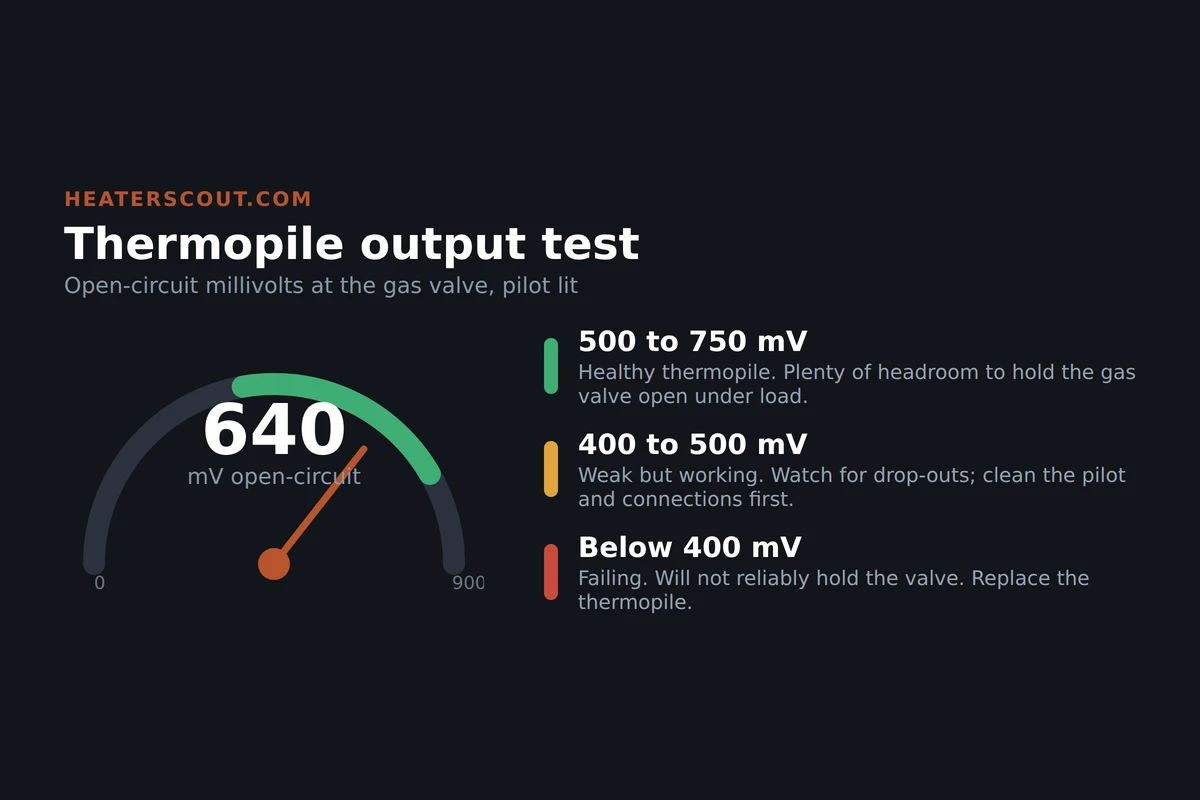
A healthy thermopile on a gas water heater puts out somewhere between 500 and 750 millivolts with the pilot lit, and that tiny voltage runs the whole show: it powers the gas valve, the thermostat, and the safety circuit with no house wiring and no batteries. When it weakens below about 400 millivolts, the pilot may still burn while the main burner refuses to light or drops out mid-cycle. A ten-dollar multimeter tells you exactly where your thermopile stands in about two minutes, and the reading decides whether you clean the pilot or buy the part.
Thermopile or thermocouple: know which you have
These two parts look almost alike, both sit in the pilot flame, and people swap the names constantly. They are not the same, and testing one as if it were the other will send you chasing the wrong fault. The quick tell is the gas valve. A thermopile system has a temperature dial and an electronic-style millivolt valve with two screw terminals for the generator leads. A thermocouple system has a simpler safety valve and a separate thermostat. The voltage each part makes is an order of magnitude apart, which is the whole reason a thermopile can run a control system and a thermocouple can only hold one small valve.
| Thermopile (powerpile / generator) | Thermocouple | |
|---|---|---|
| Open-circuit output | ~400 to 750 mV (many junctions in series) | ~25 to 30 mV (single junction) |
| Job it does | Powers the whole millivolt control: gas valve, thermostat, high-limit | Holds one magnetic pilot safety valve open, nothing else |
| System it belongs to | Millivolt valve, temperature dial, no external power | Standing-pilot valve with separate thermostat |
| Leads at the valve | Two terminals (often TP and TP TH) | One single fitting into the safety valve |
| Typical price | $15 to $30 universal | $8 to $18 universal |
| Symptom when weak | Pilot lights, main burner will not fire or drops out | Pilot will not stay lit after releasing the button |
If your heater has a knob you turn to Warm, Hot, and a Vacation setting, and the pilot generator lands on two screws, it is a thermopile. Rheem, AO Smith, State, and Bradford White have all shipped millivolt models with Honeywell or Robertshaw gas valves, so the brand on the tank does not tell you much. The valve body does.
Testing the thermopile with a multimeter
You do not need to remove anything. The test is done at the gas valve terminals with the pilot lit, and it comes in two parts: open-circuit, with the thermopile making voltage into nothing, and closed-circuit, with the valve actually pulling load. The gap between the two numbers is what tells you whether the part is strong or just barely alive. Set a digital multimeter to the 200-millivolt or 2-volt DC range before you start.
Read it loaded, not just idle
Open-circuit and closed-circuit readings tell you two different things, and you need both. Open-circuit is the thermopile's raw output with nothing drawing on it, and it shows whether the part can make voltage at all. Closed-circuit is the reading under the real load of the gas valve operator, and it shows whether the part can deliver that voltage when it counts. A thermopile that reads a healthy 620 mV open-circuit but drops to 250 mV the instant the valve pulls in has high internal resistance and is worn out, even though the first number looked perfect. Always read it both ways and let the loaded number make the call.
Before you replace the thermopile
New thermopiles are cheap, but a fresh part will not fix a starved pilot or a corroded terminal, and you will be back under the heater a week later chasing the same drop-out. Run this list first. Most low-reading thermopiles that turn out to be fine were being starved by a dirty pilot or losing voltage at a loose connection.
- The pilot burns a firm blue flame that wraps the top inch of the thermopile probe, not a small yellow or lifting flame.
- The pilot orifice is clear of lint, dust, and webbing. Clean it with compressed air or a soft brush, never a drill bit or wire.
- The thermopile tip sits in the hottest part of the flame and has not slipped out of its bracket.
- The two thermopile leads are clean, tight, and fully seated on the gas valve terminals with no green corrosion.
- You waited 30 to 60 seconds for the open-circuit reading to climb and settle before recording it.
- You took a closed-circuit reading under load, not just the idle open-circuit number.
- The replacement is a 750-mV-class thermopile with the right lead length to reach the valve without strain.
- The gas valve itself clicks and tries to open. If it stays dead with a good thermopile reading, the valve, not the generator, is the fault.
| 500 to 750 mV open-circuit | Healthy thermopile. If the burner still will not fire, look at the gas valve, thermostat, or high-limit. |
| 400 to 500 mV open-circuit | Marginal. Clean the pilot and connections, then retest. Watch the loaded number closely. |
| Below 400 mV open-circuit | Failing thermopile. Replace it. A good pilot cannot pull this number back up. |
| Holds 350 mV or more under load | Closed-circuit is fine. The thermopile can hold the valve open. |
| Drops below 300 mV under load | Valve operator drops out. Burner will quit even with the pilot lit. Replace the thermopile. |
| High open-circuit, low under load | Worn thermopile with high internal resistance. Replace it despite the good idle reading. |
| Low both ways, weak pilot | Starved pilot, not a dead part. Clean the orifice and reseat the tip, then retest. |
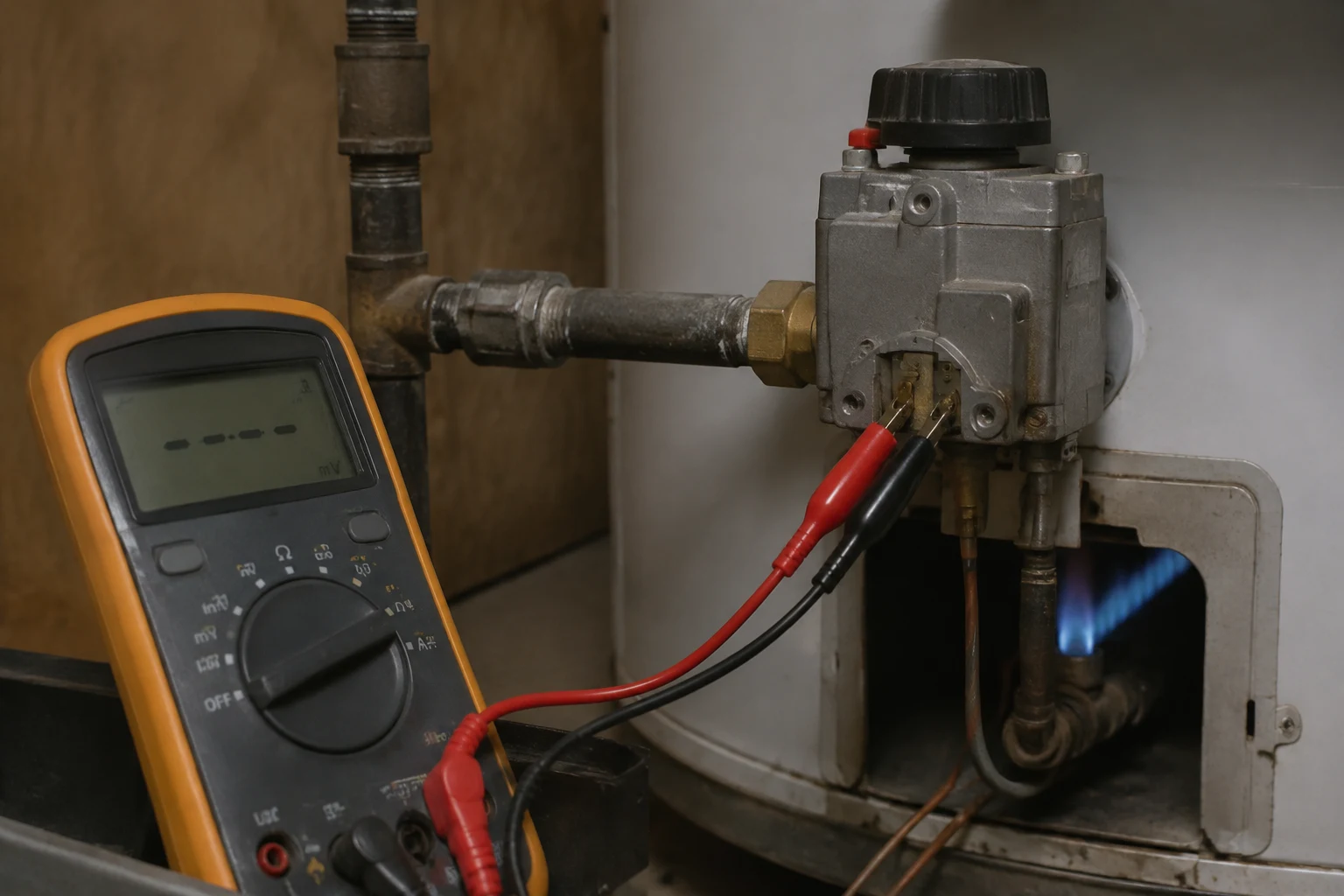
One last check when the readings all look good but the burner still sits dead: put the meter on the valve itself. If the thermopile makes a solid 600 mV open-circuit, holds 380 mV under load, and the main burner still refuses to light, the fault has moved past the generator to the gas valve operator, the thermostat, or the high-limit in the millivolt loop. At that point you are into valve territory, and a new thermopile would just be a part you did not need.
Frequently asked
What is the difference between a thermopile and a thermocouple on a water heater?
Both are heat-driven safety devices sitting in the pilot flame, but they do different jobs and put out very different voltages. A thermocouple is a single junction of two dissimilar metals. It makes about 25 to 30 millivolts open-circuit, just enough to hold one small magnetic gas safety valve open. That is all it does. A thermopile, sometimes stamped powerpile or generator on the box, is a stack of many thermocouple junctions wired in series inside one probe. Stacking them multiplies the voltage to roughly 400 to 750 millivolts open-circuit. That is enough to power an entire millivolt control system: the gas valve operator, the thermostat, and any high-limit switch, with no house wiring or batteries. If your heater has a knob you turn to a temperature and an electronic-looking gas valve with two screw terminals for the pilot generator, you have a thermopile. If it has a simple safety valve and a separate thermostat rod, you likely have a thermocouple.
What millivolt reading means my thermopile is bad?
Read it two ways. Open-circuit, meaning the two thermopile leads disconnected from the gas valve or read across the terminals with the valve doing nothing, a healthy thermopile with the pilot fully lit reads about 500 to 750 millivolts. Anything below 400 millivolts open-circuit is failing and should be replaced. Closed-circuit, meaning under load with the gas valve actually trying to hold open and the burner calling for heat, the reading drops. That drop is normal and expected. What matters is where it lands: it should hold around 350 millivolts or higher under load. If the closed-circuit reading sags below roughly 300 millivolts, the valve operator lets go and the main burner drops out even though the pilot is still lit. A thermopile that reads fine open-circuit but collapses under load is worn out internally and needs replacing.
Why does my pilot stay lit but the main burner will not fire?
That symptom points straight at the millivolt side of the system, and the thermopile is the first suspect. The pilot has its own tiny flow that keeps burning, but firing the main burner asks the thermopile to supply enough voltage to pull the gas valve operator open against a spring while the thermostat and high-limit are in the circuit. A weak thermopile can make just enough to keep the pilot safety happy but not enough under load to open the main valve. Test it: pilot lit, read open-circuit across the thermopile terminals, then read again with the burner trying to fire. If open-circuit is above 500 millivolts but the closed-circuit reading crashes below 300, replace the thermopile. If both readings are low, first clean the pilot orifice and make sure the thermopile tip is buried in a strong blue flame, because a starved or yellow pilot cannot heat the probe enough to make voltage.
Can I test a thermopile without removing it from the water heater?
Yes, and that is the easiest way. Most millivolt gas valves, both Honeywell and Robertshaw, have two labeled screw terminals on the valve body where the thermopile leads land, usually marked TP and TP TH, or a similar pair. Set a digital multimeter to the 200-millivolt or 2-volt DC range, light the pilot, and hold the pilot button in so the flame stays on. Touch the meter probes to the two thermopile terminals, or backprobe the leads, and read the open-circuit voltage after the flame has heated the probe for 30 to 60 seconds. To get a closed-circuit reading, let the pilot button go, set the thermostat to call for heat, and watch the number as the valve tries to open the main burner. You never have to unthread the thermopile from the pilot bracket to test it.
How long should I wait before reading the millivolts?
Give the pilot flame at least 30 to 60 seconds on the thermopile tip before you trust the number. A thermopile is a thermal device: it takes time to come up to full output as the junctions heat, and it climbs steadily rather than jumping. If you read it the instant the pilot lights you will see a low, still-rising figure and might condemn a good part. Light the pilot, hold the button, watch the meter climb, and record the peak once it stops rising. That peak is your open-circuit reading. On the closed-circuit test, again wait a few seconds after the valve pulls in, because the voltage settles to a steady value under load rather than dropping instantly to its floor.
Will cleaning the pilot fix a low thermopile reading?
Often, yes, and it is always worth doing before you spend on a new part. The thermopile only makes voltage in proportion to how hot and how enveloping the pilot flame is. A pilot orifice partly blocked by lint, dust, or spider webbing, common on older atmospheric heaters, makes a small, lazy, or yellow-tipped flame that does not properly bathe the thermopile tip. Shut the gas, pull the pilot assembly if your model allows, and clear the orifice with compressed air or a soft brush. Never ream it with a drill bit or wire, which enlarges the calibrated hole. A clean pilot should burn a firm blue flame that wraps the top inch or so of the thermopile probe. If a cleaned, strong pilot still reads under 400 millivolts open-circuit, the thermopile itself is done.
Are thermopiles interchangeable between brands and gas valves?
Mostly, within the millivolt world, but match the details. The common replacement is a 750-millivolt-class thermopile with a threaded fitting or a push-in tip that seats in the pilot bracket, and two spade or bare-wire leads that land on the gas valve terminals. Honeywell and Robertshaw both sell universal generators that fit a wide range of Rheem, AO Smith, State, and Bradford White heaters, and lead length is the main thing to get right so it reaches the valve without strain. What you cannot do is put a thermopile where a thermocouple belongs, or the reverse. They mount similarly and both sit in the pilot, but the gas valve is built for one or the other: a millivolt valve expects roughly 400 to 750 millivolts to run its whole control, while a standing-pilot safety valve expects a 25 to 30 millivolt thermocouple. Bring the old part and your heater model number when you buy.