A tankless unit stamped 7 gallons per minute on the box will give you barely 4 in January, and nothing is broken. The number on the box was measured against a gentle temperature rise, the kind you get when incoming water is already warm. When the groundwater feeding your house drops toward 40 degrees in the dead of winter, that same burner has to work a lot harder for every gallon, and the flow it can keep hot falls off a cliff. The variable doing all of this is temperature rise, and it is the one number that decides whether a tankless install feels great or feels weak.
Temperature rise
The difference between the water temperature you want at the tap and the temperature of the water entering the heater. Rise equals target minus incoming. Want 120 degrees at the shower from 50-degree groundwater, and your rise is 70 degrees. On a tankless unit the burner must add that entire rise in the fraction of a second water spends inside the heat exchanger, so a larger rise directly cuts how many gallons per minute the unit can serve hot.
How rise flips a spec sheet number into a real one
Storage tanks mostly ignore rise. The tank sits full of already-hot water, reheating on its own schedule between draws, so a cold inlet just means the burner runs a few minutes longer to recover. Tankless is a different machine. There is no reservoir. Water enters cold, crosses a heat exchanger, and leaves hot in one pass, which means the burner has to deliver the whole rise in real time. That constraint is what the flow rating is really measuring.
Run the numbers with the standard heating equation and it becomes obvious. Below is how the same appliance behaves as incoming water swings across a year.
Start with the rise
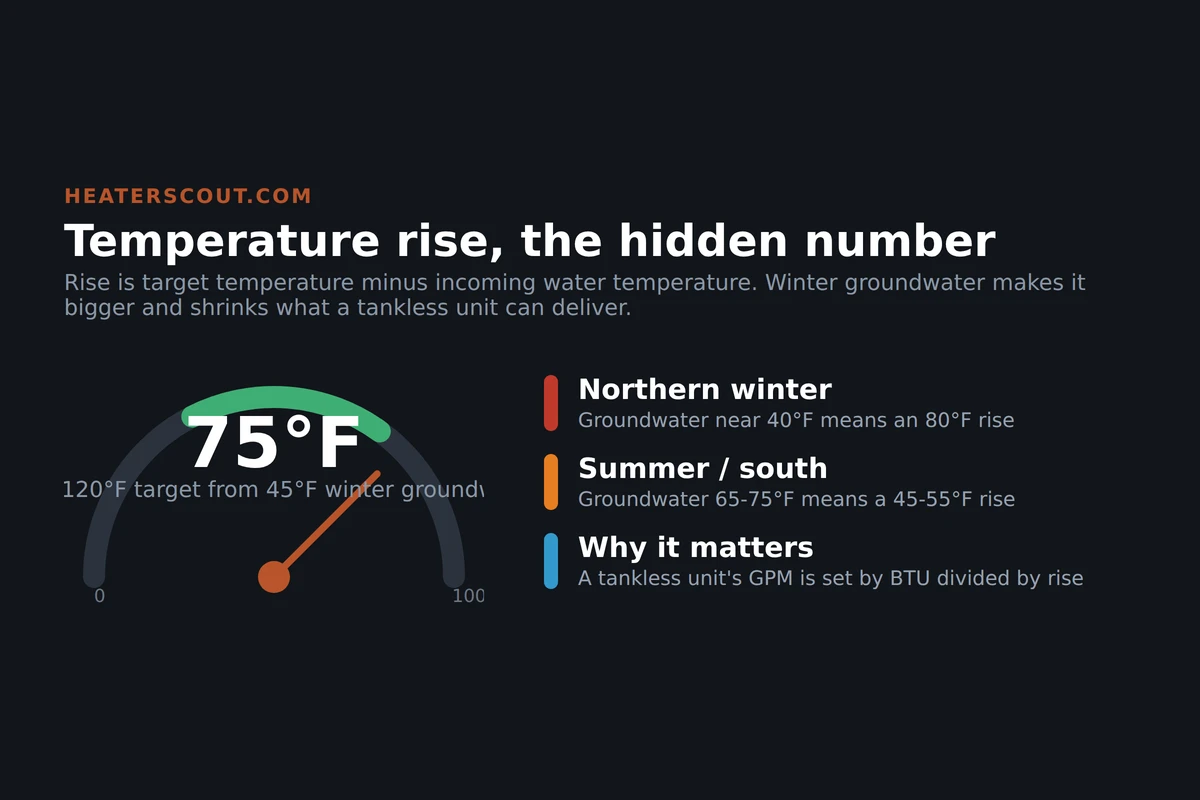
Rise is target minus incoming. A 120-degree setpoint from 50-degree water is a 70-degree rise. From 40-degree winter water it is 80. From 70-degree summer water it is only 50. Same target, very different job for the burner.
Turn BTU into flow
The deliverable flow is GPM equals BTU times efficiency, divided by 500 times the rise. The 500 is 8.33 pounds per gallon times 60 minutes. A 180,000 BTU unit at 82 percent efficiency and a 50-degree rise gives 180000 times 0.82 over 500 times 50, about 5.9 GPM.
Push the rise up and watch it fall
Hold that same 180,000 BTU unit and change only the rise. At 70 degrees it drops to about 4.2 GPM. At 80 degrees it is down near 3.7. The burner never changed. The colder inlet ate a third of the flow.
Size to winter, not to the box
The headline GPM on the carton is a summer number at a small rise. If you size to it, the house runs short every cold month. Find the unit's output at your coldest realistic rise and make sure it beats the flow you need running at once.
Run your own rise and flow
Set incoming to your groundwater and target to your setpoint. The tool shows the rise, then flips between two questions. In Tankless GPM mode you pick a unit's BTU rating and it tells you the gallons per minute that unit can actually keep hot at that rise. In BTU needed mode you pick the flow you want and it tells you the burner input required. The core formula sits behind both: GPM equals BTU times efficiency divided by 500 times rise, rearranged to solve for whichever one you left open. Efficiency is fixed at 82 percent, a fair number for a mid-grade non-condensing unit; a condensing unit near 95 percent does a little better.
Temperature rise and tankless flow calculator
Rise = target minus incoming. Then GPM = BTU × efficiency ÷ (500 × rise). Toggle whether you know the unit's BTU and want its flow, or know the flow you want and need the BTU. Efficiency fixed at 82%.
Temperature rise
70°F
Target minus incoming
Result
—
—
—
Who gets bitten by this
Rise punishes some houses and spares others. The pattern is climate first, then how much simultaneous hot water the household actually pulls.
Northern house, two showers at once
Winter inlet near 40 degrees means an 80-degree rise. A 199k BTU unit that reads 7-plus GPM in July delivers barely 4 in January, which is one shower, not two. This is the install that gets the angry call in the first cold snap. Size to the 80-degree rise or plan on two units.
Gulf Coast or Florida, single unit
Inlet water sits near 70 most of the year, so the rise stays around 50 even in winter. A single 150k to 180k BTU unit delivers 4 to 5 GPM year round with almost no seasonal swing. The same appliance that struggles up north is generous here.
Mid-latitude, one main shower
Inlet swings from the mid-50s in summer to the mid-40s in winter, a rise range of roughly 65 to 75 degrees. A well-chosen 180k to 199k BTU unit covers a single strong shower plus a sink all year. Add a second full shower in January and it will modulate the temperature down.
How much flow different rises leave you
Here is the same class of unit read across the rise range it will actually see. The bars are the deliverable flow, not the box rating.
A rough regional guide to incoming water
Groundwater temperature roughly tracks the annual average air temperature of a region, then swings a few degrees with the seasons. Use this to estimate your winter rise, which is the number that should drive sizing. Measure your own if you can; these are ballparks, not gospel.
| Region | Summer inlet | Winter inlet | Winter rise to 120°F |
|---|---|---|---|
| Upper Midwest, Northern Rockies | 58-63°F | 38-42°F | ~78-82°F |
| Northeast, Great Lakes | 60-66°F | 40-45°F | ~75-80°F |
| Mid-Atlantic, Ohio Valley | 64-70°F | 45-50°F | ~70-75°F |
| Pacific Northwest | 58-64°F | 45-50°F | ~70-75°F |
| Desert Southwest | 72-80°F | 55-62°F | ~58-65°F |
| Gulf Coast, Florida, Deep South | 74-80°F | 62-70°F | ~50-58°F |
Notice the two right columns. A Minnesota winter rise is close to 80, a Florida winter rise is closer to 52, and that 28-degree gap in rise is what turns a single tankless unit from generous into gasping depending on where the same box is installed. Sizing charts from Rinnai, Navien, Noritz, and Rheem all publish flow across a spread of rise values for exactly this reason. Read your unit at 77 or 80 degrees of rise if you live up north, not at the 35-degree rise that produces the headline GPM.
One more practical point. Everything above assumes the burner is actually reaching its rated BTU. A gas line that is undersized or shared with a furnace and range can starve a large tankless unit, which drops real output below the chart and makes the winter shortfall worse than the math predicts. If the flow feels short even after sizing for the correct rise, check gas supply and inlet filter screens before blaming the unit.
Frequently asked
What is temperature rise for a water heater?
Temperature rise is the target hot-water temperature minus the temperature of the water coming into the heater. If your incoming groundwater is 50 degrees and you want 120 at the tap, your rise is 70 degrees. For a storage tank it barely matters, because the tank reheats between draws. For a tankless unit it is everything, because the burner has to add that entire rise in the seconds the water spends passing through the heat exchanger. The bigger the rise, the fewer gallons per minute the same unit can serve.
How do I calculate temperature rise?
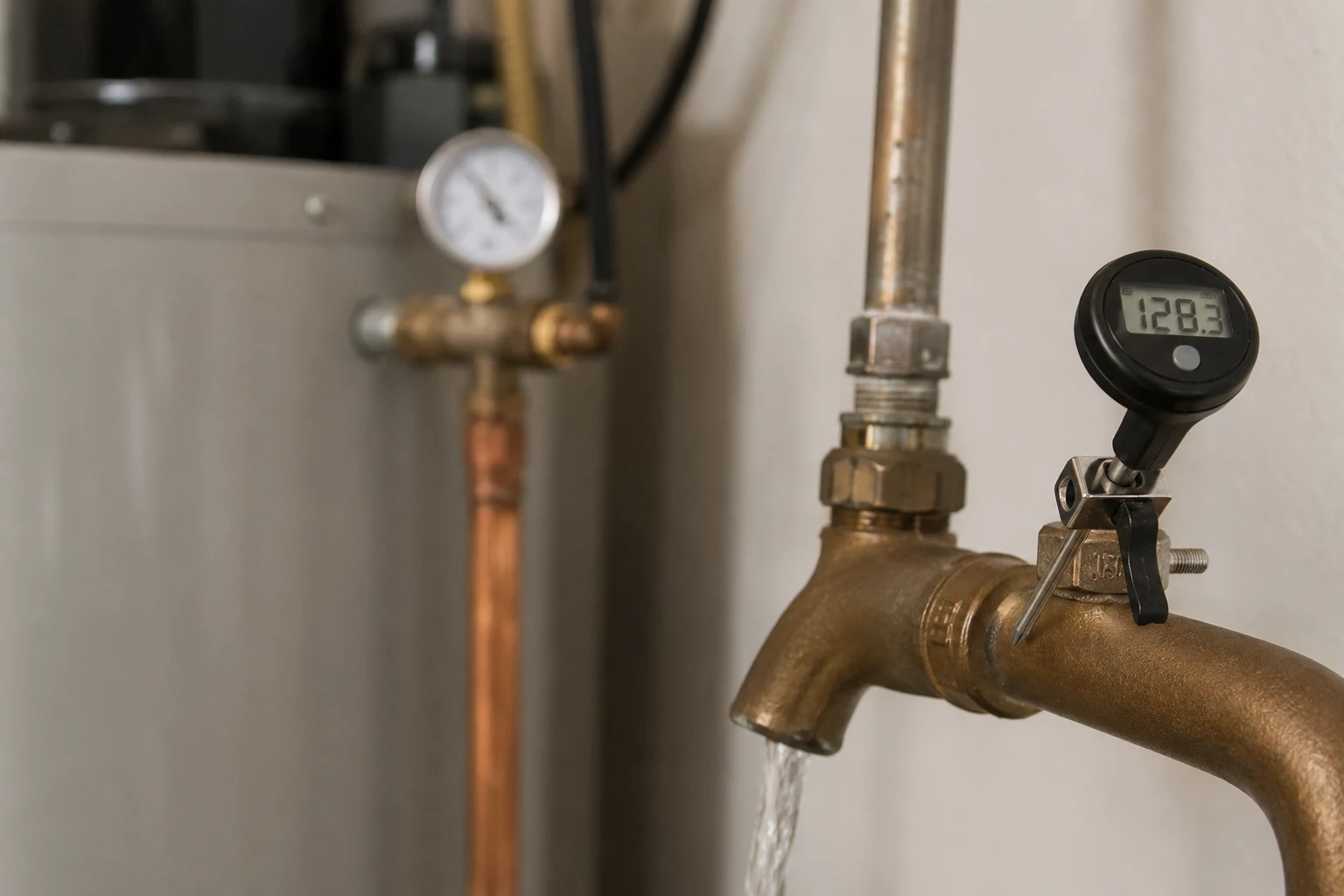
Subtract incoming water temperature from your target temperature. Rise equals target minus incoming. The only real work is knowing your incoming number, and that changes with the season. In summer or in the south it might be 65 to 75 degrees. In a northern winter it can drop to the low 40s. Measure it by running the cold tap for a minute and reading a thermometer, ideally in both January and July, because those two readings bracket the range your tankless unit has to cover.
Why does a tankless water heater give less hot water in winter?
Because the incoming water is colder in winter, so the temperature rise is larger, and a tankless unit's flow rate is set by its BTU output divided by that rise. The formula is GPM equals BTU times efficiency divided by 500 times rise. Hold the BTU steady and raise the rise from 50 degrees in summer to 80 in winter, and the deliverable flow drops by more than a third. A unit rated at 7 gallons per minute on the box was measured at a small rise. At an 80-degree winter rise the same unit might only give 4. Nothing failed. The rise changed.
What temperature rise should I size a tankless heater for?
Size for your worst case, which is the coldest incoming water you will ever see, not the average. For most of the northern United States that means a 70 to 80 degree rise: roughly 40-degree groundwater up to a 120-degree setpoint. In the deep south a 45 to 55 degree rise is realistic year round. Pick the rise, decide how many gallons per minute you actually need running at once, then find a unit whose output at that rise beats your flow. Sizing to the summer rise is the classic mistake that leaves a house cold in January.
How many GPM does a 199,000 BTU tankless unit deliver?
It depends entirely on the rise. At a 45-degree summer rise, 199,000 BTU at 82 percent efficiency delivers about 7.3 gallons per minute. At an 80-degree northern winter rise the same unit drops to about 4.1 gallons per minute. That is the full spread on the largest common residential unit. The math is BTU times 0.82 divided by 500 times the rise. This is why manufacturers publish a flow chart across several rise values instead of one headline number, and why you should read the chart, not the big number on the front.
Does incoming water temperature really vary that much by region?
Yes. Groundwater roughly tracks the annual average air temperature of a region, then swings a bit with the seasons on top of that. Along the Gulf Coast and Florida it can sit near 70 to 77 degrees most of the year. In the upper Midwest and the mountain states, winter incoming water can reach the upper 30s to low 40s. That is a 30-plus degree difference in incoming temperature, which flips straight into a 30-plus degree difference in rise, which cuts a tankless unit's usable flow nearly in half between a warm climate and a cold one for the exact same appliance.
Can I lower the temperature rise instead of buying a bigger unit?
Sometimes. Anything that raises the incoming temperature shrinks the rise and buys back flow. A drain-water heat recovery pipe preheats incoming water off the warm water going down the shower drain and can lift the inlet 10 to 20 degrees during a shower. Running the tankless unit in series with a small buffer tank or a solar preheat does the same. Lowering the target setpoint helps too, though 120 is already about as low as you want for comfort and legionella safety. Each degree you cut off the rise is a degree the burner does not have to add.