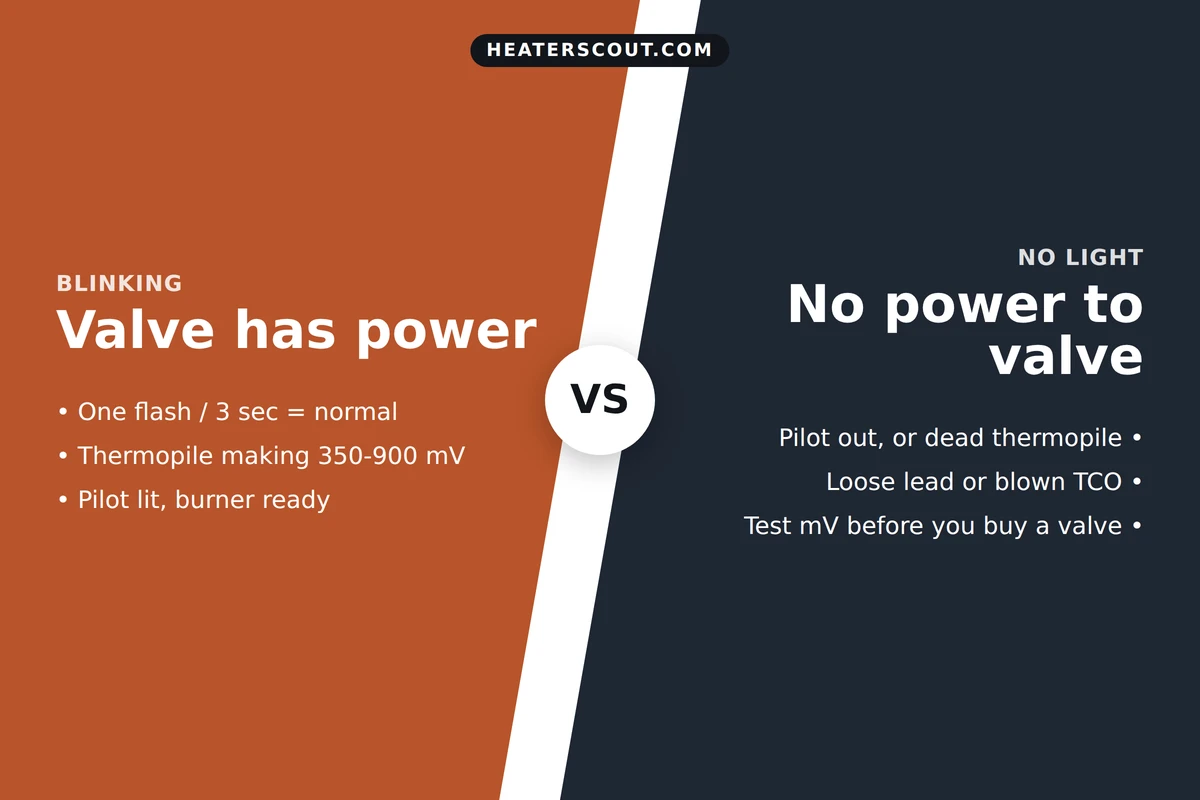
A gas water heater status light that blinks, even a fault burst, is actually good news: it proves the gas control valve has power. A light that sits completely dark is a different animal. No light at all means no voltage is reaching the valve, and on a standing-pilot heater that voltage comes from one small part heated by the pilot flame. So a dark light is not a flash code to look up. It is a no-power problem, and it walks a specific order: is the pilot even lit, is the thermopile making its millivolts, is the lead connected, did a one-time cutoff blow, and only at the very end, is the valve itself dead. This applies across A.O. Smith, State, Rheem, and Bradford White gas tanks, because they all run the same thermopile-powered valve logic.
First: blinking versus dark are not the same problem
People mix these up constantly, and it sends them down the wrong path. A blinking light, whether it is the calm one-flash-every-three-seconds heartbeat or a rapid fault burst, tells you the thermopile is generating voltage and the control board is alive. That is a flash-code situation: you count the flashes and match the number to a chart. A dark light tells you the opposite. Nothing is powering the valve. There is no code to count because the board has no juice to blink with. If your light does nothing at all, close the flash-code charts and work the checklist below instead.
- Confirm the pilot is actually out, not just hard to see through the sight glass
- Relight the pilot per the burner-door instructions and hold the knob 60 seconds
- Watch whether the pilot holds when you release the knob, or drops right back out
- Check the thermopile lead is fully seated and clean where it plugs into the valve
- Test thermopile output in millivolts DC with the pilot burning several minutes
- Suspect a blown one-time TCO if the pilot will not stay lit and mV is dead
- Only after the thermopile tests good and the light stays dark, suspect the valve
A blinking light means the valve has power. A dark light means it has none. That one distinction decides whether you count flashes or chase the thermopile.A.O. Smith Status Light Does Not Blink service flow
Why the pilot and thermopile come first
The thermopile is a bundle of thermocouples the pilot flame heats to make a small DC voltage, somewhere in the range of 350 to 900 millivolts. That tiny voltage does two jobs: it holds the pilot gas valve open once you release the knob, and it powers the control and its status light. If the pilot is out, the thermopile makes nothing and the light is dark. If the pilot is lit but weak, or the thermopile is carboned and tired, the voltage sags too low to hold the valve or light the LED. That is why the very first move on a dark light is always to relight the pilot and watch what it does, before you assume a single expensive part has failed.
Step 1: relight the pilot and watch it
Turn the gas control knob to OFF and wait five minutes for any gas to clear. Then turn the knob to PILOT, press and hold it, and press the piezo igniter button repeatedly until you see the pilot flame through the sight glass. Keep holding the knob down for a full 30 to 60 seconds after the flame lights, then release it slowly. This is essentially the same sequence on A.O. Smith, State, Rheem, and Bradford White ICON valves. If you just flushed the tank or the gas was recently off, air in the line is common, so hold the knob 60 to 90 seconds to purge it and expect a few tries.
Now watch. If the pilot holds a strong blue cone and the status light starts blinking normally, you had a pilot outage and you are done. If the pilot lights while you hold the knob but drops out the instant you release it, that is the signature of a weak thermopile or a dirty pilot, and you move to the millivolt test. If the pilot will not catch or stay lit at all no matter how long you hold, suspect either no gas, a clogged pilot orifice, or a blown one-time cutoff opening the circuit. It is also worth a quick vent and combustion-air check here: a blocked flue or a clogged air-inlet screen starves combustion, keeps the pilot from burning cleanly, and on flammable-vapor models is exactly what trips the one-time TCO.
Step 2: test the thermopile in millivolts
This is the test that saves you from buying a gas valve you do not need. With the pilot lit and burning for at least a few minutes so it is fully heated, set a multimeter to millivolts DC on the 750 or 2000 mV scale. Pull the two black thermopile wires off the gas control valve, usually a single two-conductor plug, and touch your meter leads to the two terminals. Read the voltage with no load on the circuit.
A healthy thermopile reads roughly 350 to 900 millivolts, and most good ones land between 500 and 750. If you read below about 350 mV, the thermopile can no longer hold the valve open or light the LED, and the fix is to replace the pilot and thermopile assembly. A dead-flat reading near zero with a lit pilot points at a completely failed thermopile or, importantly, a blown one-time TCO in series with it, since the cutoff opening the loop reads the same as a dead thermopile at the plug. If the millivolts are healthy and the light still refuses to come on once you reconnect, the thermopile is fine and the gas control valve is the failed part.
Quick answer
A water heater status light that is completely dark, not blinking, means the gas control valve is getting no power. On a standing-pilot gas heater that power comes from the thermopile heated by the pilot flame. Work it in order: relight the pilot, confirm it holds when you release the knob, then test the thermopile in millivolts DC. Healthy is 350 to 900 mV; below 350 you replace the pilot and thermopile assembly. A dead-flat reading can also mean a blown one-time thermal cutoff (TCO) in that assembly. Only if the thermopile tests good and the light is still dark is the gas control valve itself the culprit.
My pilot lights but the light still will not blink. Now what?
If the pilot burns a strong blue flame and holds when you release the knob but the status light stays dark, the valve is either seeing no power through the plug or seeing power it can no longer act on. Test the thermopile in millivolts at the valve terminals to settle it. Healthy voltage with a dark light means the gas control valve has failed internally and needs replacing. Low or dead voltage with a lit pilot means the thermopile itself, or a blown one-time TCO in series with it, is the problem, so you replace the pilot and thermopile assembly. The millivolt reading is what tells those two apart, so do not skip it and guess your way to an expensive valve.
Step 3: the loose or corroded lead, the cheapest miss
Before you condemn the thermopile on a low or zero reading, look at the connection. The thermopile plug at the gas valve loosens with heat cycling and vibration, and the terminals corrode in humid basements and garages. A plug that is backed out a couple of millimeters, or green with corrosion, drops the voltage the valve sees even when the thermopile itself is fine. Unplug it, look for corrosion, clean the terminals gently, and reseat it firmly until it clicks or bottoms out. This is a free fix that gets skipped because it looks too simple to be the answer, and sometimes it is the answer.
Four of the five causes of a dark light live on the thermopile side and cost nothing or under fifty dollars. The gas valve is the last stop, not the first.
Step 4: the one-time thermal cutoff (TCO)
Flammable-vapor-resistant gas heaters carry a one-time thermal cutoff wired into the pilot and thermopile circuit. It is not the same as the ECO high-limit that trips on hot water and has a reset button. The TCO is a one-shot fuse for combustion: if the heater ever ignites flammable vapors it pulled in, or if combustion goes bad from a starved air inlet, the TCO blows open permanently to lock the heater out. When it opens, it breaks the thermopile loop, so the pilot will not stay lit and the status light stays dark. There is no reset. On most A.O. Smith, State, and Rheem tanks the TCO is built into the pilot/thermopile assembly, so you clear it by replacing that assembly.
The part that matters is why it tripped. A TCO does not blow for no reason. Before you replace the assembly, vacuum the air inlet screen at the base of the heater, remove any gasoline, paint thinner, or solvents stored anywhere near it, and confirm the flue and draft hood are clear. If you swap the assembly and ignore the cause, the new TCO will trip again. If it keeps tripping with no stored fuels and a clean air path, the flammable-vapor sensor or the combustion setup needs a licensed tech, not another part.
Step 5: when it really is the gas control valve
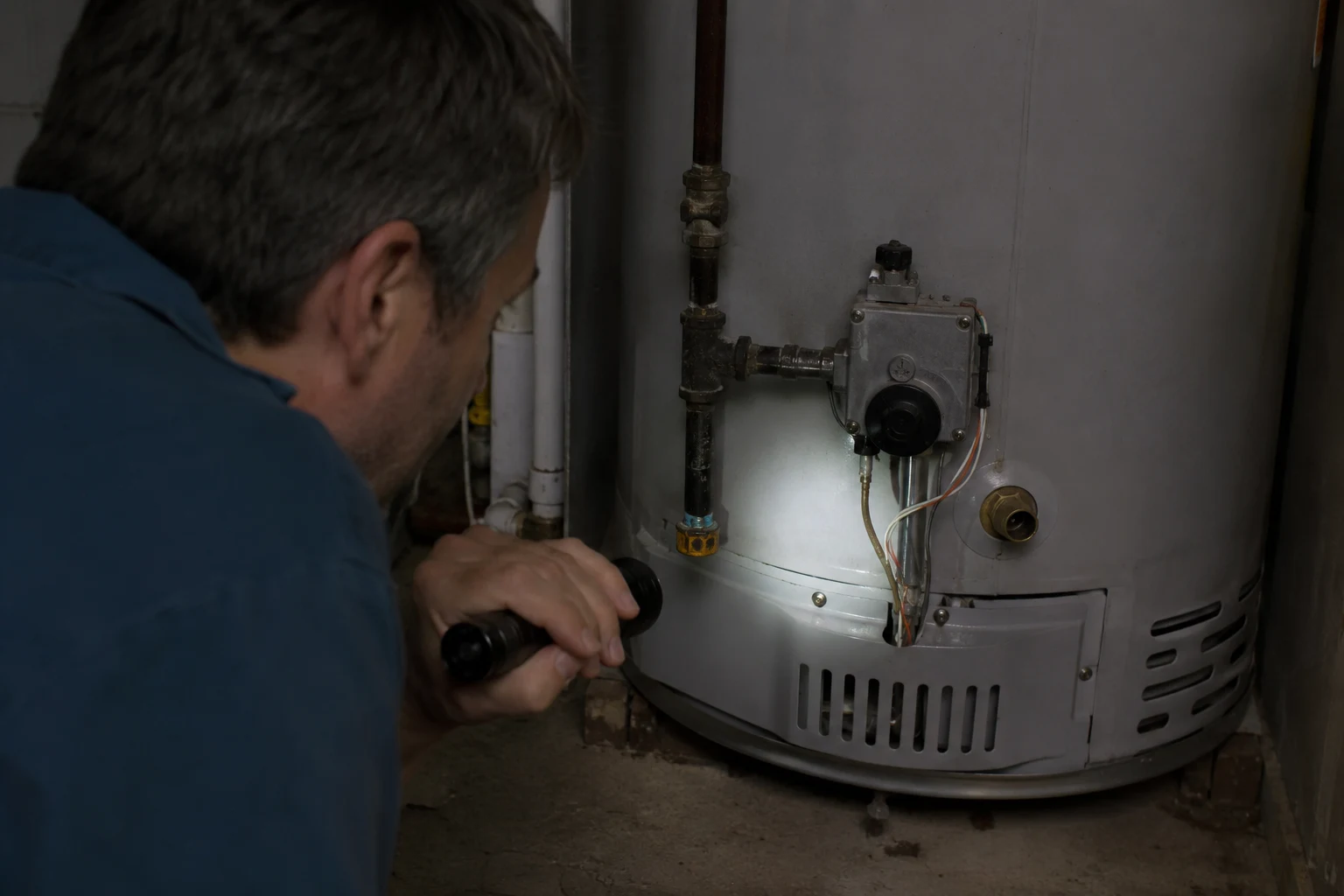
You reach the valve only by elimination. The pilot lights and holds a strong blue flame, the thermopile tests healthy at 350 mV or more under load, the lead is clean and seated, no TCO is blown, and the status light still will not come on. At that point the valve is not accepting the voltage it is being handed, and the gas control valve assembly gets replaced. This is the expensive path: the part alone runs roughly $150 to $300, and because replacing it means draining the tank and disconnecting the gas line, most homeowners hand this one to a licensed plumber. Total installed is commonly $300 to $500.
Check the warranty first, every time. Pull the model and serial number off the rating label and look up coverage, because the gas control valve and pilot assembly are covered parts on most gas water heaters for the first several years. A covered valve turns a part-plus-labor bill into labor only, and sometimes the manufacturer ships the part free to your door.
Where the DIY line sits
Relighting a pilot is homeowner work, full stop. Testing the thermopile with a meter and swapping the pilot/thermopile assembly is squarely DIY for anyone comfortable shutting off gas at the knob and turning a wrench, and it is the fix for the majority of dark-light cases. Diagnosing and clearing a blown TCO is borderline: replacing the assembly is the same job, but you must correctly identify and remove the vapor or combustion cause, and repeated trips mean a pro. Replacing the gas control valve is where most people stop and call a plumber, because it involves draining the tank and breaking the gas union. And any time you smell gas, cannot get the pilot to hold after a clean relight and a good millivolt reading, or the TCO keeps blowing, that is the moment to stop testing and get a licensed tech on it.
Frequently asked
Why is my water heater status light not blinking at all?
A completely dark status light means the gas control valve is getting no power, and on a standing-pilot gas heater that power comes from the thermopile. So a dark light points at the thermopile circuit, not the valve's brain. The usual order, most common first, is: the pilot is actually out, the thermopile is worn or carboned up and no longer makes enough millivolts, the thermopile lead is loose or corroded at the valve, a one-time thermal cutoff in the pilot assembly has blown, or the gas control valve itself has failed. Notice that four of those five are on the thermopile side and cost either nothing or under fifty dollars. The expensive gas-valve replacement is the last thing you check, not the first, because you only reach it after the thermopile tests good and the light is still dark.
How do I test the thermopile on my water heater?
Relight the pilot and let it burn for at least a few minutes so the thermopile heats fully. Set a multimeter to read millivolts DC on the 750 or 2000 mV scale. Pull the two black thermopile connectors off the gas control valve, usually a single two-wire plug, and touch the meter leads to the two terminals. With the pilot burning and no load, a healthy thermopile reads somewhere between 350 and 900 millivolts, and most read 500 to 750. Below about 350 mV the valve cannot hold open and the light stays dark, so you replace the pilot and thermopile assembly. If the reading is good but the light still will not come on once you plug it back in, the fault is downstream in the gas control valve.
What is a TCO on a water heater and can I reset it?
TCO stands for thermal cutoff, a one-time safety switch wired into the pilot and thermopile circuit on flammable-vapor-resistant gas heaters. If the heater ever pulls in gasoline or solvent fumes and flashes them off, or if combustion goes bad because the air inlet screen is clogged, the TCO blows open to shut the pilot and burner down for good. It is a one-shot device, so unlike the resettable ECO high-limit there is no button to press. A blown TCO opens the circuit, which is why the pilot will not stay lit and the status light stays dark. On most A.O. Smith, State, and Rheem gas heaters the TCO is built into the pilot/thermopile assembly, so you clear it by replacing that assembly, not by resetting anything. Find and fix why it tripped first: vacuum the air inlet screen and remove any stored fuels near the heater.
The pilot lights but goes out when I let go of the knob. What is wrong?
That is the classic signature of a weak or dead thermopile, or a dirty pilot. When you hold the knob in, you are manually forcing gas to the pilot. When you release it, the valve only keeps the pilot fed if the thermopile is generating enough voltage to hold the magnet open. If the flame drops the instant you let go, the thermopile is not making its millivolts. First make sure the pilot flame is a strong blue cone that fully wraps the thermopile tip, because a small, lazy, or yellow flame from a partly clogged pilot orifice will not heat it. Clean or clear the pilot, hold the knob longer on relight to purge air, and if the flame still drops and the meter confirms low millivolts, replace the thermopile assembly.
How much does it cost to fix a water heater with no status light?
It splits sharply by cause. Relighting a pilot that simply blew out is free. A pilot and thermopile assembly, which is what you replace for a dead thermopile or a blown TCO on most tanks, runs roughly $20 to $60 for the part and is a common homeowner job, so DIY it is just the part. A gas control valve is the expensive end, around $150 to $300 for the part alone and often $300 to $500 installed once you add a plumber draining the tank and disconnecting gas. Before you buy a valve, read the model and serial off the rating label and check the warranty, because the gas control valve and pilot assembly are covered parts on most gas heaters for several years, which can drop the bill to labor only.
Is a dark status light dangerous?
The dark light by itself is not dangerous, it just means the heater is off and making no hot water. The reason behind it can matter. If a one-time TCO blew, that is a safety device telling you it detected bad combustion or flammable vapor, and the right response is to find the source, not to bypass the switch. Never jumper across a TCO or thermopile to force the burner to run, and never store gasoline, paint thinner, or solvents near a gas water heater. If you relight the pilot and it holds but keeps going out days later, or you smell gas at any point, shut the gas off at the knob and call a licensed plumber rather than chasing more relights.
Does a blinking light and a dark light mean different things?
Yes, and it is the single most useful distinction on this heater. A light that blinks, even a fault burst, proves the valve has power: the thermopile is making millivolts and the control is alive and reporting a code. A light that is completely dark means no power is reaching the valve at all, which is a thermopile-circuit problem, not a code. So if your light flashes two or four or seven times, you have a flash-code problem and you count the flashes. If it does nothing, you have a no-power problem and you walk the pilot, then the thermopile, then the lead, then the TCO, then the valve. Do not go hunting flash-code charts for a light that never lights.
Why did my status light go dark right after I flushed the tank?
Almost always trapped air in the gas line, not a broken part. When you shut the gas off to flush, air works into the pilot supply, and on relight that air keeps the pilot from catching or holds it too small to heat the thermopile. Hold the knob in on PILOT for a full 60 to 90 seconds while you press the igniter, which purges the air and lets a real flame build. It can take several tries. If the pilot finally holds a strong blue flame and the light comes back, you are done. If it still will not stay lit after purging, then test the thermopile, because flushing occasionally coincides with a thermopile that was already on its way out.