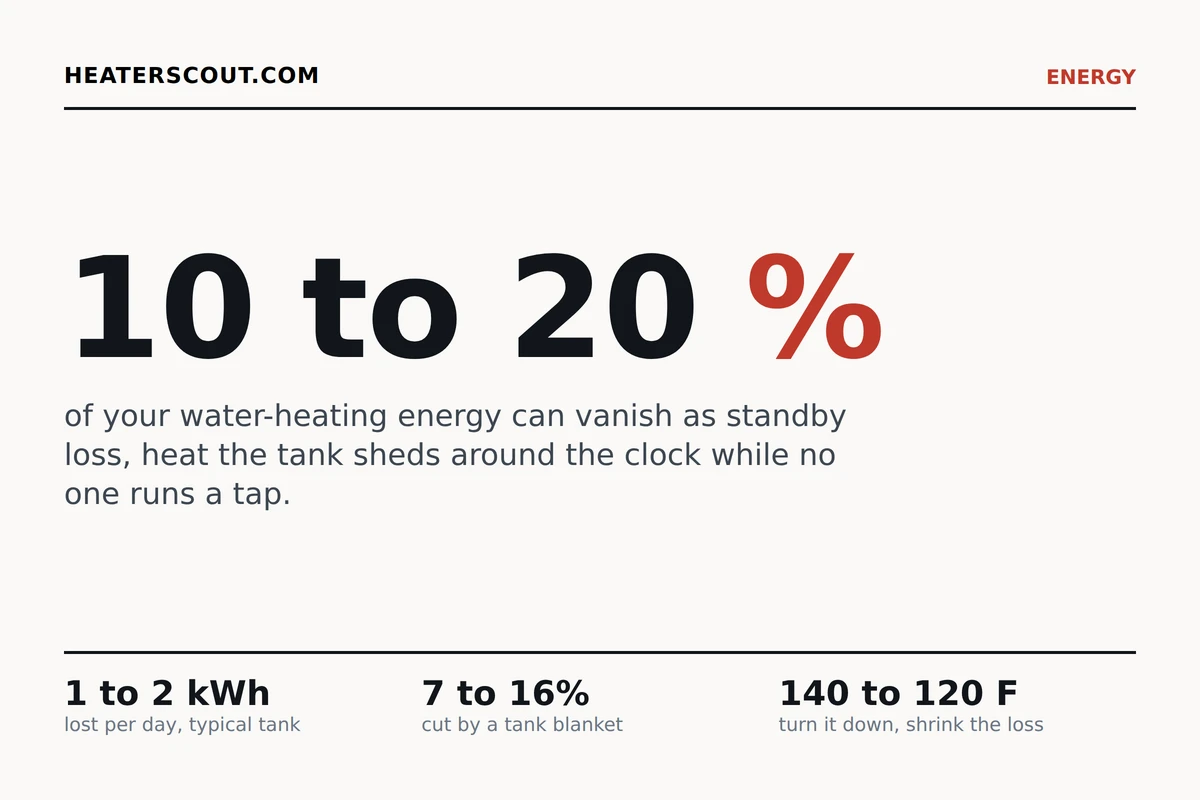
A storage water heater spends most of its life doing nothing useful. Between the shower in the morning and the dishes at night, it just sits there and stays hot, and staying hot costs money. That quiet, around-the-clock cost is standby heat loss, and on a typical tank it eats 10 to 20 percent of everything you spend heating water. The label on the side never mentions it.
Find your own standby loss with the overnight meter test
You do not have to trust an average. You can measure the loss on your own tank in one night with nothing but the meter you already have. The idea is to make the tank reheat itself while no water leaves it, then read how much energy that took. Everything the heater burns with zero draws is standby loss, plain and simple.
Most people who run this test are surprised twice. First by how much the tank cycles with no water used at all, and second by how much colder the surrounding air makes it. A tank in a 55-degree basement works harder than the same tank in a 70-degree utility closet, because the loss tracks the gap between the water and the air around it. Note the temperature of the room while you are at it; it matters as much as the setpoint.
The numbers that make standby loss real
Averages from field studies and energy agencies converge on a tight range. These are the figures worth carrying in your head before you decide whether to wrap the tank, turn it down, or leave it alone.
Those numbers move with four things, and only four: how hot you keep the tank, how good its insulation is, how cold the room is, and what you pay per unit of energy. Push the setpoint up, thin the insulation, chill the room, or raise the rate, and the annual cost climbs. Every fix for standby loss works by pulling one of those four levers. Nothing else is in the equation.
How the setpoint drives the loss
Standby loss is proportional to the temperature gap between the tank and the room. Physicists write it as loss equal to UA times the difference between the tank temperature and the room temperature, where UA is a fixed property of the tank's shell and size. The room usually sits near 70, so raising the tank from 120 to 140 widens that gap from 50 degrees to 70, a 40 percent jump in the driving force behind the loss. That is why a hotter setpoint is not a small penalty. The bars below show how the daily standby loss climbs with the temperature you keep on the dial.
Insulation age tells the same story from the other side. A tank built in the early 2000s often carried an R-6 foam shell, while a current high-efficiency model wraps the tank in R-16 or better. Double the insulation value and you roughly halve the heat that escapes through the walls for the same temperature gap. That single change is why a new tank at 120 degrees can lose less than a third of what an old tank at 140 degrees leaks, before you add a blanket to either one.
Estimate your standby cost
Set the dial to how hot you keep the tank, flip the blanket on or off, pick your fuel, and slide the rate to what you actually pay. The tool returns an estimated annual standby cost and shows what you would save by adding a blanket or dropping the setpoint. The model is deliberately simple and transparent, so you can see the levers move.
Standby cost estimator
A transparent estimate, not a meter reading. It scales a typical 1.5 kWh-per-day loss by your setpoint, blanket, fuel, and rate.
Annual standby cost
$0
You could save
$0
Model: base 1.5 kWh/day of standby at 140 F over a 70 F room, scaled by the tank-to-room temperature gap, blanket multiplies by 0.88, gas converted at 1 therm = 29.3 kWh. Real tanks vary with insulation and room temperature, so treat the number as a ballpark.
Standby heat loss
The energy a storage water heater spends holding its water at temperature while no one draws any. It is driven by the gap between the tank and the room and it runs continuously, which makes it the hidden operating cost of a tank heater. Tankless units have almost none of it because they heat water only on demand and store nothing.
UEF and the standby test
UEF, the Uniform Energy Factor, is the federal efficiency rating printed on every new water heater, and standby loss is baked into it. The 24-hour simulated-use test that produces the UEF includes long idle periods where the tank just sits and reheats, so a tank with heavy standby loss scores a lower UEF. When you compare two tanks by UEF, part of what you are really comparing is how little each one wastes standing still.
Start with the free fix
The cheapest standby fix is free: turn the dial from 140 to 120. It cuts the tank-to-room gap from 70 degrees to 50, trims the daily loss by roughly a third, and 120 is the safer setting against scalding besides. Do it first, then decide whether a blanket is worth adding. Put your hand on the tank's side afterward; if it still feels warm, a blanket will pay off, and if it feels close to room temperature the factory foam is already doing the job.
Frequently asked
What is standby heat loss on a water heater?
It is the heat a storage tank sheds into the room while nobody is drawing water. The tank holds 40 or 50 gallons at 120 to 140 degrees, the room around it sits near 70, and heat always flows from hot to cold. So the tank leaks warmth through its shell every hour of every day, and the burner or the elements fire now and then just to top it back up. That reheating with no water used is standby loss. It runs around the clock, which is why a tank costs more to own than the sticker on the side suggests.
How much energy does standby loss actually waste?
For a typical storage tank it runs roughly 1 to 2 kilowatt-hours a day of energy, or a matching slice of the gas bill. Over a year that is 400 to 700 kWh, and studies put standby at 10 to 20 percent of a home's total water-heating energy. The exact number depends on how hot you keep the tank, how well it is insulated, and how cold the space around it is. A brand new tank with thick foam insulation loses far less than a twenty-year-old unit with a thin R-6 shell sitting in an unheated garage.
How do I measure my own standby loss?
Read the meter overnight while no one uses hot water. On an electric tank, note the kWh reading at bedtime, run no hot water for eight hours, and read it again at dawn; subtract any other overnight loads and what is left keeping the tank hot is your standby draw. On gas it is harder because the pilot and the burner both count, but you can watch the gas meter's smallest dial cycle with every hour and no draws. Whatever the tank burns with zero water leaving it is pure standby loss.
Does a water heater blanket really save money?
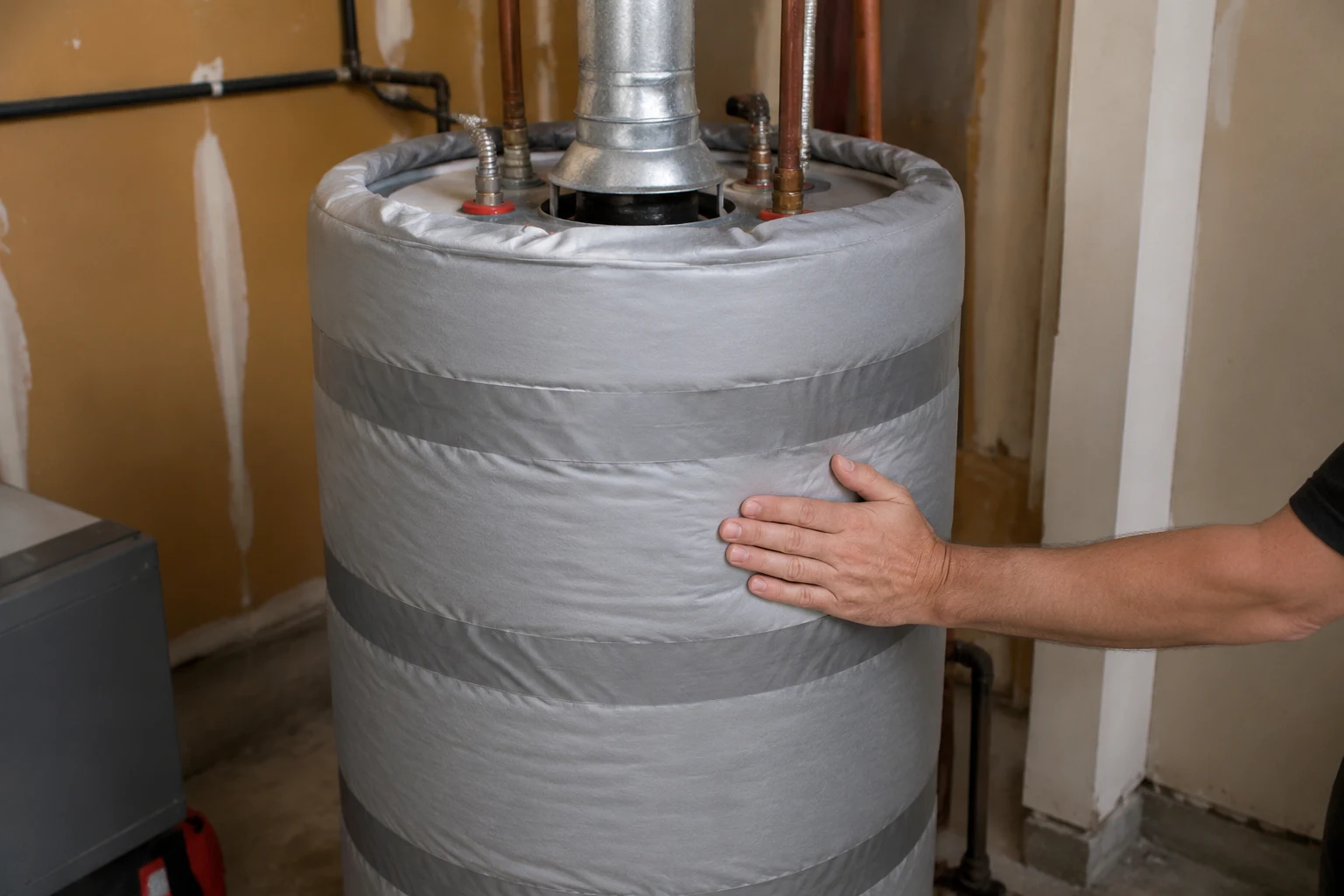
On an older or uninsulated tank, yes. A fitted insulation blanket cuts standby loss by about 7 to 16 percent, which pays for itself in a year or two on a tank with a thin factory shell. On a modern tank already wrapped in thick foam, the shell is doing most of that work and a blanket adds little, sometimes only a percent or two. The test is simple: put your hand on the side of the tank. If it feels warm, a blanket will help. If it feels room temperature, the insulation is already good and a blanket is not worth it.
Should I lower my water heater temperature to cut standby loss?
Turning a tank from 140 down to 120 degrees is one of the easiest cuts you can make. Standby loss scales with the gap between the tank temperature and the room, so shaving 20 degrees off that gap trims the loss by a real chunk and saves a few percent on the whole water-heating bill. 120 degrees is the setting most agencies recommend for safety against scalding anyway. The one caution is Legionella: if anyone in the house has a weak immune system, some plumbers keep the tank at 140 and add a mixing valve to deliver 120 at the tap.
Where does a tank lose the most heat?
Through the shell, through the top where the hot and cold connections sit, and out the flue on a gas unit. The connections on top are a quiet path because hot water rises into those fittings and the metal carries heat straight out; heat-trap nipples and a few feet of pipe insulation shut that path down. On a gas tank, warm air also drifts up the flue between burns and carries tank heat with it. The tank walls are the biggest single surface, which is why insulation quality and a blanket matter most there.