A full 50-gallon water heater weighs close to 500 pounds once it is filled, and in a lot of garages that half-ton of steel and water has to sit on a platform you built yourself. The platform is not decoration. It exists to lift the burner up out of the pool of gasoline vapor that collects along a garage floor, and it has to carry that load without flexing or racking for the twenty-year life of the tank. Get the height right, get the framing right, and an inspector passes it in thirty seconds. Get either wrong and you are rebuilding it, or worse.
The 18-inch rule and what an ignition source actually is
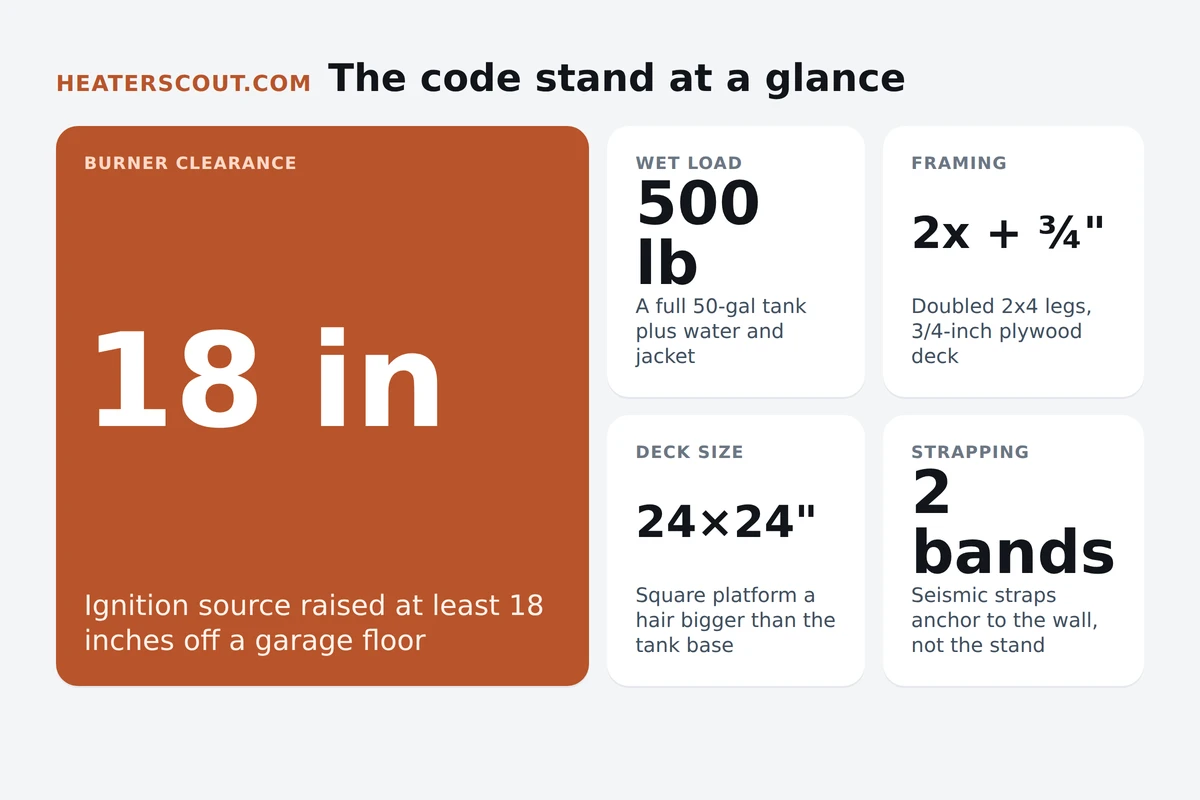
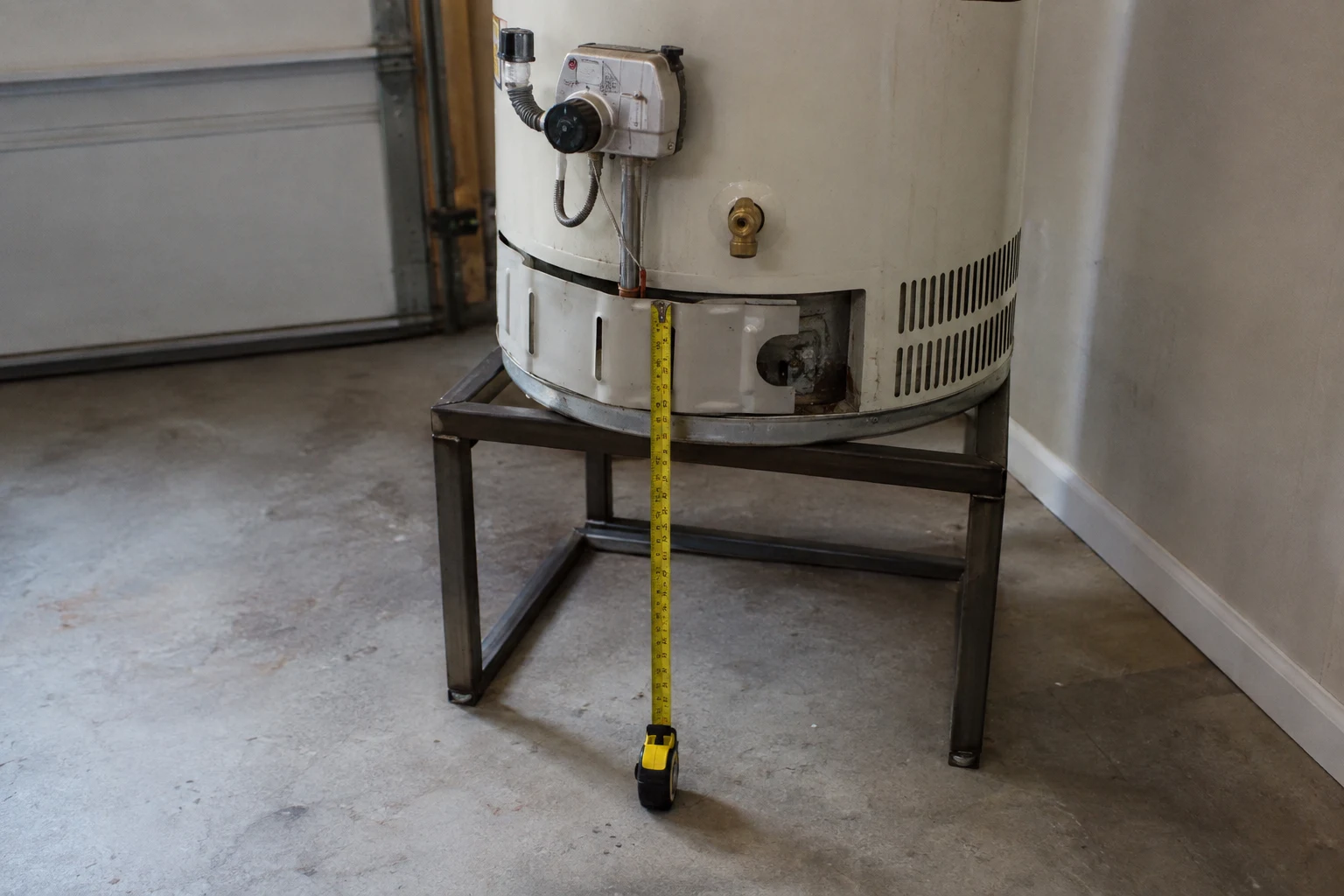
The residential code, both the IRC and the Uniform Plumbing Code, requires that the ignition source of a fuel-burning appliance in a garage sit at least 18 inches above the floor. The ignition source is the part that makes fire: the burner flame or the electronic igniter on a gas water heater. It is not the bottom of the tank and it is not the top of your stand. That distinction matters when you size the platform, because the burner on an atmospheric gas heater sits a few inches up inside the combustion chamber, so the platform itself can be a little under 18 inches and still put the burner where it belongs. The rule is aimed at gasoline vapor, which is heavier than air and settles in a shallow layer right at floor level. Raise the flame above that layer and a spilled tank of gas in the garage is far less likely to find a light.
The stand spec at a glance
Before the build, know the targets. A residential garage platform for a 40 or 50 gallon tank comes down to four numbers: how high, how big, how much it holds, and what it is made of. These are the values an inspector checks and the ones your framing has to hit. The height is set by your specific burner, so treat 18 inches as the floor, not a suggestion.
| Height to burner | 18 in minimum from the garage floor to the burner or igniter, not to the deck. A platform 15 to 18 in tall usually gets an atmospheric burner there. |
| Deck footprint | About 24 by 24 in for a standard 50-gal tank, sized a little larger than the tank base so the full footprint of the tank is supported. |
| Wet load | Roughly 500 lb for a full 50-gal tank, near 400 lb for a 40-gal. Concentrated on a small footprint, so no deck flex allowed. |
| Framing | Doubled 2x4 or 2x6 legs, 3/4-in exterior plywood deck, every joint glued and screwed. No particleboard, no single thin ply. |
| Drip pan | Pan sits on top of the deck with the tank inside it, drained to a floor drain or the exterior. Height does not replace the pan. |
| Seismic straps | Two straps around the tank in seismic zones, upper third and lower third, anchored to wall framing or masonry, not to the stand. |
Wood stand, steel stand, or no stand at all
There are three honest answers to how you get a heater to code height, and the right one depends on your heater, your local rules, and whether you would rather cut lumber or buy a bracket. A DIY wood platform is cheap and passes everywhere. A steel stand is a fast bolt-together. And in a surprising number of cases you need no stand at all, either because the heater is electric or because it is a modern FVIR gas unit rated for the floor. Match your situation to the row below before you spend a dollar.
| Option | Cost and effort | Load and durability | Best when |
|---|---|---|---|
| DIY 2x lumber platform | $25 to $50 in lumber, an hour of cutting and screwing. Needs a saw, a drill, and squared cuts. | Doubled 2x legs and 3/4-in plywood carry ~500 lb with margin. Add a moisture barrier so the base does not rot on a wet slab. | You want the cheapest code-legal fix and do not mind building it. Passes inspection everywhere. |
| Prefab steel stand | $40 to $90, bolts together in minutes. No cutting, no saw. | Welded or bolted steel rated for tank weight, will not rot or warp. Confirm the model's height and load rating fit your tank. | You would rather buy than build, or the garage floor stays damp and you want steel instead of wood. |
| No stand required | $0. Set the tank on the slab, or on a low pan. | The slab carries everything. Add a drip pan piped to a drain regardless. | The heater is electric, or a gas FVIR unit whose label approves floor installation, or the tank is not in a garage. |
When you actually need a stand, and when you are wasting lumber
The single most common mistake is building a platform that the code never asked for. The 18-inch rule is narrow. It applies to a fuel-burning appliance whose ignition source could light garage floor vapors, and nothing else. Walk through the two columns below before you frame anything. If everything on your install lands in the right-hand column, put the saw away and set the tank down.
You need the stand
- The heater burns gas or propane and sits in a garage or a room where fuel vapor can reach the floor.
- It is a pre-2003 atmospheric gas heater with no FVIR flame arrestor and no floor-approval on the label.
- The model plate does not clearly state that floor installation is approved, and your inspector enforces the 18-inch rule.
- Local amendments still require 18 inches even for FVIR units. Some jurisdictions do, so check.
- You want the tank up off a floor that floods or stays damp, and you would build a platform anyway.
You can skip it
- The heater is electric. No burner, no igniter, no rule. Set it on the slab with a drip pan.
- It is a modern FVIR gas heater whose label approves installation directly on a garage floor.
- The tank is in a basement, a utility closet, an attic, or an interior room, not a garage. The vapor rule is a garage rule.
- You are on a tankless gas unit hung on the wall. There is no floor-level burner to raise.
- You still add a drip pan wherever a leak would cause damage. The pan is a separate requirement from the stand.
Building the wood platform
The build is simple carpentry. Cut a top and a matching bottom frame from 2x4 or 2x6 on edge, join them into rectangles with glue and 3-inch screws, and skin the top frame with 3/4-inch exterior plywood glued and screwed on a tight fastener pattern. Cut four legs from doubled 2x4 so the finished height puts your specific burner at or above 18 inches, and screw a leg into each corner where it bears straight down into the frame, not just into the plywood. Keep every leg plumb. The load path you want is tank, deck, leg, slab, in a straight vertical line, so the legs land on the concrete and the screws only hold things in position, not carry the weight in shear.
Size the deck a little larger than the tank base, around 24 inches square for a standard 50-gallon cylinder, so nothing hangs past an edge. If the garage floor ever sees water, and most do, set the frame on pressure-treated sleepers or a moisture barrier so the raw lumber does not wick off the slab and rot from the bottom up. Do not use particleboard, OSB shelving, or a single sheet of quarter-inch ply for the deck. Those flex under a 500-pound point load and will eventually let the tank tilt.
The drip pan and the seismic straps
Two things get added on top of the platform, and neither one is optional where it applies. The drip pan sits on the deck with the tank inside it, and its drain line runs off to a floor drain or out through the wall. The pan catches a slow tank leak before it floods the garage or the finished room below, and raising the tank on a stand does nothing to catch water once a tank splits. Build the platform first, then set the pan on it, then set the tank in the pan, so the pan stays flat and fully supported.
In earthquake country the tank also gets two seismic straps, one around the upper third and one around the lower third, spaced at least the tank width apart. Here is the part people get wrong: the straps anchor to the wall, into solid studs or masonry behind the heater, not to the platform. In a shake the platform and the tank move as one unit, so a strap bolted to the stand restrains nothing. The stand handles the vertical weight and the wall straps handle the sideways load. Use lag screws or masonry anchors rated for the pull, not drywall screws into sheetrock.
Check the height before you fill it
The last step before water goes in is the measurement that decides whether this passes. Dry-fit the tank on the finished platform, find where the burner or igniter sits on your heater, and measure from the garage floor to that point. If it clears 18 inches, you are done. If it comes up short by an inch, adding a shim course or taller legs now, with the tank empty, beats doing it after you have filled 500 pounds of water. Once the height checks out, connect the pan drain, strap it to the wall if you are in a seismic zone, and only then bring water and fuel to it.
Frequently asked
How tall does a water heater stand have to be by code?
The number people quote is 18 inches, and it is close but not quite what the code says. The IRC and the Uniform Plumbing Code require that in a residential garage the ignition source of a fuel-burning appliance sit at least 18 inches above the floor. Ignition source means the burner flame or the electronic igniter, not the base of the tank and not the top of your platform. On an older atmospheric gas heater the burner sits a few inches up inside the combustion chamber, so a platform around 15 to 16 inches can put the burner at 18. Most builders just make the platform a clean 18 inches to leave no argument with the inspector. Measure your heater: find where the burner or igniter sits, then size the platform so that point clears 18 inches.
Does an electric water heater need a stand in the garage?
No. The 18-inch rule exists to keep a burner flame or a spark up out of the layer of heavy gasoline vapor that pools along a garage floor. An electric heater has no burner, no pilot, and no open ignition source, so there is nothing for the rule to protect against and no platform is required. You can set an electric tank right on the slab. The one thing you still want under it in a garage or over a finished space is a drip pan piped to a drain, because a leaking tank floods regardless of fuel. Some people build a low platform under an electric unit just to get the tank off a wet floor and make the drain connections easier, but that is convenience, not code.
Do the new FVIR gas water heaters still need to be raised 18 inches?
Often not, and this trips up a lot of people. Since 2003 residential gas water heaters have been built with FVIR technology, which stands for flammable vapor ignition resistant. A flame arrestor plate and a sealed combustion chamber are designed so the heater will not ignite gasoline vapor drawn in from the floor. The model plate on an FVIR unit usually carries wording that it is approved for installation on a garage floor without elevation. If your heater says that, you do not have to build a stand. Two cautions: read the actual label, do not assume, and check your local amendments, because some jurisdictions still enforce the 18-inch platform regardless of FVIR. When in doubt, raising it never fails an inspection.
What does a water heater stand have to hold?
A full 50-gallon tank is heavier than most people expect. Water weighs about 8.3 pounds per gallon, so 50 gallons alone is around 415 pounds. Add the steel tank, the glass lining, the insulation, and the fittings and a full 50-gallon heater lands near 500 pounds sitting on a platform maybe two feet square. A 40-gallon unit runs closer to 400 pounds wet. That load is concentrated, so the deck cannot flex and the legs cannot wobble. A platform framed from doubled 2x4 legs with a 3/4-inch plywood top carries it with a large margin as long as the legs sit plumb and land on the slab, not on hollow air. Never build the deck out of particleboard or a single layer of thin plywood.
Can I build a water heater platform myself out of wood?
Yes, a wood platform is a standard DIY build and inspectors pass them every day. Use construction lumber and exterior-rated plywood, not shelving material. A common design is a box frame of 2x4 or 2x6 on edge with a 3/4-inch plywood deck screwed down and short doubled-2x4 legs at each corner, sized so the burner ends up 18 inches off the floor. Glue and screw every joint, keep the legs plumb, and make the top a little larger than the tank base. If the garage floor ever sees water, set the wood on pressure-treated sleepers or a moisture barrier so the bottom does not wick and rot. A steel stand is the buy-it option if you would rather not cut lumber.
Where do the seismic straps attach, the stand or the wall?
The wall. In seismic zones the code wants two straps around the tank, one in the upper third and one in the lower third, at least the width of the tank apart, both anchored into solid framing or masonry behind the heater. The straps stop the tank from walking off its base or toppling in a quake. Bolting a strap to your platform does almost nothing, because in a real shake the platform and the tank move together and can tip as a unit. The stand carries the weight; the wall straps carry the sideways load. Both jobs have to be done in earthquake country.
Do I still need a drip pan if the heater is up on a stand?
Usually yes, and the pan and the stand solve different problems. The stand raises the burner for vapor safety; the pan catches a leak so a failing tank does not flood the garage or the room below. Code generally requires a pan under a heater installed where a leak would cause damage, piped out to a drain or the exterior. The clean way to combine them is to size the platform so the pan sits on top of the deck with the tank inside the pan. That keeps the pan flat and supported and still lets you run the drain line off to the side. Do not skip the pan because the tank is elevated; height does nothing to stop water once a tank splits.