A water heater that has quietly gotten slower is a different problem from one that is stone cold. The burner still lights, the elements still click on, but the second shower goes lukewarm and the tank takes forever to feel hot again. That symptom has a name behind it, recovery rate, and a companion number most people never see, first hour rating. Sort those two out and the causes of slow recovery line up in a short, checkable list: sediment on the floor, a dead lower element, a cracked dip tube, a weak burner, or a tank that was never big enough for the house it feeds. This page walks the numbers first, then the fixes.
Recovery rate is how fast the tank reheats. First hour rating is how much hot water you actually get in the first hour. A heater can pass one and fail the other.
| Gas (40k BTU) | Electric (4500 W) | |
|---|---|---|
| Heat source | Burner under the tank floor | One element firing at a time |
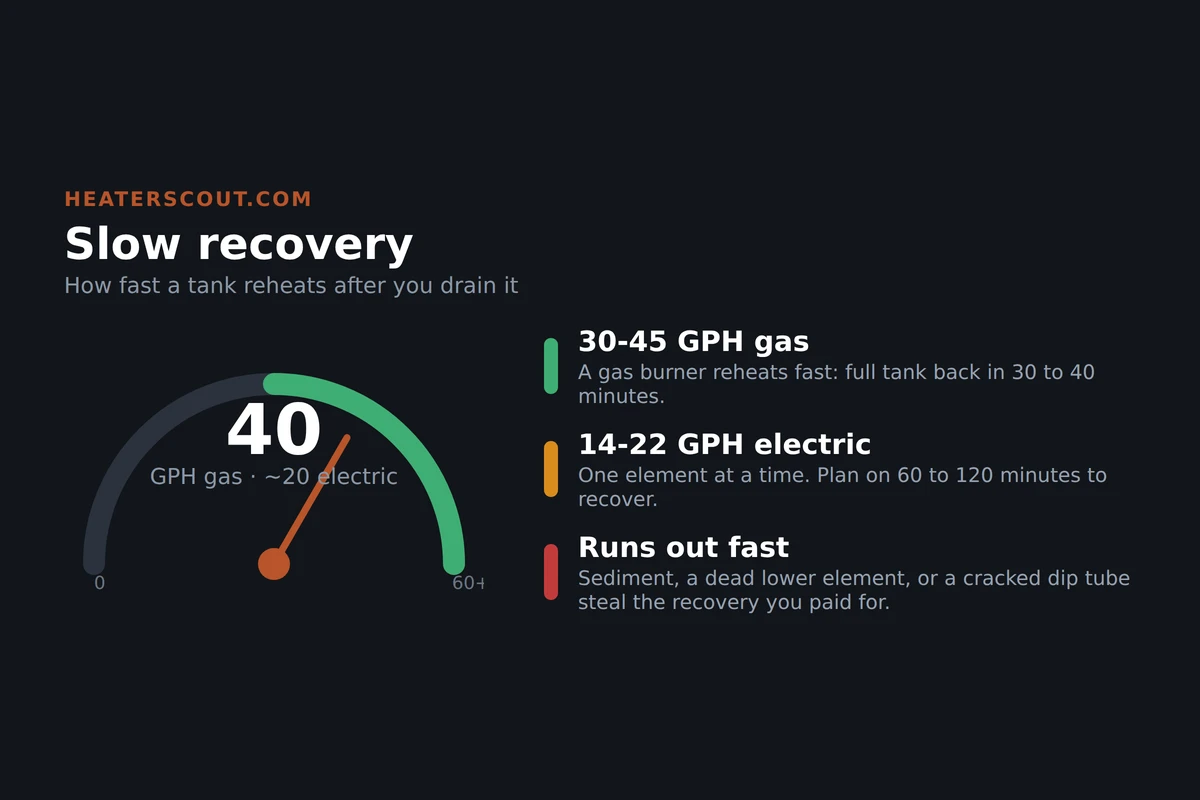
| Typical recovery rate | 30 to 45 GPH | 14 to 22 GPH |
| Full reheat from cold | About 30 to 40 min | About 60 to 120 min |
| First hour rating, ~50 gal tank | Higher (recovers while you draw) | Lower (recovers slowly) |
| What slows it down | Sediment insulating the burner, weak gas or flue | Dead lower element, buried element, sediment |
| Runs while power is out | Standing pilot models yes | No |
Recovery rate: what the number actually is
Recovery rate is the number of gallons a heater can raise about 90 degrees Fahrenheit in one hour. It is a measure of reheat speed, not of how much hot water is sitting ready. Under the hood it comes from a simple formula. For a gas unit, gallons per hour equals the burner input in BTU per hour times its efficiency, divided by 8.33 times the temperature rise. The 8.33 is the weight of a gallon of water in pounds, and the temperature rise is your setpoint minus the incoming cold water temperature. Run the numbers on a typical 40,000 BTU gas heater at 80 percent efficiency lifting water 65 degrees, from a 55 degree inlet to 120, and you get about 59 gallons an hour of pure reheat capacity. Real-world sticker figures land lower, in the 30s and 40s, once you account for standby loss and colder winter inlet water.
Electric works the same way but with wattage instead of BTU, and it is where people get surprised. A 4500 watt element lifting water 80 degrees recovers only around 20 to 23 gallons an hour. Worse, a dual-element electric tank never runs both elements at once. The upper and lower elements alternate, so you only ever get one element's worth of recovery at a time. That single fact is why an electric heater of the same tank size reheats at roughly half the speed of gas, and why a big family draws an electric tank down faster than it can keep up.
| Recovery rate, definition | Gallons the heater can raise about 90 F in one hour. Reheat speed, not stored volume. |
| Gas formula | GPH = (BTU/hr input x efficiency) / (8.33 x temperature rise). |
| Gas example | 40,000 BTU x 0.80 / (8.33 x 65 F rise) = about 59 GPH of raw capacity. |
| Typical gas recovery | 30 to 45 GPH standard, 50 to 70 GPH on high-efficiency units. |
| Typical electric recovery | 14 to 22 GPH. A 4500 W element at 80 F rise is about 20 to 23 GPH. |
| Electric element rule | Upper and lower elements fire one at a time, never together. |
| Full reheat time, gas | About 30 to 40 minutes for a drained tank. |
| Full reheat time, electric | About 60 to 120 minutes for a drained tank. |
| First hour rating (FHR) | Stored hot water plus one hour of recovery. Roughly tank gallons x 0.70 + recovery. |
| FHR example | 50 gal tank at 30 GPH recovery = (50 x 0.70) + 30 = about 65 gal in the first hour. |
| How to size | Match FHR to your busiest hour of hot water use, not to tank gallons. |
First hour rating and why it beats tank size for sizing
Here is the number that decides whether you run out. First hour rating is how many gallons of hot water the heater can deliver in the first hour, starting from a full, hot tank. It bundles two things together: the hot water already stored, plus one hour of recovery layered on while you draw. A rough way to figure it is tank capacity times 0.70, plus the recovery rate. Take a 50 gallon tank that recovers 30 gallons an hour: 50 times 0.70 is 35, plus 30 is a first hour rating around 65 gallons. That is why FHR always comes out bigger than the tank on the label, and why it is the number that matters when you buy.
Size to your peak hour. Add up the hot water your house pulls in its busiest 60 minutes. A shower is roughly 10 to 20 gallons, a dishwasher 6 to 10, a laundry load 7 to 15. Three morning showers plus a dishwasher can easily need 60 to 70 gallons inside one hour, and a 40 gallon tank cannot serve that regardless of how new it is. Two heaters can both say 50 gallons on the side and deliver very different amounts, because the gas one recovers fast enough to refill part of the tank while you are still drawing. When people say their heater is too small, this is almost always what they mean, the first hour rating is below their peak demand.
The causes, worst offenders first
On an electric tank, start at the lower element. The upper element heats the top few gallons, then hands off to the lower element for the bulk of the reheat. When the lower element burns out, you get a short burst of hot followed by cold, and recovery slows to a crawl because only the upper element is left working. Ohm the elements with the breaker off and swap the dead one. A lower element that keeps failing early is usually buried in sediment that makes it overheat, so flush the tank when you replace it.
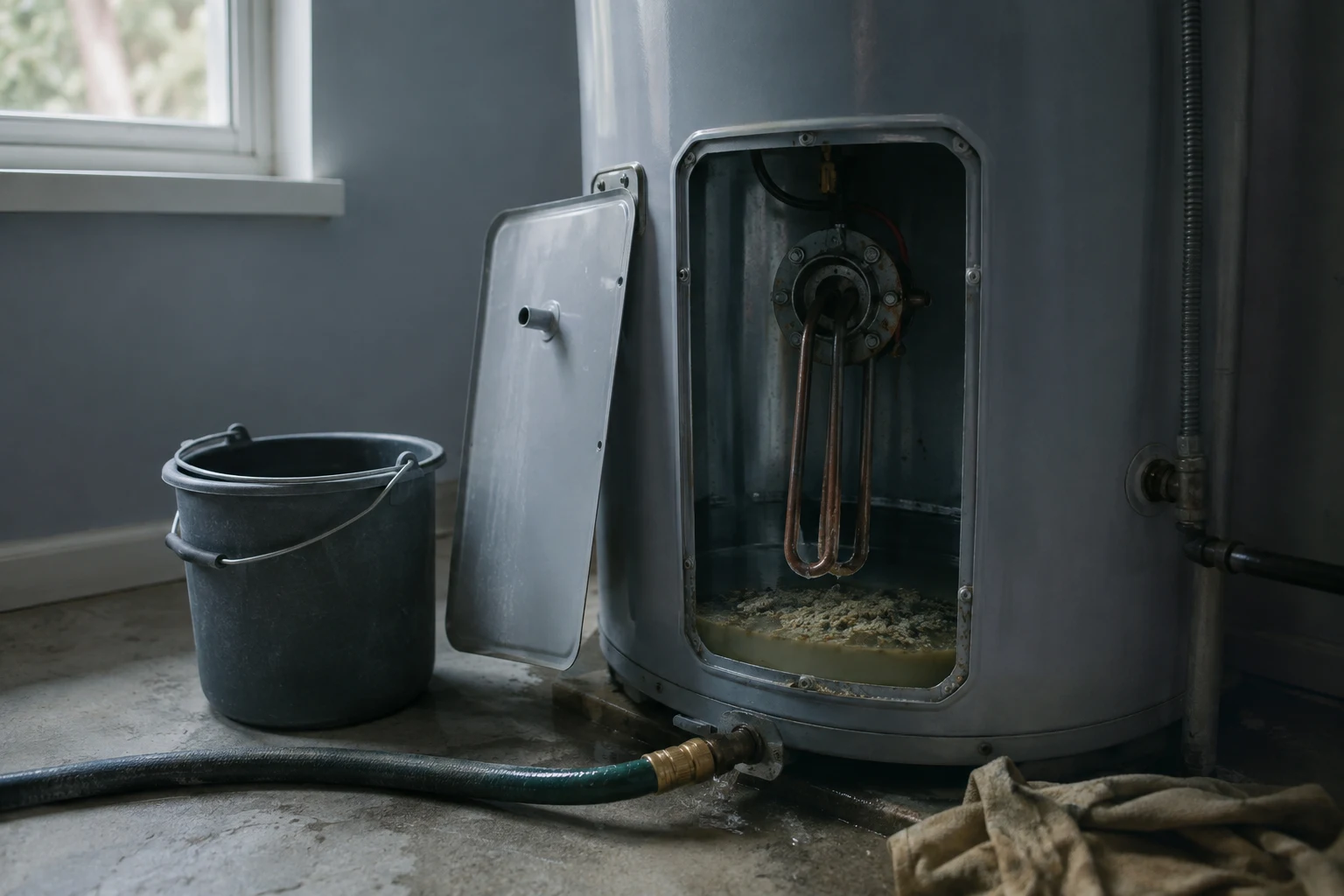
Sediment is the slow, quiet thief. Minerals settle out of the water and cook into a hard crust on the tank floor. On a gas heater the burner fires from underneath, so that crust turns into an insulating blanket between the flame and the water, and the burner has to run longer for the same result. On electric it buries the lower element. Either way, recovery drops and you often hear popping or rumbling as water trapped under the scale flashes to steam. A yearly drain and flush is the cheapest fix and the best prevention. On a tank that has gone a decade without a flush, some of that scale has baked on for good.
The dip tube is the sneaky one. It is the plastic tube that carries incoming cold water down to the bottom of the tank so the burner or element can heat it before it rises to the outlet. When that tube cracks or breaks, cold water dumps in near the top and mixes straight into the hot outlet. The tap runs lukewarm and short even though the heater is heating normally, and you may find little white plastic flakes clogging aerators and showerheads. It looks exactly like a heater that lost its capacity, but the fix is a cheap tube, not a new tank.
Then the plain ones. A temperature dial or a pair of thermostats knocked down low makes the tank act like it runs out fast because it is simply not heating as hot as you expect. On gas, a partly clogged burner, low gas pressure, a wrong regulator on propane, or a restricted flue all cut the burner's real BTU input, which drops recovery directly out of the formula above. And sometimes the heater is just too small for a household that grew, in which case the honest answer is a bigger first hour rating, not another repair.
How to work the problem
Chase slow recovery in order. Check the temperature setting, it is free. On electric, ohm the lower element and flush the tank. On gas, flush for sediment and have the burner, gas pressure, and flue checked. Suspect the dip tube if the water is lukewarm and short with plastic bits at the faucets. If the parts are all healthy and the house simply outgrew the tank, size the replacement to your peak-hour demand by first hour rating, not by tank gallons.
Safety first on gas and 240 volts
Two parts of this are not casual DIY. Electric water heater elements and thermostats sit behind the access panels on 240 volt wiring, so kill the breaker and verify it is dead with a meter before you open anything or ohm an element. On gas units, leave gas pressure, regulator, burner, and flue work to a licensed tech. A restricted or backdrafting flue is a carbon monoxide hazard, not just a performance problem, and gas leaks are a hard stop. If you smell gas, leave and call the utility, do not flip switches.
When repair stops making sense
A single dead element, a flush, a new dip tube, or a thermostat are normal parts jobs on a heater with years of life left. The math tilts toward replacement when the tank is past 10 to 12 years, when a flush no longer restores recovery because the scale has cooked on hard, or when the real issue is that the first hour rating never matched the household. Throwing element after element at an old, scale-packed tank buys weeks, not years. If you are replacing anyway, that is the moment to size up by first hour rating and, if you have gas available and a big family, to weigh the faster recovery of a gas unit against the efficiency of electric. Get the peak-hour number right and the lukewarm-second-shower problem goes away for good.
Frequently asked
What is a good recovery rate for a water heater?
It depends on the fuel. A standard 40 or 50 gallon gas tank recovers roughly 30 to 45 gallons an hour, and high-efficiency gas units push 50 to 70. A standard electric tank recovers far slower, around 14 to 22 gallons an hour, because it heats with a single element at a time instead of a burner. Recovery rate is the number of gallons the heater can raise about 90 degrees Fahrenheit in one hour, so it is really a measure of raw reheat speed, not how much hot water sits ready. A gas unit typically brings a drained tank fully back in 30 to 40 minutes. An electric one often needs 60 to 120 minutes for the same job. So a good recovery rate for a gas heater is one in the 30s or 40s of GPH, and for an electric heater anything in the high teens to low 20s is normal. If yours is suddenly slower than it used to be, the number did not change, something is getting in the way of it, usually sediment, a failing element, or a weak burner.
What is the difference between recovery rate and first hour rating?
Recovery rate is reheat speed. First hour rating, or FHR, is total delivery. Recovery rate answers how many gallons per hour the heater can bring up to temperature from cold, and it depends on burner BTU or element wattage, efficiency, and how cold the incoming water is. FHR answers a more useful question for a real morning: starting with a full, hot tank, how many gallons of hot water can I pull in the first hour before it goes cold. FHR combines two things, the hot water already stored in the tank plus one hour of recovery on top of it. A rough version of the math is tank gallons times 0.70, plus the recovery rate. A 50 gallon tank that recovers 30 GPH lands near a 65 gallon first hour rating. That is why FHR is always bigger than the tank itself, and why two 50 gallon heaters can deliver very different amounts of hot water depending on their burners. When you size a heater, match the FHR to your busiest hour of use, not the tank sticker.
Why does my water heater run out of hot water so fast all of a sudden?
A sudden change points at a part that failed, not at sizing. On an electric tank the classic cause is a dead lower heating element. The upper element heats the top of the tank for the first several gallons, then the lower element is supposed to carry the rest of the reheat. When the lower element burns out, you get one short slug of hot water and then cold, and the tank recovers at a crawl because only the upper element is working. On any tank, a cracked or broken dip tube will do something similar. The dip tube carries incoming cold water to the bottom of the tank, and when it fails, cold water dumps in at the top and mixes straight into the hot outlet, so the tap runs lukewarm and short even though the heater is heating. Heavy sediment on the tank floor is the slower-building version, it steals usable volume and insulates the heat source. Check the temperature setting first because it is free, then work through the element, the dip tube, and a flush.
How do I size a water heater so it stops running out?
Size to your peak hour, using first hour rating rather than tank gallons. Add up the hot water your household pulls in its busiest 60 minutes. A shower runs roughly 10 to 20 gallons, a dishwasher 6 to 10, a laundry load 7 to 15. Total the worst-case morning, then buy a heater whose first hour rating meets or beats that number. Three back-to-back showers plus a dishwasher can need 60 to 70 gallons in that hour, which a 40 gallon tank cannot deliver no matter how new it is. This is about FHR, not the tank size on the label. If your usage grew and the heater never catches up, the unit is undersized for the new demand and no repair fixes that.
Do gas and electric water heaters recover at different speeds?
Yes, and it is not a small gap. Gas recovers about twice as fast as electric for the same tank size. A gas burner dumps a large, steady load of heat into the bottom of the tank, so a common 40,000 BTU residential gas unit recovers somewhere in the 30 to 45 gallon per hour range and brings a drained tank back in about 30 to 40 minutes. An electric tank uses resistance elements, and the two elements do not run at the same time, only one fires at a moment, so even a 4500 watt element only gives you roughly 20 to 23 gallons an hour and a full recovery can take one to two hours. The tradeoff is that electric heaters are simpler, have no combustion or venting to fail, and run more efficiently at the meter. But when a big family drains the tank, the gas unit gets everyone hot water sooner. Heat pump hybrid electric units are a separate case and recover slower still in their efficient mode.
Can sediment really slow down how fast my water heater reheats?
It can, and on a gas unit it is one of the most common quiet causes. Minerals settle out of the water and cook into a hard layer on the tank floor. On a gas heater the burner sits under that floor, so the sediment becomes an insulating blanket between the flame and the water, the burner runs longer, and you may hear popping or rumbling as trapped water flashes to steam under the scale. On an electric heater the lower element gets buried in sediment, overheats, and fails early, leaving the tank to recover on the upper element alone. A yearly flush clears loose sediment and is the cheapest recovery fix there is, though on a tank that has gone ten years without one, some scale has baked on for good.
Why is my recovery slow even though the burner or element seems fine?
Look past the heat source at three things. First, the temperature setting, since a dial or thermostats bumped down make the tank feel like it runs out fast. Second, the dip tube, because a cracked tube lets cold water short-circuit to the hot outlet no matter how well the burner fires. Third, on gas units, the fuel and air side: a partly clogged burner, low gas supply, a wrong regulator, or a restricted flue all cut effective BTU and drag recovery down. None of those show up as a dramatic failure, they just make the heater sluggish. If the element ohms out fine and the burner lights, have a pro check gas pressure and inlet water temperature before you condemn the whole heater.