The tank starts talking to you. Not a hum, but a popping and rumbling from the bottom every time the burner fires, like a kettle full of gravel coming to a boil. Nothing has broken yet. That noise is the first thing a plumber listens for, because it means minerals have been piling up on the tank floor for a couple of years, and the tank has started paying for it in efficiency and lifespan.
Sediment
the layer of precipitated calcium and magnesium carbonate that hard water leaves behind when it is heated. Minerals that were dissolved and invisible in cold water drop out of solution at the bottom of the tank, where the water is hottest, and settle into a gritty, chalky crust on the steel floor. That crust is what does the damage.
Where the grit comes from, and how it shows up
Cold water is a better solvent than hot water, and that single fact is the whole story. Groundwater picks up calcium and magnesium as it moves through limestone and other rock, and it holds those minerals in solution as long as it stays cool. You never see them. The water is clear at the tap. Then it hits the bottom of the tank and warms toward 120 or 140 degrees, and the chemistry flips: the minerals can no longer stay dissolved, so they precipitate out as solid carbonate and sink. Every gallon that comes in drops a little more. Hardness gets measured in grains per gallon. Under about 3 grains the water is soft and sediment is slow. Around 7 grains you are into moderately hard water and the buildup picks up speed. Well water and much of the municipal supply through the Midwest and the Southwest sit at 10, 15, even 20 grains, and a tank on that water lays down a real layer of scale in one to two years. If you do not know your number, a test strip tells you in seconds, or your water utility publishes it in the annual consumer confidence report it is required to mail out. The layer does not sit quietly, either: every heating cycle bakes it harder and bonds it tighter, so fresh sediment flushes out with a garden hose while five-year scale turns into a cement-like cake. Once it forms, it announces itself in a rough sequence, and each sign says something different about how far along the buildup is. Here is how much weight to put on each of them.
What the layer actually costs you
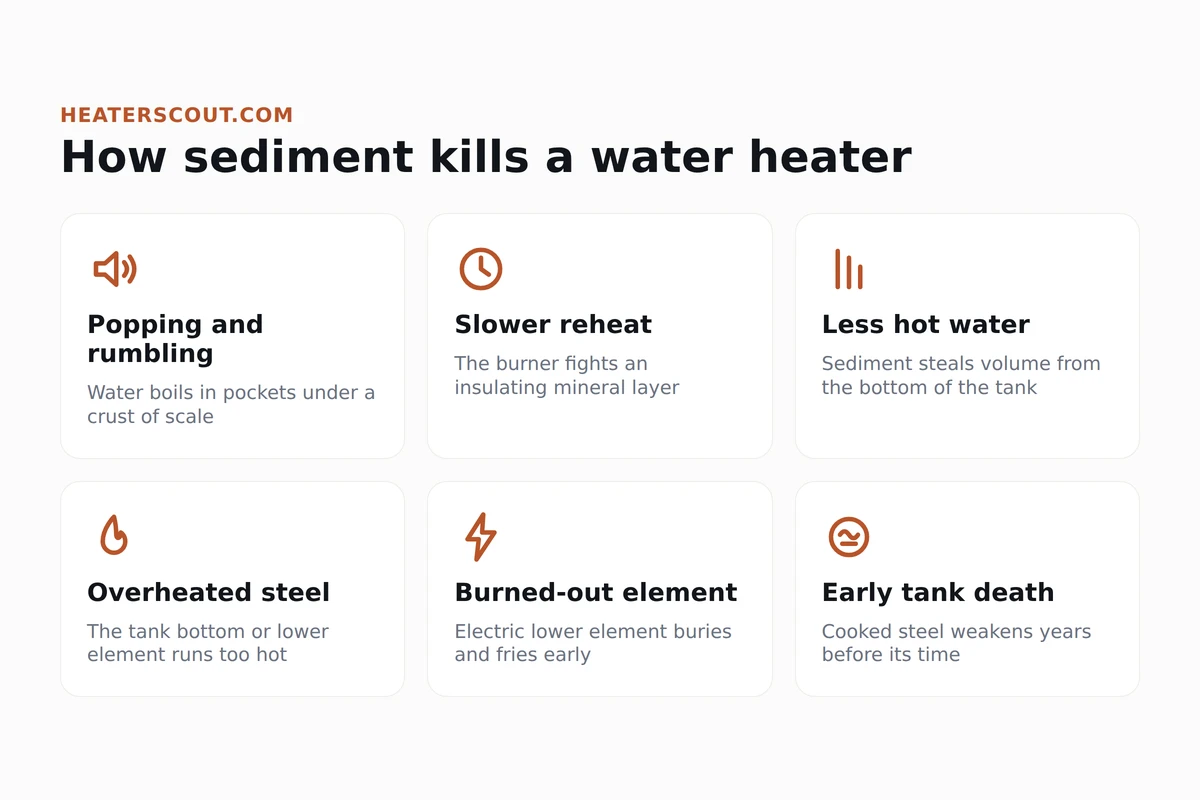
The popping ranks first because nothing else in a tank makes that sound. Water gets trapped under the crust of scale, the burner heats it past boiling in those small pockets, and the steam bursts through with a knock while the crust shifts. The rest of the symptoms are the sediment quietly stealing performance and life. On a gas tank the burner fires straight up through the scale, so the layer works like a blanket over the flame: the steel floor overheats because the heat cannot pass into the water fast enough, and steel that runs too hot over and over fatigues, warps, and eventually leaks at a seam years before its rated life. On an electric tank the grit climbs up and buries the lower element, which then fires inside a pocket of scale instead of open water, cannot shed its heat, and burns out early; when it dies the upper element heats only the top third of the tank, so you get a short burst of hot water and then cold. Either way the mineral layer slows heat transfer and steals volume, so a 50-gallon tank behaves like a smaller one, recovery drags, the drain valve can clog with grit, and the burner or elements run longer against the insulating crust, which is exactly what pushes the gas or kilowatt-hour bill up month after month.
The popping is the symptom you hear. The one you pay for is the burner running an extra ten or fifteen minutes on every cycle, month after month, because a quarter inch of scale is standing between the flame and the water.
Confirm it before you blame it
Popping is a strong hint, but a stuck expansion tank, water hammer, or a failing check valve can each imitate a sediment symptom, so it is worth ten minutes to confirm rather than flushing on a guess. Three checks take you from a hunch to a sure thing, and none of them needs a tool you do not already own.
Draw a jar from the drain valve
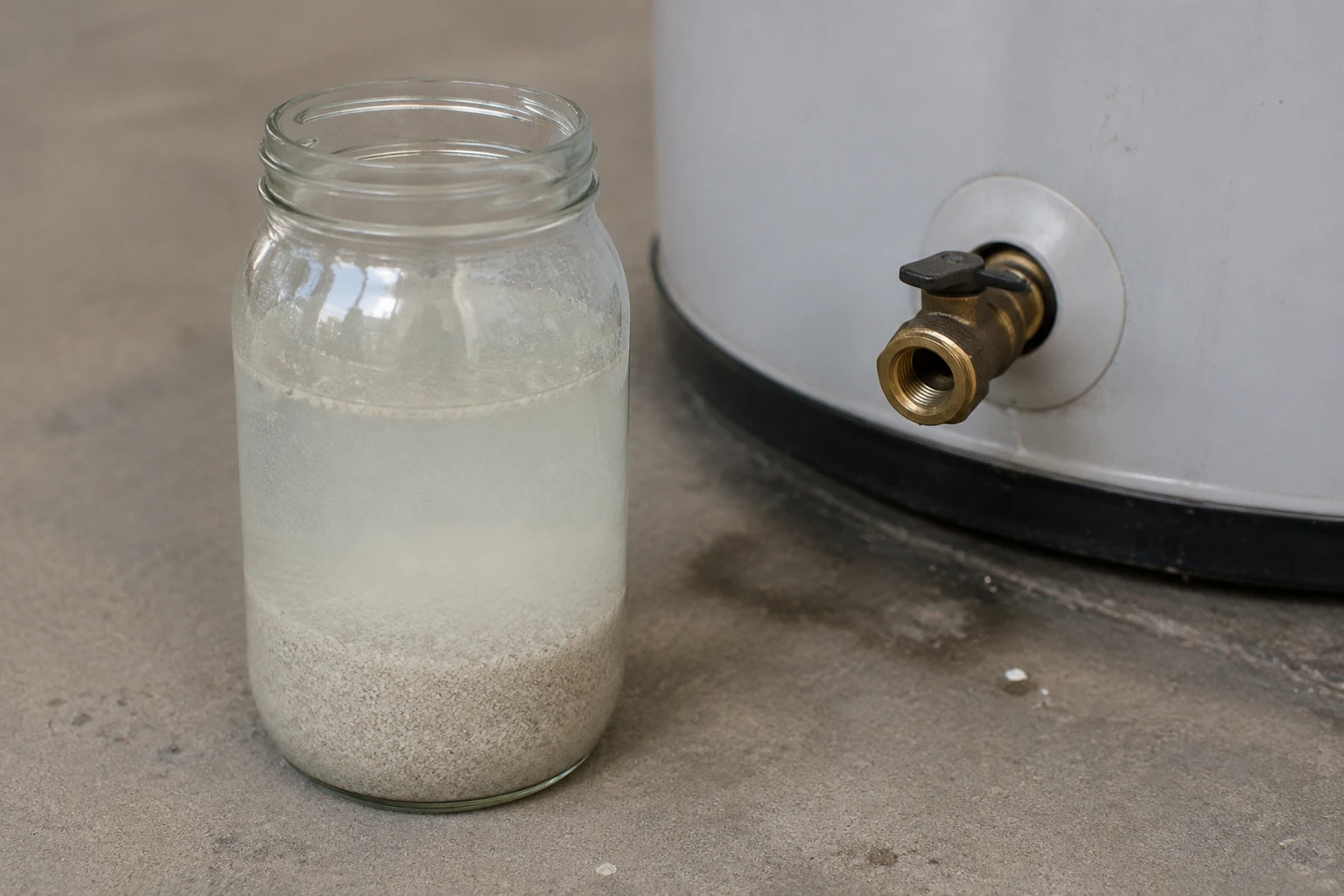
Hook a hose to the drain valve at the base of the tank, or open it straight into a clear glass jar, and let a couple of gallons run. Clear water is a good sign. Cloudy water full of sand-like grit, white flakes, or chalky sludge is sediment coming off the tank floor, and it settles the question on its own.
Listen at the tank on a heat cycle
Run hot water somewhere in the house to trigger the burner or elements, then stand by the tank as it heats. Popping, rumbling, or a gravelly boil from the bottom is the sediment tell. On an electric tank listen for a sizzle low on the tank where the buried element sits. A steady hiss or a knock in the pipes is something else.
Time the recovery and the capacity
Note how long a hot shower lasts now versus a year ago, and how long the tank takes to reheat afterward. A tank that used to give twenty minutes and now gives ten, or that recovers noticeably slower, is losing volume and heat transfer to a layer of scale rather than to any single failed part.
Flushing it out
If the buildup is caught before it cements itself down, a flush clears it and hands back the performance you lost. The job is a drain, a stir, and a rinse, and it runs under an hour on a tank that gets serviced regularly. On a caked, long-neglected tank it takes several fill-and-drain cycles and, if the crust will not break loose, a full drain with the cold inlet cycled hard to knock it apart. Here is the sequence.
Before you flush an old, never-flushed tank
Sediment can be the only thing plugging a spot where the tank has already rusted thin. On a tank that is several years old and has never been flushed, a hard flush sometimes dislodges that plug and the tank starts to weep afterward. Have a hose and a plan ready before you start, and if the tank is past ten years and heavily scaled, weigh replacement before you disturb an old layer of scale. Check the anode rod every few years and flush yearly on soft water or twice yearly on hard, because a live anode and softer water extend a tank's life more than any fix made after it has already cooked itself.
Frequently asked
What causes sediment buildup in a water heater?
Hard water. Every gallon that enters the tank carries dissolved calcium and magnesium. When that water is heated, the minerals fall out of solution and settle as gritty scale on the tank floor. The harder your water, the faster the layer grows. Municipal supplies across the Midwest and Southwest routinely run 10 to 20 grains per gallon, and above about 7 grains the buildup speeds up enough to matter within a year or two.
Why is my water heater making a popping or rumbling noise?
That sound is water trapped under a layer of sediment. As the gas burner heats the steel floor, pockets of water beneath the crust boil and flash to steam, and the crust itself shifts and knocks as it does. It is almost always a sign of a sediment layer thick enough to insulate the bottom of the tank. On an electric Rheem or A. O. Smith you can hear a similar sizzle around a buried lower element instead.
Can sediment ruin a water heater?
Yes. On a gas tank the sediment insulates the steel from the flame, so the floor overheats and the metal fatigues and weakens years early. On an electric tank the lower element gets buried in grit, cannot shed its heat, and burns out. Either way sediment eats into the 8 to 12 year life a tank should give you and cuts efficiency the whole time it is building.
How do I know if my water heater has sediment?
Listen for popping or rumbling on a heat cycle, notice whether hot water runs out faster or takes longer to come back, and draw a glass from the drain valve. If it comes out cloudy with sand-like grit or fine white flakes, you have sediment. A gas bill creeping up with no other explanation is a quieter clue pointing at the same thing.
How often should I flush my water heater?
Once a year on city water. On hard water above 7 grains per gallon, or on well water, twice a year keeps the layer from getting ahead of you. If you have never flushed a tank that is several years old, do it now, then set a yearly reminder. A whole-house softener stretches that interval a long way.
Is it too late to flush an old water heater with a lot of sediment?
Sometimes. Flushing a tank that has never been serviced can dislodge scale that was quietly plugging a corroded spot, and the tank can start leaking afterward. If the tank is past ten years and heavily scaled, a flush may buy a little time but it will not undo overheated, fatigued steel. On an old, caked tank, budget for replacement rather than counting on a flush to save it.
Does a water softener stop sediment buildup?
Largely, yes. A softener swaps out the calcium and magnesium that precipitate on heating, so far less scale forms on the tank floor. It does not clean out sediment that is already there, and it does not remove other dissolved solids, so an occasional flush is still worth doing. But a softener plus a live anode rod does more to extend a tank's life than any repair you make after the fact.