A half inch of lime on the bottom of a water heater tank can cut its efficiency into the double digits, because calcium carbonate conducts heat about a fiftieth as well as the steel it sits on. The burner or element still fires the same, but a growing share of that heat has to climb through a mineral crust before it ever reaches the water. You keep paying the gas or electric bill; you just get less hot water for it. That gap is the scale tax, and how big it gets comes down to three things you can measure.
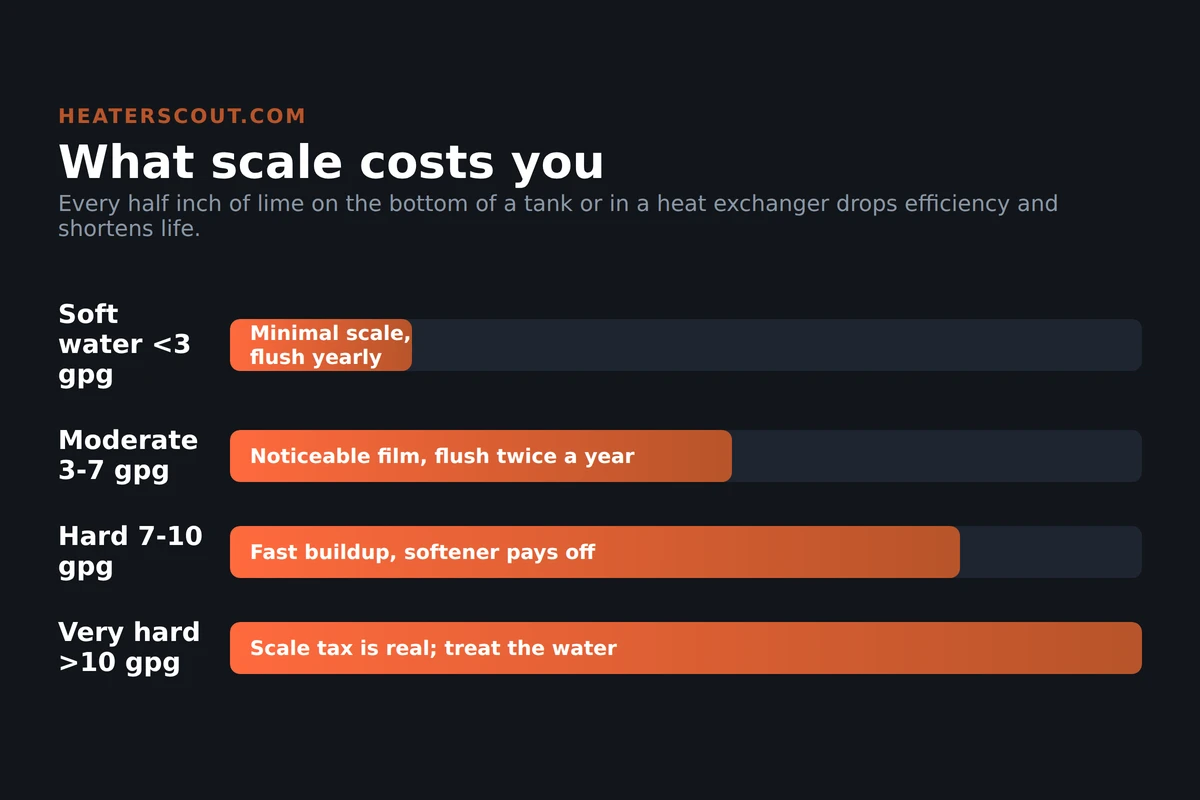
The scale tax by water hardness
Hardness is measured in grains per gallon, the standard unit on a US water report. One grain is 17.1 parts per million of dissolved calcium and magnesium, so a report that reads 137 ppm is right around 8 grains. Where you land on this scale sets how fast lime builds and how often you have to fight it.
| Hardness (gpg) | Scale rate | Efficiency drag | What to do |
|---|---|---|---|
| Soft, under 3 | Minimal | Negligible | Flush once a year, no treatment needed |
| Moderate, 3 to 7 | Noticeable film | A few percent once built | Flush twice a year, watch the setpoint |
| Hard, 7 to 10 | Fast buildup | High single digits | Softener starts to pay off, flush quarterly |
| Very hard, over 10 | Aggressive | Double digits possible | Treat the water; a softener is the real fix |
The middle two columns are the whole argument. A house at 2 grains can ignore the issue for years. A house at 12 grains that runs the tank at 140 degrees is laying down scale fast enough to feel it in the utility bill and in a heater that dies early. The difference is not luck. It is the product of hardness, temperature, and how much hot water moves through the tank.
How scale steals efficiency
The mechanism differs between gas and electric, and it is worth knowing which failure you are buying.
Gas: the burner runs longer
On a gas storage heater the flame heats the steel tank bottom, and that steel passes heat up into the water. Drop a scale layer between them and the heat has to conduct through lime first. The burner compensates by firing longer for the same thermostat target, so recovery slows and gas use rises. The trapped water under the scale also flashes to steam, which is the rumble and popping you hear in an old tank. That noise is the sound of wasted fuel.
Electric: the element cooks itself
An electric element heats the water directly by immersion, so scale does not sit between a flame and the tank; it coats the element itself. That mineral jacket traps heat against the resistance wire instead of letting it shed into the water. The element runs hotter, the sheath fatigues, and it burns out early. A scaled lower element in a hard-water house is one of the most common reasons an electric heater loses capacity years before its time.
Both: recovery and capacity fade
Whichever fuel you burn, the felt symptom is the same. Hot water takes longer to come back after a big draw, the tank seems smaller than its rating, and the last shower of the morning runs cool. People read that as a heater wearing out, and in a sense it is, but the wear is a mineral layer you could have measured and slowed.
Estimate your own scale tax
The driver is a product, not a single number: hardness times a temperature multiplier times daily usage. Hardness sets how much mineral is in every gallon. Temperature matters because calcium carbonate is unusual, it gets less soluble as water heats, so above about 130 degrees it drops out of solution faster; the calculator applies a multiplier that rises from 1.0 at 120 to 1.6 at 150. Usage matters because every gallon you draw pulls fresh, mineral-loaded water into the tank to be heated. Multiply the three and you have the precipitation rate. The efficiency loss and the wasted dollars follow from there. Treat the output as an estimate, not a meter reading; real scale depends on water chemistry a slider cannot capture.
Scale cost calculator
Set your water hardness, tank setpoint, daily hot-water use, and energy rate. Output is estimated efficiency loss, annual wasted cost, and how long until a noticeable layer forms. This is a model, not a lab measurement.
Efficiency loss
4.2%
Heat lost to the insulating layer
Wasted per year
$28
Money burned heating through scale
Years to a layer
4.0
Until a noticeable half-inch crust
—
What to do about it
The fix depends on which side of the hardness line you fall, so match the effort to the water rather than defaulting to the most expensive option.
Flush and forget
Under about 7 grains, an annual or twice-yearly tank flush handles it. Kill the power or gas, connect a hose to the drain valve, and run it until the water clears the sediment. Ten minutes and a garden hose keep a soft house in the clear for the life of the heater.
Drop the temperature
If you run the tank at 140, dropping to 120 or 125 both slows scaling and cuts standby loss, because calcium precipitates faster the hotter the water. If you need hot storage for legionella, store at 140 but add a thermostatic mixing valve so the house sees a safe, lower temperature and the scale rate is set by the delivery point.
Soften the supply
Above roughly 7 grains, and certainly past 10, a whole-house softener is the only thing that stops precipitation at the source. It swaps calcium and magnesium for sodium before the water reaches the heater, so no new scale forms. On very hard water it usually pays for itself in fuel savings and a heater that reaches its full service life.
Scale is one of the few problems in a water heater where the cheapest tool, a garden hose, and the most expensive one, a softener, are both correct answers depending on a single number you can measure for a few dollars.
Scale (lime scale)
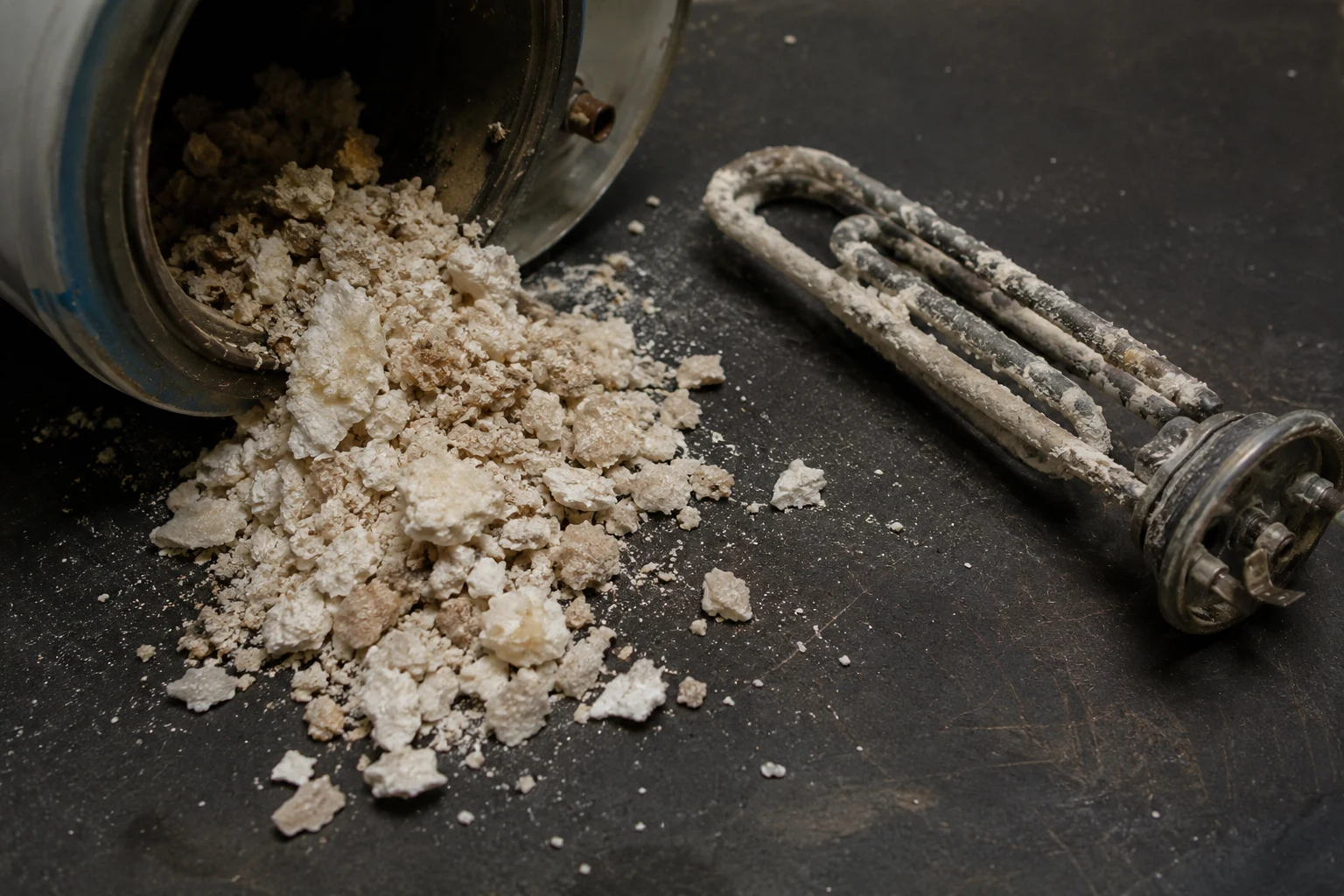
The hard, chalky deposit of calcium carbonate and magnesium that precipitates out of hard water when it is heated. It settles on the bottom of a storage tank and coats electric elements and tankless heat exchangers. Because it conducts heat far worse than metal, it insulates the burner or element from the water, which lowers efficiency, slows recovery, and shortens heater life. It gets worse with higher hardness, higher temperature, and higher hot-water use.
Frequently asked
How much does hard water scale actually cost per year?
It depends on how hard your water is, how hot you run the tank, and how much hot water you draw, but the range on a residential heater is roughly $10 to $80 a year in wasted heating cost once a real scale layer is present. The insulating lime forces a gas burner to run longer for the same delivered temperature, or makes an electric element work through a mineral crust, so you pay for heat that never reaches the water. Hardness above 7 grains per gallon combined with a setpoint over 130 degrees is where the number climbs fast. Run the calculator with your own hardness and rate to see your figure, and remember it compounds every year the scale gets thicker.
Does scale really lower water heater efficiency, or is that marketing?
It is physics, not marketing. Calcium carbonate has a thermal conductivity around 2 W per meter-kelvin, roughly a fiftieth of steel, so even a thin layer between the flame or element and the water acts like insulation. The Department of Energy has cited scale as a measurable efficiency drag on storage heaters. A half inch of lime on a gas tank bottom can cut efficiency into the double digits because the burner heat has to climb through the crust before it reaches the water. On an electric heater the element itself gets jacketed in scale, which traps heat against the metal and shortens its life.
What water hardness causes scale problems in a water heater?
Under about 3 grains per gallon, water is soft and scale is minimal; a yearly flush is plenty. From 3 to 7 grains you get a noticeable film and should flush twice a year. Above 7 grains, and especially past 10, buildup is fast enough that a softener starts to pay for itself in reduced energy waste and longer heater life. Grains per gallon is the US unit on a water report; if your report is in parts per million, divide by 17.1 to convert. Well water and much of the Southwest and Midwest run well into the hard range.
Will lowering my water heater temperature reduce scale?
Yes, and it is the cheapest lever you have. Calcium carbonate is one of the few minerals that becomes less soluble as water gets hotter, so it drops out of solution faster the hotter the tank runs. Above roughly 130 degrees the precipitation rate climbs sharply, which is why the calculator applies a temperature multiplier up to 1.6 at 150 degrees. Setting the tank to 120 instead of 140 both slows scaling and cuts standby loss, with the tradeoff that 120 is the floor for scald safety and legionella control. If you need hot storage for legionella reasons, store hot and use a mixing valve rather than running the whole house at 140.
How do I know if my water heater already has scale buildup?
Listen and look. A gas tank with a scale layer often rumbles, pops, or crackles as it heats, because water is trapped under the lime and flashes to steam. On any heater, hot water that takes longer to arrive, runs out sooner, or comes with white or tan flakes in the aerators points to buildup. When you flush the tank, sediment that comes out chalky, gritty, or in hard chunks is precipitated scale rather than loose sand. An electric heater that trips the upper element or runs the lower one hot can have a scaled element.
Does flushing the tank remove scale, or do I need a softener?
Flushing removes the loose sediment that piles up on the tank bottom, and doing it once or twice a year keeps a soft or moderate house in good shape. What flushing does not do is stop the mineral from precipitating in the first place, and it barely touches hard scale that has bonded to the element or the tank floor. If your water is hard, above 7 grains, flushing is a holding action while the layer keeps rebuilding between services. A softener removes the calcium and magnesium before they ever reach the heater, which stops new scale at the source and is the only real fix for very hard water.
Is scale worse on tankless water heaters than tank models?
Scale hits tankless units harder in one specific way. A tankless heater pushes water through a narrow heat exchanger at very high heat flux, so even a thin scale layer chokes flow and drops output fast, and manufacturers like Rinnai, Navien, and Noritz specify annual descaling with a vinegar or citric acid flush, sometimes required for warranty. A storage tank tolerates more buildup before you notice because the scale mostly settles on the bottom. Neither is immune. Hard water shortens the service interval on both, and a softener ahead of a tankless unit is often the difference between annual descaling and a clogged exchanger.