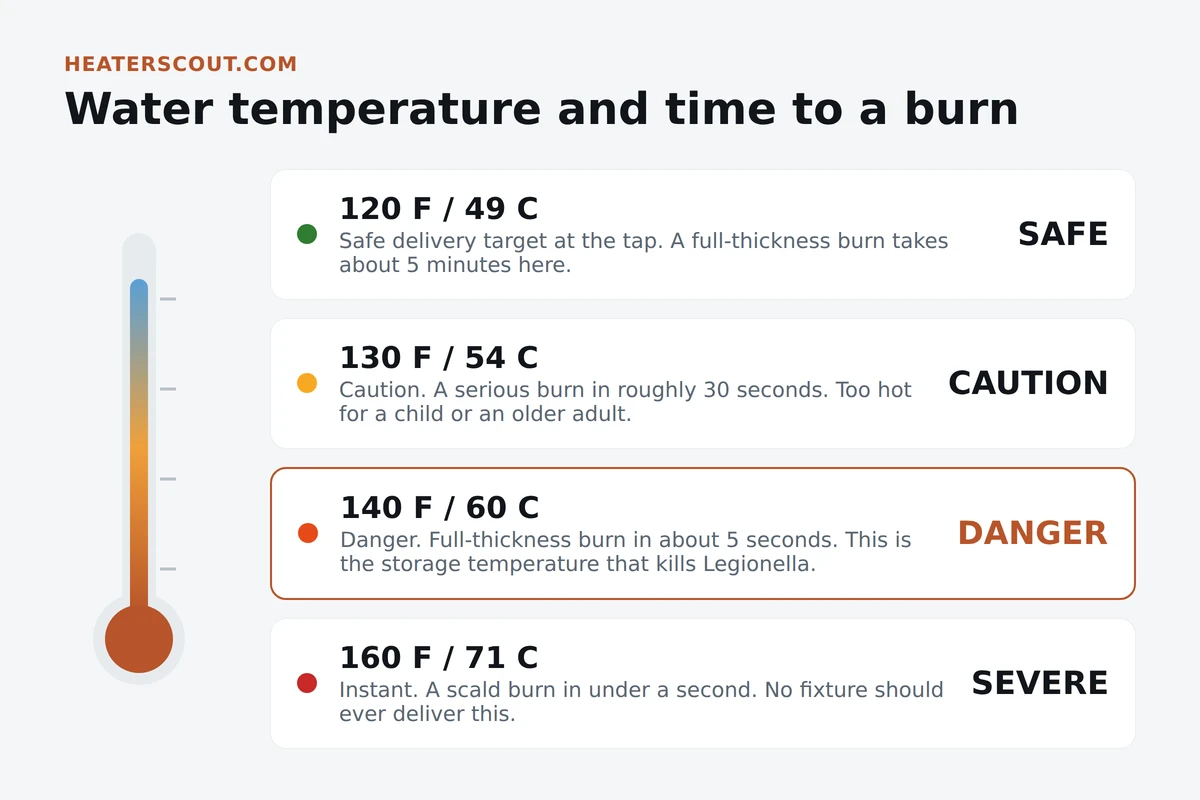
Water at 140 F burns full-thickness through adult skin in about five seconds. Water at 120 F takes roughly five minutes to do the same damage. That gap is the entire scald-prevention problem in two numbers, and it collides head-on with a second fact: Legionella bacteria survive comfortably in a tank held below 122 F, and you only get a reliable kill at 140 F. So the safe storage temperature is the dangerous delivery temperature. The way out is not to pick one. You store hot and you mix down.
Who gets hurt, and how to stop it
Scald injuries are not evenly distributed. They land hardest on the people least able to react: children under five and adults over sixty-five make up the large majority of serious tap-water burns treated in emergency rooms. Thin skin burns faster, and slow reflexes mean longer contact. The checklist below is the short version of what a safe install looks like. The rest of the article is why each line is there.
- Set the tank thermostat to 140 F to suppress Legionella in stored water, not 120 F unless you have no mixing valve.
- Install an ASSE 1017 thermostatic mixing valve on the heater outlet, set to deliver 120 F to the house.
- Confirm every shower and tub-shower has an ASSE 1016 pressure-balancing or thermostatic valve against pressure spikes.
- For tubs used to bathe small children, cap fill temperature at 110 F with a point-of-use ASSE 1070 device or tub valve.
- Measure the actual delivered temperature at the tap with a thermometer, do not trust the thermostat dial.
- Re-check delivered temperature after any water heater service, thermostat swap, or sediment flush.
- Never leave a small child or a person with limited mobility unattended near running hot water.
Time to a burn, by temperature
The numbers below come from the burn-threshold work by Moritz and Henriques in the 1940s that plumbing codes still cite today. They measured how long skin can contact water of a given temperature before a full-thickness burn forms. The bars show relative danger: a longer bar is a hotter, faster, more dangerous delivery. Read them as reaction-time margin. At 120 F you have minutes. At 140 F you have the length of a startled flinch.
Those are adult figures. A child's skin is thinner and burns in a fraction of the time, which is why the codes that regulate tub fill push the limit down to 110 F. Any water above about 120 F reaching a fixture is a burn waiting for a slow reaction, and the people with the slowest reactions are the ones most likely to be under that tap.
Store hot, deliver cool: how the split works
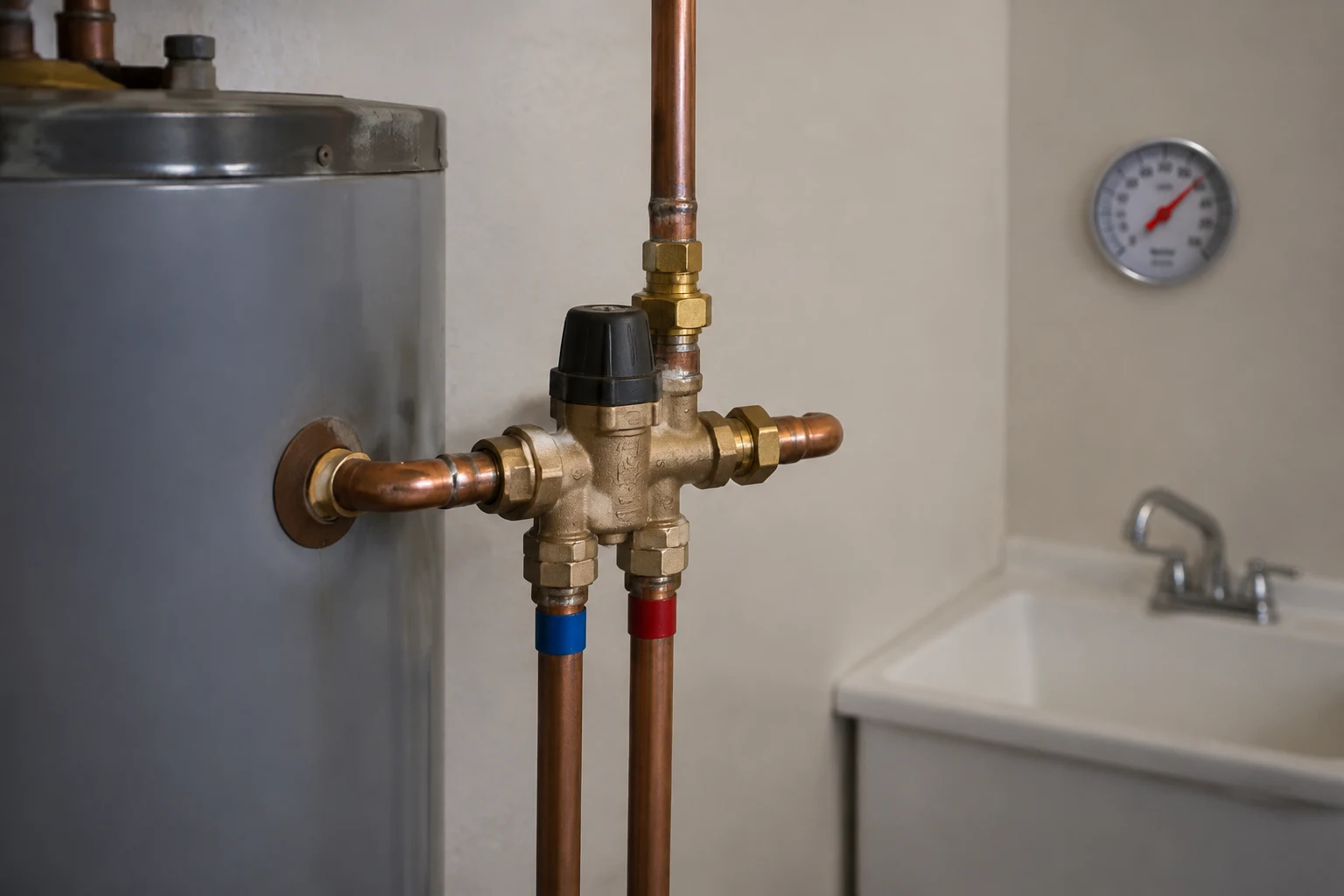
The mechanism that resolves the contradiction is a thermostatic mixing valve, and it is worth understanding before you decide which household situation you are in. The valve is a brass body with an internal element, wax or bimetal, that expands and contracts with temperature. Hot storage water enters one port, cold supply enters another, and the element throttles the two streams to hold a set outlet temperature. Set it to 120 F and it does not matter that the tank behind it is at 140 F; the house sees 120 F. If the cold supply ever fails, the element shuts down the hot side so the fixture cannot suddenly go full-hot. Watts sells the LFMMV and LFL111 valves for this, and Honeywell, now under the Resideo brand, sells the AM-1 series. Both are ASSE 1017 rated, which is the standard for a master valve at the heater.
That master valve is different from the anti-scald valve in your shower. The shower valve is ASSE 1016, a pressure-balancing or thermostatic control that reacts when someone flushes a toilet and the cold pressure drops, keeping the shower from spiking hot in that instant. Codes require it in showers, and it is the device that prevents the classic scald-and-fall sequence. A third option, ASSE 1070, is a point-of-use limiting valve you fit at a single sink or tub when you want an extra cap there. Good installs layer them: 1017 at the heater to set the ceiling, 1016 at every shower for spike protection, 1070 where a specific fixture needs a lower limit than the rest of the house.
Which combination you need depends on who lives in the house. The three scenarios below cover the common cases.
Young children in the home
Store at 140 F, deliver 120 F through an ASSE 1017 valve, and cap the bathtub at 110 F with a point-of-use ASSE 1070 device or a dialed tub valve. Toddlers burn faster than adults and cannot test water first, so the tub is the single most important fixture to limit. Verify with a thermometer at the tub spout, not the dial on the heater. A written setting is not proof; the water that fills the tub is.
Elderly or limited-mobility residents
Same 140 F storage and 120 F delivery, with special attention to the shower ASSE 1016 valve. Older adults have thinner skin and slower reactions, and a temperature spike during a shower can cause a startle, a slip, and a fall on top of the burn. If mobility is a real concern, a thermostatic shower valve that holds a fixed temperature outperforms a basic pressure-balancing one. Grab bars and a seat address the fall risk the burn creates.
Healthy adults, no vulnerable residents
A 140 F tank with a 120 F mixing valve is still the best practice, but a 120 F tank with no mixing valve is a reasonable, code-compliant setting that eliminates scald risk from the heater itself. The tradeoff is a smaller Legionella margin. If the house sits empty for stretches, or the tank is oversized and the bottom runs cool, lean back toward 140 F storage with a valve rather than a lukewarm tank.
The numbers that drive every decision
Strip away the hardware and the whole subject reduces to a handful of measured figures. These are the ones worth memorizing, because they are the reason the codes read the way they do and the reason a mixing valve is not optional in a house full of vulnerable people.
Notice how tightly the safe zone is bounded. Below 122 F the bacteria live. Above 120 F the skin burns fast. The only way to satisfy both is to keep the storage above the bacterial line and the delivery below the burn line, with a valve doing the translation between them. There is no single thermostat setting that does both jobs, which is the point people miss when they simply crank the tank up or down.
One more practical note on measurement. Thermostat dials on tanks are notoriously inaccurate, often off by ten or fifteen degrees, and they read the thermostat pocket rather than the water leaving the tank. The only number that matters for burns is the one at the tap, so put a cheap cooking thermometer under a running hot faucet, let it stabilize, and read it. If it comes in above 120 F, your delivery protection is either missing or drifted, and that is worth fixing before someone finds out the hard way.
Getting it verified and set right
If your house was last re-plumbed before mixing valves were common, there is a good chance the tank stores and delivers the same temperature to every tap. A licensed plumber can add an ASSE 1017 valve at the heater in an afternoon, and it is one of the higher-value safety upgrades you can make for the money, especially before a baby comes home or an older parent moves in. Ask for delivered temperature to be set and measured at 120 F, and ask whether your local code caps tub fill at 110 F. The tank can run hot. The tap must not.
Frequently asked
What temperature should I set my water heater to?
Store at 140 F and deliver 120 F. Those two numbers look like a contradiction, but they solve two different problems at once. Setting the tank thermostat to 140 F keeps the stored water hot enough to suppress Legionella bacteria, which grow well between roughly 77 F and 108 F and only die off reliably above 122 F, with rapid kill at 140 F. The catch is that 140 F water scalds a full-thickness burn into skin in about five seconds. So you do not send 140 F to the tap. You install a thermostatic mixing valve at the heater outlet that blends the hot storage water with cold to deliver 120 F to the fixtures. Storage stays lethal to bacteria, delivery stays safe for skin. If you have no mixing valve and small kids or elderly residents in the house, the common compromise is 120 F at the tank, which trades some Legionella margin for burn safety. The real fix is to store hot and mix down.
Why not just turn the water heater down to 120 F and be done with it?
Because 120 F storage sits close to the temperature band where Legionella thrives. The bacteria multiply fastest between about 95 F and 115 F, and a tank held at 120 F, especially at the cooler bottom third where sediment collects, can drift into that range. Legionnaires disease is a pneumonia caught by inhaling contaminated water droplets from a shower or tap, and it kills roughly one in ten people who get it. For a healthy adult with no vulnerable people in the home, a 120 F tank is a reasonable and code-compliant setting that eliminates scald risk from the heater itself. But it is a tradeoff, not a free win. Storing at 140 F with a mixing valve gives you both the bacterial kill and the 120 F delivery. That is why plumbing codes and the CDC lean toward hot storage plus a tempering valve rather than simply lowering the tank.
What is a thermostatic mixing valve and where does it go?
A thermostatic mixing valve, or TMV, is a brass valve with an internal wax or bimetal element that senses outlet temperature and automatically adjusts the ratio of hot to cold to hold a set delivery temperature. At the water heater it is an ASSE 1017 valve, plumbed on the hot outlet: hot storage water and cold supply both feed it, and it sends a blended, temperature-limited stream to the whole house. Watts makes the LFMMV and LFL111 series, Honeywell (Resideo) makes the AM-1 series, and both are common on residential installs. You set the dial to 120 F, and if the cold supply fails the element shuts the hot side down so you never get a slug of 140 F water. A TMV at the heater protects every fixture at once, which is why it is the cleaner solution than trying to limit each tap.
Is a mixing valve at the heater the same as an anti-scald shower valve?
No, they are different devices solving overlapping problems, and a careful install uses both. The mixing valve at the heater (ASSE 1017) sets the maximum temperature delivered to the whole house, usually 120 F. An anti-scald shower valve (ASSE 1016, the pressure-balancing or thermostatic mixing type built into the shower control) protects against a sudden temperature spike when someone flushes a toilet or runs a faucet elsewhere and the cold pressure drops. Without a pressure-balancing valve, that flush can send a jolt of near-full-hot water at the showerhead, and the startle reflex is what causes falls and burns. Modern codes require ASSE 1016 valves in showers and tub-showers. There are also point-of-use ASSE 1070 devices you can add at an individual sink or tub to cap delivery there. Layered protection: 1017 at the heater, 1016 at the shower, 1070 where you need an extra limit.
How fast does hot water actually burn skin?
Fast enough that reaction time does not save you. At 140 F, a full-thickness burn (through the entire thickness of the skin, the kind that needs grafting) takes about 5 seconds of contact on adult skin. At 130 F it takes about 30 seconds. At 120 F it takes around 5 minutes, which is why 120 F is the accepted safe delivery target. At 150 F it is under 2 seconds, and at 160 F it is under a second. These are adult numbers from the classic Moritz and Henriques burn-threshold research that plumbing codes still cite. Children and older adults burn faster because their skin is thinner, so the times are shorter for them. A toddler under 140 F water can take a deep burn before a parent can react. This is the whole reason the delivered temperature matters more than any warning sign taped to a faucet.
Do plumbing codes actually require this, or is it just a recommendation?
Codes require it in most of the country, though the exact numbers vary by jurisdiction and edition. The Uniform Plumbing Code and International Plumbing Code both mandate ASSE 1016 pressure-balancing or thermostatic valves for showers and tub-shower combinations, and they cap the maximum delivered temperature at those fixtures. Many codes limit shower and tub-filler delivery to 120 F, and some limit bathtub fill specifically to 110 F because tubs are where the most serious pediatric scald injuries happen. Public and commercial buildings often require an ASSE 1017 master mixing valve on the system. Residential retrofits are where enforcement is thin, so an older house may store at 140 F and deliver 140 F to every tap with nothing in between. If you are unsure what your local code adopted, the plumbing inspector or a licensed plumber can tell you the delivered-temperature limit that applies to your address.
I have young kids and grandparents in the house. What should I actually do?
Store at 140 F, install an ASSE 1017 mixing valve set to 120 F at the heater, and confirm every shower has an ASSE 1016 pressure-balancing valve. Then verify the result: run the hot tap at the kitchen or bathroom, let it reach full temperature, and check it with a cooking thermometer. You want to read at or just below 120 F. For a bathtub used to bathe small children, consider dialing a point-of-use ASSE 1070 device or a tub valve to 110 F, which is warm enough for a bath and well below the burn threshold. Never rely on teaching a toddler to test the water first, and never rely on a written setting alone: thermostats drift, and dip-tube and sediment problems change the mix. Measure the water that actually comes out of the tap, because that is the number that touches skin.