Quick answer
A tank only hands over about 70% of its rated gallons as truly hot water before the incoming cold dilutes it below shower temperature. So a 50-gallon tank gives you roughly 35 usable gallons — about a 14-minute shower at full flow. The real question is whether your heater always ran out that fast (a sizing problem) or started running out fast (a failure). Those are two different articles, and this one covers both.
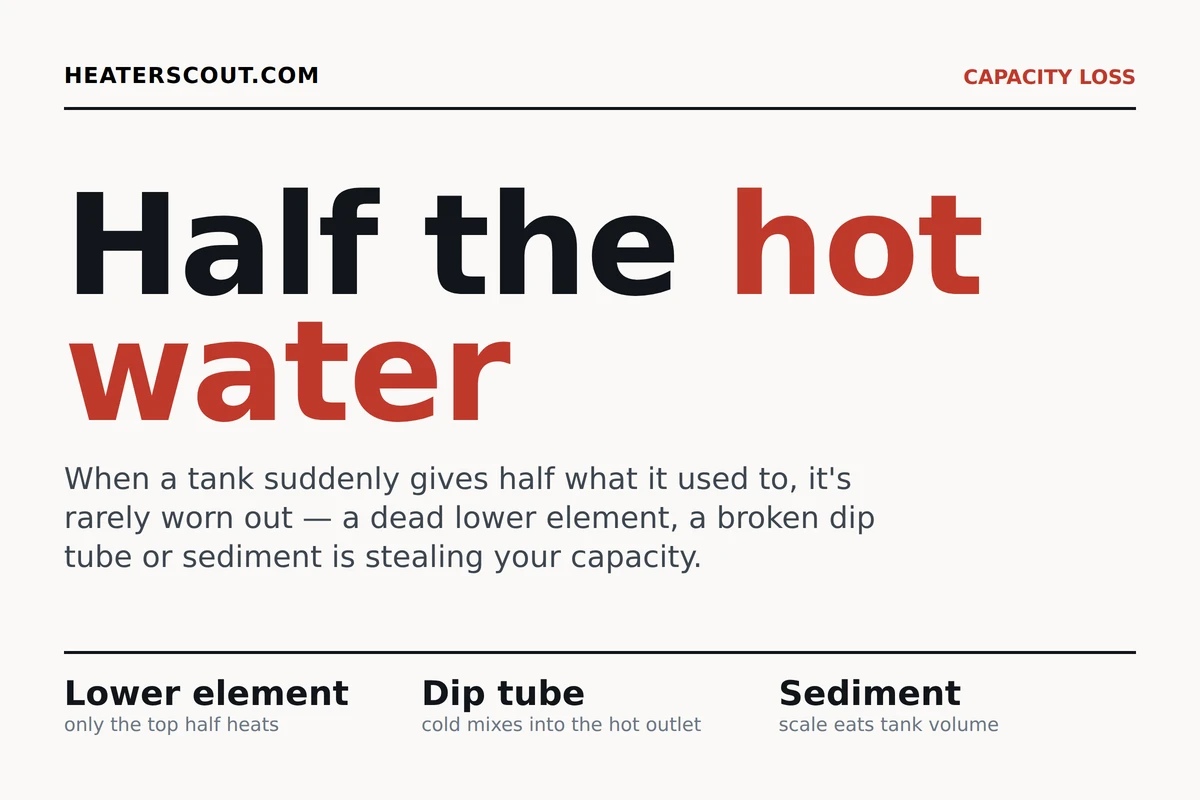
Before you buy a bigger heater, figure out which problem you actually have. A tank that was fine for years and suddenly runs cold has broken something. A tank that never lasted long enough is just too small for the house — and swapping it for the same size fixes nothing.
Start with the math: how long should it last?
Plug in your tank size and your shower’s flow rate. The calculator uses the industry 70% usable rule and shows how many minutes of hot water that buys, plus how long the heater needs to recover that volume.
Usable hot water calculator
Fuel type changes only the recovery time, not the usable minutes.
Usable hot water
gallons (~70% of tank)
Shower minutes
before it turns cold
Reheating that usable volume takes about 51 minutes.
WaterSense showerheads cap flow at 2.0 gpm; older heads and federal-max heads run 2.5 gpm. Dropping from 2.5 to 2.0 stretches the same tank by roughly a fifth — often the cheapest fix of all if the tank is merely borderline.
Did it always run out, or did it start?
It was ALWAYS short
The tank is undersized for your peak demand, or nothing is wrong and you’re asking more of it than 70% allows.
- Match the First Hour Rating to your busy hour, not just the gallon number.
- Lower the shower flow or stagger showers.
- Consider a larger tank or tankless.
It STARTED running out
Something failed. Capacity didn’t shrink on its own — a part did.
- Electric: a burned-out lower element.
- Any fuel: a cracked dip tube mixing cold into the hot.
- Years of sediment stealing volume and slowing recovery.
The classic electric failure: a dead lower element
Electric tanks have two elements. The upper one heats the top of the tank; the lower one keeps the whole volume hot. When the lower element burns out, you still get a brief slug of warm water from the top — then it goes cold fast, because nothing is heating the bulk below. That exact symptom, warm-then-suddenly-cold on an electric heater, points straight at the lower element.
A dead upper element usually gives you no hot water at all, which is a different complaint. You confirm either one the same way: kill the breaker, pull the access panels, and test each element for continuity with a multimeter. No continuity means it’s burned out. A standard 4,500-watt element recovers about 21 gallons an hour, so a failed one roughly halves your effective hot water even before it dies completely.
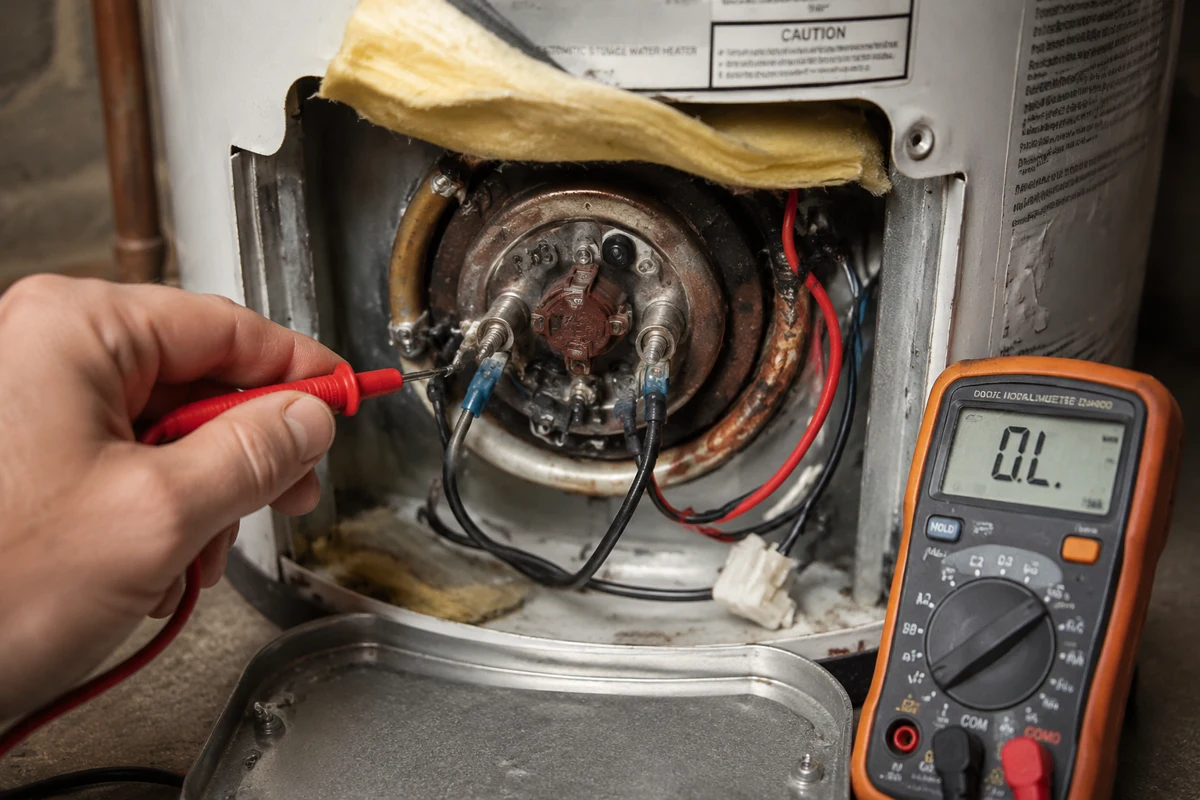
Confirming it is straightforward and cheap. Switch off the breaker and verify power is dead, remove the lower access panel and fold back the insulation, and touch a multimeter’s probes to the two element terminals set to resistance. A healthy 4,500-watt element reads somewhere around 12 to 16 ohms; an open reading (no continuity) means the element is burned out and needs replacing. While you’re in there, check that sediment hasn’t caked the element, since that’s what usually kills it — the crust makes it overheat and fail early, so flushing after the swap keeps the new one alive longer.
The sneaky one: a broken dip tube
The dip tube carries incoming cold water down to the bottom of the tank so it heats before rising to the outlet. If it cracks or breaks, cold water dumps in near the top and short-circuits straight to the hot outlet — so your hot water is both weaker and shorter, no matter the tank size. A tell is small white plastic flakes showing up in faucet aerators and screens. Dip tubes manufactured between 1993 and 1997 are a known bad batch and fail early, so an older tank from that era is a prime suspect.
Sediment: the slow capacity thief
Minerals settle to the bottom and physically take up space that used to hold water. Ten gallons of sediment in a 40-gallon tank is a 25% loss of capacity — and the same layer insulates the burner or lower element from the water, so recovery slows and energy use climbs. An annual flush prevents it; a tank that’s never been flushed in a decade may have quietly lost a quarter of its output. Flushing hard, old sediment carries a small risk of starting a leak at the drain valve, so know that before you open it.
Sizing it right if it was always too small
Gallons aren’t the number that matters — First Hour Rating (FHR) is. FHR is roughly the usable 70% plus the recovery rate, and it’s printed on the yellow EnergyGuide label. Pick a heater whose FHR lands within a gallon or two of your peak-hour demand, the most hot water you draw in your busiest hour. Two heaters with the same 50-gallon label can have very different FHRs depending on how fast they reheat, so a gas 50 and an electric 50 are not interchangeable for a busy morning.
| Household | Typical tank | Target FHR |
|---|---|---|
| 1–2 people | 30–40 gal | ~40–50 gal |
| 3–4 people | 40–50 gal | ~50–60 gal |
| 5+ / 3+ baths | 50–80 gal | ~60–80 gal |
Gas recovers about twice as fast as electric — roughly 40 gallons an hour on a typical 40,000-BTU burner versus about 21 on a 4,500-watt element — so two gas tanks and electric tanks of the same size can behave very differently under heavy back-to-back demand.
Two things people overlook
The thermostat set too low. A tank set to 110°F holds less usable hot water than the same tank at 120°F, because you mix in less cold at the shower to reach a comfortable temperature — so more of the tank drains per minute. If someone nudged the dial down to save energy, that alone can turn a fine tank into one that seems to run out fast. The common recommendation is 120°F: hot enough for a full usable draw, cool enough to limit scald risk and standby loss.
A tankless heater that goes cold isn’t “running out.” Tankless units never store water, so they don’t run out — but they have a flow-rate ceiling. Ask for more gallons per minute than the unit can heat (two showers plus a dishwasher on a cold-winter inlet, say) and the outlet temperature drops. That’s an undersized-for-demand problem, not an empty tank, and the fix is a higher-capacity unit or staggering the draws.
Quick gut check: if the water goes from hot to cold suddenly, think dip tube or lower element. If it fades gradually and never really got hot, think sediment or an undersized tank. If it’s stone cold from the first drop, that’s a no-hot-water problem, not a runs-out-fast one.
Frequently asked
Why does my hot water run out so fast all of a sudden?
“All of a sudden” is the key word: capacity doesn’t shrink on its own, so a part failed. On electric heaters it’s almost always a burned-out lower element — you get a short warm burst, then cold. On any fuel, a cracked dip tube or years of sediment will do it too. If it was always this short, the tank is just undersized.
How many minutes of hot water should a 50-gallon tank give?
About 35 gallons are usable (the 70% rule), which is roughly a 14-minute shower at 2.5 gpm or about 17 minutes at a WaterSense 2.0 gpm head. Two people showering back-to-back will outrun that unless the second waits for the tank to recover.
Can a bad heating element make hot water run out fast?
Yes — specifically the lower element on an electric tank. It heats the bulk of the water; when it fails, only the upper element works, so you get a small amount of warm water from the top and then it turns cold quickly. Test both elements for continuity with the power off to confirm.
What is a dip tube and how does a bad one cause this?
The dip tube sends incoming cold water to the bottom of the tank to heat before it rises to the outlet. If it cracks, cold water enters near the top and mixes straight into the hot outlet, cutting both temperature and duration. White plastic flakes in your faucet aerators are the giveaway; tubes made 1993–1997 fail notoriously early.
Will flushing sediment give me more hot water?
If sediment has built up, yes. It physically displaces water — ten gallons of it in a 40-gallon tank is a quarter of your capacity gone — and it slows recovery by insulating the heat source. Flushing restores that volume. On a very old, never-flushed tank, be aware that disturbing the sediment can occasionally start a drain-valve leak.
Do I need a bigger water heater or a repair?
Depends on the history. If it used to last and now doesn’t, repair the failure — a bigger tank won’t fix a broken dip tube or dead element. If it never kept up, size by First Hour Rating to your peak-hour demand, not by gallons alone, or move to tankless.